Resources
Databases, archives, libraries and digitized materials, arranged by country and region: where to look and how to use them.
Singapore35
Newspapers & news archives
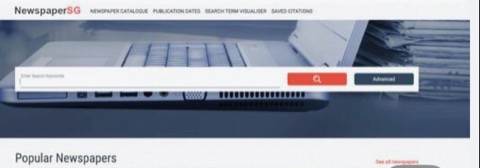
- NewspaperSG (新加坡报纸数据库)NewspaperSG is an online historical newspaper database built by the National Library Board of Singapore (NLB). It was launched on 28 January 2010, arising from a 2007 collaboration agreement between NLB and Singapore Press Holdings (SPH). Users can read over a century of content online from newspapers such as Sin Chew Jit Poh, Nanyang Siang Pau, Lianhe Zaobao, The Straits Times and Berita Harian. According to the site, no account registration is required, making it one of the most accessible primary-source platforms for research on Singapore and Malaya. The newspapers span Chinese, English and Malay, so Chinese-language papers can be read alongside English and Malay ones; for research on Chinese society, Chinese education, clan associations, Chinese business activity, Singapore-Malaysia relations, and the political and social history of the colonial and postwar periods, these reports are often the most direct primary material. The homepage offers keyword search and advanced search, as well as a newspaper catalogue, browsing by publication date, a search term visualiser and saved citations. The coverage and access conditions described here are compiled mainly from NLB materials and public search results; please refer to the official website for specifics.
Coverage, how to use, and notes
Coverage According to NLB materials, the database covers newspapers published in Singapore since 1827. When launched in 2010 it included 14 newspapers, among them Nanyang Siang Pau, Sin Chew Jit Poh and Berita Harian; six more were added in December 2017, bringing the total to 41 (per Wikipedia's description of NewspaperSG). Languages include English, Chinese and Malay, and the Tamil-language newspaper Tamil Murasu also appears in the popular titles section. For the start and end years of each title, please consult the Newspaper Catalogue on the site; they are not listed individually here.
How to use After opening the official website, enter keywords in the search box on the homepage to search; click Advanced to open advanced search, where you can limit by newspaper, date range, article type and so on. The top menu offers Newspaper Catalogue, Publication Dates, Search Term Visualiser and Saved Citations. When searching Chinese-language newspapers, it is advisable to try both simplified and traditional characters, as well as older transliterations and variant spellings of personal names; the site's citation function can be used for referencing. According to the site, no account is needed for access.
Notes Openness is not uniform: according to NLB information found in searches, earlier content (roughly before 1989) can mostly be consulted remotely, while more recent SPH newspaper content generally has to be consulted on NLB premises, and some third-party content is limited to library terminals. This could not be verified directly on the official website, so please rely on the official site's statements before use. The newspapers are scanned with OCR full text, so recognition errors are unavoidable; it is advisable to try several spellings when searching.
- Xinguozhi (新国志)Xinguozhi (《新国志》) is a Chinese-language website on Singapore's politics, society and culture. The site states that it was created in April 2011, with its first article published on 3 April 2011, and has since carried more than 4,000 articles and is still being updated; as of November 2026, the latest article was published in November 2026. By its own account, the site pays particular attention to circulating reports and articles from outside Singapore's mainstream media, in order to draw readers' attention, reflection and discussion on various Singapore issues. Its content includes reports, analysis and commentary, many of them reposted or translated from other media and commentators, as well as articles on history. The site welcomes submissions and recommended articles, and provides email subscription, RSS and a link to a traditional Chinese version. For researchers, its value lies in more than ten years of accumulated Chinese-language articles on issues, which can be used to understand different voices and the contexts of issues in Singapore's public discussion; according to its introduction, the site also collects many articles in which older people recall past events in Singapore, which is of some help to historians of Singapore. It should be noted that this is a general commentary and repost site, not a peer-reviewed academic publication; when used as research material it should be treated as leads and primary opinion material, and checked against the original sources.
Coverage, how to use, and notes
Coverage Chinese-language articles on Singapore politics, society and culture, created in April 2011, with more than 4,000 articles accumulated and updated to the present. Content includes reports, analysis and commentary, including many reposted or translated articles from non-mainstream media, as well as recollections by older people and articles on history.
How to use Visit xinguozhi.wordpress.com directly; no registration or login is needed to read. Use the search box on the page to search by keyword, or browse by date archive and page number; the site offers email subscription and RSS, and has a link to a traditional Chinese version. The site also has a Tumblr mirror page. When searching, use Chinese keywords such as personal names, events, organisation names and issue terms.
Notes Articles are mostly reposts, translations or commentary with varying standpoints; please check the original sources and original authors when citing. It is not a peer-reviewed academic resource. The site is a personal, blog-style site with fairly simple sections and search functions.

- Malay Newspapers Collection, NUS Libraries Digital Gems (马来报刊特藏(新加坡国立大学图书馆 Digital Gems))This special collection was digitised by NUS Libraries (National University of Singapore) and is available through its Digital Gems platform. It is an access point to primary materials from Malay-language newspapers of Malaya (today's Peninsular Malaysia and Singapore). The official NUS Libraries guide states that the collection includes Malay-language newspapers published in Jawi and romanised Malay (Rumi), mainly carrying local news, covering developments of the Malay community in Malaya and Singapore and advocacy of Malay rights. The titles listed in the guide are Majlis, Utusan Melayu and Warta Negara. For researchers of the political history, social history, ethnic relations and public opinion of Malaysia and Singapore from the late colonial period to early independence, these Malay newspapers can be read against English and Chinese newspapers to observe the perspectives of different ethnic groups. Digital Gems also holds other digital collections on Malay studies, for example the Malay Heritage Centre collection (including journals such as Hiburan, Mastika and Waktu) and the Syed Sheikh Al-Hadi collection (including Al-Imam and Al-Ikhwan), which can be searched further on the same platform.
Coverage, how to use, and notes
Coverage Includes the Malay-language newspapers Majlis, Utusan Melayu and Warta Negara, in both Jawi and romanised Malay, with content mainly on local news of Malaya and Singapore and on Malay community development and rights issues. The official guide page does not state the start and end years or the number of issues for each title; please refer to the Digital Gems website.
How to use From the NUS Libraries Malay studies guide (libguides.nus.edu.sg/malaystudies/spcoll), go to the link to this collection, or visit the Malay Newspapers collection page of Digital Gems directly, and browse individual issues by title and date. Some issues that have been made public can be viewed without login; whether they can be downloaded depends on the notice on each item page. For details of the collection, contact the NUS Libraries contacts listed on the guide page. The platform also offers related Malay studies collections that can be searched for comparison.
Notes Not all issues are open: search results show that the terms of use for some items are marked restrictedAccess, so please check the Terms of Use on the item page before use. Digital Gems has had maintenance notices and may be temporarily unavailable. The scope of this entry was verified against the official NUS Libraries guide page; the Digital Gems page itself could not be fetched automatically at the time of verification (it returned 403), so please refer to the official website. The newspapers are mainly in Jawi and Malay, so corresponding language ability is needed.
Archives & historical document databases
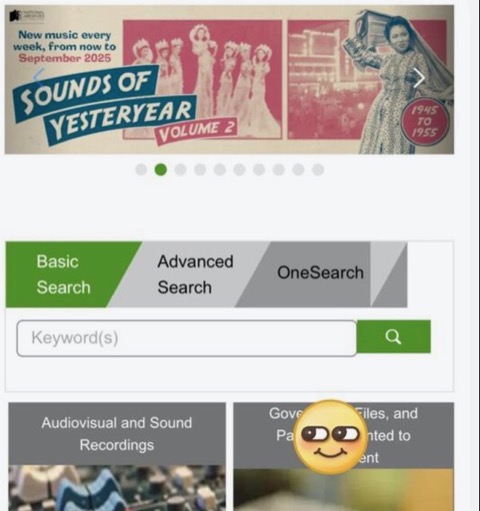
- Archives Online (National Archives of Singapore) (新加坡国家档案馆在线档案库)Archives Online is the online search and request portal of the National Archives of Singapore (NAS). According to its interface, it offers three search modes: basic search, advanced search and OneSearch, with entry points by category, such as audiovisual and sound recordings, government records, documents and publications, maps and building plans, and oral history interviews. According to the NAS official reading room page, the collections available include government records, Straits Settlements records, private records, maps and building plans, and oral history interviews and audiovisual records. According to the description, these materials include oral interviews, historical materials and speeches from around Singapore's 1965 period; most can be used directly online, while some must be requested for viewing at the main premises in Singapore. For readers studying Singapore history, Singapore-Malaysia relations and regional history, this is the core entry point for finding primary official sources.
Coverage, how to use, and notes
Coverage According to the NAS official reading room page, collection types include government records, Straits Settlements records, private records, maps and building plans, oral history interviews and audiovisual records, as well as reproductions from overseas archives. According to the description, the holdings include materials and speeches from around Singapore's 1965 period. The number of items and language composition should be checked on the official website.
How to use Enter Archives Online and use basic search with keywords, or use advanced search to limit by category and conditions; OneSearch can search across categories at once. Per the official instructions: search first in Archives Online, and if a record cannot be viewed online from home, click Request to View and fill in the online application to consult it in the reading room; copies are requested through Request a Copy. Whether an account must be registered should be checked on the official website.
Notes The Archives Online page itself could not be fully read; the information above comes from the NAS official reading room page and interface screenshots. Which types can be viewed online and which must be consulted on site needs to be confirmed on the individual record page. Some records require the consent of the transferring agency or donor before they can be viewed or copied.
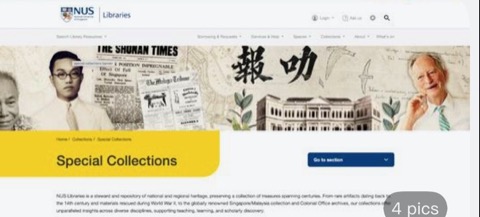
- NUS Libraries Special Collections (新加坡国立大学图书馆特别收藏)This is the Special Collections page of the NUS Libraries (National University of Singapore Libraries), which brings together the library's rare and digitised special collections. According to its introduction, the holdings include rare artefacts dating back to the 14th century and materials rescued during the Second World War, including internationally renowned Singapore and Malaysia collections and Colonial Office records; the digital collections cover historical periodicals and newspapers of Malaya and Singapore, which are very valuable for scholars approaching Malaysia and Singapore studies through the press, and about half of these resources can be read directly while the other half require an NUS Libraries account (this proportion has not been verified on the site). According to other official pages of the library, the Malay Studies special collection includes Malay-language periodicals such as Al-Imam and three Malay-language newspapers, Majlis, Utusan Melayu and Warta Negara, as well as copies of Colonial Office records from the UK National Archives (for Malaya, Singapore and the Borneo region); an official librarian blog states that the Southeast Asian Chinese special collection is located on Level 5 of the Central Library and contains more than a hundred Southeast Asian Chinese-language newspapers, pre-war Chinese-language periodicals, genealogies, gazetteers and literary works. These materials are useful to readers studying Chinese society in Malaysia and Singapore, the Chinese-language press, colonial history and the Malay world.
Coverage, how to use, and notes
Coverage According to the introduction, the collections span several centuries and include Singapore/Malaysia collections and Colonial Office records. The official librarian blog states that the Southeast Asian Chinese special collection has 34,463 printed items and 12,410 microform items, about 60 percent from Singapore and Malaysia, including over a hundred Chinese-language newspapers, over a hundred pre-war Chinese-language periodicals, over a hundred genealogies, gazetteers and nearly 11,000 literary works, as well as commemorative volumes and records of Chinese schools, clan and native-place associations, trade guilds and religious bodies. The Malay Studies special collection also includes Malay-language newspapers and copies of Colonial Office records.
How to use Enter from https://www.nus.edu.sg/nuslibraries/collections/special-collections, where a Go to section drop-down menu on the page allows jumping to each special collection. Digitised special collections are viewed through Digital Gems; some items can be opened directly, while items requiring login need an NUS account. Printed and microform materials can be searched in the LINC library catalogue. Appointments, identification and opening hours for on-site consultation could not be read from the official page; please ask the library before visiting.
Notes The main text of the Special Collections page could not be read, so the content above comes mainly from other official NUS Libraries pages and related introductions. Specific newspapers mentioned in the introduction, such as Lat Pau, have not been verified on official pages. Which items in Digital Gems require login has not been checked item by item; it has only been confirmed that the official collection guide states that the digitised Malay Studies special collection is openly available.
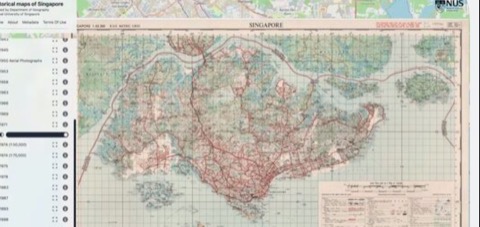
- Historical Maps of Singapore (新加坡历史地图)Historical Maps of Singapore is an online platform for viewing historical maps. The maps were scanned and georeferenced by the Department of Geography at the National University of Singapore (NUS); the site is maintained by NUS Libraries, and the maps are provided with permission from the Singapore Land Authority and the Ministry of Defence. The site overlays maps of Singapore from different periods on a single base map, mainly so that users can compare them and see changes in urban construction, land use, transport networks and urban planning. The layer list is arranged by year and includes aerial photographs and topographic maps at different scales. Features described on the site are zooming and full screen, Swipe comparison (comparing two layers left-right or top-bottom, with an opacity slider), geolocation (showing the user's current position on maps of each period), layer display and opacity control, and metadata for each layer. It is a tool for direct spatial comparison for readers studying Singapore's urban history, land use, spatial change of the wharves and Chinese settlement areas, and colonial-era urban planning.
Coverage, how to use, and notes
Coverage The site states that the maps were scanned and georeferenced; for the number, dates and types of maps, please see the Metadata page, as the About page does not give a total. The years visible in the layer list range from the mid-20th century to around 2010, and include aerial photographs and topographic maps at different scales.
How to use Visit libmaps.nus.edu.sg. In the layer panel on the left, tick a year to display its map and use the slider to adjust opacity. The Swipe function compares two periods left-right or top-bottom; full-screen mode is suited to close viewing; geolocation maps your current position onto maps of different periods. Each layer has an information button for viewing metadata, and the Metadata page lists all the maps. Before citing or reusing, read the provisions on the Terms of Use page.
Notes The maps are provided under authorization from the Singapore Land Authority and the Ministry of Defence, and use must comply with the site's terms of use. Some claim the site contains about 100 maps spanning 1846 to 2023, but the official About page gives no exact number or year range, so this claim is not confirmed by the site; refer to the Metadata page for specifics.
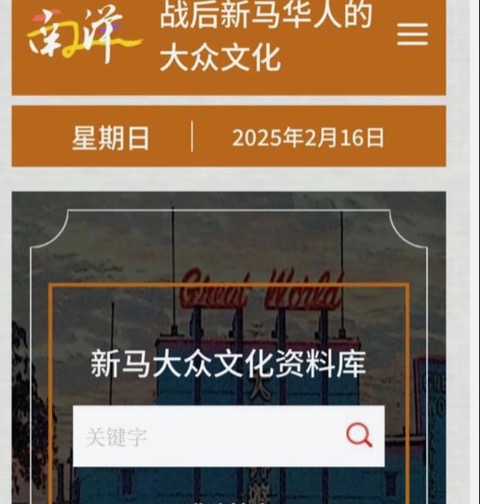
- Chinese Popular Cultures in Postwar Singapore and Malaya (战后新马华人的大众文化(新马大众文化资料库))This is an online database built by the Department of Chinese Studies at the National University of Singapore, focusing on the popular culture of Chinese in postwar Singapore and Malaya/Malaysia, and searchable by the public and researchers. The site is presented in Chinese and English, is maintained by an NUS project team, and lists research funding and team information. According to the introduction, the database records content information from publications such as Rediffusion's Voice (《丽的呼声》), Nanyang Pictorial (《南洋画报》) and Nanyang Radio Weekly (《南洋广播周刊》), organized around themes such as film, records and bookstores. The homepage highlights periodicals such as Asia Pictorial (《亚洲画报》), Film Circle (《电影圈》), Rediffusion's Voice, Spray (《浪花》), Nanyang Pictorial and Sin Lik Pao (《新力报》); the site has keyword search and advanced search, and a page explaining the scope of searchable materials. The site is organized into eight thematic areas: the film industry, song-and-dance troupes and amusement parks, bookstores, broadcasting and records, literary and arts periodicals, tabloids, television, and others, introducing related people and institutions and discussing issues. Its value lies in listing the contents of many periodicals with keyword search, letting researchers see which topics fields beyond literature and the arts followed at the time and how different media shaped popular culture in their own forms. It is a good entry point for studying the media, entertainment, reading and listening cultures of postwar Chinese in Singapore and Malaya.
Coverage, how to use, and notes
Coverage The theme is the popular culture of Chinese in postwar Singapore and Malaya/Malaysia. The site lists eight thematic areas: the film industry, song-and-dance troupes and amusement parks (theatre and amusement parks), bookstores, broadcasting and records, literary and arts periodicals, tabloids, television, and others. Periodicals shown on the homepage include Asia Pictorial, Film Circle, Rediffusion's Voice, Spray, Nanyang Pictorial and Sin Lik Pao. The homepage does not give the total number of entries or an exact period, so no specific figures are listed here. Content is mainly in Chinese, and the site interface is available in Chinese and English.
How to use After opening the site homepage, enter the main page and type keywords in the search box to search; you can also use Advanced Search to narrow the scope. A page on the site explains which materials can be searched, and it is advisable to read it first. You can also browse the eight thematic areas to learn about the people, institutions and issues under each. When searching, try periodical names, film company names, singer or performer names, bookstore names and amusement park names. The site pages show no login requirement; the site also offers options to subscribe to updates and to lecture and event information. The site does not say whether bulk download or export is supported; when citing, record the entry page URL and access date.
Notes The database mainly provides content information and catalogues of periodicals and is not a full-text database; the original periodicals must be consulted in the relevant collections. The site does not publish the number of entries, and the range of periodicals covered follows the explanatory page on the site.
- Official Reports of Parliamentary Debates (Hansard), Parliament of Singapore (新加坡国会辩论官方报告(议事录))The Singapore Parliament website points the search entry for the official report of parliamentary debates (Hansard) to the Singapore Parliament Reports search system. The Hansard records verbatim members' speeches, government replies, and legislative debates, and is a primary source for studying policy formation, the legislative process, and political discourse in Singapore. The NUS Libraries legal history guide states that 1955–65 are the official reports of the Legislative Assembly and 1965 to the present are the official reports of Parliament, and it lists them as a free resource. The guide also notes that most Legislative Council proceedings before 1955 must be consulted in print or in subscription databases. For research on Chinese communities in Southeast Asia and regional studies, it can be used to examine parliamentary discussion of topics such as Chinese education, language policy, citizenship, immigration, regulation of associations, and Malaysia–Singapore relations.
Coverage, how to use, and notes
Coverage According to the NUS Libraries legal history guide, the online official reports cover the period from the 1955 Legislative Assembly to the present, in English. For the exact scope and search functions, please rely on the official site. Proceedings from earlier periods (such as the Straits Settlements Legislative Council) are mostly in print or in subscription databases.
How to use Enter from the Parliamentary Business page of the Parliament website to the official report search entry; the search system is at sprs.parl.gov.sg/search. You can search by keyword, member's name, and date. The search system itself could not be opened during verification, so please rely on the official site for filtering and export functions. The most recent official reports are available online only.
Notes The verification tool could not open the search system this time, so please confirm the page functions yourself. Proceedings before 1955 are not in this system, and other sources listed in the NUS Libraries guide need to be consulted.
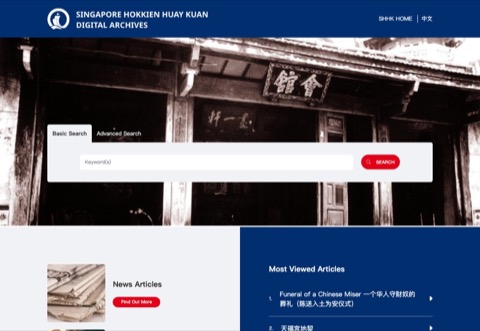
- SHHK Digital Archives (Singapore Hokkien Huay Kuan) (新加坡福建会馆数字档案)SHHK Digital Archives was built by the Singapore Hokkien Huay Kuan and launched on 15 February 2025 on the 185th anniversary of the Huay Kuan, which describes it as the first digital archive of its kind among local Chinese clan associations. The platform collects news reports, literary works and records related to the Huay Kuan, its affiliated institutions and the Hokkien community, and the website is divided into categories such as News Articles, Literatures and Special Features. Most materials come from newspapers, from 14 sources in total, including The Straits Times, Lianhe Zaobao, Sin Chew Daily and Straits Settlements records. The Huay Kuan has long managed temples such as Thian Hock Keng and run several schools, so these materials are useful for studying Chinese associations in Singapore, temples and religious activities, dialect-group history, Chinese education and community networks. The website has Chinese and English interfaces and is free and open to the public without login.
Coverage, how to use, and notes
Coverage The website and the Huay Kuan's press release state that the platform will include more than 5,000 news reports, literary works and records related to the Huay Kuan and its affiliated institutions, with the earliest records dating back to 1827. According to media reports, about 800 items had been uploaded at launch, with completion expected within two years, so for the actual number at present please refer to the official website. The search page lists 14 sources, and the languages include English and Chinese.
How to use On the website, choose Basic or Advanced Search, enter keywords and select among All Words, Any Word and Exact Phrase matching; results can also be filtered by source, or browsed by the categories All, News Articles, Literatures and Special Features. The homepage has a Most Viewed Articles list. No registration is required. The website does not mention bulk download or export; when citing, note the item title, source newspaper and date.
Notes Media reports note that some traditional Chinese texts were re-keyed into simplified Chinese, and some faded or blurred pages are hard to read, so when citing it is advisable to check the original or the original newspaper. The materials focus on content related to the Huay Kuan and are not a comprehensive community archive.
- eGazette (Republic of Singapore Government Gazette) (新加坡政府公报电子版)The eGazette is the official electronic publication site of the Singapore Government Gazette. The page is marked Published by Authority and states that it is the designated website under section 48 of the Interpretation Act 1965. The page also states that gazettes published on this website on or after 9 March 2025 take precedence over gazettes in other forms. The Gazette is the formal vehicle for government appointments, notices, regulations, announcements, and tender information, and can be used to verify the timing and basis of policies and regulations. For research on Chinese communities in Southeast Asia and regional studies, it is suited to tracking official notices and regulatory changes in areas such as society registration, education, immigration, and public affairs. The NUS Libraries legal history guide states that the site contains Gazette supplements from 1998 onwards, as well as revised statutes and subsidiary legislation, with earlier issues placed under the archive section.
Coverage, how to use, and notes
Coverage The homepage does not state the full date range. According to the NUS Libraries legal history guide, it contains Government Gazette supplements from 1998 onwards, plus revised statutes and subsidiary legislation, with older issues in the archive section. For the exact scope, please rely on the official site.
How to use From the homepage, view Current notices, or use the Search link to reach the Gazette browsing page for searching. No registration is needed to browse and read. When citing, note that documents printed from the website are not copies printed by the Government Printer.
Notes The homepage does not state the scope of the archive of older issues, and this could not be confirmed during verification. Gazettes before 1998 need to be sought from archives or library sources, such as the Straits Settlements Government Gazette (subscription database) listed in the NUS guide.
Scholarly databases & search tools
- Southeast Asian Studies: Introduction (NUS Libraries LibGuide) (新加坡国立大学图书馆东南亚研究学科指南)This is a subject guide (LibGuide) on Southeast Asian studies produced by the National University of Singapore (NUS) Libraries and maintained by its librarians. NUS has gathered on this page the main materials likely to be used for research on the region, including papers, digital resources and journals; by reading it through, one can follow the librarians' arrangement to gradually understand the scholarly landscape of the field. Some resources require an NUS account, while others have no barrier. According to the website, the guide is divided into sections including Introduction, ASEAN Law, Resources, Journals, Reference Works (broken down by country such as Singapore, Malaysia and Indonesia), Web Resources, Newspapers, Theses, Research Methods, Citation Styles, Reference Management, Full-Text Access and Scholarly Communication, and also lists related guides on history, geography, political science, Singapore statistics and Singapore primary sources. The guide describes itself as a selective list, not an exhaustive one. Its value lies in giving beginners a starter roadmap organised by country and material type, and in offering a view of NUS's Southeast Asia-related holdings, including the Singapore-Malaysia Collection on Level 5 of the Central Library. NUS also produces LibGuides for other fields, which can be browsed by research area.
Coverage, how to use, and notes
Coverage The guide covers various reference materials for Southeast Asian studies: journals, reference works, web resources, newspapers, theses, and research methods and citation tools. According to the website, books on ASEAN, Brunei, Malaysia and Singapore are generally kept in the Singapore-Malaysia Collection (SMC) on Level 5 of the Central Library, while books on other ASEAN countries are in the main collection. The website does not give the number of resources.
How to use Open the guide's URL directly and browse through the section tabs at the top; the librarians' contact details are listed on the right side of the page, and you can ask questions about finding resources. A Google Scholar search box is on the left side of the page. Some databases and e-resources in the guide require an NUS account, while others are publicly available; external readers who encounter restricted resources need to find other legitimate means of access (such as through their own institution's library).
Notes The guide itself can be read publicly, but many of its databases require an NUS account or institutional subscription. The website states that the guide's content is licensed under CC BY-NC 4.0 and requires attribution; text and data mining of the pages (including with AI tools) is not permitted without prior approval from NUS Libraries. At the time of viewing, the page showed its last update as 7 July 2026.
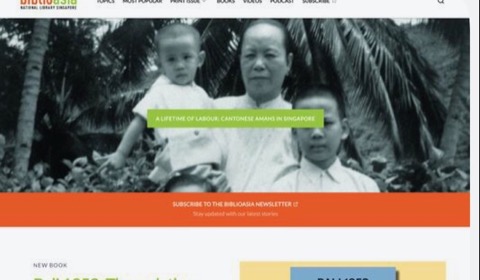
- BiblioAsia (《BiblioAsia》(新加坡国家图书馆管理局季刊))BiblioAsia is a free quarterly published by Singapore's National Library Board. It carries articles on the history, culture and heritage of Singapore in the wider Asian context, and often introduces the National Library's collections and services. According to the site, print copies are available free of charge at the entrances to the reading rooms of the National Library in Singapore; the website is also free to read and offers videos and expert podcasts on Singapore history. Content is organised by theme (Arts, Culture, History, Food, Nature, People) and by category (Videos, Podcasts, Books), with a New Books section, for example Bali 1952: Through the Lens of Liu Kang, featured on the homepage. Issues are labelled by quarter and volume/issue number; the homepage shows the issues of Volume 22 for 2026, and search results show that issues also have PDF versions. Articles are mostly written in an accessible style with no reading prerequisites, and suit general readers interested in Singapore's humanities and history. For research on Chinese communities, features on Chinese communities, people and collections (for example the feature on Cantonese amahs that appears on the homepage) can serve as introductory reading and sources of leads; when citing, the original sources should be checked again. It is not a peer-reviewed journal and is better used as background reading.
Coverage, how to use, and notes
Coverage Content focuses on Singapore history, art, culture, food, nature and people, and also includes videos, podcasts and new book introductions. It is published quarterly; the site shows the latest issue as Volume 22 (2026), and earlier issues, such as those from 2016, are available as PDFs. The homepage does not state how far back coverage goes. The language is mainly English.
How to use Visit biblioasia.nlb.gov.sg and browse by theme or category (Videos, Podcasts, Books), or obtain whole issues through Print Issue. Issue PDFs can be opened directly on the site and saved. No registration is required; to receive updates, subscribe to the newsletter on the site. In Singapore, print copies can be picked up free of charge at the National Library and public libraries. When searching, use topic names, personal names or event names, then return to the full-issue PDF to read the complete article and notes.
Notes It is not a peer-reviewed academic journal, and its content is general in nature, so please cross-check with primary sources when citing. The homepage does not state the starting year of the full archive, and there is no public description of site-wide search.
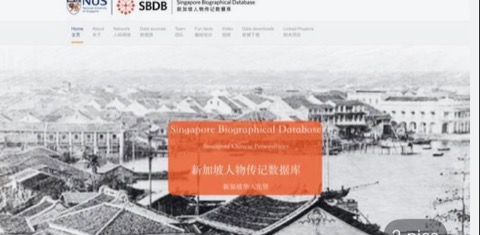
- Singapore Biographical Database (SBDB) (新加坡人物传记数据库)The Singapore Biographical Database (SBDB; subtitle: Singapore Chinese Pioneers) is a digital humanities project built jointly by the Department of Chinese Studies at the National University of Singapore (NUS), the National Library Board (NLB) and the Singapore Federation of Chinese Clan Associations (SFCCA). It was launched to the public in 2019 to commemorate the bicentennial of Singapore's founding. The first phase focuses on 200 Chinese men and women from the 19th to the 21st century who contributed to Singapore, and presents the social relationships among them as a network view. Besides searchable biographical data, the site provides links to external data that connect the database with materials of the National Library, the National Archives, and the image archive of the NUS Department of Chinese Studies. This makes it more than a set of biographical entries: it links people, institutions and primary sources. The site has sections on networks, data sources, the team, fun facts, videos, data downloads and linked projects. According to the project team, it plans to build a big-data database of the personal and relational networks of eight generations of Singapore pioneers, from 1819 to 2019. It is a practical entry point for readers studying the social history of Singapore's Chinese, clan associations, business and community leader networks, and the analysis of personal relationships.
Coverage, how to use, and notes
Coverage The first phase covers 200 Singapore Chinese pioneers, spanning the 19th to the 21st century. Content includes biographical information, networks of relationships among the figures, and external data links to the National Library, the National Archives, the NUS Department of Chinese Studies image archive and others. The site has a Data downloads section. The planned expansion to eight generations of figures from 1819 to 2019 is the project team's plan and does not indicate the current scale.
How to use Visit sbdb.nus.edu.sg. The homepage shows a network graph of people; click a node to view the person and their relationships. The top navigation includes Network, Data sources, Data downloads and Linked Projects; the pages are bilingual in Chinese and English. You can search by name (Chinese or English). To consult original materials, follow the external data links to the corresponding entries at the National Library, the National Archives and others. Please check the format and terms of use on the data download page before citing the data.
Notes The project is still under construction and the number of people is limited (200 in the first phase), so it cannot serve as a comprehensive directory of Singapore figures. The site is dynamic, and some content must be loaded in a browser; automated crawlers may not be able to read the pages. Background information on the project is based on public sources such as the NLB launch press release and the NUS Faculty of Arts and Social Sciences report; please refer to the official site for specifics.
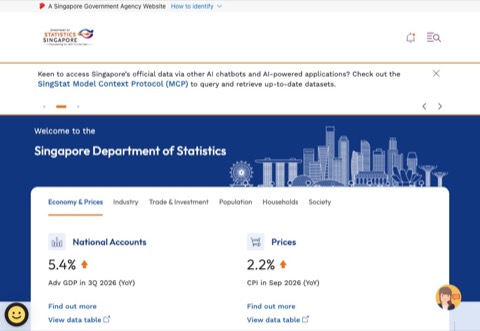
- Department of Statistics Singapore (SingStat) (新加坡统计局官方网站(SingStat))SingStat is the official website of Singapore's Department of Statistics and the primary entry point for official population and social statistics on Singapore. Data are organised by theme, including economy and prices, industry, trade and investment, population, households and society; the Population, Households and Society themes bear directly on research into population, ethnicity and the family. The site's core tool is Table Builder, which the homepage describes as offering about 2,800 customisable datasets and about 180,000 data series from 70 public-sector agencies, together with a developer API with an OpenAPI specification. The Census of Population page and the Publications section hold descriptions and reports for past censuses (including the 2020 census, the sixth since independence and the fifteenth counting from the first census in 1871), as well as annual reports such as Population Trends and thematic articles. For research on the Chinese in Nanyang and on the region, official statistics are the authoritative source for discussing the structure of ethnic groups such as Chinese, Malays and Indians, as well as language, religion, educational attainment, households and housing change. The site also has an entry point to the Anonymised Microdata Access Programme (AMAP) for scholars at local autonomous universities.
Coverage, how to use, and notes
Coverage The site holds thematic data on population, households, society and the economy. The Table Builder homepage indicates about 2,800 datasets and about 180,000 data series from 70 public-sector agencies. The Census of Population section lists explanatory articles and reports for the 2020 census and outlines the history of censuses since 1871; the Population theme page lists reports such as Population Trends 2026 and several thematic articles. For the full list of individual census reports and how to download them, please refer to the official website.
How to use On the official website, browse by theme under Find Data, or use Table Builder to select data series and customise tables; developers can use the API provided on the site. Census reports and publications can be found under Publication & Resources and in the Census of Population section. Viewing public statistical tables is free of charge; whether registration is required should be checked against the current notice on the website. When citing, it is advisable to record the table name, variables, reference year and access date.
Notes At the time of checking, some deep links to census reports (including direct PDF links) could not be opened; paths may change after website redesigns, so please start from the homepage or the Census of Population section. Population data distinguish between residents (citizens and permanent residents) and non-residents, and the basis used should be stated when citing. The homepage does not list a physical address; for contact details please see the Contact Us & Statistical Enquiries page on the website.
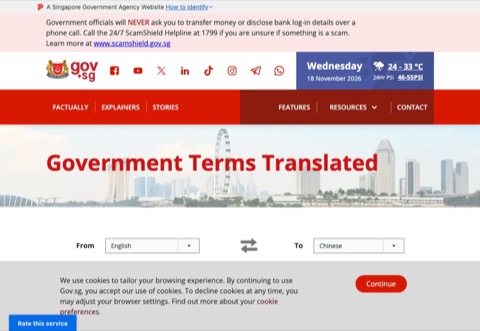
- Government Terms Translated (政府术语翻译库)The Government Terms Translation database (translatedterms.gov.sg) is a multilingual terminology lookup tool on the Singapore government (gov.sg) website; the Speak Mandarin Campaign website says it is maintained by the Translation Unit of the Public Communications Division of the Ministry of Communications and Information. Users can choose a source language and a target language among English, Chinese, Malay and Tamil, then look up officially adopted translations of terms by category. Singapore has four official languages, and government documents, public notices and media translation need consistent terminology. For readers studying Singapore's language policy, translation practice, and official Mandarin versus local usage, it can serve as a reference for official translated names. For example, one can compare the Chinese, Malay and Tamil renderings of names of institutions, systems and policies to judge whether a translated name is the form adopted by the government. When reading Singapore Chinese newspapers, government press releases or archival materials, it can be used to check names of institutions and policies, alongside other corpora or dictionaries.
Coverage, how to use, and notes
Coverage Provides lookup between English, Chinese, Malay and Tamil, with a category filter that defaults to All. The homepage does not state the total number of terms or the list of categories; please refer to the official website. The page footer shows Last updated on 21 Oct 2026.
How to use Open translatedterms.gov.sg, choose the source and target languages in the From and To drop-down menus, then select a Category to narrow the range and view the results. The Government Terms Translation page on the Speak Mandarin Campaign website also links to this site. No registration is required. The homepage does not mention download or export functions.
Notes This is a government terminology comparison tool, not a scholarly dictionary; it gives no etymology or usage analysis and has no example sentences. The homepage does not state the number of terms. When citing, please note the date of the query.
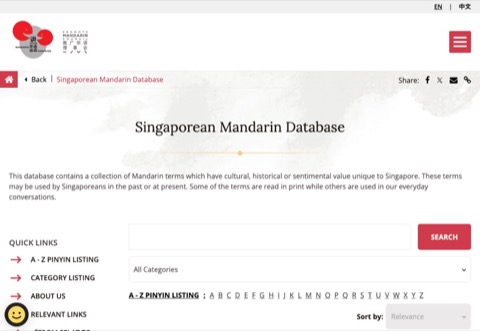
- Singaporean Mandarin Database (新加坡华语资料库)The Singaporean Mandarin Database is published on the Speak Mandarin Campaign website under the Singapore Mandarin Council (Language Councils Singapore), and collects Mandarin words with distinctive cultural, historical or emotional value in Singapore. Some of these words appear in print and some are used in everyday speech. Some are used in Singapore and other Chinese-speaking regions but are not common in mainland China. The website states that a five-member expert panel (whose backgrounds include the National University of Singapore, the Ministry of Education and a former editor-in-chief of Lianhe Zaobao) and a five-member research team took part in building it, and the page says the database is still under construction. For readers studying Singapore Mandarin vocabulary, language contact and localisation, and the social and cultural history of the Chinese community, it is an official source of entries with example sentence sources and references. Entries are organised in nine categories: culture, society, places, speech, education, transport, food/plants, communities/institutions, and law/politics. The sample entry 新加坡华语 contains the Chinese characters, pinyin, Chinese and English definitions, newspaper example sentences (with sources and dates) and a link to references. The database has accompanying publications, Volumes 1 and 2 of From Selat to Singapore: Singaporean Mandarin Database, and the page links to flip-book e-versions.
Coverage, how to use, and notes
Coverage The database covers Mandarin words with distinctive cultural, historical or emotional value in Singapore, in nine categories: culture, society, places, speech, education, transport, food/plants, communities/institutions, and law/politics. Entries with no corresponding Chinese characters (such as sayang) are not included. Each entry has Chinese characters, pinyin and a definition, with example sentences, their newspaper sources and references. The website does not state the total number of entries. The page says the database is still under construction and notes that information is valid as of 4 May 2021; the website says English translations will eventually be provided, and they are not yet complete.
How to use From the Speak Mandarin Campaign website (mandarin.languagecouncils.sg), go to the Learning Resources section and then the Singaporean Mandarin Database; no registration is required. Entries can be browsed by pinyin A–Z or by the nine categories, or searched by keyword, with category and letter filters combined, and results can be sorted by relevance, A–Z or category. Clicking an entry opens a detail page with example sentence sources and a reference PDF. For continuous reading, use the e-versions of the two volumes linked on the page. When citing, record the entry page URL and access date, and check the reference list.
Notes The website does not give the total number of entries or the exact launch date. The data validity date shown on the page is 4 May 2021; for later updates, please refer to the official website. English translations for some entries are not yet complete. For terms of use, please refer to the official website.
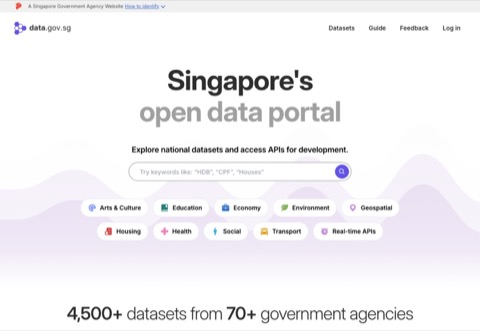
- data.gov.sg (新加坡政府开放数据门户(data.gov.sg))data.gov.sg is the Singapore government's open data portal; the page footer credits Open Government Products. The homepage states that it holds over 4,500 datasets from more than 70 government agencies, such as the National Environment Agency and the Housing & Development Board. The website states that the datasets are covered by the Open Data Licence and may be used free of charge for commercial or personal purposes. Besides data downloads, the portal supports viewing and embedding live charts and tables online, subscribing to dataset update notifications, and an API for obtaining real-time and historical data. For research on the Chinese in Nanyang and on the region, it offers official open data on housing, population, transport, the environment and other areas, suitable for empirical studies of Singapore's urban society, housing and ethnic distribution, communities and infrastructure. For aggregate population and census statistics, it can be used together with the Department of Statistics website.
Coverage, how to use, and notes
Coverage The homepage indicates over 4,500 datasets and more than 70 government agencies. Data themes include transport, housing and the environment. The time span, formats and update frequency of datasets vary by dataset; please check each dataset page. For descriptions in dataset metadata, please refer to the official website.
How to use Visit the homepage directly, find datasets through search or browsing, check the description and licence on the dataset page, and download the data or use the online charts. For programmatic access, use the API on the website; higher-frequency calls may require an API key, and the specific rules should be checked on the website's developer page. Dataset update notifications can be subscribed to. When citing, please record the dataset name, publishing agency, update date and access date.
Notes Datasets are provided by different agencies, and their definitions, fields and update frequencies are not uniform. For authoritative aggregate statistics on population and ethnicity, it is advisable to also check the publications of the Department of Statistics Singapore. The portal's API usage rules have been changed in the past; please refer to the current notice on the website.
Libraries & archives
- National Archives of Singapore - Archives Reading Room (新加坡国家档案馆档案阅览室)The Reading Room of the National Archives of Singapore (NAS) is the on-site facility used when records need to be consulted at the main premises in Singapore. According to the official NAS page, the reading room provides access to government records, Straits Settlements records, private records and copied records, maps and building plans, and oral history interviews and audiovisual records, and offers reference copies in microfilm and digital formats. It also handles copy requests, enquiries about the collections, and searches of civil marriage records registered on or before 15 September 1961 and school records. Staff are on duty to assist with search and research needs. The reading room is used together with Archives Online: search for records online first, then apply to view or copy as needed. For readers studying the history of Singapore and Malaya, any records that cannot be viewed from home on Archives Online can be consulted here after applying online.
Address 1 Canning Rise, Singapore 179868 View on map ↗
Coverage, how to use, and notes
Coverage According to the official page, the reading room provides access to government records, Straits Settlements records, private records and copied records, maps and building plans, and oral history interviews and audiovisual records, as well as reference copies of records from overseas archives, in microfilm and digital formats. Marriage record searches are limited to civil marriages registered on or before 15 September 1961.
How to use Submit an online application at least 5 days in advance through the Request to View button on Archives Online, or email the contact page on the official website to enquire about the collections and the availability of records. Copies are requested through Request a Copy in e-Request. Some records require prior consent from the transferring agency or donor.
Notes Opening hours (per the official reading room page): the reading room is open daily from 10:00 to 21:00 and closed on public holidays; staff services are available from 10:00 to 18:30 on weekdays, with no staff service on weekends and public holidays; it closes at 13:00 on the eves of Christmas, New Year and Chinese New Year. Please check the official website for notices again before visiting.
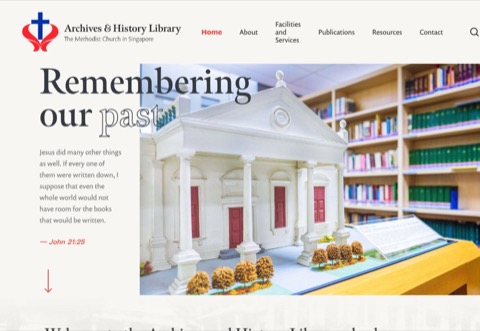
- Archives and History Library, The Methodist Church in Singapore (新加坡卫理公会档案与历史图书馆)This is the church archives and history library established by The Methodist Church in Singapore, and its website introduces the collection under the title Remembering our past. The archive is responsible for collecting, organising and preserving materials related to the work of the Methodist Church, and welcomes researchers. The website states that the collection covers 1885 to the present, including original documents, microfilm, audiovisual materials, photographs and books. The books include Methodist publications, works by John Wesley, and books on the history of Methodism in Southeast Asia, general church history and Methodist theology. The early Methodist mission in Singapore was closely tied to evangelism, education and social services among the Chinese and Indian communities, so these internal church records can supplement official archives and newspaper accounts. For readers studying Chinese Christianity in Singapore, mission schools, inter-ethnic religious networks and community organisations, this is a source of primary materials from the church's side.
Address 70 Barker Road, #04-01, Methodist Centre, Singapore 309936 View on map ↗
Coverage, how to use, and notes
Coverage The website says the collection covers 1885 to the present, with types including original documents, microfilm, audiovisual media, photographs and books, as well as Methodist publications, works by John Wesley, and books on the history of Methodism in Southeast Asia, church history and theology. The website does not publish the total holdings; for the specific scope and openness of each type of material, please refer to the website and the archive's reply.
How to use A visit requires an appointment: it is open Monday to Friday by appointment only, and closed on weekends and public holidays. To book, email the archives address published on the website's contact page. The website states that academic researchers must attach a letter of recommendation. The website says the collection catalogue can be consulted on computers in the archive; it does not state that an online archive search is provided. It is therefore advisable to first email your research topic and the types of material you wish to consult, and confirm whether relevant holdings exist and whether photographing or copying is allowed.
Notes The website does not describe online search or digitised collections; whether photographing or photocopying is allowed, and any restrictions on some materials, are not stated on the website, so please refer to the archive's reply.
- Lee Kong Chian Reference Library (National Library, Singapore) (李光前参考图书馆(新加坡国家图书馆))The Lee Kong Chian Reference Library (LKCRL) is located in the National Library Building in Singapore and is operated by the National Library Board (NLB). It is named after the overseas Chinese entrepreneur Lee Kong Chian, following a donation from the Lee Foundation. According to its official introduction, it is positioned as the premier source of information on works about Singapore and the region, serving local and overseas researchers. Floors are divided by subject and language: Level 7 for business, social sciences, and technology; Level 8 for arts and humanities (including art and literature); Level 9 for the Chinese, Malay, and Tamil collections; and Level 11 for the English-language Singapore and Southeast Asia collections. Level 11 also provides microfilm viewing of local newspapers, rare books, and other publications. According to the official NLB page, the National Collection exceeds 1.7 million items, centred on Singapore-related publications in the four official languages, with strengths in history, politics, economics, socio-cultural development, and the arts, and includes primary and unpublished materials such as manuscripts, photographs, maps, and registers. For readers studying Chinese society in Malaya and Singapore, Chinese-language publishing, and regional history, it is an important place for consulting Chinese, English, and Malay materials on site.
Address National Library Building, 100 Victoria Street, Singapore 188064 View on map ↗
Coverage, how to use, and notes
Coverage Reference collections on Singapore and Southeast Asia. Levels 7 and 8 hold English-language subject collections, Level 9 holds Chinese, Malay, and Tamil collections across disciplines, Level 11 holds the English-language Singapore and Southeast Asia collection, and Level 11 also offers microfilm viewing. The official site states that the National Collection exceeds 1.7 million items, including primary materials such as manuscripts, photographs, maps, and registers, but the specific date range and the number of items in each category are not stated; please rely on the official site.
How to use First learn about the collections through the NLB reference services website. Most materials are for in-library use only, and ordinary reference materials can be borrowed through RefToGo. Photography requires an application form first and must comply with copyright rules. Microfilm is viewed on Level 11, and printing is charged per page. Researchers and publishers (including overseas users) can apply for a fee-based high-resolution digital reproduction service, with terms on the official site. For enquiries about finding resources, email via the contact page of the official site. For opening hours and entry requirements, please check the NLB website.
Notes An NLB page notes that some links may not work during website migration. The conditions for consulting rare materials are not stated on the official reference pages, so please confirm by writing in first. The digital reproduction service is fee-based.
- Rotunda Library & Archive, National Gallery Singapore (新加坡国家美术馆 Rotunda 图书馆与档案馆)The Rotunda Library & Archive is the research library and art archive of the National Gallery Singapore, housed in the historic building that holds the Gallery. The library collection mainly concerns modern and contemporary art of Singapore and Southeast Asia, and includes rare books, artist monographs, exhibition catalogues, museum publications and periodicals. The archive holds fonds of artists, art writers, historians, collectors and institutions, including photographs, letters, sketches, diaries, manuscripts, rare catalogues, audiovisual material, interviews and exhibition-related documents. For scholars of Singapore and Southeast Asian art history, Chinese artists and Nanyang art, it offers rare primary materials, as well as related oral-history interviews and audiovisual records. The Gallery also provides an online collection search that covers artworks, archival fonds and books. The library does not lend books, and original archival materials must be consulted on site.
Address 1 St Andrew's Road, Singapore 178957 View on map ↗
Coverage, how to use, and notes
Coverage The library holds more than 10,000 titles on modern and contemporary art of Singapore and Southeast Asia, including rare books, artist monographs, exhibition catalogues, museum publications and periodicals, shelved by the Dewey Decimal Classification. The archive holds art archive fonds, mostly created in the 19th and 20th centuries, including photographs, letters, sketches, diaries, manuscripts, rare catalogues, videos, films, interviews and exhibition-related documents. For languages and total volume, please refer to the official website.
How to use Start with the online collection search on the official website (https://www.nationalgallery.sg/sg/en/our-collections/search-collection.html), where results can be filtered by artworks, archival fonds and books. The search supports exact matching with English quotation marks, and a hyphen before a word excludes it. Books are not digitised, so the online search gives only call numbers. Some archival materials can be viewed only on digital viewing devices in the library. Researchers who wish to consult reference materials or archives on site must make an appointment, using the email address on the website's contact page, and register at the counter on arrival. Copying archival materials or images requires an image request form, and processing can take up to four weeks. The website states that digital copies are free where permitted, printing costs S$1 per A4 page and photocopying S$0.20 per A4 page.
Notes The website states that the library is temporarily closed from 14 February 2026 to October 2027. During this period materials remain available online or by appointment on site. Please confirm current arrangements with the official email address before travelling. Some archival materials are subject to copyright or access restrictions.
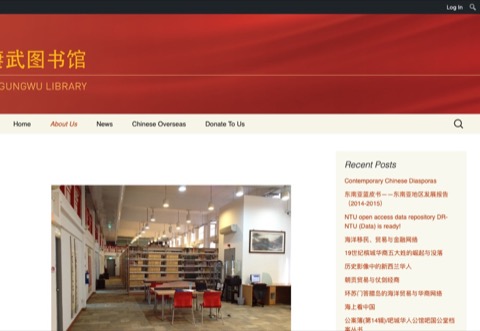
- Wang Gungwu Library, Chinese Heritage Centre, Nanyang Technological University (王赓武图书馆(南洋理工大学华裔馆))The Wang Gungwu Library is located in the Chinese Heritage Centre at Nanyang Technological University, Singapore, and is a specialized library on overseas Chinese studies. According to its official page, Professor Wang Gungwu donated more than 30,000 volumes in 2003, laying the foundation of the collection, and the library is named after him. The Chinese-language page states that the holdings now exceed 50,000 volumes, mainly literature on overseas Chinese studies. Besides general books, the library holds genealogies, early textbooks, thread-bound books, school publications and publications of Chinese clan and native-place associations. These materials are mostly local, non-commercial publications that are hard to find together in ordinary libraries. For those studying Chinese society in Malaya and Singapore, Chinese education, clan and native-place organizations, and clan migration, it can serve as a specialized entry point for on-site consultation. The Chinese Heritage Centre is located in the former administration building and library building of Nanyang University, and the premises are themselves tied to the history of Nanyang University. The library belongs to the Nanyang Technological University system, and its holdings can be searched through the NTU Library search system.
Address Wang Gungwu Library, Chinese Heritage Centre, 12 Nanyang Drive, Singapore 637721 View on map ↗
Coverage, how to use, and notes
Coverage Themed on overseas Chinese studies. The official page states a donation of more than 30,000 volumes from Wang Gungwu (2003), and the Chinese-language page says current holdings exceed 50,000 volumes. Special collections include genealogies, the Early Textbook Collection, thread-bound books, school publications and publications of Chinese clan and native-place associations. The number of volumes, date range and language composition of each special collection are not listed on the official pages; please refer to the website.
How to use First search the holdings through NTU Library's OneSearch. The official FAQ notes that the library is currently in a period of temporary collection reorganization: the Early Textbook Collection can be used in the Chinese Library Special Collection Room, while other holdings must be requested through OneSearch or by email via the contact page on the website. Opening hours and entry rules are not stated on the official pages; you can inquire by email (see the website's contact page) or by telephone at +65 6513 8682 / 6513 8680, and it is advisable to contact them before visiting.
Notes The collection is undergoing temporary reorganization, so some books may need to be requested in advance; for opening hours and visiting rules, please refer to the website and the library's reply. Different pages give two figures for holdings, more than 30,000 volumes (donation) and more than 50,000 volumes (current holdings); the former refers to the 2003 donation.
Museums & memorials
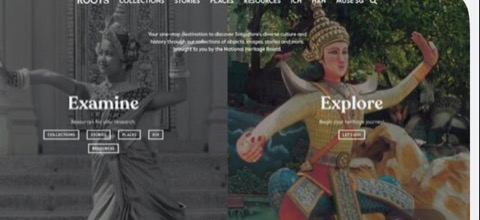
- Roots.gov.sg (新加坡国家文物局文化遗产门户)Roots.gov.sg is a heritage portal built by Singapore's National Heritage Board. The site describes itself as a one-stop gateway to discovering Singapore's diverse cultures and history, presented through collections, images, stories and other formats. Readers can learn about Singapore's multicultural society and history in one place, as the homepage confirms. The homepage has two entry points, Examine (research resources) and Explore. Examine links to Collections, Stories, Places, ICH (intangible cultural heritage) and Resources; there are also sections such as HAN (Heritage Activation Nodes) and MUSE SG. For research on Chinese communities in Southeast Asia and on the region, it is useful for finding information on museum collections, historical images, places and heritage entries in Singapore, and it can serve as an introduction and a source of leads on Singapore's multi-ethnic society and the cultural heritage of its Chinese communities. The homepage does not list the number of collections, language options or similar data; for the exact scale, please consult the site.
Coverage, how to use, and notes
Coverage The content covers Singapore's culture and history. Main types include museum collections (objects), images, thematic stories, historic places, intangible cultural heritage and research resources. The homepage does not state the chronological span, the number of entries or the languages; please consult the site for details.
How to use Go directly to www.roots.gov.sg and use the top navigation to enter Collections, Stories, Places, Resources or ICH. The Examine section on the homepage lists entry points aimed at research. A search icon on the right of the navigation bar allows keyword searching. It is advisable to first run cross-searches in Collections and Stories using English keywords (such as Chinese, clan association, Teochew), and then use Places to find related historic sites. Before using any image, check the copyright notice on the relevant entry page.
Notes The homepage does not say whether registration is required, nor does it provide the scale of the collections, whether images can be downloaded, or terms of use; please consult the site. Entries vary in completeness, so it is advisable to check the entry pages.
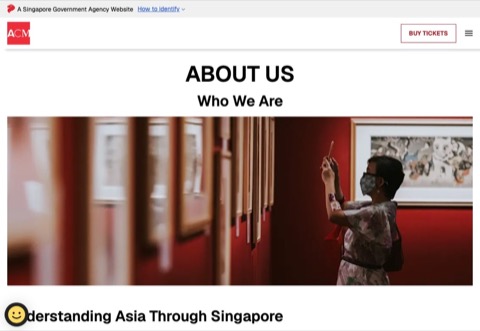
- Asian Civilisations Museum (亚洲文明博物馆)The Asian Civilisations Museum (ACM) is managed by Singapore's National Heritage Board and is located at Empress Place on the Singapore River. Its official introduction describes it as the only museum in the region with a pan-Asian perspective, presenting Asian art and history through Singapore's role as an international port city. Themes include maritime trade, faith and belief, materials and design, and the art and culture of the Peranakans. The collection originated in the colonial-era Raffles Library and Museum, initially consisting mainly of ethnographic objects from Malay and other indigenous cultures of Southeast Asia, along with a small number of Chinese artefacts, and was later expanded with West Asian, Islamic and South Asian holdings. The museum also operates the Peranakan Museum. The three thematic floors listed on the website are Maritime Trade, Faith & Belief, and Materials & Design. For readers studying the Maritime Silk Road, Southeast Asian material culture, the Straits Chinese and regional art history, it offers objects and exhibitions that can be viewed in person, as a complement to documentary research.
Address 1 Empress Place, Singapore 179555 View on map ↗
Coverage, how to use, and notes
Coverage Scope is Asian art and history, covering maritime trade, faith and belief, materials and design, and Peranakan culture. The earliest holdings came from the Raffles Library and Museum and include Southeast Asian ethnographic objects and a small number of Chinese artefacts. The website's About page does not state the total number of objects, the date range or the library's status; please consult the website.
How to use Opening hours, tickets and current exhibitions can be found on the website's visit page. The website's access path sometimes redirects; please enter from acm.nhb.gov.sg. It is advisable to check current exhibitions and guided tour arrangements before visiting. The official pages do not say whether research access to materials is provided; for research purposes, please contact the museum first.
Notes The official About page does not mention a library or research facilities, and there is no dedicated section on Chinese studies. Please treat it as a resource for objects and exhibitions rather than a documentary archive. Exhibitions change over time; please consult the website.
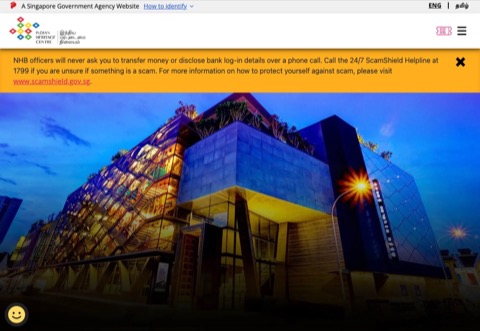
- Indian Heritage Centre (印度传统文化馆)The Indian Heritage Centre (IHC) opened in May 2015 and is part of the National Heritage Board's museum network in Singapore. Built on the memories and contributions of the community, it tells the history of the Indian and South Asian communities in Singapore. Its narrative begins with early contacts between South Asia and Southeast Asia around the 1st century CE, extends to the migration networks of overseas Indians, and then to the contributions of the Indian community in Singapore. The Centre has five permanent galleries, with exhibits such as heirlooms, jewellery, diaries and family photographs. One collection item shown on the website is a late 19th-century Chettinad door, linked to the Nattukottai Nagarthar Chettiars, who traded and lent money in Southeast Asia. For readers studying Singapore's multi-ethnic society, inter-ethnic comparison and Nanyang migration history, it is an important place for the material and oral background of the Indian community.
Address 5 Campbell Lane, Singapore 209924 View on map ↗
Coverage, how to use, and notes
Coverage The theme is the history of the Indian and South Asian communities in Singapore and Southeast Asia, with objects on display such as heirlooms, jewellery, diaries and family photographs. The website has Collection, Library and Publication pages, but their size, date range and searchable scope could not be verified this time; please refer to the official website.
How to use On the website https://www.indianheritage.gov.sg/en, the Resources section has Collection, Library and Publication pages, which can be browsed first. The Centre is open daily from 10:00 to 18:00 and closed on Mondays. Entry is free for Singapore citizens and permanent residents. Whether an appointment is needed to use the library or research materials on site should be confirmed on the official website.
Notes The collection page on the website shows only selected items, and no searchable online catalogue could be verified this time. For research purposes, please contact the Centre first to confirm.
- National Museum of Singapore (新加坡国家博物馆)The National Museum of Singapore was founded in 1887 and is the oldest museum in Singapore, managed by the National Heritage Board (NHB). The building underwent a three-year redevelopment starting in 2003 and reopened in December 2006; its permanent galleries reopened after a revamp on 19 September 2015. The permanent exhibitions listed on the website's homepage include the Singapore History Gallery and Singapore Odyssea. The museum has a Resource Centre, and the website has a section called NMS Online that includes online exhibitions. For readers studying Singapore's social history, urban history and ethnic cultures, the museum offers artefacts and displays on site, and its online exhibitions show the museum's narratives and collections. The museum also hosts festivals, art installations, performances and film screenings.
Address 93 Stamford Road, Singapore 178897 View on map ↗
Coverage, how to use, and notes
Coverage Museum collections and exhibitions on the history and culture of Singapore. The website lists two permanent exhibitions, the Singapore History Gallery and Singapore Odyssea: A Journey Through Time, both on Level 2. The homepage does not state the size, date range or languages of the collections; please refer to the official website.
How to use The website is https://www.nationalmuseum.nhb.gov.sg/, where the NMS Online section contains online exhibitions that can be browsed directly. For the Resource Centre's opening hours and usage rules, consult the visitor information and contact pages of the website. Before visiting, please confirm opening hours and ticketing arrangements on the website.
Notes The specific holdings of the Resource Centre and any appointment requirements could not be verified on official pages this time; please enquire with the museum first. Online exhibitions are not a complete collection catalogue.
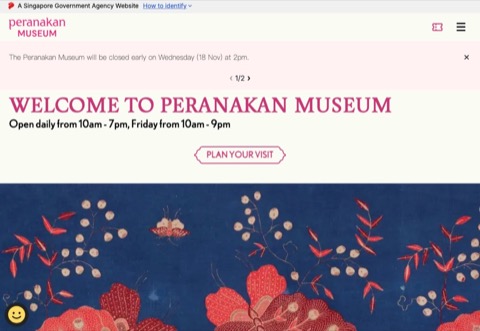
- Peranakan Museum (土生华人博物馆)The Peranakan Museum is a museum under Singapore's National Heritage Board (NHB), located on Armenian Street in the city centre. According to its website, the museum explores Peranakan culture, with a focus on how this culture took shape in the diverse port cities of Southeast Asia. The permanent exhibition spans three levels: Level 1, Origins, asks what Peranakan culture is and what its multiple sources are; Level 2, Family & Community Life, introduces customs, food, language and beliefs; Level 3, Fashion, shows how dress combined many influences. The website also offers digital resources such as videos, event materials and articles, as well as sections on publications and collections. For readers studying the Straits Chinese and the material culture, family and community life of Peranakan Chinese, it is a site that can be visited in person to see the related material culture and exhibition narratives. The museum is operated by the Asian Civilisations Museum, and its research and exhibitions can be read alongside the social history of Chinese communities in Southeast Asia.
Address 39 Armenian Street, Singapore 179941 View on map ↗
Coverage, how to use, and notes
Coverage Exhibition themes include the origins of Peranakan culture, family and community life, language, beliefs and dress. The website does not state the total size or date range of the collection; please consult the website. It has sections on collections, digital resources and publications. The exhibition Exceptional/Everyday: New Acquisitions, New Perspectives runs from 30 October 2026 to 29 August 2027.
How to use Check opening hours on the website and buy tickets before visiting. The website shows daily hours of 10:00–19:00, until 21:00 on Fridays, with early closing on some dates; please check the website's announcements for the day. You can browse the collections and digital resources sections first to decide what to focus on. Ticket prices are not stated on the website's visit page; please check the ticketing page. Website telephone: +65 6332 7591.
Notes This is an exhibition museum, not an archive reading room. The website does not say whether research access to materials is offered; if you need to consult collections, please call or write first. Exhibition content changes over time; please consult the website.
Institutions & societies
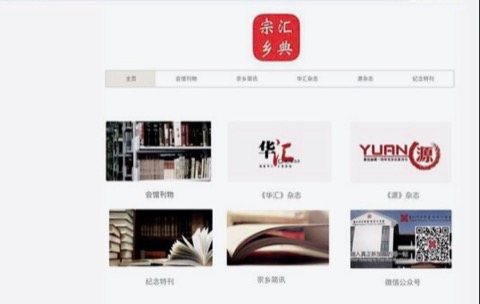
- Singapore Federation of Chinese Clan Associations (SFCCA) – Publications (新加坡宗乡会馆联合总会(出版物与资料))The Singapore Federation of Chinese Clan Associations (SFCCA, 新加坡宗乡会馆联合总会), founded in 1985, is the umbrella body of Singapore's Chinese clan associations. Its official website offers many digital resources related to clans and Chinese people that can be downloaded free of charge, which are useful for scholars studying Chinese clans and folk customs in Malaysia and Singapore. As verified on the site, there is a Publications section listing the magazine Yuan (《源》), the magazine Oneness (《华汇》), the booklet Cultural Journey (《文化之旅》), a resource room and other publications. Yuan is a Chinese-language publication whose back issues are placed on the site as PDFs; PDF links for issues 117, 132 and 134 can be seen, and the latest issue in the page navigation is issue 183. The Oneness page lists issues 53 to 57 and an entry to back issues. It should be specially noted that the URL originally recommended was clanmagazine.org (Clan Compendium, 宗乡汇典, reportedly collecting association publications, clan newsletters, commemorative volumes and so on), but when checked this domain redirected to a website unrelated to clans and is no longer valid, so the SFCCA official site is used here as the working entry point. For researchers, these publications can be used to understand the activities and histories of Singapore's clan associations and Chinese folk culture.
Coverage, how to use, and notes
Coverage The Publications section of the site includes the magazine Yuan (Chinese; issues visible up to 183), the magazine Oneness (visible up to issue 57), the booklet Cultural Journey, a resource room and other publications. The specific issues available for download and their date range are not stated on each magazine's page; back-issue pages need to be checked issue by issue. The association publications, clan newsletters and commemorative volumes in the Clan Compendium could not be verified.
How to use Open the homepage of the site, go to the Publications section, then choose Yuan (sfcca.sg/yuan/) or Oneness (sfcca.sg/oneness/) and click Back Issues to see each issue; some issues have PDF links that can be downloaded directly. The resource room and other publications are under the same section. No registration is needed. To find materials on a specific clan association, first look in the back-issue contents of Yuan, then download the relevant issue.
Notes Not all back issues are confirmed to be available for download, so they need to be checked issue by issue; clanmagazine.org is no longer valid and should not be used, while the Clan Compendium link on the official site still points to it. The federation's address is 397 Lorong 2 Toa Payoh, Singapore 319639; to consult materials on site, please contact the federation first.
- ISEAS FellowshipsNavigation page for the ISEAS visiting scholar programmes, listing the Wang Gungwu Visiting Fellowship and visiting opportunities under special projects, with accompanying materials on planning a visit. The page does not list deadlines or eligibility.
- Research & Publications (Singapore Chinese Cultural Centre)Page of research and publication grant outputs from the Singapore Chinese Cultural Centre, including the 2019 conference e-book Diversity and Singapore Ethnic Chinese Communities and several research outputs in PDF, covering identity, religion, language and literature among Singapore Chinese communities.
Other
- Culturepaedia (新加坡华族文化百科)Culturepaedia is published by the Singapore Chinese Cultural Centre. Its website describes it as a growing repository of information on Singapore Chinese culture, and it is available in Chinese and English. The site introduces Singapore Chinese culture and history with text and images, and is recommended as an entry-level resource. Content is organised into eight themes: Community, Language and Education, Popular Culture and Media, Social Customs, Literature, Art, Music, and Performing Arts. There are also featured collections (such as Lunar New Year, People, and a retrospective on Chinese schools) and recommended articles and videos. For research on Chinese communities in Southeast Asia, it works as an introductory reader and a source of leads on many aspects of Singapore Chinese society and culture. Its entries give an overview of topics such as classical-style Chinese poetry, the history of Chinese schools, associations, and customs, from which readers can look further for specialist literature. It is a popular encyclopedia for the general public, not an academic paper database, so citations should be checked against original sources.
Coverage, how to use, and notes
Coverage Covers the eight themes of Singapore Chinese culture (Community, Language and Education, Popular Culture and Media, Social Customs, Literature, Art, Music, Performing Arts) and several featured collections; available in Chinese and English. The homepage does not state the total number of entries.
How to use Open the website directly; no registration is required. Browse by theme on the Explore page, or enter through featured collections, recommended articles, and recommended videos; the page can be switched between English and Chinese. A good approach is to find entries by theme first, then look for further academic literature based on their content.
Notes This is a popular reference resource, and entries vary in depth. The homepage does not state the number of entries or how often they are updated.
- SINGAPO人 Online(SINGAPO人线上站)SINGAPO人 Online is the online companion site to SINGAPO人, the permanent exhibition of the Singapore Chinese Cultural Centre, and is recommended as an entry point for understanding Singapore Chinese identity and culture. According to the website (the original URL now redirects permanently to singaporen.sg), the exhibition explores what it means to be Chinese in Singapore, an identity that is constantly changing and has no simple definition. The site has three parts. Discover is a virtual journey starting from Chapter 1 that invites readers to get to know, or rediscover, the culture of Chinese Singaporeans. Resources is a resource centre for learning more about Singapore Chinese culture, with themes previewed on the homepage including festivals, food, and craft and design. Exhibition introduces the physical exhibition and includes a video preview. For readers studying Singapore Chinese identity, cultural transmission, and public narratives, it offers an example of how an official institution tells the story of Chinese history and culture, and it can also serve as online material for teaching and outreach. The site is richly illustrated and suited to casual learning, but it is not a professional scholarly search tool.
Coverage, how to use, and notes
Coverage Exhibition narrative and a resource centre centred on Singapore Chinese identity and culture, with themes including festivals, food, craft and design, and art. The homepage does not state the number of chapters or the total number of resources.
How to use On the website, click Discover or explore to tour online from Chapter 1; click Resources or Learn More to browse the resource centre; click Exhibition to learn about the physical exhibition (this opens an external exhibition page). No registration is required. The page also lists the Centre's opening hours, address, and contact details for planning a visit.
Notes This is a popular companion site for an exhibition, and its overview page does not list chapter details. The original URL singaporen.singaporeccc.org.sg now redirects permanently to singaporen.sg. The physical exhibition is currently closed for upgrading works.
- Under the Five Trees: Singapore History Workshop (五丛树下(新加坡文史工作室))Under the Five Trees (五丛树下) is a Chinese-language blog hosted on WordPress.com. The page describes itself as a new starting point for Singapore History Workshop / SingaporeHistoryWorkshop / OMY History Expert. It appears on a recommended list of personal Malaya–Singapore history websites (11 sites in total), and its content is summarised as focusing on Singapore's history, culture, people, and geography, covering Singapore's past and present as well as Nanyang history related to Singapore. As verified, the site organises its articles by section, including news on history events, footprints of people, customs and folkways, the British and Japanese periods, postwar and nation-building, Nanyang and China, a series on historical artefact collections, and tours of the literary and performing arts. The pinned article on the homepage discusses the origin of the place name Shui Xian Men, citing materials such as early Hokkien–English dictionaries. The site is popular history writing by an individual or small group. It is suited to serving as a source of leads, in a Chinese-language context, on Singapore local history, folk customs, and Chinese society, but it is not an academic publication, and citations should go back to the original sources.
Coverage, how to use, and notes
Coverage Mainly Singapore history and Nanyang history, written in Chinese, covering the British colonial and Japanese occupation periods, postwar nation-building, links between Nanyang and China, people, customs, artefact collections, and arts performances. The date of the most recent article on the site is 5 July 2015; the total number of articles is not stated.
How to use Visit the blog homepage directly and browse by section, or use the built-in WordPress search to look up keywords such as place names, personal names, or years. No registration is required, and articles can be read online.
Notes The other 10 personal blogs on the recommended list could not be verified one by one because no URLs were provided, so only the verified Under the Five Trees is included here. The site's latest update dates to 2015, and its content is personal writing, so historical facts need to be checked separately.
- Foreign Workforce Numbers (Ministry of Manpower, Singapore) (新加坡人力部外籍劳动力人数统计)Foreign Workforce Numbers is a statistics page on the website of Singapore's Ministry of Manpower (MOM) that gives the number of foreign workers in Singapore by pass type. The categories include Employment Pass, S Pass and Work Permit, with further figures for foreign domestic workers and for Construction, Marine Shipyard and Process (CMP) Work Permits, as well as other passes (such as Letter of Consent, Training Work Permit and Training Employment Pass). The page gives several totals: all foreign workers, excluding foreign domestic workers, and excluding both foreign domestic workers and CMP Work Permit holders. For readers studying labour migration, transnational mobility, ethnic and workforce composition in Singapore, and workers from China and Southeast Asian countries in Singapore, it is the most direct official source of figures, and can be used alongside census and labour force survey data. The page includes an Excel file for download and further compilation.
Coverage, how to use, and notes
Coverage The page currently lists data for December of each year from 2021 to 2025, and for June 2026. Numbers are given by pass type, with totals under several definitions. The page does not break down figures by nationality, and the website does not say where data for earlier years are kept; please refer to the official website. The latest update date shown on the page is 22 September 2026.
How to use Open the website page to view the table; no registration is required. The page provides an Excel file named Foreign Workforce Numbers, which can be downloaded for time-series compilation. The website does not state a fixed update schedule; from the data points, releases appear mostly for June and December, but please refer to the official website for the actual release pattern. For more detailed labour market data, see the MOM statistics and publications section and datasets on data.gov.sg.
Notes The data are stock figures at specific points in time, not flows. The website notes that totals may not equal the sum of components because of rounding. The page lists only recent years, so long-term trend research needs MOM's other annual reports or historical series on data.gov.sg. The page does not break figures down by nationality, so please do not infer numbers by country of origin from it.
- Population in Brief (National Population and Talent Division) (《人口概览》(新加坡国家人口与人才司))Population in Brief is an annual report published by Singapore's National Population and Talent Division (NPTD), presenting key updates and trends in Singapore's population landscape. The NPTD was established on 1 January 2011 and is responsible for formulating, coordinating and reviewing population and talent policies; since 1 August 2016 it has been part of the Strategy Group under the Prime Minister's Office. The Population in Brief page in the website's Media Centre lists 19 issues from 2008 to 2026, all as PDF files. In addition, the site's census page carries an infographic of 2020 Census of Population highlights (population, marriage and fertility), with the Department of Statistics Singapore given as the data source. These materials present in condensed form the composition of and changes in the total population, citizens, permanent residents and non-residents, and serve as a supplement to the Department of Statistics' original reports for researchers who need to quickly check Singapore's population policy context and annual population size.
Coverage, how to use, and notes
Coverage The Population in Brief page lists 19 issues from 2008 to 2026, all in PDF. The page describes the content as important updates and trends on Singapore's population situation; whether every year includes ethnic composition is not stated on the page, so please check each PDF. The site also carries an infographic of 2020 Census highlights covering population growth, median age, dependency ratio, ethnic distribution (2010–2020), and marriage and fertility data.
How to use On the official website, go to the Population in Brief page under Media Centre and download the PDF by year. For census highlights, open the Census of Population 2020 page on the site. When citing, please state the publishing agency, year and page number; for original statistical figures, it is advisable to also check the original tables of the Department of Statistics.
Notes This is a summary publication from a policy agency, not microdata or a full census report. Statistical definitions (residents versus non-residents, reference dates) may differ between issues, so please read the notes in each issue when making comparisons.
Malaysia47
Newspapers & news archives
- Penang Monthly (槟城月刊)Penang Monthly (《槟城月刊》) is a monthly published by Penang Institute, which calls itself 'the voice of Penang' and an enlightening read for curious Malaysians. Penang Institute is a think tank funded by the Penang state government; it was founded in 1997 as SERI (Socio-economic and Environmental Research Institute) and renamed after rebranding in 2011. The magazine reports on Penang's livelihood issues and people, and also carries analyses of politics, economics, culture and society aimed at the national and occasionally regional level. The magazine's website provides a digital edition of every issue, so readers can browse covers by issue and read the whole magazine in flipbook form. For Southeast Asian studies, it is first-hand material for understanding local governance, urban and heritage issues, and ethnic and social issues in Penang and Malaysia, and also shows how a think tank explains local policy to the public. Its issues have clear topics (such as cover stories), which makes tracing by theme easy; it suits use as background for fieldwork, context for current affairs and a reference for local studies, but it is a think-tank magazine and not a peer-reviewed journal, and should be cited accordingly.
Coverage, how to use, and notes
Coverage The site's Issues page shows an archive from December 2009, continuously updated to the latest issue; each issue has a cover story. More recent issues can all be read online by flipbook. Articles are mainly in English and cover politics, economics, culture and society in Penang and Malaysia, occasionally touching on regional issues. The site does not state the total number of issues or articles, so none is given here.
How to use Open the site penangmonthly.com and go to the Issues page to browse covers of each issue by month; more recent issues have a Read as Flipbook link for reading online. The site says that registering a free account unlocks the full back-issue library; the Support Us page states that the three latest issues are currently free to read. When searching, locate the issue by number and cover story first, then read the contents. The site does not say whether bulk download or export is possible; when citing, record the issue, author and URL.
Notes The site says the full back-issue library requires registering a free account; whether the latest three issues can be read without logging in is not clearly stated. Not all earlier issues have flipbook links. The magazine is a general-readership publication from a think tank, not a peer-reviewed journal.
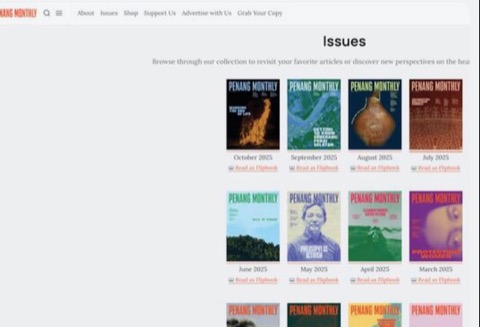
Archives & historical document databases
- Malaysian Chinese Literature Digital Library (马华文学电子图书馆)The Malaysian Chinese Literature E-Library is a Chinese-language digital library dedicated to collecting and presenting materials on Malaysian Chinese literature. The website is operated by Malaysian Chinese Literature Digital Library Sdn Bhd. It holds a large number of books on Malaysian Chinese literature, Chinese studies and Malaysian studies, which can be downloaded directly without registration or login, making it suitable for readers interested in Malaysian Chinese literature and Malaysian Chinese. Note that most of the resources are fairly old, but they include some early periodicals, such as the inaugural issue of Chao Foon, which are useful for research on literary history and the history of the Chinese-language press. According to the official website, the site has sections for Library, Authors, Publishers and News, as well as a video series, Echoes of Malaysian Chinese Writers. Books are organised by category, including literary creation (fiction, essays, poetry, drama, children's literature, etc.), literary criticism, literary studies (individual papers, master's theses, Chinese diaspora studies), literary periodicals, literary historical materials and studies of Malaysian Chinese, making them easy to find by genre and theme. For those researching Malaysian Chinese literature, Chinese-language publishing and cultural ecology, this is a rare consolidated entry point.
Coverage, how to use, and notes
Coverage According to the statistics on the official homepage, the library holds 872 books by 82 authors from 69 publishers, with over 4 million cumulative reads and over 1.58 million downloads (figures as of the time the homepage was viewed; they change with updates). Content is mainly in Chinese, with categories including literary creation, literary criticism, literary studies, literary periodicals, literary historical materials and studies of Malaysian Chinese. Periodicals include Jue Huo, Xin Shiji Wenyi, Malaysian Chinese Literature Web Edition and Chao Foon Monthly. The official website gives no unified statement of the period covered, so no estimate is made here.
How to use After entering the website, browse by category from the Library section at the top, or search by title or author using the search box at the upper right; you can also reach works through the Authors and Publishers sections. Each book's page allows online reading, and according to the site it can be downloaded directly without registration or login. The website shows download counts but does not appear to explain the download process or file formats, so please follow the prompts on the page.
Notes Most resources are old, with few recent research outputs. Pages for some periodical entries (such as Chao Foon) do not directly provide files for all issues but point to corresponding links at the National University of Singapore Libraries; whether all books on the website are open for download has not been checked one by one. When citing, please note each book's copyright statement.
- David Chen Electronic Library (陈充恩电子图书馆)The David Chen Electronic Library (陈充恩电子图书馆) is a digital database built by the Centre for Malaysian Chinese Studies (CMCS), which digitises the holdings of the CMCS Jixian Library for online searching. According to its introduction, CMCS was founded in 1985 and over more than thirty years has published over a hundred monographs and thematic reports, held hundreds of seminars and activities, and built a book and document database for Malaysian Chinese studies; the Jixian Library and several special collection rooms hold more than 100,000 monographs and research materials. Some descriptions call it one of the most complete archives of materials on Malaysian Chinese studies, a claim not confirmed on the site. The homepage offers Chinese and English interfaces and a search box, and organises materials into seven sections: books, newspaper clippings, periodicals, pictures, special collections, CMCS publications and the library catalogue. For readers studying Malaysian Chinese society, Chinese associations, Chinese education and Chinese history, it allows searching for collection leads and, through the special collections and clippings sections, finding local Chinese community materials that are hard to find elsewhere. Readers in Malaysia can also visit CMCS's physical Jixian Library for more materials.
Coverage, how to use, and notes
Coverage The homepage lists seven types of material: books, newspaper clippings, periodicals, pictures, special collections, CMCS publications and the library catalogue. The content focuses on Malaysian Chinese studies, and Chinese and English interfaces are provided. According to the introduction, CMCS holds more than 100,000 items; the homepage does not give the number of entries or the date range for each section, so please consult the site.
How to use Open http://davidchenlib.org/ and search directly from the search box on the homepage, or browse by category through the sections for books, clippings, periodicals, pictures, special collections, CMCS publications and catalogue. The language can be switched between Chinese and English at the top right. When searching, use Chinese personal names, organisation names, place names or event names, and search the clippings and periodicals sections separately so as not to miss press materials. The homepage does not say whether registration is required or whether full texts can be downloaded; please check the individual entries. To visit the physical Jixian Library, first confirm opening arrangements with CMCS by phone or email.
Notes Only the homepage and the contact page have been checked so far; access to full-text viewing and downloading in each section has not been tested one by one. The site does not separately list the address and opening hours of the Jixian Library; the contact page gives CMCS's address, and the homepage footer states office hours of Monday to Saturday, 9:00 to 17:00 (referring to the CMCS office, not necessarily the library). Evaluations such as most complete and the holdings figure of 100,000 items come from the introductory text and have not been verified on the site.
- Malaysia Design Archive (马来西亚设计档案馆)The online archive of the Malaysia Design Archive (马来西亚设计档案馆) collects and displays visual culture materials from Malaysia. The site states that its aim is to establish an open platform for collective critical discussion of visual culture, and its homepage is themed Design, Arts, Culture, Politics. Users can search here for historical design artefacts related to Malaysia, which is especially suitable for scholars studying Malaysian art and Malaysia from a visual perspective. As verified on the site, the collection categories include advertising, architecture, graphic design, photography, placards and caricatures, and item types include posters, placards, magazines, stamps and photographs; the Recently Added section on the homepage includes placards from 2024 to 2025 on gender, patriarchy and human rights, as well as designs related to Hari Raya, showing that the archive holds historical material and is also being continuously updated. For scholars interested in Malaysian society, politics, religious festivals and popular culture, visual materials can supplement textual sources. The site provides advanced search, and has a member login and a donation entry; physical materials can be viewed by contacting the archivist to make an appointment. The site footer shows a copyright period of 2008 to 2026, and the site is currently accessible.
Address Lot 84B, The Zhongshan Building, Jalan Rotan, Kampung Attap, 50460 Kuala Lumpur, Malaysia View on map ↗
Coverage, how to use, and notes
Coverage The site does not state the total number of items or the start and end dates. Verifiable content includes: categories covering advertising, architecture, graphic design, photography, placards and caricatures, and item types including posters, placards, magazines, stamps and photographs; the recently added items on the homepage are mainly placards from 2024 to 2025. The content relates to Malaysian design, art, culture and politics.
How to use Open search.malaysiadesignarchive.org and enter keywords in the homepage search box, or use advanced search to filter by title, start and end year, accession number, source, item type, category and subject. The homepage also lists Collections and Finding Aids sections for browsing the holdings and finding aids. Online browsing requires no registration; the site also has a member login. To view physical materials, contact the archivist through the link on the site to make an appointment.
Notes The site does not publish the total size of the holdings or terms of use, and copyright should be confirmed with the archive before images are reused. Online content may not cover all physical holdings. Consultation of physical materials requires an appointment.
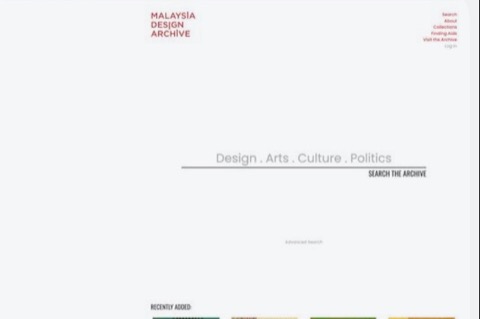
- Online Finding Aid (OFA), Arkib Negara Malaysia (马来西亚国家档案馆在线检索平台)The Online Finding Aid (OFA) is an online search platform for the holdings of the National Archives of Malaysia (Arkib Negara Malaysia), used to find the various records the National Archives holds, and is a basic entry point for the study of Malayan and Malaysian history. The platform covers government documents, historical photographs, maps, audio and video, and the homepage also allows entry by type, such as documents, audio, video and images. The site lists seven categories of holdings: public records, private records, records acquired overseas, commemorative and library materials, royal records, overseas donated records and Straits Settlements records. Private records include records of various organizations and associations as well as newspapers and magazines, and the Straits Settlements records concern Penang, Melaka and Singapore, which is especially useful to scholars of early Chinese society, colonial administration and regional connections. The procedure is: search by keyword first, then use advanced search to narrow the scope by category, date, number and other conditions, and view descriptive information such as title, abstract and date in the results. According to the introduction, only a small number of records can be viewed or downloaded online directly; the rest require registration and an appointment, and are consulted in the National Archives research room with an appointment number. It mainly provides search and descriptive information, a catalogue tool for preparing on-site consultation, and is not a full-text database.
Coverage, how to use, and notes
Coverage The homepage lists seven categories of holdings, with the numbers shown on the page: about 1.9 million public records, about 396,000 private records, about 10,600 Malaysia-related records acquired overseas, about 4,200 commemorative and library items, about 3,700 royal records, 188 overseas donated records and 137 Straits Settlements records. Content is mainly records of the Malaysian government and various sectors of society, including documents, newspapers and periodicals, photographs, and audio and video. The homepage does not describe the overall time span or the language proportions of the materials; please check the search results.
How to use After opening the platform homepage, you can switch between Malay and English interfaces. Click Keyword (Katakunci) and enter search terms; for more precision, go to Advanced Search (Carian Terperinci) to limit the scope by conditions; you can also browse step by step by category, subcategory, source, record type and archival material type, and there is a search guide (Panduan Carian). List pages offer PDF download. The homepage has registration (Pendaftaran Baharu) and login. According to the introduction, undigitized or restricted records require registering as a member, then making an online appointment, and then collecting them in the National Archives research room with the appointment number; this appointment procedure is not detailed on the homepage, so refer to the Archives' latest notices. When searching, try Malay and English keywords as well as terms related to Chinese associations and clan halls.
Notes The homepage does not state the detailed rules for registration and appointments, and the appointment procedure above has not been verified item by item against the site's pages. The platform mainly offers search and descriptive information, and most records must be consulted in person. Malaysian media have criticized the platform's search experience and record classification as unsatisfactory, so it is advisable to try several sets of keywords.
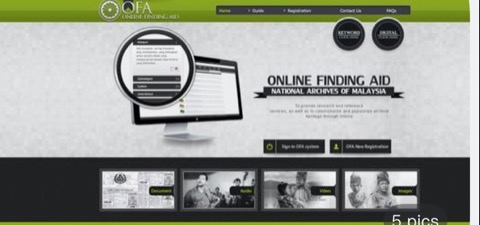
- Arkib Filem Rakyat (People's Film Archive) (人民影像档案(Arkib Filem Rakyat))Arkib Filem Rakyat is a film archive on Malaysian social movements. It describes itself as Malaysia's only human rights film archive and aims to preserve historical audiovisual material from multiple sources, presenting civil-society movements of the past thirty years from alternative perspectives on people's history, identity and nation-building. The archive is divided into Film and Raw Footage, each organised under 14 themes: alternative history, citizens' rights, corruption, environment, free and fair elections, harmony, Indigenous peoples, workers' rights, land rights, law and reform, people's movements, racism, the urban poor and women's rights. Examples listed on the homepage include a 2000 May Day rally at Strathisla estate in Perak, interviews with former Internal Security Act detainees, 2003 footage of an Orang Asli village in Bidor, Perak, defending customary land, and 1999 footage of nomination day in Petaling Jaya. For readers studying Malaysian political and social movements, labour and land issues, Indigenous rights and electoral history, this raw footage is primary material beyond the press.
Coverage, how to use, and notes
Coverage Mainly films and raw footage of Malaysian social movements, organised under 14 themes; the examples seen date from about 1999 to 2003. The homepage does not state the total volume, the full date range or the language policy; titles are in English and Malay. Please refer to the official website.
How to use Open the homepage and browse by Film or Raw Footage and by theme; the site's search can also be used. Some videos are played on YouTube via a Play Video link. For enquiries about content and for submitting films, use the contact entry (Speak to us) on the About Us page.
Notes The homepage does not state the operating organisation, the size of the collection or the licensing conditions for reuse; some footage depends on YouTube playback, whose availability is not controlled by the archive; when citing, record the film title and source page, and rely on the official website's statements.
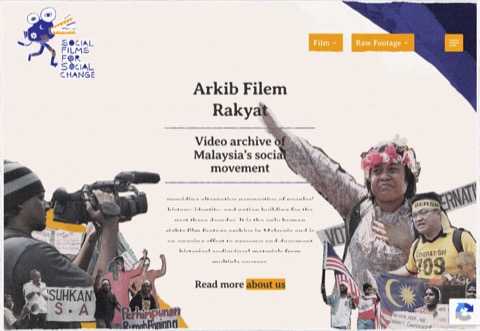
- Electronic Sarawak Gazette, Pustaka Negeri Sarawak (电子版《砂拉越公报》(砂拉越州立图书馆))The e-Sarawak Gazette is published by the Pustaka Negeri Sarawak (Sarawak State Library) and is a digitised copy of the printed Sarawak Gazette. The site footer credits an ICC project by White Hornbill and states that the work is being done in phases. According to the site, the Sarawak Gazette was first published by the Government Printing Office in 1870 and is a historical source on Sarawak affairs, especially for 1870 to 1941; its content covers economic history, trade statistics, commodity prices, agriculture, mineral and petroleum statistics, anthropology and archaeology. For scholars studying society, the economy, Chinese migration and development (such as land settlement and commerce) in Sarawak under the White Rajahs and in the postwar colonial period, it is a rare continuous primary source available for download online.
Coverage, how to use, and notes
Coverage The browse-by-year list covers 1907 to 1993, 39 years in total, not every year. The number of issues per year ranges from 1 to 25; some years have an index available for download. The site does not list content for 1870 to 1906.
How to use From the homepage (home.php), browse by year via Browse, or click a specific issue under Latest Updates to download. Download links for each issue take the form download_file.php?id=; the file format is not stated on the site. No full-text search was seen on the site, so browse by year first and then use the index (Download Index) offered for some years to locate items. No registration is needed, and the site can be accessed at any time.
Notes The holdings are not continuous, and the early content (1870-1906) was not seen on the site. There is no search box, so finding a specific topic requires going through the years one by one. The site's copyright is marked 2013 and the browsers it recommends are dated; please check yourself that downloaded files open properly.
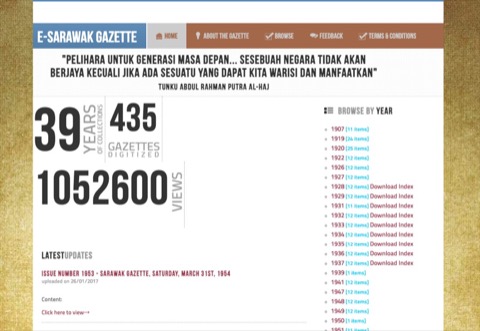
- Federal Legislation Portal, Laws of Malaysia (马来西亚联邦法律门户(马来西亚法律))The Federal Legislation Portal (lom.agc.gov.my) is maintained by the Attorney General's Chambers of Malaysia and provides online texts of Malaysian federal legislation. The portal describes itself as the sole official and authoritative publication channel for Malaysian law. The site is organised into the Federal Constitution, Acts, Ordinances and subsidiary legislation (P.U.(A), P.U.(B)), and has a What's New section that lists newly published documents by date. For scholars studying Malaysian history, politics, ethnic policy, religious and educational systems, citizenship and immigration, the Constitution and the various Acts are the most basic primary official texts. Ordinances also help trace legal developments before and after independence. The page supports Malay and English interfaces, which can be switched between, making it easy to compare the original text with the official translation. Scholars of Chinese society can use it to check the current provisions and revised versions of laws on societies, education, citizenship and nationality.
Coverage, how to use, and notes
Coverage Includes the Federal Constitution, Acts (including original, updated, repealed, translated and revised versions and amending Acts), Ordinances, and two types of subsidiary legislation, P.U.(A) and P.U.(B). The ASEAN law guide of the National University of Singapore Libraries adds that the site contains the main laws enacted after 1969, and laws before 1969 as revised by the Commissioner of Law Revision. For the exact year range and total number of Acts, please refer to the official website.
How to use From the homepage, search using Search in the navigation bar, browse by the Act, Ordinance and Subsidiary Legislation categories, or view newly published documents by date in What's New. The homepage can be switched between Malay (BM) and English (ENG). No registration is required. When looking for the historical text of an Act, check categories such as updated, revised and repealed versions. When citing, it is advisable to record both the version category and the date of the text.
Notes The page does not state the specific year range covered, and does not clearly mention the federal government gazette. Early colonial-period legislation and gazettes are not in this portal and must be sought through archives or other collections. State-level laws are not here; for Sabah and Sarawak, consult their own state legislation websites.
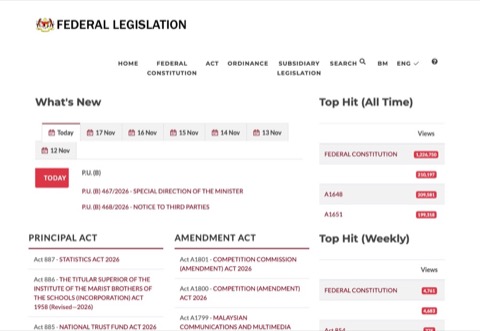
- Pusat Sejarah Rakyat (People's History Centre) (人民历史中心(Pusat Sejarah Rakyat))Pusat Sejarah Rakyat (PSR) is a civil-society website on Malaysia's people's history, publishing in Malay and English and bringing together events, projects, publications and archives. Its oral history project, Making of Malaysia People's Histories, was launched in 2015 on the premise that ordinary people's stories are absent from the national narrative; the project trains volunteers (mainly students and NGO members) to conduct and record interviews, and plans to build a digital archive to catalogue the recordings. The site also has a Hari Ini Dalam Sejarah Rakyat (Today in People's History) column, downloadable PDFs of the magazine Nadi Insan (issues 47 to 52 of 1983 on the page), an interviews section and a public submission page, as well as research projects on transnational progressive networks, environmental memory (CETDEM), an oral history of Malaysian protest movements (DEMO), and a sound history of national development. For readers studying the Malaysian left, labour, social movements and popular memory, it is an entry point to non-official sources and oral history methods.
Coverage, how to use, and notes
Coverage Content includes an oral history interviews section, magazine archives (such as several issues of Nadi Insan from 1983), a calendar-style history column and several research project pages. The size, languages and date range of the oral history archive are not stated on the site's description page; please refer to the official website.
How to use Visit the website and browse the interviews, archives and projects sections; issues of Nadi Insan are provided as PDFs; webinar recordings are available on YouTube. The public can contribute through the Submit Your Story page. The oral history description page mentions that audio and text materials will be open to the public, but does not state specific search and download methods.
Notes In the project description, the digital archive of oral history is still planned, so the extent of recordings or transcripts that can currently be consulted directly needs to be verified on the site; the website does not list an address or the names of those in charge; check the copyright statement on each page before using the materials.
- Sabah LawNet, State Attorney-General's Chambers, Sabah (沙巴法律网(沙巴州总检察署))The official website of the State Attorney-General's Chambers, Sabah (SAGC) has a Sabah LawNet section providing the texts of Sabah state laws. It lists Sabah state laws, subsidiary legislation, the State Constitution, the Agreement Relating to Malaysia, the Malaysia Act, treaties and orders, and local government by-laws. The Agreement Relating to Malaysia and the Malaysia Act are core documents for studying the legal and political basis of Sabah's and Sarawak's entry into Malaysia, and are especially important for scholars discussing Sabah-federal relations, autonomy and ethnic politics. The site also has an Our Law Library section and an Amendments section, and offers both Malay and English interfaces. Used together with the Sarawak legal portal and the federal legal portal, it allows comparison of legislative arrangements between the federation and the East Malaysian states.
Coverage, how to use, and notes
Coverage The homepage lists Sabah state laws, subsidiary legislation, the State Constitution, the Agreement Relating to Malaysia, the Malaysia Act, treaties and orders, and local government by-laws. The homepage does not give enactment years for most laws; please refer to the official website for the range of years and number of items.
How to use On the homepage (switchable between BM and English), use the search bar at the top, or choose Sabah Lawnet in the menu to see the categories. For foundational documents such as the Agreement Relating to Malaysia, look in the Sabah Lawnet section. The homepage does not say whether registration is required. For amendments, consult the Amendments section.
Notes The homepage does not show an office address or the years of individual laws; check the version and amendment date of a text before use. Sabah laws are state-level only; for federal laws, see the federal legal portal.
- Sarawak LawNet (砂拉越法律网(砂拉越州法律))Sarawak LawNet is the official Sarawak state government website for publishing the Statutes of Sarawak, provided and maintained by the State Attorney-General's Chambers. It contains state laws (Ordinances) and subsidiary legislation, and explains the five parts of the Sarawak Government Gazette. The site also notes that, from 1 January 1993, Ordinances are numbered by chapter (Cap.). Sarawak has special legislative and administrative autonomy within the Malaysian federation, and matters such as land, customary law and local government differ markedly from the Peninsular states. Scholars studying Sarawak's Chinese communities, land tenure, local governance, and Sabah-Sarawak-federal relations can find state-level primary legal texts here. It complements the federal legal portal; together they cover both the federal and state levels of the Malaysian legal system.
Coverage, how to use, and notes
Coverage Covers Sarawak state Ordinances and subsidiary legislation. The site navigation offers Full Listing, By Alphabet, By Year and Search. The homepage does not state the range of years or the number of items; please refer to the official website.
How to use From the homepage, browse via Full Listing, By Alphabet or By Year, or use the Search page. The homepage does not say whether registration is required. When consulting Ordinances, distinguish between Ordinances numbered by chapter (Cap.) and subsidiary legislation. To check the text of the Gazette, refer to the homepage's explanation of its five parts.
Notes The homepage description is brief; please refer to the official website for details of the search function and the earliest year covered. The system is labelled v1.0 and the page design is dated, so check whether a text is the latest revised version.
- The Living History Project (活历史计划(马来西亚口述历史数字博物馆))The Living History Project (TLHP) is a free, open online digital museum that preserves, in the subjects' own words, the personal experiences of people who have had an impact on Malaysian society. It is operated by Living History Sdn Bhd and positioned as a non-profit public resource. The site organises profiles of people as a Permanent Exhibition by category, including Performing Arts, Visual Arts, Sports, and Culture and Society, with additional thematic projects such as Penang Heritage, Kuala Lumpur Heritage, Directors Cut and Orang Asli. For readers studying Malaysian social and cultural history, art history, urban heritage and postwar social change, such first-person interview material can supplement the individual experience and insider perspectives that official archives and newspapers struggle to convey, and it also serves as a reference case for oral history methods. The site can be browsed online at any time without visiting in person. It should be treated as a combination of secondary compilation of personal narratives and primary oral testimony; when citing, return to the specific person's page and check the interview format and source information.
Coverage, how to use, and notes
Coverage Mainly self-narrated archives of Malaysian people, organised by categories such as Performing Arts, Visual Arts, Sports, and Culture and Society, with additional thematic projects on Penang, Kuala Lumpur, Directors Cut and the Orang Asli. The homepage does not state the total number of people, the time span or the languages; please refer to the official website.
How to use Visit the website directly and go to Permanent Exhibition to browse profiles by category; you can also see the person of the month and the thematic projects. The homepage does not explain registration, search syntax, or download or export rules; check the copyright and terms of use on each page before use. The site provides email and telephone contacts for enquiries about using the materials.
Notes The homepage does not give the size of the collection or how interview texts and recordings are provided; the content format of each person's page (video, text) varies, so check item by item. The website does not state the conditions for reuse; please refer to the official website.
- Visions of Penang (George Town World Heritage Incorporated) (槟城印象档案(乔治市世界遗产机构))Visions of Penang (VOP) is an online archive of images and documents on Penang on the website of George Town World Heritage Incorporated (GTWHI). It began as a set of historical survey maps of Penang Island and the mainland portion, and later expanded into several categories: postcards (greetings sent by letter and postcard before the internet), photographs and paintings (the earliest item is stated to date from 1869, reflecting life and architecture during Penang's development), maps, Malay manuscripts related to Penang, and a newer category of building plans, which holds design proposals and architectural plans from the mid-1880s onward. For readers studying Penang urban history, colonial-era urban form, Chinese settlements and neighborhood change, and architectural heritage, these maps, old photographs and plans are primary visual materials available for direct viewing, and can be used together with gazetteers, newspapers and land records.
Coverage, how to use, and notes
Coverage Categories include postcards, photographs and paintings, maps, Malay manuscripts and building plans; the earliest photograph dates from 1869 and the building plans from the mid-1880s. The website does not state the total number of items or the languages; please refer to the official site.
How to use Go to the Visions of Penang category page on the GTWHI website and browse the sub-pages for postcards, photographs and paintings, maps, Malay manuscripts and building plans. The category page does not explain search methods, download rules or terms of use; for further information, contact GTWHI (contact page on the website, tel. +604 261 6606).
Notes The category page does not give a separate URL for the archive's entry point; the URL above is the closest official page on the website. Copyright and reuse conditions for each image must be confirmed individually. For information on premises and on-site access, please ask GTWHI; this entry does not cover it.
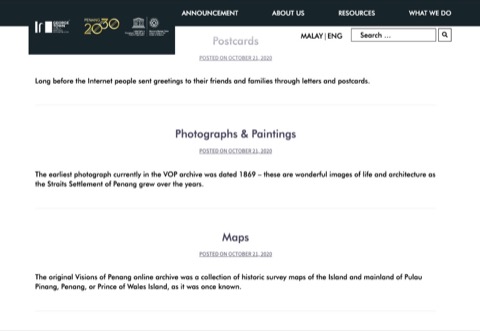
- Dong Zong Resource Portal (董总华教要闻与文献)This website is managed by the Resource and Archives Bureau of the United Chinese School Committees' Association of Malaysia (Dong Zong). It organises Dong Zong's important materials and documents over the years into thematic sections so that the public can consult materials on Chinese education. The main sections are: Chinese Education Issues and Events (thematic pages on major issues, with chronologies, documents and press clippings); Dong Zong Organisation (constitution, lists of past council members, lists of the Independent Chinese Secondary School Working Committee, and proposals from joint meetings with state associations); Documents and Resources (statements and declarations, education statistics, documents, speeches, work reports, activities and special topics); History of Chinese Education (A Brief History of Chinese Education in Malaysia, a chronology of 70 years of Chinese education, a chronicle of major events, and thematic pages on key figures). For scholars studying Malaysian Chinese education, the independent secondary school system, mother-tongue education policy and Chinese community mobilisation, it provides primary documents and statistics produced by the education body itself, which can be compared with official education documents and newspapers. The latest statement date shown on the page is November 2026, indicating that the content is still being updated.
Coverage, how to use, and notes
Coverage Themed on Malaysian Chinese education, including Dong Zong statements and declarations, education statistics, meeting proposals, work reports, speeches and chronologies of Chinese education history. The start and end years and total number of items for each section are not stated uniformly on the website.
How to use Visit resource.dongzong.my; no login entry is seen on the page and it can be browsed directly. You can start from Chinese Education Issues and Events by topic, then use the chronology to locate years; for organisational history see Dong Zong Organisation; statistics and statements are under Documents and Resources. Most files on the site are PDFs that can be read online; whether they can be downloaded depends on the file page. When citing, record the document title and publication date.
Notes These are materials compiled by the organisation itself and reflect Dong Zong's own standpoint; they should be compared with government documents and materials from other bodies and newspapers. Coverage of content does not amount to a complete archive.
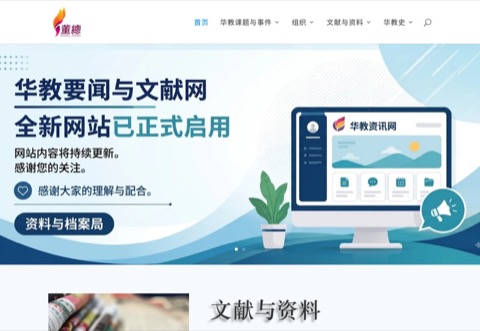
Scholarly databases & search tools
- Malaycivilization Portal (Portal Tamadun Melayu) (马来世界历史文化在线档案(马来文明门户网站))The Malaycivilization Portal (马来文明门户网站) is built by the Institute of the Malay World and Civilisation (Institut Alam dan Tamadun Melayu, ATMA) of Universiti Kebangsaan Malaysia (UKM). The site calls itself Data Raya, a collection of databases, aimed at scholars studying the Malay world and also open to the public interested in Malay culture and thought. Its content covers areas such as Malay nature, history, literature, art, language, medicine and martial arts, in forms including books, articles, images and videos. The main databases verifiable on the site are: PADAT, which collects journal articles, book chapters, conference papers, theses and reports on the Malay world; the N.A. Halim collection, which includes glossaries, books, images and videos on Malay houses, mosques, gravestones and old maps; Karya Jawi, which includes Jawi literary and non-literary works published in Malaysia and Singapore; and Peribahasa Melayu, which collects Malay proverbs and similar genres. For scholars of Malay language and literature, Jawi documents, material culture and the history of the Malay world, this is a rare consolidated entry point. The site is in Malay and offers no other language versions, so users need some knowledge of Malay or can use browser machine translation as an aid. It suits researchers of Malay culture and learners of Malay.
Coverage, how to use, and notes
Coverage The databases listed on the site include PADAT, the N.A. Halim collection, Karya Jawi and Peribahasa Melayu, with types covering theses and reports, glossaries, images, videos, Jawi works and proverbs. Some holdings involve Jawi, Sundanese literature, and early Malay word lists written in Chinese characters. The site pages do not give the total number of entries or the date span of each database.
How to use Open the homepage and enter the desired database from the database menu, or use the site search. Search offers three modes, keyword, Boolean and exact match, and results can be filtered by record type such as items, files, collections, simple pages and exhibits; advanced search applies only to Items. The interface and instructions are in Malay, and browser translation can be used. Some entries note that physical materials can be consulted at UKM's ATMA library by call number.
Notes The site states that all content is protected by ATMA and UKM copyright and may not be transferred, copied or used in any application without written permission; users should comply. The interface is in Malay with no other language version, and machine translation results are for reference only.
- Journal of the Malaysian Branch of the Royal Asiatic Society (JMBRAS) (《皇家亚洲学会马来西亚分会会刊》)JMBRAS is published by the Malaysian Branch of the Royal Asiatic Society (MBRAS) twice a year, in June and December. Its ISSN is 0126-7353 and its eISSN is 2180-4338, and it is indexed by Scopus. Its origins can be traced to the Journal of the Straits Branch of the Royal Asiatic Society in 1878, so the journal is itself a classic source for the study of the Malay Peninsula and Singapore. It covers the Malay Peninsula, Singapore, Borneo and Sumatra, as well as the wider Malay world and its diaspora, with topics including anthropology, sociology, archaeology, architecture, crafts, culture, ecology, history and heritage. The society's website states that the journal prefers research of lasting value and does not publish fast-changing topics such as current affairs or contemporary politics. Manuscripts must be in English (British spelling). For readers studying colonial Malaya, the Straits Settlements, Chinese communities and local social history, it is a frequently consulted mix of primary and secondary material; the society's website is also the most authoritative entry point for how to obtain the journal.
Coverage, how to use, and notes
Coverage Current and back issues come from the same journal lineage: the website states that back issues are available through JSTOR, going back to the predecessor journal of 1878; current issues are provided through Project MUSE, whose page shows coverage from Volume 83 (2010) to the current issue.
How to use On the JMBRAS page of the society's website you can see the journal introduction, author guidelines and submission form. Readers need to access the full text through their institution's subscription to JSTOR (back issues) or Project MUSE (current issues); some printed back issues can be purchased by emailing the society. As for location, the society has a resource centre in the Department of History, Universiti Malaya, and the administrative office is by appointment only. When searching on JSTOR, search separately under the predecessor titles (Straits Branch, Malayan Branch, Malaysian Branch).
Notes The Project MUSE page states that the journal is not open access and requires an institutional or personal account; JSTOR access likewise depends on one's institution. Please refer to the platform pages.
- KNOVA - Student Works (Universiti Malaya) (马来亚大学 KNOVA 学位论文库(学生作品))KNOVA (Knowledge Nexus and Open Vision Access) is the institutional repository of Universiti Malaya. Its Student Works section is officially described as the official digital platform that collects and preserves the university's master's and doctoral theses and academic exercises, and it supports open access principles and long-term digital preservation. Universiti Malaya is Malaysia's oldest comprehensive university, and its departments of history, Chinese, Asia-Pacific studies, social sciences and others have produced many theses on Malaysian Chinese society, ethnic relations, Chinese education and regional history. The repository is divided by date into four collections: 2020–2029, 2010–2019, 2000–2009 and pre-2000, and can be browsed by subject or author. Researchers can use it to find local scholars' primary fieldwork and archival research, track existing work on a topic, and use theses' bibliographies to find leads to primary sources. The library established an EPrints-based thesis repository in 2010; the current platform is maintained by the university.
Coverage, how to use, and notes
Coverage Master's and doctoral theses and academic exercises by Universiti Malaya researchers, in four collections: 2020–2029, 2010–2019, 2000–2009 and pre-2000. The website does not publish the total number of items; language and full-text availability depend on each record.
How to use Visit knova.um.edu.my/student_works/. In the search box you can choose This Collection, This Repository or All Repositories, or use advanced search, or browse by collection, subject or author. Email or RSS alerts can be subscribed to. When searching for Chinese-related theses, try Chinese, Malaysian Chinese, Chinese education and Tionghoa, as well as Malay and Chinese keywords, in parallel. Whether full text can be downloaded depends on each thesis's access setting.
Notes The page does not state specific access and licensing terms; some theses may be under embargo or restricted access, so please check each record. The old URL studentsrepo.um.edu.my could not be reached at the time of checking.
- KamusDBP (Kamus Dewan Perdana Online) (马来语国家语文局在线词典(Kamus Dewan Perdana))KamusDBP is an online dictionary portal launched by Malaysia's Dewan Bahasa dan Pustaka (DBP, the national language and literary agency). The site hosts the online edition of the Kamus Dewan Perdana and says it is part of a government digital transformation initiative. DBP's PRPM portal also lists entry points such as Kamus DBP Dalam Talian, a terminology database, the Gerbang Kata electronic dictionary, the Korpus DBP corpus and manuscript records, which can serve as official starting points for research on Malay vocabulary, terminology and corpora. For Chinese-in-Southeast-Asia and area studies, when reading Malay-language archives, newspapers, treaties and legal documents, or studying Malay loanwords in Chinese and its dialects, such an official dictionary can be used to check meanings and modern spelling; but it is a modern standard dictionary, not a historical one, and the spelling of early sources needs to be compared against historical corpora.
Coverage, how to use, and notes
Coverage The KamusDBP page mentions only the Kamus Dewan Perdana and does not state the number of entries; the PRPM portal also links to Korpus DBP (sbmb.dbp.gov.my/korpusdbp), the terminology database and manuscript search, and the size and current availability of each resource should be checked on the official website.
How to use Go to kamus.dbp.gov.my and enter a headword in the search box; the page also has 'word of the day' and 'popular searches'. The site has 'Daftar Akaun' (register) and 'Log Masuk' (log in); the page says use is 'free until further notice', and whether fees apply afterwards should be checked on the official website. The PRPM entry point is prpm.dbp.gov.my.
Notes The page says free use lasts only until further notice, so the policy may change; whether login is required to search is not made clear on the page. The dictionary covers modern standard Malay and not historical spellings (such as Jawi and old romanisations).
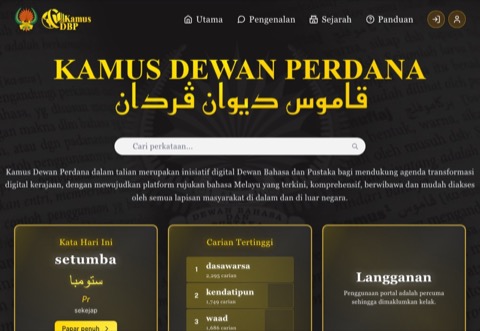
- Malaysian Journal of Chinese Studies (MJCS) (《马来西亚华人研究学刊》)The Malaysian Journal of Chinese Studies (《马来西亚华人研究学刊》) is an academic journal on Malaysian Chinese. Its online edition is provided on the e-journal platform of New Era University College, and the footer credits New Era University College and New Era Edu Sdn Bhd. According to journal descriptions that can be found online, the journal uses double-blind peer review and focuses on Malaysian Chinese and their relations with other ethnic groups, approached from social science and humanities perspectives; manuscripts may be in Chinese or English. It was earlier published by the Malaysian Chinese Research Centre, and the publisher has changed over time, which readers should note. The e-journal platform is based on OJS, browsable by issue, with a PDF download link for each article, and provides Atom and RSS feeds. For readers studying Chinese society, Chinese education, clan associations, Chinese politics and cultural identity, it is one of the few local academic journals with Malaysian Chinese as its core subject, and can be used together with Chinese studies collections and thesis repositories.
Coverage, how to use, and notes
Coverage The page shows that issues can be browsed through Current and Archives; Volume 8, Issue 2 (published 31 December 2019), containing four articles and one reference item, has been verified. The full range of years, total number of issues and proportion of languages are not stated on the website pages; please refer to the official website.
How to use On the journal page, use Current to see the latest issue and Archives (ejournal.newera.edu.my/mjcs/issue/archive) to go back issue by issue. Each article lists its page range with a PDF download link. Subscribe to Atom or RSS for new articles. For submission and copyright terms, consult the journal's policy pages.
Notes The old and new sites of the journal coexist, with slight differences in URLs and version information, and web search results also differ on the licence (CC BY or CC BY-ND); before citing or reproducing, please rely on the journal's policy page.
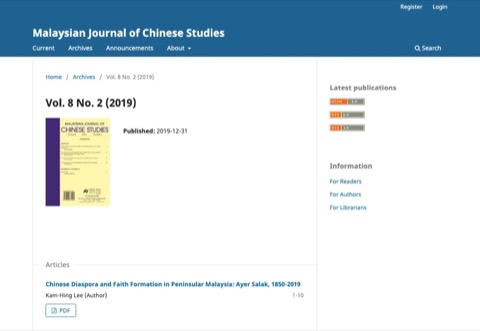
- PRPM@DBP (Pusat Rujukan Persuratan Melayu) (马来文学参考中心(DBP 语言文学局在线参考门户))PRPM@DBP is an online language reference portal built by Dewan Bahasa dan Pustaka (DBP), Malaysia's national language and literature agency, bringing together its dictionary, terminology, corpus and manuscript lookup services under one entry point. The resources listed on the homepage include Kamus DBP Dalam Talian (DBP online dictionary), Istilah Semasa Dalam Talian (online current terminology database), the Financial Services Industry Glossary (2nd edition), Gerbang Kata (eKamus word portal), Korpus DBP (corpus), Semakan Manuskrip (manuscript lookup) and Pustaka (library database). When a word is entered, the system gives definitions from dictionaries such as Kamus Dewan (4th edition) and Kamus Pelajar (2nd edition), and indicates where the word appears in other DBP resources such as Malay and English dictionaries, MABBIM terms, science glossaries, newspaper articles, books and language consultation services. For those studying the Malaysian language, this is the authoritative official entry point for standard Malay word meanings, normative terminology and corpus evidence; it is suitable for checking official definitions and terminology translations of Malay words, and for verifying word meanings when reading Malay historical sources, newspapers and archives. Readers studying interactions between Malaysian Chinese and Malay society, language policy and terminology standardization can also use it to compare official usage.
Coverage, how to use, and notes
Coverage The homepage shows a page copyright year of 2017, and the content is maintained by DBP. Searchable content types include dictionary definitions (Kamus Dewan 4th edition, Kamus Pelajar 2nd edition, etc.), current and sector-specific terminology, MABBIM terms, science vocabulary, the word portal Gerbang Kata, the corpus Korpus DBP, manuscript lookup, and the DBP library database. The homepage does not state the size or date range of each sub-database; please refer to the official site.
How to use Open prpm.dbp.gov.my and enter a Malay word in the Carian PRPM@DBP search box on the homepage; the results page shows definitions from the various dictionaries, with links to other resources such as terminology, the corpus, newspapers and books. You can also go directly from the homepage to sub-services such as Korpus DBP, Gerbang Kata or manuscript lookup. No registration is needed to search the public pages; Pejabat Maya on the homepage is marked as for staff only, and readers can ignore it. The homepage does not describe how to search the corpus, whether results can be downloaded, or the restrictions on each sub-database; please check the relevant sub-pages and refer to the official site.
Notes The homepage is only a navigation entry; the interface, update times and functions may differ considerably between sub-databases. The copyright year on the page is early, and the addresses or availability of individual sub-services may change, so please confirm each before use. The interface and definitions are mainly in Malay, so some knowledge of Malay is needed. When citing entries or corpus data, please state the edition of the dictionary used.
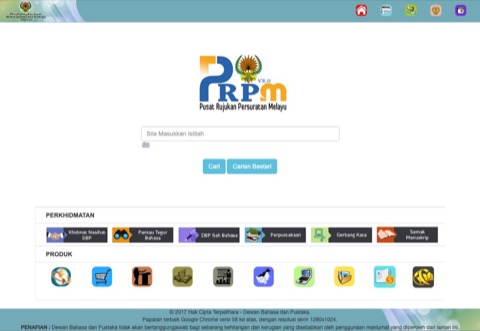
- Repository@USM, Universiti Sains Malaysia (马来西亚理科大学机构知识库)Repository@USM is the institutional repository of Universiti Sains Malaysia (USM), built on EPrints 3 software to publish and preserve the university's research and scholarly output, including doctoral dissertations and other academic works. USM is located in Penang, and its research in the humanities and social sciences, Malaysian studies and area studies is well established in the country. The repository is therefore directly useful for finding research on the society, history, language and culture of Penang and northern Malaysia, as well as theses on Malaysian Chinese and Malaysian society. It offers advanced search and browsing by year, type, subject, school or research centre, and author, plus a list of latest additions for tracking newly uploaded theses. The system supports OAI 2.0 metadata harvesting and provides Atom, RSS 1.0 and RSS 2.0 feeds, which suits researchers who need to collect bibliographic records in bulk. For researchers unable to visit Malaysia in person, such institutional repositories are a common entry point for primary theses and for following domestic research trends.
Coverage, how to use, and notes
Coverage Contains doctoral dissertations and other scholarly works held by USM, with a section for browsing by type. The homepage does not give the total number of items, the time span or the proportion of languages; please refer to the official website.
How to use On the homepage, use the search box or advanced search directly; you can also browse via By Year, By Type, By Subject, By School or Research Centre, and By Author. Browsing and searching on the homepage require no login; a login link is provided for depositors. To track new theses, subscribe to the RSS or Atom feeds; for systematic collection, use the OAI 2.0 interface. When searching, use both English and Malay keywords (such as Cina, Tionghua, masyarakat Cina) and narrow the scope by school or research centre.
Notes The site states that downloaded USM theses and scholarly works may not be shared, distributed or copied without USM's written permission. Whether full text can be downloaded varies by item; refer to each item's page.
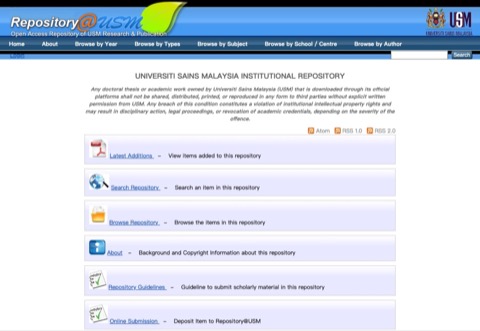
- UKM Journal Article Repository (UJAR) (马来西亚国民大学期刊论文库)The UKM Journal Article Repository (UJAR) is the journal article repository of Universiti Kebangsaan Malaysia (UKM), installed and configured by the Information Systems and Technology unit of the UKM Library, based on EPrints 3 and supporting the Open Archives metadata harvesting protocol. UKM has considerable influence in the country in Malaysian and Malay world studies, history, language and literature, and social and cultural studies, and the humanities and social science journals it hosts (such as those on Malaysian society and culture) are an important source for understanding local scholarship. The repository organises content by journal title, publication year and author, has a Latest Additions section listing items added in the past week, and offers quick search and advanced search across multiple fields. For readers who want to browse one journal systematically, or trace changes in Malaysian scholarly topics by year, this journal-by-journal browsing is more intuitive than general search. The system provides an OAI 2.0 interface and Atom, RSS 1.0 and RSS 2.0 feeds.
Coverage, how to use, and notes
Coverage Mainly UKM journal articles, browsable by journal title, year and author. The homepage does not give the total number of items, time span or languages; please refer to the official website.
How to use The homepage offers browsing by year, by journal title and by author; every page has a quick search box at the top, and advanced search can combine multiple fields. Browsing requires no login; the page also has login and registration links. It is advisable to find the relevant journal by title first and then go through issues year by year, searching separately with Malay and English keywords. For bulk collection of bibliographic records, use the OAI 2.0 interface (the base address is given on the site). The site also has a Repository Policies page explaining the rules of use.
Notes The homepage does not say whether every item provides full text; refer to each item's page. For terms of use, see the Repository Policies page.
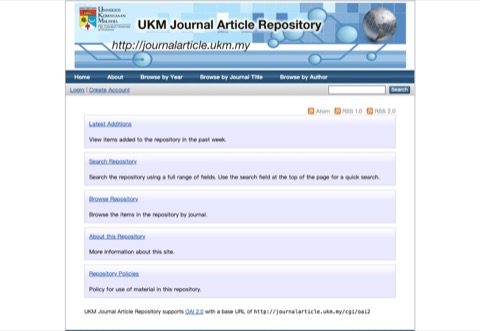
- UUM Electronic Theses and Dissertation (UUM ETD) (北方大学电子学位论文库)UUM ETD is the electronic theses and dissertations repository of Universiti Utara Malaysia (UUM); its footer shows that it is maintained by the university's Sultanah Bahiyah Library, and it is likewise built on EPrints. UUM is strong in management, business, international relations, public policy and the social sciences, so the repository is especially useful for theses on Malaysian political economy, public administration, local governance, ethnic and social issues, ASEAN and Malaysia's foreign relations. It offers search by title or author, with All words or Any word matching, and dates can be filtered by a single year or a range, for example 1985- or 2001-05-17-2002-05-16. Browse options include year, subject, school and author. The site also has statistics, FAQ, search tips, feedback and a sitemap, and provides Atom and RSS feeds for tracking new theses. For researchers who want to understand the state of Malaysian domestic thesis research, it is a search entry point complementary to repositories such as those of USM and UKM.
Coverage, how to use, and notes
Coverage Contains UUM's electronic theses and dissertations. The homepage does not state the total number of items, time span or languages; please refer to the official website.
How to use Use the search box on the homepage, or go to advanced search to search by title, author and date range, and choose All words or Any word matching. You can also browse by year, subject, school and author. Browsing and searching on the homepage require no login; the login link is for submitters. It is advisable to search with English and Malay keywords in parallel, then narrow the scope with a date range. The Search Tips page explains each field in detail; the Statistics page shows usage figures.
Notes Whether the full text of a thesis can be downloaded varies by item; some may have only bibliographic records and abstracts. Please refer to each item's page.
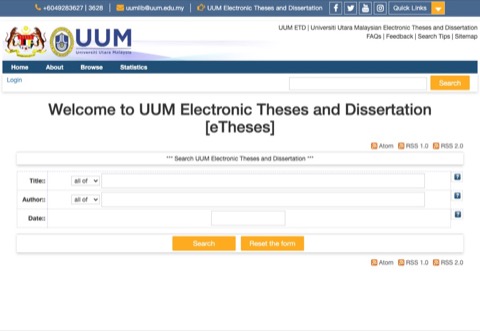
- data.gov.my (Malaysia Open Data Portal) (马来西亚政府开放数据门户)data.gov.my is the official open data portal of the Malaysian government; the page describes itself as a one-stop entry point for browsing open data from Malaysia's public sector. The data catalogue and dashboards on the homepage come from multiple government agencies, including population tables from the Department of Statistics (DOSM), as well as data in other fields such as fuel prices. The portal also provides a developer API documentation site (developer.data.gov.my), and its front-end, back-end and other source code are published as open source. For research on the Chinese in Southeast Asia and on Malaysia, it is the main entry point for finding official open datasets on population, regions and society. Researchers can first confirm here whether an official dataset has an open version, then obtain downloadable or machine-readable raw tables for analysis of population structure, regional comparison and long-term trends. This entry covers only its use as a government open data portal for population and social statistics; financial, general economic and health data on the portal fall outside the scope of this site.
Coverage, how to use, and notes
Coverage It includes open datasets and dashboards from multiple government departments and agencies; agencies mentioned on the homepage include JPJ, JPN, Prasarana, AADK, MOF, DOSM and NPRA. Population datasets (such as population tables) are the most relevant part for this site. The total number of datasets, their time span and language distribution are not stated on the homepage; please refer to the official website. The interface is displayed in English.
How to use Open the website directly and browse or search datasets in the Data Catalogue; the website states that users can download data and also access it programmatically. For bulk or automated retrieval, see the API documentation (including static and real-time APIs) at developer.data.gov.my. The homepage also links to two related sites, OpenDOSM and KKMNOW. No login was found to be required for browsing and downloading.
Notes The homepage does not state the data licence terms or the specific name of the operating organisation; before citing or reusing data, please check the terms of use on the relevant pages of the website. Update frequency, statistical definitions and geographic levels differ across datasets, so the data notes should be read one by one. The Department of Statistics' population data are presented more fully in OpenDOSM.
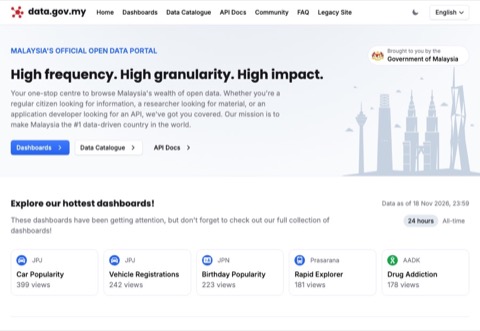
Research methods & tools
- Kawasanku (OpenDOSM) (Kawasanku(我的地区)人口与地区仪表板)Kawasanku is a area dashboard on the OpenDOSM platform, produced by the Department of Statistics Malaysia, for viewing and comparing local indicators such as population, labour conditions and public services. Its population section is sourced from the Population and Housing Census of Malaysia 2020 (MyCensus 2020); the page shows a national population of 32,447,385 and notes that these population data are published for the first time by Parliamentary Constituency and State Legislative Assembly (DUN) constituency. For readers studying Malaysian constituencies, regional population structure and the geographic distribution of ethnic groups, official population data at the constituency level supplement traditional census tables at the state and district levels and can be combined with electoral studies and local society research. Users can locate their area with Find my area and compare it with other areas, or use the map to view the distribution of a selected indicator. The page also lists indicators such as the 2024 poverty incidence, but the source pages for these indicators are not stated.
Coverage, how to use, and notes
Coverage The population section is based on the 2020 Population and Housing Census, with levels including national, state, Parliamentary constituency and DUN. Besides population there are area comparison indicators, such as a 2024 poverty incidence map; for the list of indicators and update times, please refer to the official website. The interface shown is in English, with a Malay version also available.
How to use Open the website (kawasanku.dosm.gov.my redirects to open.dosm.gov.my/kawasanku) and follow the steps on the page: locate your area with Find my area; select an area with the Geofilter (national by default); select a state or variable for comparison in Spotlight; choose an indicator from the Indicator menu and switch between the Parliamentary constituency and DUN views on the map. No registration was found to be required. For raw tables, return to the OpenDOSM data catalogue and search there.
Notes This is a display dashboard and is not equivalent to a full census report or microdata; the page does not state whether constituency tables can be exported directly. For detailed cross-tabulations by ethnicity, age and so on, please check the Department of Statistics' census reports or data catalogue.
Libraries & archives
- Perpustakaan Negara Malaysia (National Library of Malaysia) (马来西亚国家图书馆)The National Library of Malaysia (Perpustakaan Negara Malaysia, PNM) was established in 1966 and is located on Jalan Tun Razak, Kuala Lumpur. According to published descriptions, its holdings include books and materials published in or relating to Malaysia; Malay manuscripts (such as the Hikayat Hang Tuah, which is on UNESCO's Memory of the World Register); rare books and photographs published before 1900; ephemera from various departments (postcards, posters, calendars, etc.); private papers of historical figures; electronic media such as audio and video recordings; and special collections of ASEAN countries, Harvard publications, and United Nations publications. Practical experience shows that Chinese-language holdings are very limited, so the library is not suited to searching specifically for Chinese books. Its value lies in its large body of Malay- and English-language historical documents on Malaya and Malaysia, and it is advisable to search the catalogue through the OPAC before visiting. For scholars working on Malaysian national history, Malay-language sources, and regional Southeast Asian materials, it is an important basic collection. The address is 232, Jalan Tun Razak, based on the Wikipedia entry and checked against OpenStreetMap. The official website returned 403 when accessed, so membership policy, borrowing rules, and similar details have not been verified on the official site; please rely on the official site.
Address 232, Jalan Tun Razak, 50572 Kuala Lumpur, Malaysia View on map ↗
Coverage, how to use, and notes
Coverage According to published descriptions, holdings include: Malaysiana collections, Malay manuscripts, rare books, periodicals, and photographs from before 1900, ephemera, private collections, electronic media, special collections of ASEAN member states, a Harvard publications collection, and a United Nations publications collection. The number of volumes and the size of each special collection have not been verified on the official site, so no figures are given. Chinese-language holdings are few.
How to use Before visiting, search the catalogue online through the PNM OPAC. According to published descriptions, the public can register as members free of charge with a MyKad or passport; members may borrow 6 books for 1 month and can browse tens of thousands of e-books on the PNM e-book platform. These statements have not been verified on the official site, so please follow the latest official rules. For transport, consistent with Wikipedia: take RapidKL bus 402 or the Go KL Orange Line from the Titiwangsa interchange, or walk about 5 minutes from Raja Uda–UTM station (Putrajaya Line). Please confirm with the library in advance whether rare and special materials require an appointment.
Notes The official site was inaccessible at the time (403), so please confirm opening hours through other channels. Chinese materials are few. Membership and borrowing policies are not verified on the official site. The address comes from Wikipedia and OpenStreetMap, not from the official site.
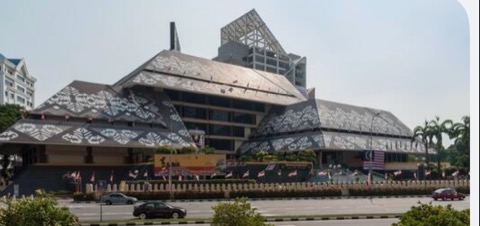
- Universiti Malaya Library (马来亚大学图书馆)The University of Malaya Library (UM Library) is one of the oldest university libraries in Malaysia. It serves teaching and research at the University of Malaya and consists of a Main Library and several branch libraries. Most valuable for Southeast Asia researchers is its Malaysiana special collection. According to the site, the Za'ba Memorial Library (Perpustakaan Peringatan Za'ba) focuses on Malaysian studies, especially Malay language, literature and culture, and holds monographs on Malaysian topics, Malay and Indonesian dictionaries (17th century to the present), local conference papers, government and statutory body publications, manuscripts and microforms, as well as personal collections of Za'ba, Ungku Aziz, Ibrahim Ya'kob, Father Pintado and others. The East Asian Studies Library focuses on classical and modern Chinese literature and also has a Malaysiana collection. The Main Library also holds microfilm and microfiche, including newspapers, which can be used only in the Main Library. The library also provides LibGuides subject guides, which can be used alongside the physical collections. For those researching Malaysian Chinese, Malay-language documents and multilingual materials, this is an important place to consult Malaysiana holdings.
Address Central Library, Universiti Malaya, 50603 Lembah Pantai, Kuala Lumpur, Malaysia;Za'ba Memorial Library 地址相同:Universiti Malaya, 50603 Lembah Pantai, Kuala Lumpur View on map ↗
Coverage, how to use, and notes
Coverage Distinguished by Malaysia-related documents (Malaysiana), and also holds Malay and Indonesian dictionaries, conference papers, government publications, manuscripts, microforms and several personal collections. The East Asian Studies Library emphasizes Chinese literature, and the Indian Studies Library holds a large amount of Tamil-language material. The site does not give a current unified total of holdings; refer to the site and the catalogue for the scale of the collections.
How to use Start by searching the catalogue on the library site umlib.um.edu.my, then use the branch and special collection pages to determine which library holds the item. Before visiting, check the Visitor page and the opening hours page. The reading area on the first floor of the Main Library and the public computers are open to visitors, who can collect temporary Wi-Fi credentials at the service counter; discussion rooms are for staff and students only, and research rooms are limited to postgraduates, faculty and researchers. Za'ba Library materials are kept in closed stacks and must be used in the designated reading area; copying of manuscripts and personal collections is restricted. It is said that most English-language Southeast Asia literature is on the second floor of the Main Library in classes D–F, but the site does not confirm this; please check with librarians on arrival. To use special collections or microforms, it is advisable to write or call in advance.
Notes Opening hours published on different pages of the site are not entirely consistent (Main Library: Monday to Friday is given both as 8:00–20:00 and 8:00–22:00; Za'ba Library: closing at 12:00, 16:00 or 17:00 are all given); please rely on the latest site notices before visiting. The library is closed on public holidays. The entry rules for visitors who are not UM staff or students are not clearly stated on the site and need to be asked of the library. Specific holdings of newspapers and periodicals such as the Straits Times, Utusan Melayu and Bianfeng (蕉风) could not be verified on the site; please confirm through the catalogue or librarians.
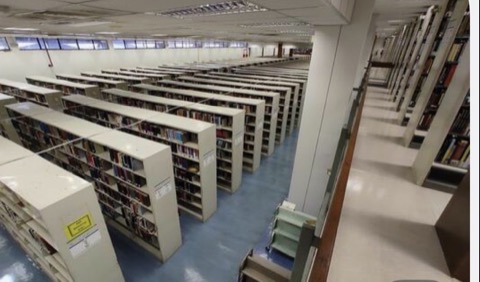
- National Archives of Malaysia (Arkib Negara Malaysia), Kuala Lumpur headquarters (马来西亚国家档案馆(吉隆坡总馆))The National Archives of Malaysia (Arkib Negara Malaysia) is Malaysia's national archival institution, with its headquarters in Kuala Lumpur. For scholars planning archival research in Malaysia, the procedure for consulting records on site is especially important. Records must first be booked online: ordinary records generally need 3 working days' notice, audio-visual records 5 working days, and film records 14 working days. Records shown by the system as held in Kuala Lumpur are consulted at the headquarters. After a successful booking, the system indicates a retrieval date, valid on that day and for the following 3 working days; after that, a new booking is needed. On the first visit, visitors must show an ID card or passport to staff and obtain a physical membership card on site, which is needed every time they enter the reading room. Bags and mobile phones must be stored in lockers, and phones and other photographic devices may not be used in the reading room; pencils, notebooks, and laptops may be brought, and dress should be formal. Records are collected at the service counter in the reading room. Photocopying requires an application form, with collection after about 3 working days, and only cash is accepted; newspapers and periodicals may be photographed with a camera. These visiting instructions come from experience of consulting records on site and have not been checked against the official site, so please follow the Archives' current notices.
Address Arkib Negara Malaysia, Jalan Tuanku Abdul Halim (formerly Jalan Duta), Kuala Lumpur, Malaysia View on map ↗
Coverage, how to use, and notes
Coverage Holdings include official records as well as audio-visual materials, films, microfilm, and newspapers and periodicals, with film records requiring a longer booking period. The official website could not be opened during verification, so the dates and quantities of holdings could not be confirmed and no figures are given; please rely on the official site or the Archives' own information.
How to use First book through the Archives' online system (OFA): ordinary records 3 working days in advance, audio-visual 5, and film 14; items whose location is shown as Kuala Lumpur are consulted at the headquarters. On arrival, show an ID card or passport to get a membership card, store bags and phones, enter the reading room, and collect records at the service counter with the membership card, up to 15 items at a time. Photocopying prices (recorded on site) are RM0.30 per A4 page, RM0.60 per A3 page, and RM1 per microfilm page; only one third of a whole item may be copied each time, and only cash is accepted. Reading hours (recorded on site) are Monday to Friday 9:00–11:45 and 14:30–15:30. All of the above is visiting experience and has not been checked against the official site.
Notes The official website could not be opened during verification because of a certificate error, so the booking rules, reading hours, and copying prices have not been checked against it; please confirm with the Archives before visiting. The address comes from Wikipedia and OpenStreetMap. The road where the Archives is located was formerly Jalan Duta and is now called Jalan Tuanku Abdul Halim; two postcodes, 51000 and 50568, are cited, so no postcode is given here. The air conditioning in the reading room is strong, so bringing long-sleeved clothing is advised.
- Perdana Library, Perdana Leadership Foundation (首要领导基金会图书馆(Perdana Library))Perdana Library belongs to the Perdana Leadership Foundation and is located in Putrajaya, Malaysia's administrative centre. According to the site, the library was opened by Tun Mahathir on 29 April 2004 and is positioned as a comprehensive library for studying Malaysia's successive prime ministers and their policies. It collects works and documents on the policies, strategies and initiatives of successive prime ministers, with holdings of biographies, speeches, government documents, periodicals, digitized press clippings and audiovisual materials. According to feedback from visitors, its collection is distinguished by Malaysian government documents and speeches of successive prime ministers, and the library is pleasant, facing Putrajaya Lake. For regional studies researchers, it suits research on Malaysian national politics, government policy and the history of prime ministerial leadership and governance, including policy and speech texts in external relations such as Malaysia–China and Malaysia–Singapore. The site says the library is open to the public, basic membership is free, and borrowing rights for open-shelf materials require an annual fee of RM10.
Address Perdana Leadership Foundation, No. 1, Jalan P8H, Precinct 8, 62250 Putrajaya, Wilayah Persekutuan Putrajaya, Malaysia View on map ↗
Coverage, how to use, and notes
Coverage The site says the collection includes more than 11,000 physical books and more than 250,000 electronic records, consisting of biographies, speeches, government documents, periodicals, digitized press clippings and audiovisual materials on Malaysia's successive prime ministers. The subjects centre on prime ministers and their policies, strategies and initiatives. The site does not state languages or time span.
How to use Consultation is mainly on site; see the site for the address. The site says the library is open to the public; basic membership is free, and borrowing from the open collection costs RM10 per year. The collection can be searched through the library's online public access catalogue (OPAC), but the site pages do not give a verifiable direct link, so it is advisable to find the entry via the library page at perdana.org.my. Group visits require an appointment; contact details are on the site's Contact Us page (library telephone +603-8885 8961). The site does not state whether individual consultation requires an appointment; it is advisable to phone in advance to confirm.
Notes Opening hours differ between the two site pages: the library page says Monday to Friday 9:00–17:00, while the contact page says the foundation is open Monday to Friday 8:15–17:30; the library is closed on weekends and public holidays, so confirm before going. Some say membership is only for Malaysian nationals and foreign visitors may enter and read for free, but the site pages do not state any nationality restriction, so refer to the library's reply. Others say the library holds some declassified archives; the site does not state this and it has not been verified.
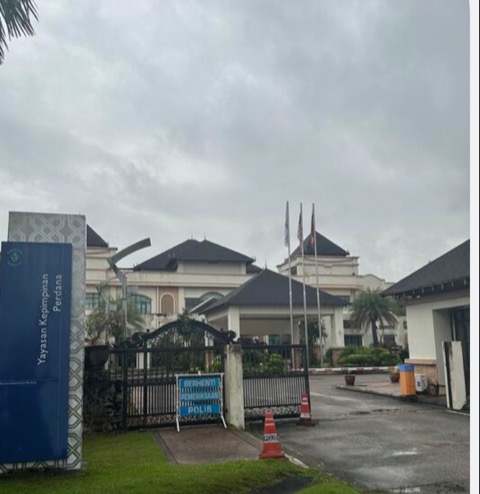
- Centre for Malaysian Chinese Studies Library (Jixian Library) (马来西亚华社研究中心集贤图书馆)The Centre for Malaysian Chinese Studies (CMCS) was established in 1985 and has collected documents related to Malaysian Chinese since that year. According to its website, its Chi Hsien Library holds about 60,000 volumes in total and keeps a press clippings archive of Malaysian newspapers in all languages from 1985 to 2012; from 2011 the library added the functions of an archive and a museum of artefacts. The library regulations on the website also list special collections, such as the Second World War collection, the Malayan Communist Party collection, Nanyang University publications and qiaopi (overseas remittance letters); special publications of clan associations, societies and schools also fall within the general collection. The library uses closed-stack management and offers on-site consultation, photocopying and printing. For scholars studying Malaysian Chinese associations, Chinese education, wartime history and Chinese politics, it is one of the few physical sites that collect local Chinese studies materials in one place. CMCS also maintains the Chen Chong'en e-library, which is already included, so users can search online first before deciding whether to visit.
Address No. 1, Jalan Maharajalela, 50150 Kuala Lumpur, Malaysia View on map ↗
Coverage, how to use, and notes
Coverage About 60,000 volumes in total (figure from the website); about 35,608 books as of June 2022; press clippings archive of Malaysian newspapers in all languages, 1985–2012; special publications of clan associations, societies and schools; special collections include the Second World War, the Malayan Communist Party, Nanyang University publications and qiaopi.
How to use The library is membership-based; the website lists an annual fee of RM50.00. Temporary membership is RM3.00 for students and RM10.00 for others, valid for one day (please check the latest fee page on the website). General collections (books, current periodicals, press clippings, special publications) are available for consultation at any time; special collections must be booked one week in advance by email, telephone or letter, stating the research plan and the supervisor. The library introduction on the website gives opening hours of Monday to Saturday 9:00–17:00, while the regulations page lists only office hours; please call 03-22734035 to confirm before visiting.
Notes The regulations page does not clearly state whether the library is open to the public; the clippings archive ends in 2012; please check fees and opening hours on the website.
- NEUC Tan Lark Sye Library (新纪元大学学院陈六使图书馆)The Tan Lark Sye Library (陈六使图书馆) is the campus library of New Era University College, Malaysia. According to a field visit, it holds a large collection of books and archives related to Chinese education, Chinese literature, and Chinese history; nearly the whole library centres on Chinese studies, with Chinese-language materials predominating. It is also a university library open to the public, which anyone may enter. From the photographs, the library has busts of community forebears, thematic bookshelves, and display cabinets, indicating that in addition to general books there are special materials suitable for exhibition. For readers studying Malaysian Chinese society, Chinese education, and Chinese literature, a concentrated Chinese-language collection like this is often easier to cover in one place than the holdings of a general university library. It should be noted that the exact size of the collection, the names of special collections, and the catalogue search method have not been verified on official pages. The above is based mainly on the field visit account, so please rely on the college website. The college is in Kajang, Selangor, and according to search results the library has opening hours from Monday to Friday and on Saturday (subject to the latest announcement by the college).
Address Kolej Universiti New Era, Lot 5, Jalan Bukit, Desa Billion, Sungai Chua, 43000 Kajang, Selangor, Malaysia View on map ↗
Coverage, how to use, and notes
Coverage According to the field visit, holdings are mainly Chinese-language materials, concentrated on Chinese education, Chinese literature, and Chinese history, including books and archives. The chronological span, number of volumes, and list of special collections have not been verified on the official site, so no figures are given.
How to use According to the account, anyone may enter. Before visiting, it is advisable to ask the library about the day's opening hours, visitor entry procedures, and whether items can be borrowed or are for in-library reading only. According to search results, students must swipe a student card to enter and may not carry opaque bags; for visitor rules, please follow the library's current instructions. The online catalogue search method has not been verified.
Notes The address is the college campus address; the library's own street number was not found directly on official pages. That the library is on the Kajang campus is based on search results and the field visit account. Please rely on the college's latest announcements for collection size and opening hours.
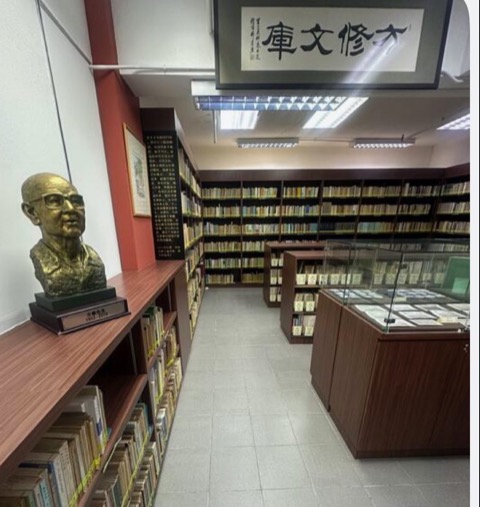
- Penang Studies Resource Centre (Penang Institute) (槟城研究资源中心(槟城智库))The Penang Studies Resource Centre (PSRC) was set up by Penang Institute and is a thematic reading room centred on Penang studies. Penang is one of the places with the greatest concentration of Malaysian Chinese history; the Straits Settlements-era port city, Chinese dialect groups, clan associations and cemeteries, and the Peranakan Chinese (Baba-Nyonya) are all important topics in Nanyang Chinese studies. The centre's collection consists mainly of publications on Penang and Malaysian society, economy and politics, and includes several special collections donated by scholars. The website states that the centre mainly serves Penang Institute's researchers, and the public may also visit to consult materials, but must book in advance. It is suitable as a supplementary resource point for researchers doing fieldwork in Penang or looking for local research literature, government publications and statistical materials.
Address 10 – 12 Brown Road, 10350 Penang, Malaysia View on map ↗
Coverage, how to use, and notes
Coverage According to the website, the collection comprises about 8,000 reading items, including published books, government publications, research papers, annual reports, statistical reports and special collections; the special collections include donations from Alexander Koenig, Mustafa Kamal Anuar, Ariffin S.M Omar and Tan Liok Ee (陈六玉). The language distribution and date range are not stated on the website; please consult the website.
How to use Visits are by appointment only. The public must give at least three working days' notice (weekends and public holidays not counted), emailing the address on the website's contact page within office hours to state the intended visit time. Penang Institute office hours: Monday to Thursday 8:30–17:30, Friday 8:30–16:00. Materials can be consulted on site; whether copying or photography is allowed is not stated on the website, so please ask when booking.
Notes The centre mainly serves the institute's own researchers, and access for external readers is conditional; opening rules may change, so please check the website and email replies before visiting.
- Sabah State Archives (Jabatan Arkib Negeri Sabah) (沙巴州档案局(Jabatan Arkib Negeri Sabah))The Sabah State Archives (Jabatan Arkib Negeri Sabah) is Sabah's archival custody and records management body. According to the history page on its website, the core of its holdings is archival documents concerning Sabah (North Borneo) spanning more than 400 years, and it also preserves records relating to Sarawak and Brunei because of early centralised collecting. The website shows that the department has a Records Management Division, a Records Centre, a Resource Centre (Pusat Sumber Cowie), and a Conservation and Reproduction Division, sells publications, and has a photo and video gallery. For scholars studying Chinese migration, Hakka and Chinese settlement, local Chinese associations and East Malaysian regional history in the North Borneo Company and colonial periods, it is an important physical source of primary archives in East Malaysia. The website homepage does not mention an online catalogue or digital collections; access requires contacting the archives to confirm.
Address Jabatan Arkib Negeri Sabah, Kilometer 5, Jalan Penampang, Beg Berkunci 2017, 88999 Kota Kinabalu, Sabah, Malaysia View on map ↗
Coverage, how to use, and notes
Coverage Archival documents on Sabah (North Borneo) spanning more than 400 years, including some records related to Sarawak and Brunei; has a Resource Centre and a photo and video gallery. The number and classification of files are not stated on the website homepage; please consult the website.
How to use The website homepage states office hours of Monday to Friday 8:00–16:30, with a lunch break 13:00–14:00, closed on weekends and public holidays. The Resource Centre's opening hours appear on the page only as an image and could not be confirmed. Telephone 088-258911. No online catalogue is seen on the website; before visiting, it is advisable to call or email, state your research topic, and confirm whether an appointment is needed and which files can be consulted.
Notes The website carries a notice titled Notis Penutupan Pusat Sumber Arkib Negeri Sabah dated 28 April 2026, whose content could not be read; please confirm whether the Resource Centre is open before visiting. The old domain archive.sabah.gov.my now redirects to arkib.sabah.gov.my.
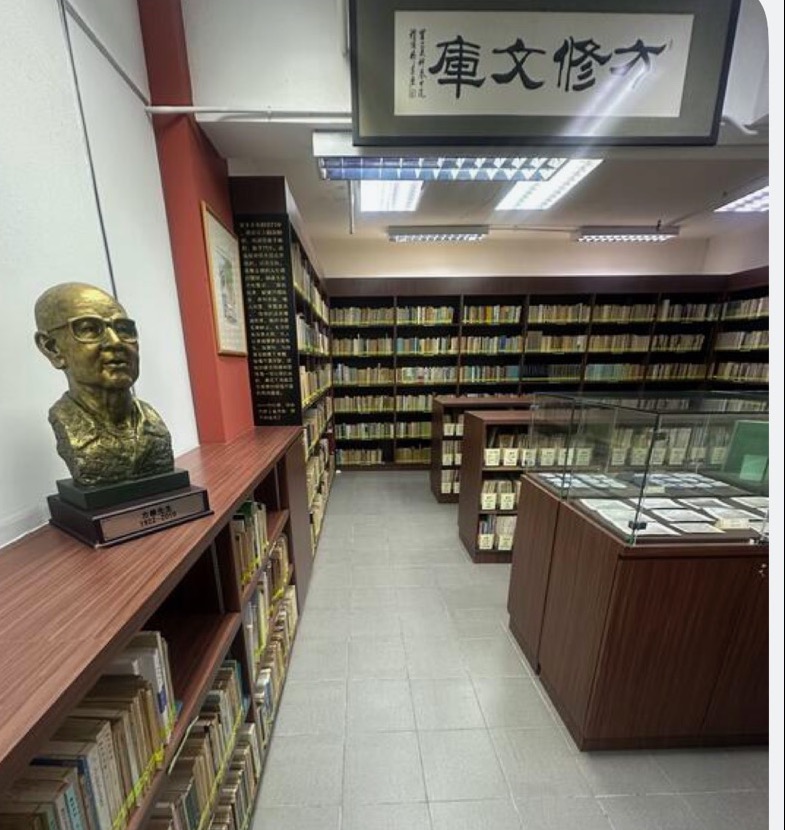
Museums & memorials
- Islamic Arts Museum Malaysia (IAMM) (马来西亚伊斯兰艺术博物馆)The Islamic Arts Museum Malaysia (IAMM) is located in Kuala Lumpur. According to its website, its permanent collection spans 1,400 years and is organised into 12 galleries: Architecture, Arms and Armour, Ceramics, China, Coins and Seals, India, Jewellery, Woodwork, the Malay World, Metalwork, Qur'ans and Manuscripts, and Textiles. Among them, the Malay World, Qur'ans and Manuscripts, and China galleries are relevant to comparative research on Islam in Southeast Asia, writing traditions, mosques and religious material culture, and Chinese Muslim art. The Research section of the website includes a Scholar's Library and offers a quarterly newsletter, a blog, videos and an exhibition map; the museum's publications on Islamic art can be purchased through its online shop. For readers studying religious art, material culture and transregional connections in Muslim Malaysia, it is one of the main institutions where one can visit in person and obtain scholarly reference materials; read alongside sources on Chinese clan associations and temples, it also helps in understanding the region's multi-religious background.
Address Jalan Lembah Perdana, 50480 Kuala Lumpur, Malaysia View on map ↗
Coverage, how to use, and notes
Coverage Permanent collection of 12 galleries spanning 1,400 years. The website mentions a Scholar's Library but does not state its collection size, opening hours or borrowing rules. The website does not provide an online collection database.
How to use The website lists gallery opening hours as daily 9:30 to 18:00 (last entry 17:30). It states that the museum is open to all every day but does not list ticket prices. The website does not explain how to use the Scholar's Library, its opening hours or how to apply for research visits; enquiries can be sent by email via the website's contact page or by phone to the numbers listed there. Publications can be purchased through the online shop linked from the website.
Notes The website has no online collection search and does not say whether the Scholar's Library is open to external researchers, so please contact the museum to confirm first. Two telephone numbers are listed on the website; please rely on the latest information on the website.
- Leong San Tong Khoo Kongsi (槟城龙山堂邱公司)Leong San Tong Khoo Kongsi is the ancestral temple and clan association of the Khoo clan organization in Penang, and its website is maintained by the kongsi itself. The website states that Khoo clansmen migrated from Sin Kang village to Penang in succession from the late 18th century to 1850; in 1835 the Ee Kok Tong was established as the prototype of the clan organization; they then settled around Weld Quay and Cannon Street, bought land and built the Leong San Tong ancestral temple, compiled the genealogy of the Khoo and Tan clans of Sin Kang, and founded the Sin Kang school. It was registered as a society in 1955 and registered in 1976 as the Trustees of Leong San Tong Khoo Kongsi (Penang), with a board of trustees managing its properties. The basement of the Leong San Tong is set up as the Leong San Tong Khoo Kongsi Museum, and there are 24 shophouses around it. For the study of Chinese clan organizations, the kongsi system, ancestral hall architecture, clan networks and property management, it is one of the most representative on-site cases in Penang; the website also states that its influence extended to Sumatra and southern Thailand in the 1880s.
Address 18 Cannon Square, 10200 Penang, Malaysia View on map ↗
Coverage, how to use, and notes
Coverage The history page of the website covers clan migration, the building of the ancestral temple, compilation of the genealogy, founding of the school, property investment and society registration from the late 18th to the 20th century; details of what the museum exhibits are not given on the website, so please refer to the official site. The website does not say whether genealogies or archives are open for consultation.
How to use You can visit directly. The opening hours listed on the website are: ancestral temple and museum daily 9:00-17:00 (including Sundays and public holidays; closed on Lunar New Year's Eve and the first day of the Lunar New Year); office Monday to Friday 9:00-17:00, Saturday 9:00-13:00, closed on Sundays and public holidays. The website does not describe a booking procedure; for matters concerning genealogies, archives or research visits, contact them through the Contact Us page of the website, and it is advisable to confirm in advance. The history section of the website can be read free of charge to learn about the clan's history and the architectural background.
Notes The website does not mention an archive room, library or genealogy consultation service, so it cannot be assumed that original genealogies can be consulted. Opening hours may change; please refer to the official site before visiting.
- Malaysian Chinese Museum (马来西亚华人博物馆)The Malaysian Chinese Museum is located on the first floor of Wisma Huazong in Seri Kembangan, Selangor. It opened in March 2018 and is housed in the building of the Federation of Chinese Associations Malaysia (Huazong). According to Tourism Selangor, it is Malaysia's first museum to systematically present the history and present of the Malaysian Chinese community. The exhibitions follow the history of Chinese migration and local Chinese cultural heritage, covering themes such as migration, settling down and taking root, and participation in nation-building. The museum's official page states that the exhibitions use trilingual text labels, QR-code audio guides, reconstructed historical scenes, miniature art and multimedia displays. For readers studying the social history of the Nanyang Chinese, migration history, clan associations and Chinese material culture, it offers a chance to see in person the overall narrative framework of Malaysian Chinese history, together with objects and scene-based displays, and is a suitable starting point for field visits and teaching tours.
Address Wisma Huazong, Level 1, Lot 15285, 0.7 km Lebuhraya Sungai Besi, 43300 Seri Kembangan, Selangor, Malaysia View on map ↗
Coverage, how to use, and notes
Coverage According to the Tourism Selangor page, the museum has 16 permanent exhibition zones and about 1,000 exhibits, covering the history of Chinese migration and local Chinese cultural heritage. The official page also mentions occasional thematic exhibitions. Names of the zones, the list of holdings and whether there is a research reading room are not stated on the website; please consult the website.
How to use You can visit directly; the official page states opening hours of 10:00 to 17:00, last entry 16:00, closed on Wednesdays and during Chinese New Year, and open on public holidays. Ticket prices (official page): adults RM20, students with a valid student card RM5. The official page does not mention online booking; for group visits or details, contact the museum through the Contact Us page on its website. Please re-check opening days and prices before travelling.
Notes The official WordPress page does not list a street address; the address below is taken from the official tourism page of Tourism Selangor. This is an exhibition museum rather than an archive or research library; exhibit labels can be used as secondary narrative references, but academic citations should go back to original sources.
- Museum of Asian Art, Universiti Malaya (Muzium Seni Asia) (马来亚大学亚洲艺术博物馆(Muzium Seni Asia))The Asian Art Museum (Muzium Seni Asia) belongs to Universiti Malaya and shares an official website with the university's Art Gallery; it is a university museum on campus that is open to the public. Both the website and third-party descriptions show that it aims to promote Asian art to Malaysia's multicultural society. The exhibitions and events section of the website covers Southeast Asian material culture themes such as wayang kulit (shadow puppetry), textiles and Nyonya Baba kebaya, and offers some online virtual exhibitions. For readers studying Southeast Asian art history, material culture, folk performance and dress, it allows in-person observation of the collection and also serves as a case of how local Malaysian exhibitions are curated.
Address Museum of Asian Art, University of Malaya, 50603 Kuala Lumpur, Malaysia View on map ↗
Coverage, how to use, and notes
Coverage The website has sections including an introduction to the museum, dedicated pages on collections such as textiles, exhibitions and events, and virtual exhibitions. The total number of objects, the date range and the specific scope of Chinese-related objects are not stated on the pages checked for this entry; please consult the website.
How to use Admission is free. Opening hours (website): Monday to Thursday 9:00–16:30; Friday 9:00–12:15 and 14:45–16:30; Saturday 9:00–16:00, open only when an exhibition is on; closed on Sundays and public holidays. Telephone: +603-7967 3805 / 7967 3936; for email see the website's contact page. The website asks visitors to follow Universiti Malaya Library's dress code and rules.
Notes The website's contact page gives only a postal address, without a building or street number; before visiting, please confirm the exact location and opening arrangements by telephone or email. The museum focuses on Asian art and is not a museum dedicated to Chinese themes.
- Muzium Negara (National Museum of Malaysia) (马来西亚国家博物馆)The National Museum of Malaysia (Muzium Negara) is managed by the Department of Museums Malaysia (Jabatan Muzium Malaysia) and is located in central Kuala Lumpur. The building opened in 1963 and is designed in the style of a Malay palace; the official introduction calls it the guardian of the nation's history. The exhibitions follow a chronological sequence, presenting Malaysian prehistory, the early Malay kingdoms (including the rise of the Malacca sultanate and the spice trade), the colonial period and the road to independence. For readers studying the history of the Malay Peninsula and regional maritime trade, it is an on-site entry point to Malaysia's official historical narrative; the place of Chinese migrants and communities in the national narrative can also be observed by comparing it with institutions such as the thematic Chinese museum.
Address Jalan Damansara, 50566 Kuala Lumpur, Malaysia View on map ↗
Coverage, how to use, and notes
Coverage According to the official page, there are four permanent galleries, covering prehistoric Malaysia, the early Malay kingdoms, the colonial period and Malaysia Today (the road to independence). The official page does not state the number of objects and does not mention a gallery dedicated to Chinese themes; please consult the website.
How to use The official page states that it opens daily at 9:00; the closing time appears on the page as both 6:00 pm and 5:00 pm, and the museum is closed on Hari Raya Aidilfitri and Hari Raya Aidiladha. Tickets are RM2 each; children under 12 and students in school uniform are free. No registration is needed and you can visit directly; for group and research visits, please contact the Department of Museums, and follow the website for details.
Notes The closing time is inconsistent on the official page, so please verify before visiting. This is a general national museum with limited Chinese-related content and cannot replace an archive or a thematic library.
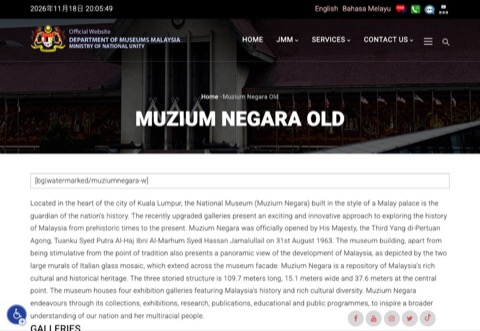
Institutions & societies
- Department of Statistics Malaysia (DOSM) Official Portal (马来西亚统计局官方门户(人口普查与官方统计))The Department of Statistics Malaysia (DOSM) is the government agency responsible for collecting and publishing statistics on national economic and social development, and its official portal dosm.gov.my is the main entry point for official national statistics. The homepage brings together several thematic platforms, including MySubNasional, a sub-national indicators portal at state, district, parliamentary constituency and state legislative assembly levels; DOSM GeoHUB for geospatial statistics; the 2024 Agriculture Census (MyAgricensus); the 2026 Economic Census; the agricultural statistics platform TaniStats; and the labour market platforms MyLabourHub, ILMIA and ILSM. The Population And Housing Census release section of the portal holds the series of results from the 2020 Population and Housing Census, such as national key findings, key findings for administrative districts (160 districts, 1,756 mukim and 155 local governments), the Orang Asli special report and the living quarters special report. For scholars studying Malaysian Chinese and regional society, the census data on ethnicity, age, religion, urbanization and household structure are the most authoritative basic material; compared with the OpenDOSM open data platform already included, this portal focuses more on full reports and release announcements.
Coverage, how to use, and notes
Coverage Taking the 2020 Population and Housing Census as an example: the total population was 32.4 million in 2020 and 27.5 million in 2010; releases at the administrative district level cover total population, living quarters, household size, sex ratio, citizenship, ethnicity (including Sabah and Sarawak indigenous subgroups), age, religion, marital status, population density and urbanization. For other statistical categories and years, please refer to the release pages on the official site. English and Malay interfaces are available.
How to use From the homepage, enter the thematic portals, or find specific reports under the Population And Housing Census release section; release pages usually provide a Download release button, and full publications can be downloaded from the eStatistik portal. Use English keywords when searching, for example Key Findings, Administrative District, Special Report. For machine-readable data, go to OpenDOSM or data.gov.my. The pages do not require registration.
Notes The site has been redesigned in recent years, so old links and the dates shown on different release pages may be inconsistent; please rely on the specific release page. The main languages of the census reports are English and Malay; no Chinese version has been seen. For the content of individual thematic portals (such as GeoHUB), please refer to their own sites.
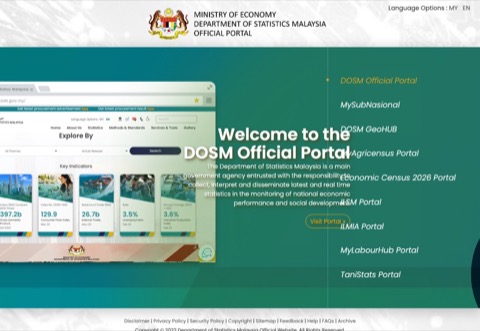
- Khazanah Research Institute (KRI) (卡扎那研究院(Khazanah Research Institute))The Khazanah Research Institute (KRI) describes itself as a not-for-profit policy research institute focused on Malaysia's most pressing issues. Its website divides output into the flagship series The State of Households, books, policy briefs, reports, discussion papers and working papers, commentary articles (Views), as well as Data Sets and Data Visualisations. Research themes include inclusive and sustainable economic development, work and livelihoods, households, demographic structure and public well-being, urbanization, housing and public infrastructure, and environment, food and climate resilience, as well as technology and digitalization. For readers studying contemporary Malaysian society and economy, the institute's analyses of household income, housing affordability and the labor market can be used together with raw data from the Department of Statistics to understand the policy context behind the data, and also provide secondary analysis for research on ethnic and regional differences.
Coverage, how to use, and notes
Coverage Publication types are as above; examples from 2026 include the 2026 edition of The State of Households (theme: income and well-being), a working paper on insurance in the age of climate change, and several articles on housing affordability. The homepage does not give the specific list or time span of the datasets and visualizations; please refer to the official site.
How to use On the website, browse by type under Publications, and see the Data Sets and Data Visualisations sections. Related reports can be found by research theme. Whether each publication is available for download, and the format and terms of use of datasets, are as stated on each page.
Notes This is a policy research institute, and its analysis has a policy orientation, so academic citations should be checked against the official raw data. For the direct URL of the Data Sets section, please enter from the website navigation.
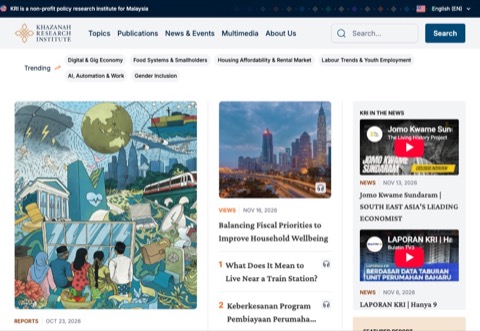
- Kuala Lumpur and Selangor Chinese Assembly Hall (KLSCAH) (吉隆坡暨雪兰莪中华大会堂(隆雪华堂))The Kuala Lumpur and Selangor Chinese Assembly Hall (隆雪华堂) is one of the most influential Chinese associations in Malaysia, and its website is maintained by the Hall itself. The brief history page of the website states that it was formally established in 1923 under the name Selangor Chinese Assembly Hall; in 1934 it was granted a 100-year land lease by the Sultan of Selangor and its building was completed and opened; in 1956 it co-organized the citizenship convention, attended by about 1,200 delegates; in 1975 it was reorganized as a non-profit company; in 2006 it was renamed the Kuala Lumpur and Selangor Chinese Assembly Hall; in 2007 its building was listed among the first national cultural heritage sites, and the page states that it was the first Chinese association building to receive this honor. The Centenary Chronicle section of the website has the Hall's historical archives and historical photo collections, and provides an application form for booking guided tours of the Hall's History Corridor; newsletters, statements and published periodicals are also released on the website. For the study of Chinese association politics, the citizenship rights movement, relations between the Chinese community and the state, joint organizations of clan and native-place associations, and pre- and postwar Chinese social history in Malaysia, it is an important primary source and on-site visit location.
Address No.1, Jalan Maharajalela, 50150 Kuala Lumpur, Malaysia View on map ↗
Coverage, how to use, and notes
Coverage The brief history page of the website sets out important events year by year from 1923 to 2016, touching on prewar fundraising and construction, the Japanese Occupation, the citizenship rights movement of the 1950s, relief after 1969, the cultural memorandum of the 1980s and joint action by Chinese associations; there are also statements, newsletters, publications of the Civil Rights Committee, event photographs and videos. The size of the physical archive and its holdings list are not given on the website; please refer to the official site.
How to use On the website, view the historical archives and photo collections under the Centenary Chronicle section; statements and newsletters can be read online. For an on-site visit, apply for the History Corridor through the booking form for guided tours on the website. The contact page lists the telephone number and email addresses of each department; office hours are not listed on the website, so it is advisable to call or write first to confirm. For consulting original archives, the website does not explain how; please ask the secretariat directly.
Notes The website does not state whether the archives are open to researchers or the borrowing procedure; the tour booking page does not list fees or opening hours. Some documents are PDFs and are large.
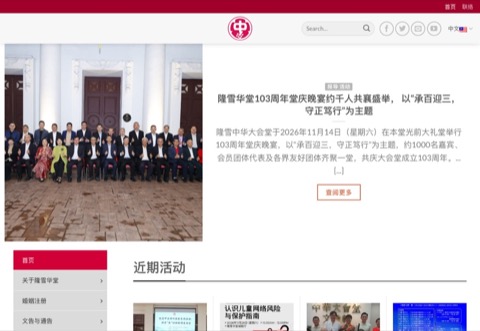
- Population Studies Unit, Universiti Malaya – DOSM Data Request (马来亚大学人口研究组——统计局微观数据申请)A web page of the Population Studies Unit at Universiti Malaya explains how researchers can apply to use microdata from the Department of Statistics Malaysia (DOSM). The page states that the data are held by the university's Faculty of Economics and Administration under a memorandum of understanding between UM and DOSM. The most relevant is the Population and Housing Census microdata; the page lists the 1980, 1991, 2000 and 2010 censuses and states that they are 2% samples of the total population data, with variables at three levels: living quarters, household and individual. The Malaysia samples currently public on IPUMS end in 2000, whereas this page mentions a 2010 sample, which is useful for readers who want to study ethnic and demographic change around the most recent decennial census. The page also lists data such as the Labour Force Survey, Salaries and Wages Survey, Household Income Survey, Household Expenditure Survey and Annual Survey of Manufacturing Industries, which fall outside the scope of this site. This entry is only for information on the application process; whether an application is approved depends on the university and the Department of Statistics.
Coverage, how to use, and notes
Coverage Census microdata: 1980, 1991, 2000 and 2010, 2% samples, with variable lists at the living quarters, household and individual levels. Whether Sabah and Sarawak are included and the specific variable contents are not stated on the page; please refer to the official website and the variable list provided when applying.
How to use The steps listed on the page are: complete the data request form and the confidentiality undertaking (Surat Aku Janji) and submit them to the contact person listed on the page; follow the usage guidelines in Appendix A (Lampiran A) when using the data; after the research ends, submit a data destruction letter and a report submission letter, together with electronic and hard copies of the research report or thesis, with the hard copy delivered to the Academic Office of the Faculty of Economics and Administration. For contact details, please see the official website.
Notes These are restricted data available by application and are not open data that can be downloaded directly. The page does not state detailed terms of use, approval times or eligibility to apply; please refer to the official website. The page content concerns the university's collaboration arrangement, and whether researchers from other institutions can apply is not stated.
Other
- Sahabat Rakyat Malaysia (人民之友)Sahabat Rakyat Malaysia (人民之友) is a Malaysian civil society group and its Chinese-language blog, maintained by the group's working committee. According to its About Us page, its predecessor was the Johor support group of Suara Rakyat Malaysia (SUARAM, registered in 1991), established in 2001; after SUARAM closed its Johor office in 2013, it began operating independently under its present name. The blog is mainly in Chinese, with some content in Malay, English and Tamil. Its content includes reposted columns from Chinese-language newspapers (mostly from Sin Chew Daily and Oriental Daily News), statements and announcements, records of talks and forums, audio, photographs, videos, cartoons, reader contributions and special topics, covering Malaysian politics, economy, language and education, culture and religion, and international affairs. It is a useful reference for scholars of Malaysian politics, allowing readers to understand the views and thinking of the contemporary Malaysian left. It should be noted that the site has a clear standpoint; its own pages state opposition to hegemony and racism and support for democratic reform, so it is best used as primary standpoint material rather than a neutral news source.
Coverage, how to use, and notes
Coverage Mainly blog posts from 2013 onwards, browsable through monthly archives; as of 17 November 2026, the latest post was published on that day. The language is mainly Chinese, with a small amount of Malay, English and Tamil. Content types include reposted columns, statements, event records, audio and video, cartoons and reader contributions. The site does not give a total number of articles.
How to use Open the blog and browse by monthly archive or by tags (such as politics, economy, language and education, culture and religion, international), or use the search box on the page. No registration is needed to read. The About Us page explains the group's history, and it is advisable to read it before citing. The blog also has a mirror at sahabatrakyatmy.pages.dev. Copyright in reposted content belongs to the original newspapers, and the original source should be credited when citing.
Notes The group has a clear standpoint, and the articles are mostly commentary and reposts, so the site is not a neutral database; please check reposted articles against the original newspapers. The site is a Blogger site and, apart from full-text search, has no systematic metadata or other search functions.

- Contemporary Review (当代评论)Contemporary Review (《当代评论》) is a semi-academic public commentary publication in the humanities and social sciences published by the LLG Cultural Development Centre (林连玉基金) in Malaysia. The LLG Cultural Development Centre was founded in 1985 by fifteen national Chinese associations, with the aim of commemorating Lin Lianyu, who campaigned for Chinese-language education and the citizenship rights of ethnic Chinese. The first issue appeared in October 2011, with the theme 'The Development of Civil Society and Democratic Transition'; since October 2017 it has changed from a print biannual to a commentary website that publishes articles regularly every week. The site describes its positioning as discussing public issues, spreading new ideas, and exploring culture and scholarship. Articles on the site cover economics, society, culture, education and other fields, and authors include scholars of Malaysian studies such as Zhuang Huaxing and He Qiliang, who present views in a semi-academic style. For readers studying Chinese society in Malaysia and Singapore, its value is that articles are written by scholars and are deeper in length and approach than news reports; that it has published continuously over a long period, showing how the Chinese community has discussed education, culture and public policy; and that it is a good source of research topic ideas. It is commentary rather than a peer-reviewed journal, and should be treated as primary commentary and opinion material when cited.
Coverage, how to use, and notes
Coverage Sections visible on the homepage are: Latest Articles; Special Topics and Issues (including 'Special Topics' and 'Interviews and Dialogues'); Selected Articles (politics, economics, society, international, culture, education, reader contributions, reader letters); and the 'Contemporary Review Lecture Series' (event information, lecture content, related news). Texts are mainly in traditional Chinese; recent articles visible on the homepage concern education policy, the PISA report, drama education and Malaysian Chinese literature. The site does not state the total number of articles.
How to use The site can be read directly without registration. From the homepage navigation, enter sections such as Latest Articles, Special Topics and Issues, and Selected Articles to browse by theme; a search box is reportedly at the top of the page, for searching by author name or keywords (e.g. Chinese education, Malaysian Chinese literature, Lin Lianyu). The site has a submission guidelines page for prospective contributors. When citing, record the article's author, title, publication date and URL.
Notes It is semi-academic commentary, not a peer-reviewed journal. The site does not state copyright or reprint rules; check the page notices before quoting extensively. The search box is visible in the page screenshot but could not be confirmed in the homepage text, so the search function should be checked on the actual site.
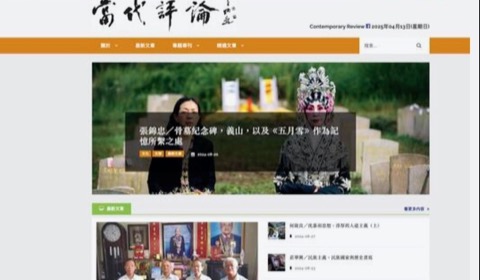
- Echoes of Malaysian Chinese Writers (马华作家回声录)Echoes of Malaysian Chinese Writers (马华作家回声录) is a series of interview videos with Malaysian Chinese-language writers, introduced in the series Three-Dimensional Malaysian Chinese Literature in the literary supplement Wenyi Chunqiu of Sin Chew Daily. According to the newspaper's report of 7 November 2025, in 2012 the team of the Malaysian Chinese Literature E-Library visited more than sixty writers across Malaysia and recorded 61 interviews in which writers talk about their creative experiences and works. The original footage later became hard to use for a time because of a damaged hard drive, and it was recovered in 2025. The recovered videos were restored and edited by Hao Ran Wen Yuan, an independent studio founded by Luo Xiangting, and have been released in batches since July 2025. Luo Xiangting was formerly a research assistant on the E-Library project. According to the report, these interviews fill in lost memories and preserve the voices and images of the writers. For researchers, they are first-hand oral material on the lives, creative ideas, and literary circles of Malaysian Chinese writers, and can be read alongside the works in the Malaysian Chinese Literature E-Library. The report notes that some of the interviewed writers have passed away, which gives the footage value as historical record. Writers listed in the report include He Naijian, Bing Gu, Li Jinzong, Wu An, Ee Tiang Hong (Wong Yoon Wah), Yong Le Duo Si, Shen Qingwang, and Chen Zhengxin.
Coverage, how to use, and notes
Coverage According to Sin Chew Daily: 61 writer interviews were recorded in 2012, with more than sixty Chinese-language writers from across Malaysia, covering their lives and writing. The report says eight instalments had been released at the time of publication, featuring He Naijian, Bing Gu, Li Jinzong, Wu An, Wang Runhua, Yong Le Duo Si, Shen Qingwang, Chen Zhengxin, and others; writers such as Tian Si can also be seen among the released videos. The language is Mandarin. For later release progress, please rely on the publisher.
How to use The videos are posted on the YouTube channel of Hao Ran Wen Yuan. Search YouTube for Hao Ran Wen Yuan or Echoes of Malaysian Chinese Writers to watch; no registration is required. The link attached to this entry is Sin Chew Daily's introductory report, which explains the project's origin and the list of writers released so far. For study, it can be used together with the Malaysian Chinese Literature E-Library, reading the works alongside the writers' interviews. When citing, it is advisable to note the writer, episode, release date, and channel name.
Notes The exact URL of the Hao Ran Wen Yuan channel could not be verified; the link in this entry is Sin Chew Daily's introductory report, not the channel itself. Videos are being released in batches, so the number and completeness depend on the channel's current state. The interviews were recorded in 2012, and writers' circumstances may have changed since.
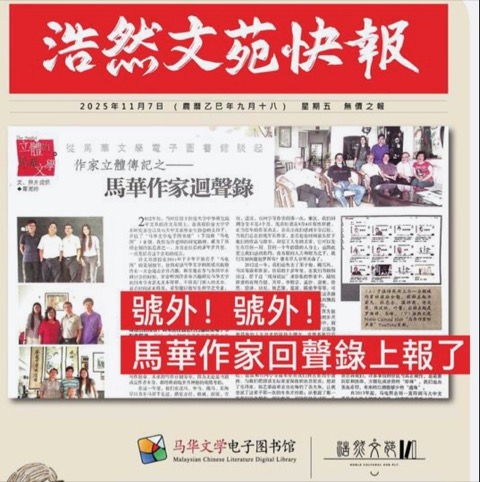
- Huajiao Gushi: Stories of Chinese Education (华教故事)Huajiao Gushi (《华教故事》; The Story of Chinese Education) is a documentary series on the history of Chinese-language education in Malaysia, published on the YouTube channel 'Huajiao Gushi' (华教故事). According to the introduction, the ten-episode documentary was published by the Selangor and Kuala Lumpur Chinese School Board Association (雪隆华校董联会), planned by Ding Ding's team, produced by Parallel Space (平行空间), with subtitles reviewed by Dr Ke Jiaxun; production was supported with funding and materials from the LLG Cultural Development Centre, Dong Zong, Nanyang Siang Pau and some Chinese independent secondary schools, in the hope of helping the public and young people learn about the history of Chinese education. Known episodes include: Chronology of Chinese Education, Student Movements of the 1950s, Lin Lianyu Special, Nanyang University, History of the Establishment of the Unified Examination, the Three-in-One (三结合), the Revival Movement of Independent Chinese Secondary Schools, Merdeka University (独立大学), Operation Lalang (茅草行动), and Notable Figures in Chinese Education. Among these, Lin Lianyu, Nanyang University, Merdeka University, the Unified Examination and the independent school revival are unavoidable topics in studying Chinese society, Chinese education and ethnic politics in Malaysia. The videos sort out these events in video form and suit use as introductory material, helping viewers grasp the outline before returning to original documents and scholarly works for further study. The documentary is popular visual material, and historical facts it states should be cross-checked against archives, newspapers and research literature.
Coverage, how to use, and notes
Coverage The ten episodes' topics are: Chronology of Chinese Education, Student Movements of the 1950s, Lin Lianyu Special, Nanyang University, History of the Establishment of the Unified Examination, the Three-in-One, the Revival Movement of Independent Chinese Secondary Schools, Merdeka University, Operation Lalang, and Notable Figures in Chinese Education. The language is Chinese, and the videos have subtitles (according to the introduction, reviewed by Dr Ke Jiaxun). The channel has other videos; for their number and update status, refer to the channel page.
How to use Search 'Huajiao Gushi' (华教故事) on YouTube, or open the channel page https://www.youtube.com/@huajiaogushi directly, and choose episodes in Videos and Playlists. No registration is needed to watch; commenting, subscribing or saving playlists requires a YouTube account. The videos are for online viewing; whether download or reposting is permitted depends on the statements of the channel and the producers. When citing, it is advisable to record the episode name, channel, release date and viewing date.
Notes Currently it is only confirmed that the channel opens and its name is 'Huajiao Gushi' (华教故事); because the page content was captured incompletely, the video list has not been checked episode by episode, and information on the publisher, producer and subtitle review could not be verified on official pages and is reported second-hand, so refer to the channel and the producers' statements. The videos are a popular documentary, not an academic work.
- Cheng Hoon Teng Temple (马六甲青云亭)Cheng Hoon Teng is a traditional Chinese temple in Melaka. Its website describes it as the oldest traditional Chinese temple in Malaysia, and it is managed by Cheng Hoon Teng Temple, Incorporated. The history page of the website states that the temple was founded in the 17th century by the Chinese Kapitan Tay Kie Ki (also known as Tay Hong Yong); besides its religious function, it served as the Kapitan's administrative center and court; it was rebuilt in 1801 by Kapitan Chua Su Cheong; after the British abolished the Kapitan system in 1824, the temple head, the Teng Choo, took over some of its duties; a board of trustees was later formed, and Tan Cheng Lock took part in promoting its registration under the Cheng Hoon Teng Temple Incorporation Ordinance of 1949. The website also states that the temple is the center of spiritual life for the Chinese of the historic city of Melaka and has received a UNESCO architectural conservation award. For the study of Melaka Chinese society, the Kapitan system, deity worship and temple governance, Cheng Hoon Teng is a frequently cited field site, and the inscriptions and plaques in the temple are also materials studied by scholars.
Address Cheng Hoon Teng Temple, Incorporated, No. 25, Jalan To'kong, 75200 Malacca, Malaysia View on map ↗
Coverage, how to use, and notes
Coverage The website has sections on history, the incorporated board of trustees, religious activities, architecture, restoration, news, location and contact; the history page covers the process from the founding in the 17th century to incorporation in the mid-20th century. The history page does not mention the content of the inscriptions, nor does it state the size of archives or collections.
How to use You can visit directly; the website does not list opening hours, so please confirm by phone or email (see the contact page on the website). The website content can be read free of charge; you can first browse the history, architecture and restoration sections for background. To study the inscriptions, you can also consult compilations by scholars, such as Chinese Epigraphic Materials in Malaysia (马来西亚华文铭刻萃编), edited by Wolfgang Franke (Fu Wukang) and Chen Tiefan, and the related compilations by Zhuang Qinyong, and check them against the originals on site.
Notes The founding date differs among sources; the website's history page gives the 17th century, and the source should be stated when citing. The temple is an active place of worship; please follow the temple's rules when visiting and taking photographs.
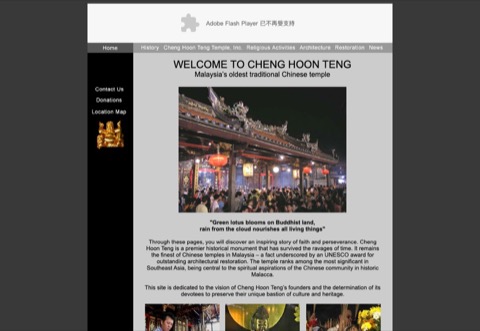
Indonesia14
Archives & historical document databases
- Arsip Tionghoa (CRCS UGM) (华人档案(UGM 宗教与跨文化研究中心))Arsip Tionghoa is a section of the website of the Center for Religious and Cross-cultural Studies (CRCS) at Universitas Gadjah Mada (UGM), publishing the results of digitizing endangered modern archives of Indonesian Chinese. CRCS describes four digitization projects: rare religious manuscripts from Boen Bio in Surabaya (2010); newly found endangered documents from Hok An Kiong in Muntilan, including Chinese Indonesian literature (2012); literary and religious archives of Hok An Kiong and Lithang Gerbang Kebajikan in Surakarta (2021–2024); and work on the remaining undigitized materials of Boen Bio and Lithang (2024–2025). The first two were funded by the University of Washington, the third by the University of California, Los Angeles, and the fourth by CRCS itself. The page states that these archives face a risk of loss because of restrictions on Chinese-language publications during the New Order. Texts currently listed include Etika dan Kepercayaan Konfusianisme, Empat Nasihat tentang Penyelesaian Masalah Sehari-hari, Primbon Djajabaja, the Zhongyong (Indonesian), and Indonesian readers of the Mahabharata, volumes one and two. The section is a useful reference for readers studying Indonesian Chinese religion (Confucianism, Buddhism), translation and publishing culture.
Coverage, how to use, and notes
Coverage Texts in the section were posted on 22 October 2024, and several items are currently listed, being religious, philosophical and literary readings in Indonesian or mixed Chinese-Indonesian. The digitization projects involve three sites, Boen Bio in Surabaya, Hok An Kiong in Muntilan and Lithang Gerbang Kebajikan in Surakarta, spanning 2010–2025. The site does not give total item or page counts for each project; please consult the official site.
How to use After opening the section page, each entry appears with a thumbnail, title and short description; click through to the full post. The list is paginated (page/2, etc.). The project description articles include access links to the earlier University of Washington projects and a page for the third-phase project. Browsing requires no login, and the page does not mention fees.
Notes The section consists mainly of published texts and notes and is not a uniformly searchable database; there is no single entry point that gathers the results of the four projects. The page does not state item counts, copyright or reuse terms; please verify before use.
Scholarly databases & search tools
- GARUDA (Garba Rujukan Digital) (印度尼西亚学术出版物检索平台 GARUDA)GARUDA (Garba Rujukan Digital) is an Indonesian platform for discovering the country's scholarly publications; the page describes itself as a resource platform for discovering Indonesian scholarly publications. It is operated by Indonesia's Ministry of Higher Education, Science and Technology (Kemdiktisaintek) and indexes Indonesian journal articles and conference papers across 40 subject areas, including arts and humanities and social and behavioural sciences. For those studying Chinese society, religion, politics, language and social history in Indonesia, it is an important entry point for finding articles in Indonesian journals; research in Indonesian often cannot be found in English-language databases. The platform offers search of articles, journals, publishers and authors, and can search by title, abstract, author and DOI, with a filter for results containing PDFs only; it also has an advanced search and a publication analytics page.
Coverage, how to use, and notes
Coverage The page lists about 5.8 million articles, 30,457 journals, 427 conferences and 40 subject areas, mainly Indonesian journals and conference papers, mostly in Indonesian with some in English. The date range is not stated on the website's home page; follow the official website.
How to use From the home page, choose what to search (articles, journals, publishers or authors) and enter keywords; the title, abstract, author and DOI fields can be selected, and a PDF-only filter can be ticked. To search for papers on the Chinese in Indonesia, use Indonesian keywords such as Tionghoa, etnis Tionghoa and Pecinan, or English ones. The website does not state whether registration is needed for downloads; rely on actual use.
Notes The page footer shows two different ministry names together with a 2018 copyright notice, suggesting the page information may not be fully updated. The website does not describe how full texts are provided or the terms of use; many full texts link to individual journal websites, and availability varies.
- Humaniora (Universitas Gadjah Mada) (《Humaniora》(加查马达大学人文学刊))Humaniora was founded in 1989 by the Faculty of Cultural Sciences of Universitas Gadjah Mada and continues to be published; it is a peer-reviewed, open access humanities journal. The website states that its focus is cultural studies from an Indonesian perspective, publishing analysis, criticism and introductions to inspiring works, and it also accepts interdisciplinary humanities research; submission types are limited to research articles and book reviews. The website states that since 2016 all articles have been published in English only, with three issues a year, submissions accepted year-round, and site content licensed under CC BY-SA 4.0. For readers studying Indonesia, the journal provides research by Indonesian scholars on language, literature, history, culture and social phenomena; English-language publication lowers the barrier to reading, making it a suitable entry point for following Indonesian humanities scholarship and finding regional cultural studies articles, and it can also be used to track recent discussion of issues related to ethnicity, religion and the arts.
Coverage, how to use, and notes
Coverage Humanities research on Indonesian culture, research articles and book reviews; founded in 1989, all in English since 2016. Three issues per year. The specific range of volumes and issues and past tables of contents should be checked on the website's archive page.
How to use After entering the journal website, browse issue contents via Current and Archives, and use site search to find items by keyword or author; articles can be read and downloaded online directly without registration. Submissions should be prepared according to the author guidelines on the website.
Notes Articles before 2016 may include Indonesian-language ones; please check each issue's table of contents. The journal is not themed on Chinese studies, so relevant articles must be filtered by keyword.
- Jurnal Masyarakat Indonesia (BRIN) (《印度尼西亚社会》(Jurnal Masyarakat Indonesia,BRIN))Jurnal Masyarakat Indonesia is a scholarly journal in the social sciences and humanities in Indonesia. The About page of the website states that it is published by IPSK-LIPI (the Deputy for Social Sciences and Humanities), the footer reads BRIN Publishing, and it is hosted on BRIN's OJS journal platform. The journal emphasises publishing articles on issues and challenges facing the Indonesian people, approached from various social and humanistic perspectives; submission types include scholarly articles, doctoral dissertation abstracts and book reviews, and it is open to scholars from Indonesia and abroad. Published since the 1970s, it currently appears twice a year, with one theme per issue, so it is suited to searching by topic and following local scholarly discussion of Indonesian society, culture, ethnicity, regional development and policy. For readers studying Indonesian society and regional issues, it is a primary local scholarly source published in Indonesian and English, supplementing international journals' coverage of domestic Indonesian issues. Site content is licensed under CC BY-SA 4.0, and the site has an open access policy page.
Coverage, how to use, and notes
Coverage Social sciences and humanities; research articles, doctoral dissertation abstracts and book reviews; in Indonesian or English; published since the 1970s, twice a year with one theme per issue. The specific founding year and range of volumes and issues are not clearly listed on the website home page; please check the website's archive page.
How to use After entering the website, browse issues via Current and Archives, and use site search to find items by keyword or author. Articles can be read and downloaded online without registration (login is only for submission and review). When searching, it is advisable to use Indonesian keywords such as etnis Tionghoa, masyarakat and migrasi.
Notes The journal is not devoted specifically to Chinese or Southeast Asian regional studies, so relevant items must be filtered by the reader; some journal pages on BRIN's OJS platform may require login, so please confirm that the target page is publicly accessible before use.
- Sensus BPS (Badan Pusat Statistik Census Portal) (印度尼西亚统计局人口普查门户(Sensus BPS))sensus.bps.go.id is a dedicated census portal built by Statistics Indonesia (BPS), bringing together information on the population census, agricultural census and economic census. According to the page descriptions, the population census provides basic population data down to the smallest administrative unit; the agricultural census presents the latest state of national agriculture; the economic census covers economic activity in sectors other than agriculture, and the homepage currently features the 2026 Economic Census (Sensus Ekonomi 2026). The 2020 Population Census (Sensus Penduduk 2020) sub-page gives the national population as 270,203,917 (136,661,899 male, 133,542,018 female) and offers thematic data tables, a Query Builder, tools for comparing regions and census years, census metadata, questionnaires and a glossary of statistical terms, as well as press releases, publications, infographics and regional reports. For Southeast Asian regional studies, the Indonesian population census is an authoritative primary source for population structure, ethnic and religious composition, and urban-rural and regional differences; when studying Indonesia's Chinese population or ethnic statistics, the questionnaires and metadata should be used to confirm how ethnic categories were set up and defined in each census round.
Coverage, how to use, and notes
Coverage The homepage lists three types of projects: population census, agricultural census and economic census. The 2020 Population Census page contains national and regional data tables, questionnaires, metadata and publications. How far other census years (such as 2010 and 2000) are covered on this portal is not stated on the homepage; please rely on the official site. The interface is mainly in Indonesian.
How to use Visit sensus.bps.go.id and choose the relevant census project from the homepage. On the 2020 Population Census page (/main/index/sp2020), the 'data tables' section offers thematic tables, the Query Builder and region comparison, allowing tables to be assembled by region and variable; the 'metadata' section gives questionnaires and the glossary, and the 'publications' section offers reports for download. The pages do not say that registration is required for browsing; download formats should be checked on each table page.
Notes Census definitions and classifications may change between years, so read the metadata and glossary before comparing across years. The main BPS site www.bps.go.id could not be opened by automated tools during checking (it returned 403); readers who need content from the main site should visit it directly in a browser and rely on the official site.
- UGM ETD Repository (Electronic Theses & Dissertations, Universitas Gadjah Mada) (加查马达大学电子学位论文库)UGM ETD is the repository of student final works of Universitas Gadjah Mada (UGM), Indonesia. It holds the university's final projects, bachelor's, master's and doctoral theses, and specialist and subspecialist medical degree theses, and is maintained by the university's library system. Gadjah Mada University is a long-established comprehensive national university in Indonesia with deep strengths in the humanities and social sciences (history, anthropology, cultural studies, politics and international relations, Southeast Asian studies, etc.). Its theses are often based on primary fieldwork and archival materials in Indonesian, on topics such as Javanese society, ethnic relations, religion and local history, including many on Chinese communities, Chinese religion and commercial networks, and ethnic relations. For readers studying Indonesia and Southeast Asia, such local theses are an important entry point for understanding the research concerns of Indonesian scholarship and for finding leads to local materials and references, and they fill gaps in local case studies that English- and Chinese-language journal literature covers less. The home page shows a total of 282,806 items, of which bachelor's and master's theses account for the great majority.
Coverage, how to use, and notes
Coverage The home page shows a total of 282,806 UGM student final works: Tugas Akhir 22,576, Skripsi 120,827, Tesis 126,304, Disertasi 9,151, Tesis-Spesialis 3,559, Tesis-Subspesialis 260 (figures are as shown on the home page at the time of access). Only works from this university, covering all disciplines and not limited to the humanities and social sciences; mainly in Indonesian, some in English.
How to use After opening the website, use Pencarian Lanjutan (advanced search) on the home page to search by title, author, keyword and so on, using Indonesian keywords such as Tionghoa (Chinese), etnis Tionghoa and Cina Peranakan. The home page has a Masuk dan Daftar (log in and register) entry, as well as a usage policy, FAQ, a problem report form, and the library's academic resource centre (ETD and KKI) service pages. The extent of full-text openness is not detailed on the home page; please check the usage policy page.
Notes The home page does not state the specific extent of full-text access for each type of thesis; public reports say that full texts of the university's theses may be limited to on-campus computers or designated library reading stations, with abstracts and some chapters viewable remotely; the actual rules should be checked in the website's usage policy. It includes only UGM's own theses and is not a national union repository.
- UI Scholars Hub (Universitas Indonesia) (印度尼西亚大学学术成果库(UI Scholars Hub))UI Scholars Hub is the institutional repository of Universitas Indonesia (UI), built on the Digital Commons platform and managed by the university's Directorate of Research and Community Engagement Management (research and innovation management office). It brings together research and scholarly output of the university's faculty and students and hosts several academic journals published by the university, such as Wacana of the Faculty of Humanities and Paradigma: Jurnal Kajian Budaya. Universitas Indonesia, located in Jakarta, is one of Indonesia's most important research universities; its Faculty of Humanities, Faculty of Social and Political Sciences and Faculty of Law publish extensively on Indonesian history, language and literature, cultural studies, archaeology and social research, which is useful for readers studying Indonesian society, culture, ethnicity and Chinese issues. The platform offers browsing by discipline, author, collection and journal, and has sections such as Journal Articles This Week, Download Ranking and Recently Added, allowing readers to quickly see the university's recent scholarly activity. The official page also links to UI's PURE research portal for further information on researchers and outputs.
Coverage, how to use, and notes
Coverage Holds the research and scholarly output of Universitas Indonesia; the discipline list includes architecture, arts and humanities, business, education, engineering, law, life sciences, medicine and health sciences, natural sciences and mathematics, and social and behavioural sciences. The home page does not state the total volume or chronological span, nor does it list specific document types; please check the website. The platform includes several journals published by the university.
How to use Enter keywords in the home page search box, choosing to search this repository only or across repositories; advanced search is also available. You can also browse by collection, discipline, author or journal, view the download ranking and recently added items, and subscribe to email or RSS alerts. Reading public content does not require an account; My Account and Submit Research are for authors submitting work. It is advisable to search with both English and Indonesian keywords, such as Chinese Indonesian and Tionghoa.
Notes The home page does not state the access terms of individual items; whether full text can be downloaded for a given item should be checked on the item page. Theses are not necessarily in this repository, and some content may have metadata only.
Research methods & tools
- BPS WebAPI (Badan Pusat Statistik) (印度尼西亚统计局 WebAPI)BPS WebAPI is a programmatic data interface provided by Statistics Indonesia (Badan Pusat Statistik) that returns statistical information published by BPS in JSON format. The website states that through the interface one can obtain BPS publications, press releases, static and dynamic statistical tables, infographics and event information. For researchers who need to obtain Indonesian population and regional statistical tables in bulk, this is a more efficient route than downloading tables page by page, and can be used for compiling population data across years, regional comparison or digital-humanities-style data pipelines. Use requires registration; after review by BPS an API token is issued, which may be used only for the registered application and is subject to rate limits. The website states that compliant use is free of charge, commercial use requires BPS approval or an agreement, and applications using its data must display the statement This service uses the Badan Pusat Statistik (BPS) API. The metadata of each table, such as reference period, unit and definitions, should be understood first, because data may be revised.
Coverage, how to use, and notes
Coverage The interface covers BPS publications, press releases, static and dynamic statistical tables, infographics and event information. Which census tables and which years can be obtained through the interface is not listed item by item on the website homepage; please check the interface documentation and metadata, and refer to the official website. The return format is JSON.
How to use After reading the terms of use on the website, register to apply for an API token, and call the API according to the documentation once approved. Keep the token confidential, do not put it in public code repositories, and do not use it for unregistered applications. The documentation page includes a guide, an API reference and an openapi.yaml file, but at the time of checking the guide section still showed as loading, so please see the website for the latest instructions. Before calling, check the metadata to confirm the reference period, unit and definitions.
Notes Registration and BPS review are required. There are rate limits, and BPS may check, reject or restrict requests. Commercial use requires separate approval. The documentation page was not fully displayed at the time of checking; for specific endpoints, please refer to the official website.
Museums & memorials
- Museum Benteng Heritage (班登遗产博物馆(Benteng Heritage 博物馆))Museum Benteng Heritage is located in the Pasar Lama (Old Market) area of Tangerang, Banten, Indonesia, and is run by the Benteng Heritage Foundation (Yayasan Benteng Heritage). The building is a restored traditional Chinese structure; the official site says it is believed to date to the mid-17th century, is among the oldest buildings in Tangerang, and its location is regarded as the 'zero point' of the city. The museum displays artifacts related to the history of the Chinese community and tells the story of that community. One theme mentioned on the site links the ancestors of Tangerang's local Chinese, the Cina Benteng, with a group believed to have landed at Teluk Naga in 1407. For readers of Indonesian Chinese society, it is a site that can be visited in person, focused on Tangerang's local Chinese community: one can see objects and displays and understand the history of Chinese settlement in the setting of the old market district. It suits fieldwork visits on Indonesian Chinese history, Peranakan communities and local society, and can be combined with related sites in Jakarta. For details of exhibitions and themes, please refer to the official site and the museum.
Address Jl. Cilame No. 20, Pasar Lama, Tangerang 15118, Banten, Indonesia View on map ↗
Coverage, how to use, and notes
Coverage The official site only states that the building is a restored traditional Chinese structure exhibiting artifacts and stories related to the history of the Chinese community, with themes including the origins of Tangerang's local Chinese (Cina Benteng). It does not list the number of holdings, date range, languages or a permanent exhibition catalogue; please refer to the official site and the museum for specific displays.
How to use The official homepage provides an introduction to the building, address and contact details: telephone +62.21.55791139, and email via the official contact page. The site does not list opening hours or ticket prices; please confirm with the museum by telephone or email before visiting. Third-party sources give differing opening hours and should not be relied on directly. For research visits, group visits or consulting materials in the museum, contact the museum in writing in advance, stating the purpose and number of people. The site offers no online search or download service; this entry is an on-site visiting resource.
Notes The official site does not publish opening hours or ticket prices; third-party sites give contradictory opening hours, so confirm with the museum before traveling. The size of the collection and whether materials can be consulted are not stated on the site; please rely on the museum's reply.
- Museum Nasional Indonesia (印度尼西亚国家博物馆)Museum Nasional (National Museum of Indonesia) is located in Jakarta. The collections section of its website presents holdings by category: archaeology, ethnography, geography, ceramics, numismatics and heraldry, prehistory and history. The website also offers a virtual tour, an online exhibition on Google Arts & Culture, a library and an e-book entry point. The museum is an important institution for Indonesian archaeological, ethnographic and historical objects, and is a useful reference for scholars of archipelagic history, maritime trade, ceramics and coins. For research involving Chinese communities, categories such as ceramics may contain relevant objects; please rely on the website and the museum for specific items. Third-party sources differ on the total number of objects and the website's homepage gives no unified figure, so no specific number is cited here.
Address Jl. Medan Merdeka Barat No.12, Kota Jakarta Pusat, Daerah Khusus Jakarta, Indonesia View on map ↗
Coverage, how to use, and notes
Coverage The collections section of the website presents holdings by category: archaeology, ethnography, geography, ceramics, numismatics and heraldry, prehistory, history, etc. The homepage does not describe a searchable online collection catalogue and gives no total number of objects; please rely on the official site.
How to use For opening hours, ticket prices and visiting rules for on-site visits, see the 'Informasi Kunjungan' (visitor information) page of the website; the homepage also mentions adjusted operating hours from 1 April 2026, so please rely on the official site for the specific arrangements. Remote users can use the website's virtual tour, the Google Arts & Culture online exhibition and the e-book entry point. The contact telephone number given on the website is +62 21 3868172.
Notes No searchable collection catalogue was seen on the homepage. The postal code is not stated on the homepage; please rely on the official site.
- Tjong A Fie Mansion (张煜南故居(Tjong A Fie Mansion))The Tjong A Fie Mansion is a museum in Medan. Its website states that it was built in 1895 and is a registered historic landmark and cultural heritage building. The two-storey, 35-room residence combines Chinese, Malay and Art Deco styles and was built according to feng shui principles; it was a gift from Tjong A Fie to his wife. The website describes his journey from China to the Deli area of the Dutch East Indies to make a living. For readers studying Chinese families, community leaders and local society in Sumatra, it is a family heritage site that can be visited in person. The website also has pages such as His Story and Gallery, and mentions photographs provided by the Tjong A Fie Institute.
Address 105 Jl. Jend. A. Yani, Medan 20111, North Sumatera, Indonesia View on map ↗
Coverage, how to use, and notes
Coverage Focuses on the residence building, its furnishings and the history of the Tjong A Fie family. The official homepage does not mention family archives, documentary holdings or research access services; please ask the museum directly.
How to use Open daily 9:00 to 17:00, with last entry at 16:30; closed on Lunar New Year Day. Admission is IDR 35.000, including a guided tour; an English- or Indonesian-speaking guide can be requested. The website's visit page does not mention reservations. Contact: telephone (+62) 8116130388; email is given on the website. For archives or research use, please contact the museum in advance.
Notes This is mainly a museum for visitors, and the website does not state that archive search services are provided. The old domain tjongafiemansion.com now redirects to tjongafiemansion.org. Please consult the official website for admission fees and opening hours.
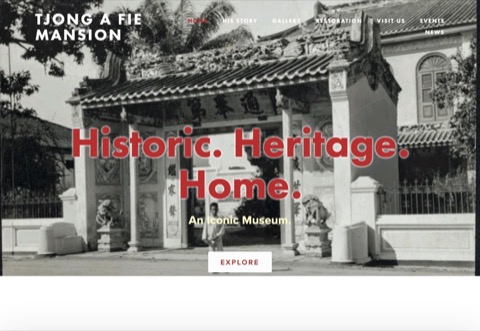
Institutions & societies
- CSIS Indonesia Publications (印度尼西亚战略与国际研究中心出版物)Overview of CSIS Indonesia publications, including commentaries, research reports and policy papers, which can be filtered by department, author and category, covering Indonesian politics, economics and ASEAN affairs.
Other
- Data Kependudukan (Direktorat Jenderal Kependudukan dan Pencatatan Sipil) (印度尼西亚内政部民政与户籍总局人口数据页)This is the Data Kependudukan page under the Publications section of the website of the Directorate General of Population and Civil Registration (Ditjen Dukcapil) of Indonesia's Ministry of Home Affairs, which publishes population statistics based on the civil registration system. Unlike the Statistics Indonesia's population census, the data derive from administrative registration rather than a door-to-door census, and are therefore suitable for comparison with census data. The page content includes: total population by identity number (NIK) for 2013 to 2022 (as of December) and for 2023 (first semester); rankings of the provinces, regencies and cities with the largest and smallest populations in December 2022; the number required to register, the number registered and the percentage for electronic ID cards (KTP-el) for 2013 to 2022; and civil registration data such as child identity cards, birth certificates, death certificates (from 2018), and marriage and divorce certificates. It is a useful reference for readers studying Indonesian population registration and changes in the population size of administrative areas. At the time of checking, the page had no data broken down by religion, sex or age.
Coverage, how to use, and notes
Coverage The content that could be verified is annual total population for 2013–2022 (as of December), the total for the first semester of 2023, rankings of administrative areas by population in December 2022, KTP-el registration (2013–2022, plus data as of 30 April 2023), and the numbers of various civil registration records. The page has no ethnic or religious breakdown data. The language is Indonesian.
How to use From the Dukcapil website homepage, go to the Data Kependudukan page under Publikasi; the data are displayed directly as web tables and no login is required. The page provides no CSV, Excel or API download, so tables must be compiled or copied manually. The website also lists an e-Database portal that requires login; the page does not state whether it provides these figures, so please do not treat it as a public data entry point.
Notes The number separators on the page are inconsistent (for example 255.615.478 and 275,344,166) and should be checked and standardised before entry. The data come from administrative registration, and their definitions differ from the Statistics Indonesia's census, so the two cannot be mixed directly. The page shows data only up to the first semester of 2023; for more recent half-yearly data, please refer to the official website. The office address listed on the website homepage is Jl. KH. Guru Amin KM 19, Pejaten Barat, Pasar Minggu, Jakarta Selatan 12510.
- Satu Data Indonesia (data.go.id) (印度尼西亚统一数据门户(政府开放数据门户))Satu Data Indonesia (data.go.id) is the official open data portal of the Indonesian government; the homepage describes it as official public data and information from the Indonesian government, operated by the Ministry of National Development Planning (Kementerian PPN/Bappenas), with its office in Jakarta. The portal brings datasets from central and regional agencies into a single search entry point, and the homepage shows more than 747,475 datasets. For researchers of population and ethnicity, it is one of the entry points for finding population, administrative division, social and regional statistics published by government departments, and can supplement the Statistics Indonesia's own publication channels. Each dataset is marked as Terbuka (open) or Terbatas (restricted) and is given in file formats such as XLSX, CSV, JSON and XML. The portal is organised by theme, for example economy and industry, education and labour, and datasets can also be found directly with the search box. The data come from multiple publishing agencies and vary in granularity, quality and update time, so users should return to the dataset page to check the source agency, definitions and time period.
Coverage, how to use, and notes
Coverage The homepage shows a total of more than 747,475 datasets, covering multiple government agencies and themes. Visible thematic categories include economy and industry, and education and labour. File formats include XLSX, CSV, JSON and XML. Which census or ethnicity-related datasets exist must be searched for on the site; please refer to the official website.
How to use On the homepage, enter keywords (such as penduduk, agama, suku, sensus) in the Cari search box, or go to Semua Data and browse by theme. After opening a dataset page, check the source agency, description and downloadable resources. The homepage does not describe an account or registration process; whether registration is required should be checked on each dataset page. If errors are found in the data, the homepage provides a feedback channel.
Notes Some datasets are marked as restricted (Terbatas) and cannot be downloaded directly. Datasets are uploaded by different agencies, and their quality and update frequency are inconsistent; when citing in research, the original publishing agency should be stated, and data should as far as possible be checked against the original publications of the Statistics Indonesia. The interface and descriptions are in Indonesian.
Thailand23
Newspapers & news archives
- Thailand Digital Chinese Newspaper (TDCN), HCU Library (泰国华文报纸数字数据库(华侨崇圣大学图书馆))TDCN is a digitization project built by the Information Center (Library) of Huachiew Chalermprakiet University (HCU) in cooperation with the National Library of Thailand (under the Fine Arts Department), started on 29 September 2008, aiming to preserve old Chinese-language newspapers and serve research. The database holds Chinese-language newspapers published in Thailand, including dailies, bi-daily papers and weeklies, and is a scarce primary source for studying Thai Chinese society, Chinese associations, Chinese education, political identity and China–Thailand relations. The official page lists institutions that have used the database, including Fudan University, the University of Tokyo, the University of Cambridge, National Chengchi University and the Institute of Asian Studies at Chulalongkorn University, indicating its use in the academic community. It is a closed system, available only on the university library's intranet and requiring prior application; it is a resource accessed by appointment, not an openly available online database.
Coverage, how to use, and notes
Coverage The official site states that the collection consists of Chinese-language newspapers published in Thailand, covering 1923–1987 (Thai and English pages); the Chinese page says from 1917, which is inconsistent with the former, so please refer to the official site. Some months in 1941–1942 and during World War II are missing. Materials are scanned page images without OCR and are not full-text searchable. The page does not list the specific newspaper titles. The originals have been returned to the National Library of Thailand.
How to use The database is available only on the campus intranet and cannot be accessed online. Application steps (according to the official site): the applicant's institution issues an official letter addressed to the HCU Library director, stating name and affiliation, research topic, intended visit date and types of materials needed; send it in English by email, at least 7 days in advance, to the contact address listed on the official page; access is allowed only after approval. The facility is on the 5th floor of the library, with service hours Monday to Friday, 8:30–15:30. Address: 18/18 Debaratana Road (Km. 18), Bang Phli, Samut Prakan 10540, Thailand (as given on the page; the district name is written differently in the two language versions, so please refer to the official site).
Notes For academic research only; printing and downloading are not permitted. Materials have no OCR and must be read page by page, so allow time; incomplete documents may lead to the application being refused. The start year differs between language versions of the pages; please rely on the official site and the library's reply.
Archives & historical document databases
- CMU Digital Collections (Chiang Mai University Library) (清迈大学数字馆藏)CMU Digital Collections is a digital repository built by the Chiang Mai University Library, with the slogan of a gateway to the wisdom of Chiang Mai University. Besides the institutional repository, it has sub-repositories for special collections, open access e-resources, Lanna heritage, rare books and manuscripts, and university archives, with content including theses, research reports, journal articles, conference proceedings, e-books and e-magazines. The Lanna heritage part includes music, food, pottery, lacquerware, poetry, inscriptions and maps related to Lanna culture in northern Thailand. For scholars studying the history, ethnic groups, religion and border societies of northern Thailand (including northern Chinese communities), it is a main digital entry point to northern local documents. The interface can be switched between Thai and English, and titles and descriptions are mostly bilingual.
Coverage, how to use, and notes
Coverage According to the official page, the sizes of the main sub-repositories are approximately: institutional repository 61,600 items, special collections 2,900, open access e-resources 9,400, Lanna heritage 3,700, rare books and manuscripts 2,300, university archives 1,400; the rare newspaper special collection has 38 items, with no detailed description on the page. Content types include theses, research reports, articles, conference proceedings, e-books and e-journals. Figures are as of the time of search.
How to use From the homepage, use advanced search (by author, title, keyword, year, with the option of choosing specific collections), or browse from each sub-repository. Some collections are marked as Chiang Mai University members only (CMU Only), while most others can be opened directly; whether login is needed for download depends on each item. When searching for Lanna materials, use Lanna and Thai keywords; the rare newspapers can be reached from the rare books and manuscripts sub-repository.
Notes Some collections are limited to on-campus users; the official site does not explain the access rules in detail, so check item by item. The rare newspaper special collection has only 38 items and is limited in scope.
- Documentation of Oct 6 (doct6.com): Online Archive on the 6 October 1976 Events (Documentation of Oct 6 (บันทึก 6 ตุลา, doct6.com)(“10月6日”事件记录档案网站))This website, run by the project บันทึก 6 ตุลา (Documentation of October 6), is an online archive that aims to collect, preserve and organize scattered materials on the political violence in Thailand on 6 October 1976 (the Thammasat University incident) so that the public can consult them. The materials are organized by section, including Thai newspapers of the time, photographs, video and audio clips, autopsy and other post-mortem documents, witness testimonies in the prosecution case, a section on the victims (with personal profiles), recollections and interviews of those who experienced the events, knowledge articles, and materials on the propaganda war (including radio networks); a Learn section provides a timeline, an account of the events and introductions to key figures. For researchers of contemporary Thai political history, the student movement, Cold War anti-communist mobilization, historical memory and trauma, and related oral and visual materials, the site offers an entry point to primary materials that can be searched and browsed directly. The site is mainly in Thai, with some titles and statements in English. The website is also one source of background material for studying the situation of the ethnic Chinese community in Thailand in the Cold War political environment, but the site has no dedicated section on the Chinese.
Coverage, how to use, and notes
Coverage The topics center on the events of 6 October 1976 and their background before and after. The content types listed on the official website are: Thai newspapers from September to October 1976 and the Athipat newspaper series from late 1974, photographs, video and audio clips, post-mortem documents (including material in which police counted at least 46 deaths), witness testimonies, victim information, recollections and interviews, knowledge articles and propaganda materials. The website does not state the total number of items; please consult the official website. The language is mainly Thai.
How to use Visit doct6.com directly; no registration is needed. There is a search button (ค้นหา) at the top of the page, and the main menu also allows browsing by category such as newspapers, photographs, victims, recollections and knowledge. The website provides a submission email address and welcomes submissions of documents, photographs, victim information and recollections; for the specific email address, see the website. Before using materials from the site commercially, the website asks that the project team or the victims' families be contacted first. When citing, it is advisable to record the section, item title and access date.
Notes The site is mainly in Thai, with limited English interface and explanation. The website does not explicitly label any section as oral history; interview and recollection materials are spread across sections such as Recollections. The website does not provide a physical address. The materials involve violent events and images of victims, so ethical and copyright requirements should be observed when using and citing them.
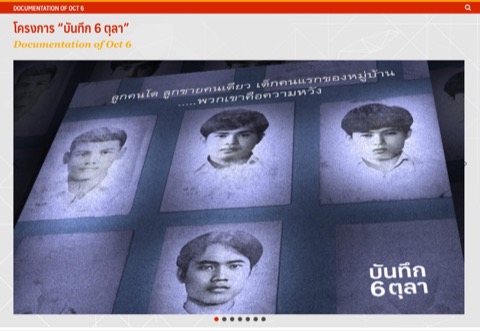
- Manuscript Search System, National Library of Thailand (泰国国家图书馆古籍手稿检索系统)This system is the online catalogue of ancient manuscripts built by the National Library of Thailand for searching its holdings of ancient documents. The official page lists four categories of materials: inscriptions (จารึก, writing carved on stone, wood or metal plates), Thai folding books (หนังสือสมุดไทย, folding books made of bark paper), scripture cabinets (ตู้พระธรรม, decorated cabinets for storing Buddhist scriptures) and palm-leaf manuscripts (คัมภีร์ใบลาน, whose contents are mostly Buddhist teachings but also cover subjects such as law). The website also has knowledge articles, e-books, videos, survey reports, a directory of experts in ancient scripts, a guide to applying to consult documents, and contact information. For Southeast Asian regional studies, these materials are basic sources for studying Thai religion, law, literature, writing traditions and local knowledge, and also help in understanding cultural exchange between Thailand and neighboring regions. Researchers can first search online to confirm that a document exists, then contact the library according to the website's application guide to consult it.
Coverage, how to use, and notes
Coverage Covers four categories of ancient documents: inscriptions, Thai folding books, scripture cabinets and palm-leaf manuscripts. The page does not state the total number of records or the proportion digitized, nor whether full texts are publicly viewable; please consult the official website. The date range and languages (such as Thai, Pali and Khmer) are not indicated on the pages checked and are not inferred.
How to use Go to http://manuscript.nlt.go.th/ and use the Search (สืบค้น) section on the page or the search button in the page header. The page has registration and login entries; which content requires an account is not explained on the page. The website provides a guide to applying to consult documents and a contact page; before consulting or copying in person, please apply to the library following the guide. The page states that the service hours of the relevant contact group are Monday to Friday, 9:00–16:00.
Notes The page is mainly in Thai, and the search fields and filtering options were not listed on the pages checked. The site was accessed during checking at an http address; please heed browser security warnings and use the website's current official address.
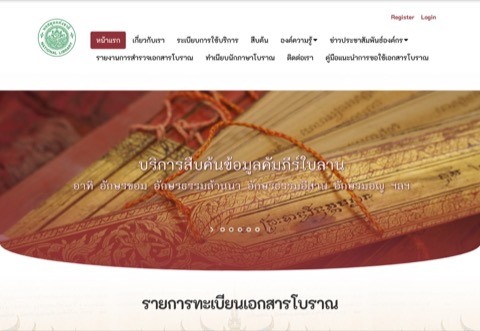
- National Statistical Office of Thailand (NSO) (泰国国家统计局)The National Statistical Office of Thailand (สำนักงานสถิติแห่งชาติ, NSO) is the agency in charge of official statistics in Thailand. It organizes the population and housing census, the agricultural census, the business and industrial censuses, and various sample surveys, and publishes statistics and publications through its website. The site has Thai and English entrances. Main sections include pages for censuses and sample surveys, the Key Statistics and Indicators data catalogue, interactive dashboards, a statistical data warehouse, e-books and statistical yearbooks, a microdata catalogue, a government data catalogue, and a no-code API service. For researchers of Thailand's population size, population structure, households and living conditions, and regional distribution, this is the most authoritative primary statistical source. Studies of Thailand's Chinese and ethnic groups that need background population data can also obtain official baseline figures at the province level here. Yearbooks and other publications are kept by year, allowing changes in official statistical definitions to be traced over a long period. The site is a basic entry point for research on Thailand's social change, population migration, and regional comparison, and used together with ASEAN statistics and the resources of national statistical offices, it can support cross-country comparison in Southeast Asian regional studies.
Coverage, how to use, and notes
Coverage At the time of checking, the Key Statistics and Indicators catalogue listed 370 datasets, divided into three fields: society, economy, and natural resources and environment. The Population and Housing branch had 39 datasets. The e-book section lists the Statistical Yearbook of Thailand by Buddhist Era year, the earliest visible being B.E. 2459, and includes categories such as census and survey reports, analytical reports, and statistical periodicals. The census section includes the population and housing census, the agricultural census, and the business and industrial censuses. The figures above are as displayed on the website at the time of checking; please refer to the website.
How to use After entering the website, you can choose the English version (set_lang=en). On the Key Statistics and Indicators page, results can be filtered by field, branch, data year, and release date, and each dataset offers Excel and metadata file downloads. Census and survey reports and statistical yearbooks can be read online in the E-book section and searched by year or keyword. For microdata, enter the microdata catalogue from the website menu and follow the official application procedure. For data services, you may call the telephone number listed on the website, 0 2141 7500; for specific contact details, please see the website's contact page.
Notes The website is mainly in Thai, and the English version has less content than the Thai version. Years are given in the Buddhist Era (subtract 543 to get the Gregorian year). The pages do not state item by item whether each publication can be downloaded free of charge; please refer to the website. Access to microdata usually requires submitting an application and complying with a usage agreement, and the rules may change; please refer to the website.
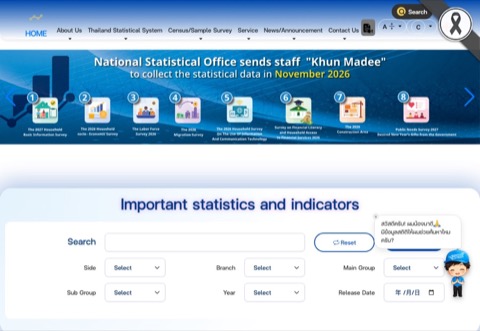
- Vajirayana Digital Library (ห้องสมุดดิจิทัลวัชรญาณ) (瓦吉拉亚纳数字图书馆(泰国文学在线))The Vajirayana Digital Library is a website for reading and studying important Thai literary works online; the site describes itself as "อ่านและศึกษาวรรณกรรมสำคัญของไทยออนไลน์". The catalog can be browsed by genre (such as verse) and author, and includes classical poetic forms such as nirat (travel poems), khlong, kap, mongkhon, klon, and kamsuan; court drama scripts; historical records (จดหมายเหตุ); royal letters; Buddhist texts; and novels, short stories, and some translated works, as well as practical texts on medicine, law, and cooking. The texts of the Thai National Historical Corpus Phase 2 at Chulalongkorn University's ChulaSEAL are taken from this site, and that corpus is also used as one source of example sentences in the DLTO dictionary, showing that it is widely used in Thai historical linguistics research. For readers studying Thai history, religion, literature, and early Sino-Thai relations, it is a commonly used entry point for finding Thai-language primary texts. The homepage does not state the operating institution; please refer to the website's Contact Us page.
Coverage, how to use, and notes
Coverage Includes classical and modern Thai literary works, historical records, royal letters, Buddhist texts, and practical documents; the listing is very long, but the homepage does not give the total number of volumes. The site is classified by genre and author, and has a "new books" section. For the span of periods covered and the edition sources of each text, please refer to each book's page.
How to use Open the homepage and enter the categories from the "genre" or "author" menus, or browse newly added titles under "หนังสือใหม่", then click a title to open its reading page. The homepage does not state whether downloads are offered or whether registration is required; please refer to the official website. For bulk texts, see the compiled version from TNHC2 at Chulalongkorn University.
Notes The site interface and texts are in Thai. The homepage does not state the operator, copyright, or terms of use, nor whether downloading is allowed; before quoting or conducting corpus research, please check the website's contact information and confirm copyright conditions.
Scholarly databases & search tools
- Chula DigiVerse (CUIR and TAIC) (Chula DigiVerse (CUIR与TAIC);朱拉隆功大学数字宇宙平台(CUIR与泰国及东盟信息库))Chula DigiVerse is a digital discovery and access platform built by the Office of Academic Resources (OAR) of Chulalongkorn University. It belongs to the Chula Digital Preservation Project launched in 2023 and works alongside the preservation repository Chula AMATA. The platform integrates two main parts: CUIR, Chulalongkorn University's institutional repository (including theses and dissertations, research reports, articles and books), and TAIC (Thailand and ASEAN Information). TAIC holds digitized cultural heritage on Thailand and Southeast Asia, such as rare books, manuscripts, archival documents, and some historical periodicals and newspapers; listed special collections include the Prince Dhani Nivat Collection, the Prince Kitiyakara Collection, the Siamese edition of the Tripitaka, and rare periodicals and newspapers. For researchers who need to find Thai theses, Thai historical documents and studies of Thai society, this is one of the largest university digital collection gateways in Thailand.
Coverage, how to use, and notes
Coverage According to the official introduction: CHULA e-Theses has over 67,000 theses and dissertations, e-Articles over 2,000 articles, and e-Researches over 2,500 research reports; TAIC covers rare books, manuscripts, archives, and some historical periodicals and newspapers; there are also institutional archives, multimedia and Chula e-Lecture, and open e-books. Languages include Thai and English. Figures follow the official pages and are updated from time to time.
How to use From the DigiVerse homepage, choose collections such as CUIR and TAIC, then search by keyword or browse by collection, subject or author. Each item carries a rights statement: public domain, CC BY-NC 4.0, copyright reserved but educational use permitted, etc.; some items are open only to Chulalongkorn University members or show only abstracts, and in institutional archives the public can see only items marked public. General use is non-commercial, with attribution, and without redistribution or modification. It is advisable to filter for open items in the search results first, then download the PDFs.
Notes Not all theses have full text; check each rights statement. Collection sizes change with updates, so please refer to the official site. The platform interface and much of the metadata are in Thai, and searching with Thai keywords works better.
- Dictionarium Linguae Thai Online (DLTO) (《暹罗语词典》在线版(朱拉隆功大学))DLTO is an online database built by the Chulalongkorn University Faculty of Arts Center of Excellence in Southeast Asian Linguistics (ChulaSEAL), digitizing the Dictionarium Linguae Thai Sive Siamensis published in 1854 (B.E. 2397). The website describes it as the earliest published Thai dictionary extant, with entries citing literary sources, and it is especially useful for studying Thai vocabulary and archaic word meanings of the early Bangkok (Rattanakosin) period. In the original book, pronunciation is marked in Roman letters and definitions are given in Latin, French, and English; the digital edition adds modern spelling and the International Phonetic Alphabet (IPA). The database is based on scans from the Internet Archive that have been proofread, and the work originated from a Thai vowel length research project funded by the National Research Council of Thailand (NRCT), which ended in 2016. The website provides a citation format; for scholarly citation, Pittayawat Pittayaporn (2021) may be cited. For readers studying 19th-century Siamese society, missionary language records, and early Sino-Thai cultural contact, it is a direct entry point to the state of Thai vocabulary at the time.
Coverage, how to use, and notes
Coverage Based on the 1854 edition of the Dictionarium Linguae Thai Sive Siamensis, which has 897 pages in total, with Thai entries and definitions in Latin, French, and English; the digital edition adds modern spelling and IPA pronunciation. The total number of entries in the digital edition is not stated on the official website; please refer to the official website. The site offers English and Thai interfaces.
How to use Enter from the "Dictionary" menu on the official homepage, which offers two modes: Search and Browse. The website's explanatory page describes how the digitized version was prepared, and reading it first is recommended to understand the format. The scanned original can be viewed on the Internet Archive (page link: archive.org/details/ahq1047.0001.001.umich.edu). No registration requirement was seen on the site. The contact email is listed on the official contact page.
Notes The official website does not specify the search options or data use license; please refer to the official website. The original is a dictionary compiled by missionaries in the 19th century, and its spelling and definitions reflect the language of that time, so it cannot be equated directly with modern standard Thai.
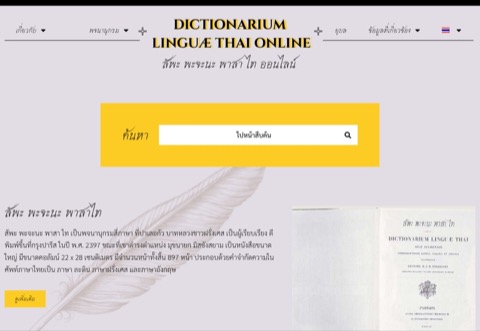
- Ethnic Group Research Database (Sirindhorn Anthropology Centre) (民族群体研究数据库(诗琳通公主人类学中心))This database was built by the Princess Maha Chakri Sirindhorn Anthropology Centre (SAC, a public organization) and systematically compiles bibliographic data on studies of ethnic groups in Thailand and Southeast Asia, so that users can find relevant studies by topic and prepare for further research. It covers studies of ethnic groups in Thailand from 1970 to the present, with some entries concerning neighboring countries such as Laos, Vietnam, Singapore and Malaysia. Search results show author, title, source and year, linked to detail pages. They include entries on Thai Chinese and related groups, for example studies of Yunnanese Chinese in the north and settlements of descendants of Kuomintang remnant troops, which can serve as a source of leads for the literature on Thai Chinese and border peoples. SAC also has other anthropological archive databases that can be consulted together.
Coverage, how to use, and notes
Coverage Covers studies of ethnic groups in Thailand from 1970 to the present; the list page shows 1,279 records (as of the time of search); some concern Laos, Vietnam, Singapore and Malaysia. Entries include author, title, source and year; in the English interface most entries are in English; a few records are marked as having full text, but the list page does not state the overall proportion of full-text records; please refer to the official site.
How to use After entering the database, use basic search, advanced search or browse the full list; the interface comes in Thai and English. When searching for Chinese-related studies, keywords such as Chinese, Yunnanese and Teochew can be used. Click an entry to open the detail page and view the bibliographic data and whether a full-text link is provided. The site offers member login and registration, but the list page does not state whether login is required to view it; please check in actual use. SAC is located at 20 Borommarachachonnani Road, Taling Chan, Bangkok 10170.
Notes Mainly a bibliographic index with limited full text; there is no separate thematic category for Chinese, so results must be filtered by keyword; the number of entries changes with updates.
- GD Catalog (Government Data Catalog, ระบบบัญชีข้อมูลภาครัฐ) (泰国政府数据目录(GD Catalog))GD Catalog is Thailand's government data catalogue system (ระบบบัญชีข้อมูลภาครัฐ). The website shows that it is operated by the National Statistical Office of Thailand (NSO) under the Ministry of Digital Economy and Society. Its purpose is to register the datasets held by government agencies in a unified catalogue, so that researchers can find in one place which agency holds a given dataset and what type it is, and then go to that agency to obtain the data. For research on Thailand's population, ethnic groups, administrative divisions, and social conditions, the catalogue helps to discover registry data, statistical tables, and geospatial data scattered across ministries and local agencies, which may not be found on a general statistical office website. The catalogue is classified by data type and supports keyword searching with logical operators such as AND, OR, and NOT (written in Thai as และ, หรือ, ไม่เกี่ยวกับ), and results can also be filtered by tag and data type. It is a metadata catalogue built by an official agency, suitable as a starting point for finding official Thai data, though it does not replace the data release pages of the individual agencies.
Coverage, how to use, and notes
Coverage At the time of checking, the numbers listed on the website by type were: records 4,672; statistics 16,472; geospatial 429; mixed 1,153; other 2,601, about 25,327 entries in total. The total shown at the top of the page was 0, which appears to be a display problem; please refer to the website. The content consists of metadata of public-sector datasets, mainly in Thai.
How to use Open the website homepage and enter keywords in the search box (Thai works best, e.g. ประชากร for population and กลุ่มชาติพันธุ์ for ethnic groups), then filter the results by tag and data type. Opening an entry shows the data-holding agency and a description; follow the entry's instructions to obtain the data from the original agency. The page has a login entry (single sign-on, with a note on two-step verification), but whether searching itself requires login should be checked on the website. The page does not indicate an API entry.
Notes The interface and entries are mainly in Thai; if you are not familiar with Thai, browser translation may help. The website does not state unified licensing terms, and the conditions of use for each dataset are determined by the data-holding agency. An entry in the catalogue does not mean that the data itself can be downloaded directly.
- Journal of the Siam Society (JSS) (《暹罗学会会刊》)The Journal of the Siam Society is published by The Siam Society under Royal Patronage and has appeared continuously since 1904, making it one of the earliest scholarly society journals in Thailand. Its content covers the archaeology, history, religion, language, literature, art, architecture and performing arts of Thailand and neighboring regions. Early volumes carry many studies and source-based articles on the pre-Bangkok and Bangkok periods, Ayutthaya, inscriptions, folklore and Chinese communities, useful for research on Thai history and Southeast Asian regional history. Issues from 2008 to the present are available on the ThaiJO platform, while the earlier 1904–2008 archive is hosted on the Siam Society website, where most articles can be downloaded directly as PDFs. The journal states that newly published articles are open access immediately.
Coverage, how to use, and notes
Coverage Published continuously since 1904, now twice a year (January–June as Part 1, July–December as Part 2). From 2008 to the present it is on the ThaiJO platform; the 1904–2008 archive is hosted separately on the Siam Society website, listing article titles, authors and PDFs by volume. The language is mainly English; the specific language policy is not stated on the official site, so please refer to it.
How to use On the journal page on ThaiJO, browse by volume and issue or use the site search. To consult early volumes, go to the Publications (JSS) page of the Siam Society website and browse by volume; each article links to its PDF. Both sites open links without registration. Search suggestion: first search recent articles on ThaiJO with keywords (such as Chinese, Teochew, Bangkok temples), then go back to the official site to look through older volumes by year.
Notes Early archives and recent issues are on two different sites, so a single search cannot cover both. The volume pages on the official site also list member-free and non-member subscription prices; these are print subscription prices, and for electronic article links please rely on what is openly accessible on the page and refer to the official site.
- Royal Institute Dictionary Online (พจนานุกรม ฉบับราชบัณฑิตยสถาน) (泰国皇家学术院词典在线查询)This site is the online search tool for the 2011 edition (B.E. 2554) of the Royal Institute Dictionary (พจนานุกรม ฉบับราชบัณฑิตยสถาน), provided by the Office of the Royal Society of Thailand (สำนักงานราชบัณฑิตยสภา, Bangkok). The dictionary is the authoritative reference for standard Thai vocabulary, spelling, and definitions, and scholarly and publishing circles generally rely on it to determine standard usage. For research on Southeast Asian Chinese and regional studies, work on Thai society, religion, the royal institution, and documents often requires checking Thai word meanings, parts of speech, and scope of use; the usage labels on entries (such as written language, archaic, colloquial, royal vocabulary, and obsolete words) help readers judge the register and historical layer of vocabulary. The site pages are in Thai, and also include sections such as the explanatory notes (คำชี้แจง), preface (คำนำ), terms of use, search statistics, and a new-word suggestion form, making it a basic tool for reading Thai historical sources, newspapers, and archives.
Coverage, how to use, and notes
Coverage Includes entries from the 2011 edition of the Royal Institute Dictionary. Entries can be filtered by part of speech (noun, verb, pronoun, adverb/adjective, etc.), field of study (such as law, medicine, physics, linguistics), and usage restrictions (written language, archaic, colloquial, royal vocabulary, obsolete words, etc.). The total number of entries is not stated on the official homepage; please refer to the official website.
How to use After opening the URL, enter a Thai word in the search box to look it up, or go to the browse-by-letter-category page (ค้นหาตามหมวดอักษร) to browse category by category. For precise filtering, use the conditional search to combine filters by part of speech, field, and usage restriction. When no result is found, the page displays "ไม่พบคำศัพท์ที่ต้องการค้นหา". The page has login and registration entries, but basic searching requires no login. The explanatory notes page describes the entry format and annotation symbols, and first-time users are advised to read it first. If an entry carries the label "ใช้เฉพาะของเจ้านาย", it means the word is used only for royalty unless otherwise stated.
Notes The interface and definitions are all in Thai, so basic Thai reading ability is needed, or use alongside a Thai-English dictionary. This is a standard dictionary of the 2011 edition; it does not include new words added after that edition, and it is neither a dialect dictionary nor a historical dictionary, so consult a historical dictionary separately when reading older documents. Please check the terms of use on the official website.
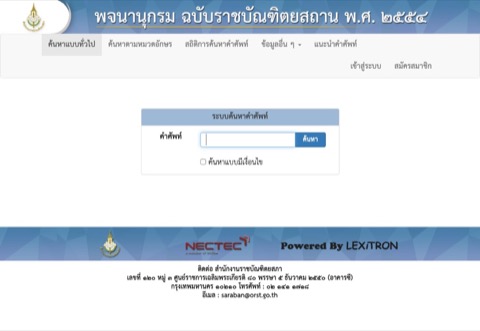
- Thai Digital Collection (TDC) (泰国数字馆藏(TDC,ThaiLIS 学位论文全文库))The Thai Digital Collection (TDC) is the digital collection platform of ThaiLIS (Thai Library Integrated System), maintained by ThaiLIS's Digital Collection Working Group; the footer shows affiliation with UniNet and Thailand's Ministry of Higher Education, Science, Research and Innovation (MHESI). It brings together master's and doctoral theses and other scholarly literature provided by the libraries of member universities and institutions, and is one of the most commonly used national entry points for finding Thai university theses. For Southeast Asian studies, theses from Thai universities cover topics such as Chinese society in Thailand, China–Thailand relations, ASEAN, ethnicity and religion, and local history; many are written only in Thai and do not enter international thesis databases. The TDC can be used to map existing research by Thai scholars on a topic and to verify bibliographic information such as title, author, institution and discipline. The platform offers browsing by document type, institution, creator, subject and thesis major, and supports Z39.50, OAI-PMH and RSS, making it easier for libraries and researchers to connect to.
Coverage, how to use, and notes
Coverage Page statistics at the time of checking: ThaiLIS holdings total 597,376 records, with 601,865 records across the whole site; there were also online users from 23 ThaiLIS member institutions. The content is mainly Thai university theses, along with other types such as research reports. For the full list of types, the date range and the number of records per institution, please consult the official website.
How to use Go to https://tdc.thailis.or.th/tdc/ and use basic or advanced search, or browse by document type, institution, creator, contributor, subject and thesis discipline. Search results can be viewed, printed, emailed or saved. The page provides login and registration entries; when not logged in it displays Not ThaiLIS Member, and some functions (especially full text) may be open only to members or registered users. Pages of several Thai university libraries mention that non-members must register and have a limited daily download quota, but this restriction was not verified on the official pages; please consult the official registration and usage instructions.
Notes The interface and most of the content are in Thai, and Thai pages may display garbled text in some environments. The extent of full-text visibility varies with the thesis's institution and the user's status, and some theses have only bibliographic information and abstracts. During checking, the connection was occasionally unstable on some networks; try again later.
- ThaiJO (Thai Journals Online) (泰国学术期刊在线平台 ThaiJO)ThaiJO (Thai Journals Online) is Thailand's electronic platform for academic journals, supported and managed by the Thai-Journal Citation Index (TCI) Centre and jointly developed and maintained with King Mongkut's University of Technology Thonburi (KMUTT) and the National Electronics and Computer Technology Center (NECTEC). It runs on the open-source Open Journal Systems (OJS) and covers journals in both science and technology and the humanities and social sciences. For researchers on Thailand, it is a main entry point for finding articles in Thai domestic journals: much work on Thai history, politics, religion, language, Chinese and migration, and Southeast Asian regional studies is first published in local journals in Thai or bilingual Thai-English, and these journals are often incompletely indexed in international databases. The platform can be browsed by article, latest issue, journal and author, and has a unified search box, making it suitable for following Thai scholarly discussion of national and neighboring regional issues and for adding perspectives beyond English-language literature.
Coverage, how to use, and notes
Coverage According to statistics on the official homepage, there are about 1,861 journals, 39,509 issues, 426,280 articles and 540,538 authors (figures are updated continuously; please consult the official website). The interface is mainly in Thai, with an English option; the language of articles depends on each journal. The disciplines are not limited to the humanities and social sciences, so users need to select journals relevant to Southeast Asia and the Chinese in Thailand themselves.
How to use Visit the homepage and search by keyword in the search box, or browse through Articles (บทความ), Journals (วารสาร), Latest Issue (ฉบับล่าสุด) and Authors (ผู้นิพนธ์); click EN at the top right to switch to the English interface. Searching with both Thai and English keywords is recommended, such as ชาวจีน, ไทยจีน and Chinese Thai. Individual journals mostly have their own sub-sites, and whether articles can be downloaded directly and whether registration is required are decided by each journal's policy.
Notes The homepage does not state overall fee and licensing terms; the degree of openness varies by journal, so please consult each journal's page. Searching in Thai works noticeably better than in English. The platform includes only journals that have joined it and is not equivalent to all Thai academic journals; quality varies, so it is best to judge using TCI's journal evaluation information.
Research methods & tools
- PyThaiNLP (PyThaiNLP(泰语自然语言处理开源库))PyThaiNLP is an open-source community and Python library of the same name for Thai text processing and linguistic analysis. The website describes it as an open-source community building Thai software and datasets, and the list of developers is published on the homepage. The library is similar in function to NLTK for English, providing sentence, word, and subword segmentation; part-of-speech tagging; romanization and IPA transcription; spelling suggestion and correction; and tools such as Soundex, conversion of Thai baht amounts to words, and Thai-style date formatting, with built-in Thai character sets, word lists, and stop words. The community also maintains several open datasets and related projects, such as the Thai Constitution corpus, the Thai government websites corpus (ThaiGov), the Thai law (parliamentary acts) dataset, a Thai-Lao parallel corpus, and Thai synonym resources, mostly licensed under CC0 or Apache 2.0. For readers studying Thai politics, law, society, and media, since Thai has no spaces between words, word segmentation is the first step of text analysis, and the library provides basic tools suited to digital humanities and computational text analysis.
Coverage, how to use, and notes
Coverage Code is licensed under Apache-2.0, and data and models under CC0-1.0 and CC-BY-4.0. The website's projects page lists 25 projects and datasets, with corpora including the constitution, government websites, law, Thai-Lao parallel corpus, social media sentiment corpus (Wisesight), and news corpus (Prachathai-67k). The current version is 5.4.0 (according to the GitHub page), supporting Python 3.9 and above.
How to use Install with pip install pythainlp; optional extras include compact, translate, wordnet, and full (full may cause dependency conflicts). Corpora are downloaded by default to pythainlp-data in the user directory, which can be changed with the environment variable PYTHAINLP_DATA; setting PYTHAINLP_OFFLINE=1 disables automatic downloads. Datasets can be found on the website's projects page (pythainlp.org/projects/), and the documentation pages are listed by version. For scholarly citation, use the Zenodo DOI 10.5281/zenodo.3519354 or the NLP-OSS 2023 paper. No registration is required.
Notes This is a general-purpose NLP tool rather than a historical source database; the segmentation and tagging performance on Old Thai, dialects, and historical documents should be tested by the user. Each dataset has a different license, so check its page before use. The homepage's description of functions is brief; please refer to the documentation for details.
Libraries & archives
- National Archives of Thailand (泰国国家档案馆)The National Archives of Thailand (NAT), under the Fine Arts Department of Thailand's Ministry of Culture, is the national institution that preserves and provides government records and historical archives. For research on modern and contemporary Thai history, Siam's foreign relations, national policy, and the social and economic position of Chinese in Thailand, it is one of the most important official archival sources. The official site states that the archives provide access to textual and audiovisual records, and offer an archive search service, an online archive search system (archives.nat.go.th), e-books, videos, exhibitions and Memory of the World content; the site also provides a gallery of precious images. The main site is in Thai with very little English content, so English readers need to use the Thai interface or contact the archives in advance.
Address The National Archives of Thailand, Samsen Road, Dusit, Bangkok, 13000, Thailand View on map ↗
Coverage, how to use, and notes
Coverage Services listed on the official site include textual records, audiovisual records, precious images, e-books and annual reports, exhibitions, and archive search and the online search system. The size of the holdings, date span and languages are not stated on the homepage; please refer to the official site.
How to use The official homepage states opening hours: textual records Monday to Saturday 8:30–16:00; audiovisual records Monday to Friday 8:30–16:00; closed on public holidays and some Saturdays; research services are suspended from 15 to 31 December each year for the annual document inventory; the site also lists some temporary closure dates in 2026. You can first search through the online archive search system (archives.nat.go.th) linked from the site, then visit to consult records. For admission rules for foreign researchers, please refer to the official site and the archives' notices; it is advisable to email in advance via the contact page on the site or call +66 2282 8423.
Notes The official site is mainly in Thai, with limited English pages. Closures and service hours are subject to temporary adjustments; please check before visiting. The official page for the address comes from NAT's conference site (sarbica2023.nat.go.th).
- National Library of Thailand (泰国国家图书馆)The National Library of Thailand is located on Samsen Road in Dusit District, Bangkok, under the Fine Arts Department of Thailand, and is Thailand's national institution for collecting and serving books and documents. Its official website brings together a single search for the holdings (Single Search, a Primo-based union catalogue entry), the D-Library digital library, a search system for ancient manuscripts, e-book and e-newspaper platforms (including 2ebook, CU-eLibrary, SE-ED E-Library and Hibrary), and video on demand of its holdings (NLT VDO on Demand). For Southeast Asian regional studies, the National Library of Thailand is a basic entry point for checking the bibliography of Thai-language publications, consulting Thai publications and official documents, and learning about the preservation of Thai manuscripts and inscriptions; it is also an important source of leads for finding Thai-language primary printed materials when studying Chinese society in Thailand and China–Thailand relations. Researchers can first confirm holdings through the website's catalogue and digital libraries, then decide whether to visit in person or contact the library about copying and reading requirements.
Address ถนนสามเสน แขวงวชิรพยาบาล เขตดุสิต กรุงเทพมหานคร 10300 View on map ↗
Coverage, how to use, and notes
Coverage Resources listed on the official homepage include: the single-search catalogue, the D-Library digital collection, the ancient manuscript search system (inscriptions, Thai folding books, scripture cabinets, palm-leaf manuscripts), several e-book and e-newspaper platforms, and video on demand. The total number of volumes, language composition and date range of the holdings are not stated on the website's homepage or contact page; please consult the official website.
How to use Online, enter the Single Search and digital collection links from the homepage at https://www.nlt.go.th/; the search interface is mainly in Thai, and an English switch can be tried. For the address for visiting in person, see above. The contact page of the website gives the main switchboard telephone as 0 2280 9828 to 32, and the general affairs section as 0 2280 9859 or 0 2281 5449. Opening hours and admission and registration rules were not listed on the pages checked; please see the website's Contact Us or FAQ page, or call to confirm. The website has previously posted notices of holiday closures and temporary adjustments during the relocation of the holdings; please check the latest announcements before traveling.
Notes The homepage and contact page do not list regular opening hours and membership rules, which must be confirmed with the library. Some digital resources may require login or registration. The website's pages are mainly in Thai.
- Princess Maha Chakri Sirindhorn Anthropology Centre Library (诗琳通公主人类学中心图书馆)The Princess Maha Chakri Sirindhorn Anthropology Centre is a Thai institution dedicated to collecting materials on and conducting research in anthropology. Its library is on the 8th floor of the Centre building. According to the official website, the collection can be browsed by Library of Congress classification (e.g. Class G, Geography and Anthropology) and by type, including books, e-books, journals and bound journals, theses and research reports, reference works, maps, audiovisual materials, and cremation books. Cremation books are a distinctively Thai type of publication and often contain biographies and local history. The library catalogue can be searched online at lib.sac.or.th. For readers studying the ethnic groups, society, culture and ethnicity of Thailand and Southeast Asia, it is a specialist source for anthropology. The Centre also hosts online resources such as a Southeast Asian social and cultural information database and anthropological archives; please consult the official website for their contents.
Address No. 20 Borommarat Chonnani Road, Taling Chan, Bangkok 10170 View on map ↗
Coverage, how to use, and notes
Coverage According to the official website, collection types include books, e-books, journals, bound journals, theses and research reports, reference works, maps, audiovisual materials, and cremation books. There is also a 'Happy Body Mind' branch library (general knowledge, literature, children's books, magazines, and audiovisual materials). The website page does not state the size or date range of the collection.
How to use On-site visit. The main library is open Monday to Friday 8:30-16:30 and Saturday 9:00-16:00, and closed on public holidays and government-announced holidays; the branch library keeps different hours, so please check the website. The catalogue can be searched online (lib.sac.or.th), and the collection can be browsed by call number or collection type. Contact: tel. 0-2880-9429 ext. 3702; email is on the website's contact page. The website does not state the conditions of use or registration procedure for external readers; contacting the library first is advised.
Notes The website has a member login, but it does not state the rules for external readers; please confirm before visiting.
- SEAMEO SPAFA Library and Documentation Services (东南亚教育部长组织考古与美术区域中心(SPAFA)图书馆与文献服务)SEAMEO SPAFA is the Regional Centre for Archaeology and Fine Arts under the Southeast Asian Ministers of Education Organization, headquartered in Bangkok. Its Library and Documentation Unit was established in 1986 and operates as part of the Centre. The official site says the library supports the Centre's programmes, collects documentation on fine art forms endangered by neglect, acquires books and information resources related to the Centre's themes, and documents cultural objects and activities. Services include answering inquiries, literature search and referral, indexing and abstracting, maintaining databases, providing research services and in-service training for librarians. For readers studying Southeast Asian archaeology, art history and cultural heritage, it is a specialized regional resource point; its publication, the SPAFA Journal, is also a commonly used journal in regional studies.
Address SEAMEO SPAFA Building, 81/1 Si Ayutthaya Rd, Thewet, Dusit, Bangkok, 10300, Thailand View on map ↗
Coverage, how to use, and notes
Coverage Topics center on Southeast Asian archaeology, fine arts and cultural heritage. The official site does not state the size, date range or languages of the holdings; please refer to the official site.
How to use Visit in person; materials can be read and photocopied in the library, and books may not be taken out. Opening hours are Monday to Friday 9:00–16:00, closed on public holidays. The official site has a link to the collection search page (http://203.146.186.3/elib/); please confirm on the official site before use. For interlibrary loans, contact the librarian. Contact: telephone +662-2804022 (extension to 9), email on the official contact page. The official site does not state whether an appointment is required; it is advisable to contact them first.
Notes The official page does not describe the catalogue's functions or the holdings in detail; the search link is in the form of an IP address, so please refer to the official site.
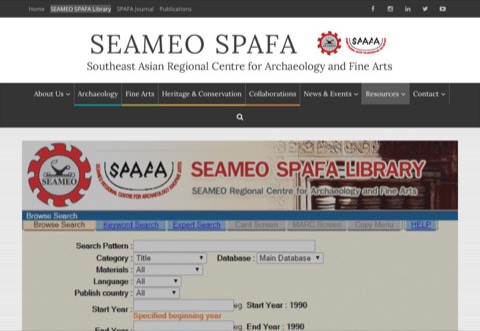
- Thailand and ASEAN Information Center (TAIC), Chulalongkorn University (朱拉隆功大学泰国与东盟信息中心(TAIC))The Thai and ASEAN Information Centre (TAIC) belongs to the Office of Academic Resources, Chulalongkorn University, and is located on the 6th floor of that office. According to its website, the Centre provides social science information on Thailand and Southeast Asia, covering politics and governance, economics, security, arts and culture, ethnic groups, and development. Its collections include Cold War-era documents, works by King Rama V and King Rama VI, writings by royal family members and the private libraries of some princes, ASEAN publications, and a China Studies corner (including nearly 2,000 volumes from Taiwan); the 6th floor also has a rare book room holding more than 20,000 old and rare books. The website lists digital resources including an ASEAN bibliographic database, a Thai and ASEAN thematic database of about 100,000 records, an open-access digital archive on communism and social development in the Cold War period, and the King Chulalongkorn digital archive. The Centre also houses the Taiwan Resource Center for Chinese Studies (TRCCS), established in cooperation with the National Central Library of Taiwan, which provides Sinological materials and databases from Taiwan.
Address 6th floor, Office of Academic Resources, Chulalongkorn University, Phayathai Rd., Pathumwan, Bangkok 10330, Thailand View on map ↗
Coverage, how to use, and notes
Coverage Materials on Thailand and ASEAN covering politics, economics, security, culture, ethnic groups, and development; Cold War documents, works by Rama V and Rama VI, ASEAN publications, a China Studies corner (nearly 2,000 Taiwanese books), and a rare book room (more than 20,000 volumes). The thematic database has about 100,000 bibliographic records.
How to use On-site visit to the 6th floor. The website states that Chulalongkorn University members may use and borrow materials at the Centre; the page does not say whether non-members may use the physical collections, and some digital resources require a Chulalongkorn account login. Please first enquire through the website's contact page or by phone at (66) 2-218-2959. Opening hours are on the Office of Academic Resources 'Libraries & Opening Hours' page (car.chula.ac.th/detail_hour.php).
Notes The website does not state the conditions for on-site use by external readers; some digital resources require a university account, and this entry does not cover logging in.
Museums & memorials
- Thailand–Burma Railway Centre (泰缅铁路中心)The Thailand-Burma Railway Centre is an interactive museum and research institution in Kanchanaburi Province dedicated to the history of the construction of the Thailand-Burma Railway (also known as the Death Railway) during the Second World War. According to its website, the Centre is an information and research facility; its research work includes mapping the entire railway line, collecting and organizing prisoner-of-war camp administrative records and related documents, compiling reports by senior POW officers, planning interviews with survivors, and locating abandoned sections and camps in the field and cataloguing recovered artefacts. The construction of the railway employed large numbers of POWs and Asian labourers and involved Thailand, Burma, Malaya and other places, so it is a useful reference for studying wartime Southeast Asia, the Japanese occupation, and the experiences of various groups, including ethnic Chinese. Which groups are covered should be checked against the exhibitions and the official website.
Address T.B.R.C. Co., Ltd, 73 Jaokannun Road, BanNua, Amphoe Muang, Kanchanaburi 71000, Thailand View on map ↗
Coverage, how to use, and notes
Coverage The subject is the construction history of the Thailand-Burma Railway in the Second World War. Items listed on the website's research page include railway maps, a database of POW records (still being collected and organized), senior officers' reports, and field survey findings; other details of scale and date range are not stated on the website.
How to use On-site visit. The website states that it is open daily 9:00-16:00, subject to official Thai holiday regulations; adult admission is 160 baht and admission for children aged 7 to 12 is 80 baht; school groups can email via the website's contact page to ask about discounts and educational services. The website's research page does not describe procedures for researchers to consult materials; to consult materials, please first contact the Centre (tel. 034 512721 or +66 34 512721; email on the website's contact page).
Notes Some website pages were last updated in 2022; please verify admission prices and opening hours before visiting. The website does not explain how research materials can be accessed.
Other
- SHT Knowledge Hub (Siamese Heritage Trust Knowledge Hub)Online heritage conservation resource platform of the Siamese Heritage Trust under the Siam Society, with conservation laws and regulations, manuals, articles and studies, a directory of experts and organisations, and a channel for reporting heritage at risk.
- Thai Missions Digital Library (泰国宣教数字图书馆)An online resource library on Christian ministry in Thailand, managed by OMF Thailand. It collects articles, books, papers, courses, maps, research reports and theses related to the Thai church and missions, which can be browsed by alphabet, resource type, topic, author or year of publication, or searched by keyword. Topics include Buddhism, church history, contextualization, missions and church planting, church statistics and tribal peoples. Examples on the site include the 1912 autobiography of Daniel McGilvary on missionary work in northern Thailand and a 1918 biographical piece on the missionary Eugene Dunlap. These materials are directly useful for studying Thai church history, the relationship between missionary groups and local society, and the interaction between Christianity and Buddhist society. The library is a collection of materials from a missionary organization, and some content reflects a missionary standpoint, so it should be read alongside academic literature. Chinese churches and Chinese Christian communities in Thailand are not a dedicated topic of the library; relevant materials must be searched within it.
Coverage, how to use, and notes
Coverage The site's search page shows 406 resources in total, including 156 articles, 87 maps and 78 courses, as well as theses, research reports, books and handbooks. Topics include Buddhism, church history, contextualization, church planting, discipleship, evangelism, leadership, syncretism and tribal peoples. The date range and language proportions are not stated clearly on the site; please refer to the official site.
How to use The homepage can be browsed without logging in. Resources can be filtered by alphabet, resource type, topic, author or year of publication, or searched by keyword (supporting both exact-term and related-concept modes). The site provides an entry for suggesting new resources. For the scope of collection, copyright and terms of use, read the About page on the site. To find church history materials, start with the church history topic and map-type resources.
Notes Maintained by a missionary organization; some materials have an evangelistic standpoint and are secondary or internal religious sources, so their nature should be borne in mind when citing. The site does not state download and reuse conditions or the specifics of the About page; please refer to the official site. The number of resources changes.
Vietnam15
Newspapers & news archives
- Digitized Newspapers, National Library of Vietnam (Thư viện báo chí – Digitized Newspapers(越南国家图书馆数字化报刊库))This site is a digitized newspaper archive built by the National Library of Vietnam. The page states that it holds 10,865 issues totaling 68,935 pages. The example on the homepage is the issue of Gia Định báo (Gia Dinh Newspaper) of 30 June 1896, one of the earliest newspapers in Vietnam printed in quốc ngữ (romanized script). The site supports searching and browsing by newspaper title or date, and has a help page. For the modern history, press history and language history of Vietnam and for studies of colonial-period society, such original newspapers are direct sources on public opinion, advertisements, notices and daily life of the time. Scholars of the Chinese community in Vietnam, Chinese merchants and China–Vietnam relations can also find contemporary reports here. As a resource built by the National Library, its source is clear and it can be used directly online; it can be used alongside databases such as the National Library Board Singapore's NewspaperSG to supplement the Vietnamese side.
Coverage, how to use, and notes
Coverage The page states 10,865 issues and 68,935 pages of digitized newspapers; the homepage example is Gia Định báo of 1896. The list of titles, start and end dates and language composition are not stated on the homepage; please consult the official site.
How to use On the official site, use the search function, or browse by newspaper title or date; a help page is provided, and first-time users are advised to read it. The entry page can be viewed without registration. Vietnamese keywords are recommended, and note older spellings and forms without tone marks. For details of the holdings, contact the library administrator listed on the page; see the contact page on the official site for the email address.
Notes Access restrictions and download terms are not stated on the homepage; please consult the official site. OCR quality varies across older newspapers, so full-text search results may be incomplete. The collection's scope does not represent the whole of Vietnamese periodicals.
Archives & historical document databases
- Indochina Book Collection, National Library of Vietnam (Bộ sưu tập Sách Đông Dương(越南国家图书馆“印度支那书籍”数字馆藏))Sách Đông Dương (Indochina Books) is a digitized collection built by the National Library of Vietnam. It contains older books related to Indochina, searchable online with page images available for browsing. According to the site, it holds 1,157 titles totaling 131,125 pages; an example on the site is the 1926 Quảng Bình địa dư tiện đọc. The interface is available in English and Vietnamese, with a search box and browsing by year. For research on Vietnam and mainland Southeast Asia, these local gazetteers, textbooks and readers published during and around the colonial period, in Vietnamese, French and other languages, are primary sources for the social and local history, language and print culture of Vietnam. For scholars of the Chinese in Vietnam, Chinese merchants and China–Vietnam contacts, they can also serve as corroborating material, though they require selection. The collection is built and managed by the National Library itself, and readers can view the digitized images online without visiting the library.
Coverage, how to use, and notes
Coverage The site states that the collection comprises 1,157 books and 131,125 pages related to Indochina. The date range, language distribution and subject classification are not stated on the homepage; please consult the official site.
How to use On the official site, use the search box, or the 'Tìm kiếm' (search) and 'Năm' (year) links to browse by year; click a book entry to view page images online. The interface can switch between English and Vietnamese. When searching, try older Vietnamese spellings, place names and title keywords. For use or reproduction, contact the library administrator listed on the page; see the contact page on the official site for the email address.
Notes The page does not state terms for downloading or reuse; follow the rules on the official site for use and citation. The languages and content types of the books are not itemized on the homepage. Older and modern Vietnamese spellings differ, so try several variants when searching.
- Công báo điện tử nước CHXHCN Việt Nam (Electronic Official Gazette of the Socialist Republic of Viet Nam) (越南社会主义共和国电子公报)The Electronic Gazette (Công báo điện tử) is an official website built and maintained by the government information and communications unit of the Government Office of Vietnam (Văn phòng Chính phủ), used to publish the formal legal documents of state agencies. The website shows that issuing bodies covered include the State President, the National Assembly and its Standing Committee, the Government and Prime Minister, ministries, the State Bank, the courts, the procuracy and the State Audit Office. Documents can be browsed by issuing body, document type (law Luật, decree Nghị định, decision Quyết định, circular Thông tư, resolution Nghị quyết, etc.) and date of issue. Each document has its own page, and whole gazette issues can be downloaded as PDF or printed. For Southeast Asian area studies, it is an authoritative official source of texts for current Vietnamese laws and policies, including investment, management of foreigners, ethnicity and religion, and foreign economic and trade matters, and can be used to verify the official versions of legal provisions and their effective dates.
Coverage, how to use, and notes
Coverage The website holds the official gazette and legal documents issued by Vietnamese state agencies, organized by issuing body, document type and date. The earliest year available and total volume are not stated on the homepage; please consult the website.
How to use Go directly to congbao.chinhphu.vn; no registration is required. The page has a search box, where you can choose to search all information, only the gazette, or only documents, and an advanced search is available. You can also browse step by step by issuing body, document type and date. Individual documents have their own pages, and whole gazette issues can be downloaded as PDF or printed. When reproducing content, the website requires the source to be cited as congbao.chinhphu.vn.
Notes The interface and documents are in Vietnamese; English or Chinese translations must be found elsewhere. The homepage does not state how far back past issues go, so this site should not be relied on for colonial-era or pre-1945 materials.
- Cơ sở dữ liệu quốc gia về pháp luật (VBPL) (National Legal Database) (越南国家法律数据库)VBPL is the national legal database portal under the Ministry of Justice of Vietnam (Bộ Tư pháp). The website states that the operating body is the Ministry of Justice, with its contact address at No. 60 Trần Phú, Ba Đình, Hanoi. The portal provides a search service for Vietnamese legal documents and is one of the officially built entry points for legal texts, with basic value for research on Vietnam's legal system, policies concerning ethnic Chinese and foreigners, and investment and trade rules. It should be noted that at the time of verification the page mainly displayed a loading prompt, so details such as scope of coverage, search functions and the range of years could not be confirmed directly from the page.
Coverage, how to use, and notes
Coverage The website is a national legal database; the specific document types, time span and number of documents included were not displayed at the time of verification. Please consult the website.
How to use Access it at vbpl.vn; no login was required at the time of verification. The page must load fully before use; for specific search fields and download and export options, please check within the site.
Notes At verification, it was only confirmed that the website opens and shows the Ministry of Justice as operator; the main body of the page was in a loading state and functional details were not confirmed. The interface and documents are in Vietnamese.
Scholarly databases & search tools
- Vietnam Journals Online (VJOL) (越南期刊在线)Vietnam Journals Online (Tạp chí Khoa học Việt Nam Trực tuyến, VJOL) is a centralized search and full-text platform for Vietnamese academic journals. According to its website, it offers readers in Vietnam and abroad scholarly work published in Vietnam. It is managed and developed by the science and technology information, statistics and evaluation authority under Vietnam's Ministry of Science and Technology, and also supplies data for the national annual journal assessment. The homepage states that there are 425 member journals, which share full texts in PDF format. Journals on the platform are mainly in Vietnamese, with some English editions. For Southeast Asian and area studies, VJOL's value lies in direct access to history, social science and humanities articles published by Vietnamese scholars, including local studies of the modern Vietnamese press, colonial-era publications, the Hoa (ethnic Chinese) community, and the social history of Ho Chi Minh City and Cholon. These articles often cite old newspapers and periodicals held in Vietnamese collections, so the platform can serve as an entry point for finding leads on colonial-era press and for gauging the state of Vietnamese scholarship. The platform is not an archive of original press items but a digital collection of contemporary academic journals, and it can be used together with French- and English-language databases of colonial-era press.
Coverage, how to use, and notes
Coverage Covers academic journals published in Vietnam; the homepage states 425 member journals. Mainly PDF full texts, including each journal's tables of contents, abstracts and full texts. Subjects span science and technology as well as the humanities and social sciences, of which history, culture and social science journals are most relevant to area studies. Start years and depth of back files vary by journal and are not listed uniformly on the site; please consult each journal's page.
How to use From the homepage, browse by journal title or use the site search box to search by keyword or author. For Vietnamese search terms, try both the diacritic form and the unaccented form. Click an article to see its abstract; PDF full texts of member journals can be downloaded. Some journal pages redirect to the publisher's own website. The platform is built on OJS (Open Journal Systems), so interfaces and sections differ slightly between journals. When searching for research on ethnic Chinese, try Vietnamese keywords such as người Hoa, Chợ Lớn, báo chí quốc ngữ and báo chí thời Pháp thuộc. The website also has a mirror domain that can be used if access fails.
Notes The homepage does not state access conditions for all journals, and openness may differ between journals. The login page is for journal editors and authors; readers do not need to log in. The platform holds contemporary academic journals, not scanned originals of colonial-era press. For the year range and download availability of specific journals, please consult the website.
Libraries & archives
- General Sciences Library of Ho Chi Minh City (胡志明市综合科学图书馆)The Ho Chi Minh City General Sciences Library is one of the largest general public libraries in southern Vietnam. According to the website's introduction, its predecessor was the library of the Government of Cochinchina established in 1868; in 1882 it was renamed the Documentary Library of the French Cochinchina Government and became Vietnam's first public library. Before 1975 it was the National Library of South Vietnam, and the current building was begun in 1968 and completed in 1972. After 1975 it was called National Library II, and on 14 April 1978 it adopted its present name. Because its collections and users are in the Saigon–Cholon area, it has practical value for scholars studying the history and society of southern Vietnam, including the ethnic Chinese community of Cholon (Chợ Lớn). The website has an online catalogue search entry (Tìm tài liệu), an electronic theses section, shared network digital resources, an e-book platform, and thematic bibliographies on southern local culture, such as Southern reformed theatre (Cải lương Nam Bộ), President Ho Chi Minh and the 1975 liberation. The library has a restricted-documents reading room (including Hán-Nôm documents) and a music research room.
Address Số 69 Lý Tự Trọng, Phường Bến Thành, Thành phố Hồ Chí Minh View on map ↗
Coverage, how to use, and notes
Coverage The homepage lists: an electronic theses and dissertations section (Luận văn – Luận án điện tử), digital resources shared across library networks, the Sachweb e-book platform, and a free digital library for children. Physical reading rooms include a general reading room, a children's and youth room, a business room, a restricted-documents room (including Hán-Nôm documents) and a music research room. The website's introduction page does not give total holdings or the number of theses; please consult the website.
How to use Search the bibliographic catalogue through Tìm tài liệu on the catalogue portal phucvu.thuvientphcm.gov.vn, which also offers online reader card registration. Electronic theses and their submission regulations can be accessed from the relevant sections of the website. For on-site research, please first contact the library (telephone +84 (028) 3 8 225 055; email is on the website's contact page) to confirm opening hours and borrowing rules; restricted documents (including Hán-Nôm) may have separate application rules.
Notes The website does not list opening hours, total holdings or postal code. The openness and download conditions of electronic theses are not stated on the website; please consult the actual pages. The website gives the address as Phường Bến Thành, Thành phố Hồ Chí Minh, without a postal code.
- General Sciences Library of Ho Chi Minh City (胡志明市综合科学图书馆)The Ho Chi Minh City General Sciences Library is one of the largest general public libraries in southern Vietnam. According to the website's introduction, its predecessor was the library of the Government of Cochinchina established in 1868; in 1882 it was renamed the Documentary Library of the French Cochinchina Government and became Vietnam's first public library. Before 1975 it was the National Library of South Vietnam, and the current building was begun in 1968 and completed in 1972. After 1975 it was called National Library II, and on 14 April 1978 it adopted its present name. Because its collections and users are in the Saigon–Cholon area, it has practical value for scholars studying the history and society of southern Vietnam, including the ethnic Chinese community of Cholon (Chợ Lớn). The website has an online catalogue search entry (Tìm tài liệu), an electronic theses section, shared network digital resources, an e-book platform, and thematic bibliographies on southern local culture, such as Southern reformed theatre (Cải lương Nam Bộ), President Ho Chi Minh and the 1975 liberation. The library has a restricted-documents reading room (including Hán-Nôm documents) and a music research room.
Address 69 Lý Tự Trọng, Phường Bến Thành, Thành phố Hồ Chí Minh View on map ↗
Coverage, how to use, and notes
Coverage The homepage lists: an electronic theses and dissertations section (Luận văn – Luận án điện tử), digital resources shared across library networks, the Sachweb e-book platform, and a free digital library for children. Physical reading rooms include a general reading room, a children's and youth room, a business room, a restricted-documents room (including Hán-Nôm documents) and a music research room. The website's introduction page does not give total holdings or the number of theses; please consult the website.
How to use Search the bibliographic catalogue through Tìm tài liệu on the catalogue portal phucvu.thuvientphcm.gov.vn, which also offers online reader card registration. Electronic theses and their submission regulations can be accessed from the relevant sections of the website. For on-site research, please first contact the library (telephone +84 (028) 3 8 225 055; email is on the website's contact page) to confirm opening hours and borrowing rules; restricted documents (including Hán-Nôm) may have separate application rules.
Notes The website does not list opening hours, total holdings or postal code. The openness and download conditions of electronic theses are not stated on the website; please consult the actual pages. The website gives the address as Phường Bến Thành, Thành phố Hồ Chí Minh, without a postal code.
- National Library of Vietnam (越南国家图书馆)The National Library of Vietnam is located on Tràng Thi Street, Hoan Kiem District, Hanoi, and is Vietnam's national library; its website has English introduction pages. The library has book reading and periodical reading departments, and the website also lists several digital collections, including Indochina Books, SINO-Nom Books, English-language books about Vietnam, and Hanoi-related books and maps. For readers studying Southeast Asian regional history, publications of the French Indochina period, the Chinese-character literary tradition between Vietnam and China, and Chinese society in Vietnam, the National Library is a basic source of literature that can be visited in person. It is not a dedicated Chinese-studies collection, but Vietnamese publications, French-period publications, and local documents are relatively concentrated here and can complement materials from archives and research institutes. The English pages of the website do not state the languages and size of the digital collections, so users need to check in the library's system or ask the library. Library services include an entry for obtaining a reader card; please check the website for specific rules.
Address 31 Trang Thi Street, Hoan Kiem District, Hanoi, Vietnam View on map ↗
Coverage, how to use, and notes
Coverage The digital collections listed on the English pages of the website are: Indochina Books, SINO-Nom Books (named on the page, which does not state language or quantity), English-language books about Vietnam, and Hanoi books and maps. The physical collection has two departments, book reading and periodical reading. The English pages do not give the total size, date span, or language proportions of the collections, and none are inferred here.
How to use The English pages of the website have 'Go to Library' and 'Get a Library Card' entries, through which one can reach the catalogue search and learn about registration. On-site use requires a reader card; the requirements, fees, and documents needed are not stated on the English pages, so please check the official website. The opening hours given on that page are daily 8:00-20:00, but the page uses an old telephone number format, so it is advisable to verify again before visiting. Foreign researchers are advised to ask in advance via the website's contact details about reading and copying rules.
Notes The English pages of the website are fairly brief, and the access rights for the digital collections (whether in-library access is required) are not stated. The page does not list a postal code.
- Trung tâm Lưu trữ quốc gia I (National Archives Center I) (越南国家档案一中心)National Archives Center No. 1 is located in Hanoi and is one of the centers in Vietnam's national archival system that preserve historical records. It is under the State Records and Archives Department of Vietnam (Cục Văn thư và Lưu trữ nhà nước). The collection highlighted on its website is the Nguyen dynasty Châu bản (Châu bản triều Nguyễn), the vermilion-annotated official documents of the Nguyen imperial court, described as a UNESCO-recognized documentary heritage. The website states that the center holds 489 representative texts among them, and also mentions other administrative records such as the archives of the Nguyen Imperial Clan Court (Tôn Nhân Phủ) and land registers (địa bạ). For Nanyang and Southeast Asian area studies, Nguyen court documents are primary sources on nineteenth-century Vietnam's diplomatic relations with neighboring states such as Qing China, Siam and Cambodia, and on policies for managing ethnic Chinese communities (Minh Huong and Qing people). The website also offers online exhibitions, such as the 2026 exhibition Chạm dấu thời gian, hành chính Việt Nam 1802 - 1945, as well as 3D exhibitions, short historical films and a publications section, which are useful for getting an overview of the holdings before a visit.
Address 5 Vũ Phạm Hàm, Yên Hòa, Cầu Giấy, Hà Nội, Việt Nam View on map ↗
Coverage, how to use, and notes
Coverage The website mainly introduces the Nguyen dynasty Châu bản and other Nguyen administrative records (Imperial Clan Court, land registers, etc.), and has online exhibition and publication sections. The dates, quantities and languages of other fonds are not stated on the homepage; please consult the website.
How to use The website is archives.org.vn and has a reading room section (phòng đọc) with pages introducing the reading room and its rules. For on-site research, contact the reading room: telephone (84-4) 37822545 ext. 208; email is on the website's contact page. The rules page cites the following: Circular No. 10/2014/TT-BNV of the Ministry of Home Affairs (regulations on use of records in historical archives reading rooms) and Circular No. 05/2015/TT-BNV (catalogue of records with restricted use), and Circular No. 30/2004/TT-BTC of the Ministry of Finance (fees for consulting and using archives). Opening hours, application procedures and copying rules are not stated on the website pages; please confirm in advance by contacting the center. No online search catalogue is visible on the homepage.
Notes The website pages do not list a postal code; opening hours, application procedures, fees and copying rules are not stated, so please contact the reading room before visiting. Châu bản documents are mostly in classical Chinese, so use requires a grounding in Classical Chinese and Hán-Nôm. Some records fall under restricted use.
- National Archives Center I of Vietnam, Hanoi (越南国家档案中心一(河内))National Archives Centre No. I of Vietnam (Trung tâm Lưu trữ quốc gia I) is a Vietnamese national archival institution based in Hanoi. Its website has sections on the centre's functions and organization, news and events, the Nguyen dynasty imperial records (Châu bản triều Nguyễn), exhibitions, publications, and an introduction to its holdings, as well as pages on the reading room and its regulations. For the study of Vietnamese history, it is the primary window onto historical archives preserved by the Vietnamese state, especially Nguyen court documents. Scholars studying Nguyen policies toward the Chinese and Chinese merchants, Sino-Vietnamese relations, and colonial-period Tonkin archives usually learn the scope of materials through the centre's holdings introduction before contacting it for access. The website provides a reading room telephone number and an email address for enquiries and appointments.
Address 5 Vũ Phạm Hàm, Yên Hòa, Cầu Giấy, Hà Nội;官网未写邮编 View on map ↗
Coverage, how to use, and notes
Coverage The website sections show that its holdings introduction covers historical archives such as the Nguyen dynasty imperial records. The date range, quantity, and languages (Chinese, Nom, French, Vietnamese, etc.) of each fonds are not stated on the home page; please check the website's holdings introduction page.
How to use On the website, learn about the holdings through the holdings introduction and reading room sections, and read the reading room regulations (Nội quy phòng đọc). The home page lists the reading room telephone number (84-4) 37822545 (ext. 208) and an email address, which can be used to ask about consultation procedures beforehand. No online search catalogue was found on the home page; one must visit or contact the reading room. The website is mainly in Vietnamese.
Notes The home page lists only the footer address, 5 Vũ Phạm Hàm, Yên Hòa, Cầu Giấy, Hà Nội, does not separately mark the reading room address, and gives no postal code; the telephone area code format is old, so please verify current contact details first. Third-party reports have given different street numbers; please rely on the official website. No online search function was found.
Museums & memorials
- Vietnam National Museum of History, Hanoi (越南国家历史博物馆(河内))The Vietnam National Museum of History is located in Hoan Kiem District, Hanoi, and is under the Ministry of Culture, Sports and Tourism of Vietnam. It is Vietnam's national institution for displaying and researching historical and archaeological objects. Its permanent exhibition presents artefacts from successive historical periods of Vietnam in chronological order, including protohistoric cultures such as the Dong Son, Sa Huynh, and Oc Eo cultures, as well as Champa sculpture. The website describes the Dong Son culture as a cultural diffusion centre in Southeast Asia, which directly helps in understanding early contacts between Vietnam and mainland and island Southeast Asia. The museum has a library and documentation room whose books and digitized materials can be searched on computers in the museum, including publications on Vietnamese culture, Cham culture, and Indochinese prehistory written by French scholars from the 19th to early 20th century. For readers studying Southeast Asian regional history, archaeology, art history, and Vietnam's relations with neighbouring regions, it is a place that can be visited in person and offers specialist literature. The museum is not a specialized institution for Chinese studies; researchers on the Chinese and Nanyang Chinese can mainly use it as a basic place to learn about the historical background and material culture of ancient and modern Vietnam.
Address No. 1, Trang Tien, and No. 216 Tran Quang Khai, Hoan Kiem, Hanoi, Vietnam View on map ↗
Coverage, how to use, and notes
Coverage The permanent exhibition includes Dong Son bronze drums (such as the Ngọc Lũ and Hoàng Hạ drums, listed on the website as national treasures), burial jars, pottery, and glass and gold ornaments of the Sa Huynh and Dong Nai cultures, Cham sandstone and terracotta sculptures from Quang Nam, Binh Dinh, Lam Dong, and elsewhere (including finds from My Son and Thap Mam), and Oc Eo culture artefacts from Dong Thap Province. The website does not state the total number of objects. It says the library and documentation room holds nearly 20,000 publications, more than 40,000 digitized images and videos, in Vietnamese, English, French, Russian, Chinese, Japanese, and German, as well as more than 200 domestic and foreign social science periodicals and more than 140 dictionaries.
How to use The website has English pages where exhibitions, ticketing, and the library and documentation room can be viewed. Visiting requires no registration, the site has an online ticket purchase entry, and ticket prices are on the website's 'Ticket Price' page. Library documents are managed by the COSLIB system; readers search publications on computers in the museum and can also search digitized materials by topic (such as historical and cultural relics, archaeological excavations). The website does not state borrowing, registration, or reading rules; it is advisable to confirm through the website's contact details before a visit whether it is open to outside readers and what ID is required. For opening hours, please check the official website.
Notes The English pages of the website do not state the library's reading rules, opening hours, or scope of services for outside readers; contact in advance to confirm. The exhibitions focus on Vietnam's domestic history and archaeology, with limited content on the Chinese, so it should not be used as an archive on the Chinese. The website address does not give a postal code; please check the official website.
- Ho Chi Minh City Museum of History (胡志明市历史博物馆)The Museum of Ho Chi Minh City History is located at 2 Nguyễn Bỉnh Khiêm Street, District 1. Its website states that it was founded on 23 August 1979 and took over from its predecessor, the Saigon branch of the National Museum of Vietnam (which had exhibited art from several Asian countries). Exhibits listed on the website include a collection of Nguyen dynasty bronzes, national treasures, and bronze sculptures such as Buddha statues from Dong Duong, the goddess Devi, and statues of Vishnu and Surya, as well as permanent displays on Vietnamese history and culture and temporary and travelling exhibitions. These Cham, Hindu, and Buddhist images are useful references for readers studying ancient Southeast Asian religion, art history, and maritime exchange. The museum has a 'Library' section, but the website home page does not state its holdings or rules of use. For researchers interested in southern Vietnamese urban history, archaeology, and Southeast Asian art history, it is a basic place that can be visited in person; it is not a specialized institution for Chinese studies, and content on the Chinese is not mentioned on the home page and must be confirmed at the museum.
Address 2 Nguyễn Bỉnh Khiêm, Bến Nghé Ward, District 1, Ho Chi Minh City, Vietnam View on map ↗
Coverage, how to use, and notes
Coverage Collections and displays listed on the website home page include Nguyen dynasty bronzes, national treasures, Buddha statues from Dong Duong, a statue of the goddess Devi, statues of Vishnu and Surya, and permanent and temporary exhibitions on Vietnamese history and culture. The total size of the holdings and the scale and languages of the library are not stated on the home page; please check the official website.
How to use Visiting requires no registration. The website home page has an 'Opening hours' section link, but the home page does not show specific times; opening hours and ticket prices given by third-party travel sites are inconsistent, so please verify with the official website and by phone before visiting. The home page does not state who the library serves or its rules of use; readers who need to consult documents are advised to contact the museum in advance.
Notes The website gives the address as Bến Nghé Ward, while some third-party sources write Phường Sài Gòn, possibly owing to administrative boundary adjustments; please follow on-site signage when visiting. The home page does not state a postal code. The website domain is baotanglichsuvn.com, and the pages also use the name 'Vietnam History Museum - Ho Chi Minh City'.
- Hoi An Center for World Cultural Heritage Management and Preservation (会安世界文化遗产保护中心及其博物馆)Hoi An was historically an important maritime trading port in Southeast Asia, and the Chinese assembly halls, commercial remains, and ceramic trade relics of its old town are often used in studies of the Nanyang Chinese and the Maritime Silk Road. The website of the Hoi An World Cultural Heritage Preservation Centre lists the museums and memorial sites under the centre, including the Museum of History and Culture, the Museum of Trade Ceramics, the Sa Huynh Culture Museum, the Museum of Folk Culture, the Cao Hong Lanh Memorial House, and the Revolutionary Tradition House. The website home page is accessible and gives the centre's contact details: address 10b Trần Hưng Đạo, Hội An, Thành phố Đà Nẵng, tel. +84-2353.862.367; email is on the website's contact page. For readers studying maritime trade, trade ceramics, and Southeast Asian port cities, it provides a list of venues that can be visited in person. Note that the website home page does not separately describe the exhibits, addresses, and ticketing of each museum, and does not mention the Chinese assembly halls; please confirm details through the centre's contact information or by visiting.
Address 10b Trần Hưng Đạo, Hội An, Thành phố Đà Nẵng, Việt Nam View on map ↗
Coverage, how to use, and notes
Coverage Museums listed on the website home page: Museum of History and Culture, Museum of Trade Ceramics, Sa Huynh Culture Museum, Museum of Folk Culture, Cao Hong Lanh Memorial House, and Revolutionary Tradition House. The holdings size, date range, languages, and ticket prices of each museum are not stated on the home page; please check the official website.
How to use On the website, one can view news and contact information and learn about each museum through the relevant 'Museum' menu links. Visiting requires no registration; ticketing and opening hours are not stated on the home page and must be confirmed at the centre or on site. If materials are needed for research (photography, consulting documents), it is advisable to contact the centre in advance by the telephone number or email published on the website.
Notes The website home page does not mention the Hoi An Chinese assembly halls (Fujian, Guangdong, Chaozhou, Hainan, etc.), so the centre should not be treated as an archive on the Chinese; the specific address of each museum is not given on the home page and must be confirmed separately.
- Vietnam Museum of Ethnology (越南民族学博物馆)The Vietnam Museum of Ethnology is under the Vietnam Academy of Social Sciences and belongs to Vietnam's national museum system. It was established in 1995 by a Prime Minister's decision and formally opened in November 1997. The museum is responsible for researching, collecting, preserving and restoring objects and materials of Vietnam's ethnic groups, and for holding exhibitions and performances on ethnic cultures in Vietnam and abroad. The museum site covers about 4.5 hectares and has three display spaces: the Bronze Drum building introduces Vietnam's ethnic groups; the architecture garden, covering about two hectares, displays ten dwellings of ten ethnic groups; and the Kite building presents the cultures of ethnic groups outside Vietnam, beginning with Southeast Asia. For research on Vietnam's ethnic composition, minority material culture, dwellings and dress, and comparisons between Vietnam and neighboring Southeast Asian cultures, it is a place where objects can be observed in person. The website also offers online content such as virtual exhibitions, a multimedia room (ethnic music, etc.), a film room, publications and the Museum and Anthropology Review, which complement an on-site visit.
Address Nguyen Van Huyen Street, Nghia Do, Hanoi, Vietnam View on map ↗
Coverage, how to use, and notes
Coverage Permanent exhibitions include Vietnam's ethnic groups (organized by eight language-family groupings), Peoples of the World (including Southeast Asian cultures and Indonesian glass paintings), and the architecture garden (ten ethnic dwellings). There are also several temporary exhibitions, such as The Central Highlands in the 1950s. The website does not list total holdings; please consult the website. Digital content includes virtual exhibitions, a multimedia room, a film room and publications.
How to use The English website is vme-en.vass.gov.vn; the museum history page lists the address and contact details (telephone +84 24 3756 2193; email is on the website's contact page). Virtual exhibitions and publications can be browsed on the website. The history page does not state opening hours, admission or whether reservations are needed for on-site visits; please check the Visit and Ticket Prices sections of the website or contact the museum directly. Opening hours may be adjusted during Tet and public holidays.
Notes The address given on the website's history page has no postal code; please consult the website. At the time of checking, the old domain vme.org.vn returned 403, so please use the English website above first. The size of the digital collections and how to search them are not detailed on the website.
Institutions & societies
- VLSP (Vietnamese Language and Speech Processing) (越南语言与语音处理协会(VLSP))VLSP is the Vietnamese Language and Speech Processing community, which describes itself on its website as a chapter of the Vietnamese Association for Information Processing (VAIP). The partners and sponsors listed on the website include VinBIGDATA, VinIF, Zalo, VCCorp, VTCC, and universities such as HUS, USTH, UET, UIT and JAIST. VLSP regularly holds workshops and evaluation tasks; the website lists VLSP 2020 (the 7th, also described as the association's launch event), 2021 (the 8th, online), 2022 (held together with O-COCOSDA 2022), 2023 (the 10th, with a two-day program for the first time) and 2025 (the 11th), and has also announced the 2026 evaluation campaign with eight shared tasks. The site has projects, archive and wiki sections. Many Vietnamese word segmentation, part-of-speech tagging, named entity recognition and treebank resources come from VLSP evaluations, so for researchers working on Vietnamese text analysis and corpus building, it is an important entry point to existing datasets and benchmarks in the field.
Coverage, how to use, and notes
Coverage Mainly workshops, evaluation tasks, projects and archives on Vietnamese text and speech processing. The homepage does not list dataset names, sizes and licenses item by item; for the evaluation tasks and data of each edition, please see the corresponding evaluation pages; please consult the website.
How to use From the website homepage, enter the workshop pages of each edition or the VLSP 2026 evaluation page to view shared task descriptions. Shared tasks require registration to participate; the homepage does not state the conditions, fees and licensing for obtaining data, which must be checked on each task page. The projects, archive and wiki sections can be used to find historical materials. It is advisable to browse the archive section first, then look up the needed data by task name.
Notes The homepage does not state data licenses, nor whether non-participants can obtain the evaluation data, so please confirm item by item before use. The website content is mainly in English and Vietnamese.
Philippines22
Newspapers & news archives
- Open Access Repository @UPD – Rare Periodicals (菲律宾大学迪利曼分校开放获取知识库·珍稀期刊)This repository is built by the University Library of the University of the Philippines Diliman (UP Diliman) and is the 'Rare Periodicals' special collection in the Open Access Repository @UPD. The official page describes it as a repository of rare periodicals digitized from print and microfilm, drawn from the Special Collections Section of the main library and the Media Services unit under the Information Services and Instruction Section. For readers studying Philippine social history, literary history, press history and print culture, it directly provides original images of 20th-century periodicals published in the Philippines, supplementing issues missing from many overseas libraries. The holdings include English, Filipino, Spanish, Tagalog and Cebuano materials, which can be used to compare how publications in different languages presented the same issues of a period, including colonial-era social and cultural issues. Regional and Chinese studies researchers can use it to search Philippine periodicals for records of Chinese communities, China–Philippines relations and business culture, though whether the collection contains relevant topics must be confirmed by searching within the repository. The repository page offers browsing by periodical, in-site search and entry detail views.
Coverage, how to use, and notes
Coverage The page shows that the collection has 2,676 items and 22,460 media files. The publication-year filter shows 1899 to 1994. The language filter includes English, Filipino, Spanish, Tagalog and Cebuano. The place-of-publication filter includes Manila, Baguio, Quezon City and others. Example titles listed on the page include The Republic (1976), Philippine Social Sciences and Humanities Review (1958), Kislap-Graphic (1959), AHS courant (1946–47) and Graphic (1940–48). For the list of titles and the full years of each, please refer to the official site.
How to use Go to the repository homepage (repository.mainlib.upd.edu.ph) and choose the Rare Periodicals collection. You can browse by title or use in-site search, narrowing by facets such as year, language and place of publication. Open an entry to see details and media files. The page does not indicate access restrictions or require reader registration; it also has a 'Staff Login' for librarians only. For citation or bulk use, it is advisable to first read the repository's 'About' page for terms of use and contact details. When searching, try keywords in English, Filipino and Spanish, such as 'Chinese', 'Tsino', 'Intsik' and 'chino'.
Notes The page does not explain in detail whether full texts can be downloaded, nor copyright and reuse terms; please refer to the official site. Digitization quality may vary depending on whether the source was print or microfilm, and whether full-text search is supported should be checked on the official site. The collection consists mainly of scattered issues of individual periodicals and is not equivalent to complete newspaper series.
Archives & historical document databases
- CICM-RP Digital Archives (圣母圣心会菲律宾省数字档案)This is the digital archive of the Philippine Province of the Congregation of the Immaculate Heart of Mary (CICM, also known as the Scheut Missionaries), built and maintained by the province, with a domain under slu.edu.ph. The page states that it holds about 22,000 documents, over 500,000 pages of manuscripts, documents and publications, beginning with preparations before the first CICM missionaries went to the Philippines in 1907 and continuing to the present. The archive is organized in ten categories, including correspondence with church authorities and other institutions, provincial and general documents, documents of general chapters, and miscellaneous linguistic, ethnographic and anthropological works (such as works by Francis H. Lambrecht and Morice Van Overbergh). For scholars of mission history in the northern Philippine highlands, relations between the church and local and indigenous communities, and church education and community development, this is an important primary source built by the institution itself. However, the great majority of documents are restricted private archives; the public part consists mainly of publications such as mission newsletters, so users should understand the access rules.
Coverage, how to use, and notes
Coverage From preparations in 1907 for the first missionaries' departure to the Philippines, to the present. Of the ten categories listed, Personal Archives has 1,926 documents, Publications 11, Correspondence with Other Organizations and Individuals 377, Correspondence with Religious Institutions 169, Correspondence with the Hierarchy 257, Philippine Province 5,412, Correspondence with CICM Regions 5,394, Correspondence with the General Government 5,488, and General Chapters 1,410. The page does not state the languages of the documents. Only the Publications category (including newsletters such as Missien van Scheut and Nova et Vetera) is marked public; the others are mostly private.
How to use On the site, use the homepage search box with keyword, Boolean or exact-match searches (item records only), the advanced search page (/items/search), or browse by item, collection or category. The public Publications category can be read online directly. For private archives, first read the site's Access page: qualified researchers may be granted access after the Provincial Superior and Provincial Archivist review the researcher and the purpose of the research, and parts of the personal archives of deceased members before 1973 may be approved for serious research. For the application procedure, please consult the official site.
Notes The great majority of the holdings are not public and are subject to strict copyright and confidentiality restrictions. Citation and quotation must follow international scholarly norms. The page does not state the language composition; the content is mainly mission history and internal church records, so material directly concerning Chinese clan associations and native-place associations must be judged by the reader.
- Martial Law Museum Digital Library (戒严博物馆数字图书馆)The Martial Law Museum is an online museum on the Philippine martial law period (the Marcos regime), and its digital library (library.martiallawmuseum.ph) gathers primary documents, secondary studies, and art, literature and audiovisual materials from this period. According to media reports, the digital library was launched in April 2024 by the Ateneo de Manila University Martial Law Library and Museum, with institutions such as the Ateneo Rizal Library taking part in its building. Materials are divided into three main categories: primary sources (including NGO data, diaries and testimonies, government documents, interviews, court records, memoirs, news reports, and reports and statistics), secondary sources (biographies, monographs, theses and journal articles), and art, literature and audiovisual materials (broadcast media, documentaries and films, fiction and poetry). For periodicals, the page lists the special issue of the Philippine Free Press of 4 September 1971 on the Plaza Miranda bombing and several 1983 issues of the tabloid Balita, whose digital versions come from the Bantayog ng mga Bayani Foundation. For readers studying Philippine politics, media and civil society in the 1970s–1980s, this is a central entry point, and links also lead to other digitized collections.
Coverage, how to use, and notes
Coverage Content focuses on the Philippine martial law period and its background. Periodical materials listed on the page are the Philippine Free Press special issue of 4 September 1971 and several 1983 issues of Balita (the dates and volume/issue records on the page are inconsistent). Besides periodicals, it includes government documents, court records, memoirs, reports, statistics, film and television, and literary works. The total quantity of each type is not stated on the official site; please refer to the official site.
How to use Open library.martiallawmuseum.ph. You can search with the keyword box or filter by category and subcategory, and sort by date, title or author. Each record usually comes with subject tags, a 'go to source' link to the original source and a suggested citation format. Some documents are uploaded in full (public domain or permitted); others link to external sources such as Google Drive, YouTube, Vimeo and publishers' websites. For materials without permission, the page uploads only the title page, table of contents and one chapter, noting that this is under fair use. The page does not require registration.
Notes This is not a systematic newspaper database; periodical holdings are limited, and it serves mainly as an entry point to materials on the martial law theme. Some entries rely on external links, whose stability you should check yourself. The volume and issue records for Balita are inconsistent; please compare with the original before citing.
- Socioeconomic Research Portal for the Philippines (SERP-P) (菲律宾社会经济研究门户)SERP-P is an online policy research repository built by the Philippine Institute for Development Studies (PIDS), which the official site calls the first electronic policy research repository in the Philippines. The site includes policy notes, discussion papers and working papers, journal articles, theses and dissertations, annual reports, as well as audiovisual materials, news, newsletters, event photos and videos, with topics covering the economic outlook, fiscal policy, health, labor and education, poverty, climate change, agriculture and governance. The site also has an author database and an expert directory, and publishes the most downloaded content. For readers studying Philippine socioeconomic conditions, development policy, and labor and migration, it directly provides first-hand research reports from an official research institution and is a practical entry point for understanding Philippine policy and social background in area studies.
Coverage, how to use, and notes
Coverage The publication date filter ranges from 1979 to 2026. Content types include policy notes, discussion and working papers, journal articles, theses and dissertations, annual reports, audiovisual materials, news and newsletters; topics lean toward socioeconomic and development policy. The total number of entries is not stated on the official homepage.
How to use You can browse and search publications, audiovisual materials and more directly from the homepage without logging in; results can be filtered by criteria such as date, and the author database and expert directory can be viewed. Partner institutions have a separate login entry, which ordinary readers do not need. The download method for a specific entry must be confirmed on the entry page.
Notes It consists mainly of economic and development policy research, with few topics on Chinese communities or history and the humanities, so keywords are needed when using it. For the copyright and reuse conditions of each entry, please refer to the entry page and the PIDS statement.
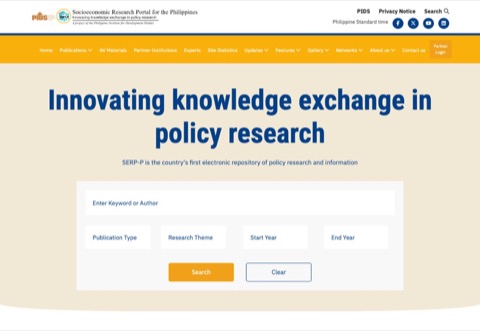
- Supreme Court E-Library (Supreme Court of the Philippines) (菲律宾最高法院电子图书馆)The Supreme Court E-Library is an online legal document repository built by the Library Services of the Supreme Court of the Philippines, whose homepage describes itself as 'Information At Your Fingertips'. It brings together within one site the Supreme Court's decisions and signed resolutions, various legal texts, various documents issued by the chief executive, materials related to constitutional conventions and commissions, and a set of treaty texts; these can be browsed by year and month or found through the search page. For readers studying Philippine politics, legal history, constitutional history, elections and international relations, the official source texts here can be cited directly as primary sources. Readers in Southeast Asian regional studies can also use the treaties and executive orders sections to find bilateral and multilateral agreements between the Philippines and neighboring countries, or within the ASEAN framework. The site also links to the Supreme Court websites of countries such as South Korea, Malaysia, Singapore and the United States, facilitating cross-national legal comparison. The site is maintained by the judiciary itself and is an official source, suitable as a benchmark page for checking statutory provisions, original case texts and dates of issuance.
Coverage, how to use, and notes
Coverage Sections listed on the homepage include: Supreme Court decisions and signed resolutions (browsable by year and month; the years listed on the page are 1996 to 2026); laws (Acts, Batas Pambansa, Commonwealth Acts, the Constitution, General Orders, Presidential Decrees, Republic Acts, Rules of Court and others); executive documents (Administrative Orders, Executive Orders, Memorandum Circulars and Orders, National Administrative Register, Presidential Proclamations); reference materials (materials of constitutional conventions and commissions, Benchbook, election cases, judicial writing manual, Official Ga... [source text truncated here].
How to use After opening the homepage, click 'CLICK THE IMAGE TO SEARCH' to enter the search page, or use the SC Case Index to look up cases. When browsing, you can enter the decision list by year and month; laws and executive documents are accessed from the categories in the Bookshelf. The page does not explain search syntax and filters; please check the search page. The homepage and Bookshelf pages do not require registration. Individual documents may show 'Document not available on the database'; in that case contact Library Services (see the official contact page; telephone (632) 8524-2706).
Notes The years listed on the decisions section page start from 1996; for earlier cases, please refer to other sources such as Lawphil or the official site's notes. Some documents are missing from the repository. When citing, please check against the officially published version.
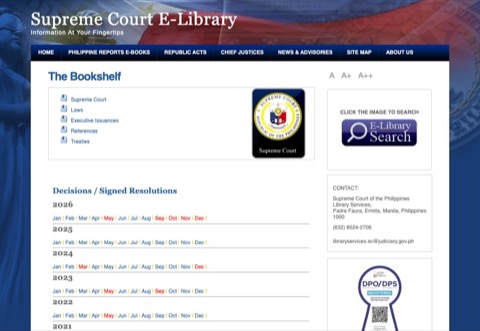
- The Lawphil Project (劳菲尔项目(菲律宾法律与判例在线库))The Lawphil Project is a Philippine legal resource website operated by Arellano Law Foundation Inc., which is also associated with arellanolaw.org and the Asian Legal Information Institute (AsianLII). The homepage has sections for Republic Acts, Executive Issuances and court decisions (Case Updates, linking to the decision search page), as well as a site map. Compared with the Supreme Court E-Library, it is built by a private foundation, but it is widely used in the Philippine legal community as an entry point for finding statutes and case law. For readers working on Philippine citizenship and naturalization, restrictions on alien business activity, and land and religious regulations who need to check the original legal texts, it can serve as a supplementary channel to cross-check against official sources.
Coverage, how to use, and notes
Coverage The sections confirmed on the homepage are Republic Acts, Executive Issuances and court decisions. The start and end years, size and languages of each section are not stated on the homepage; please consult the official site.
How to use From the homepage, browse sections such as Republic Acts, Executive Issuances and Case Updates; decisions can be searched through the judsearch page linked from the homepage, and the search syntax is explained on that page. The site map shows all sections. The homepage does not show a registration requirement.
Notes This is a private foundation project, not an official government gazette; when citing statutes or decisions, check them against the official gazette or the Supreme Court E-Library. The years covered have not been confirmed by the official site.
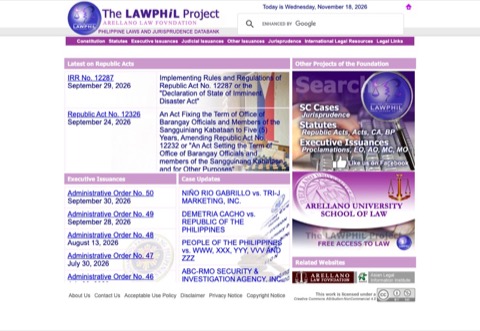
Scholarly databases & search tools
- Animo Repository (De La Salle University) (阿尼莫知识库(德拉萨大学机构库))Animo Repository is the institutional repository of De La Salle University (DLSU) in the Philippines, built on the Digital Commons platform and operated by the university library. It collects scholarly and creative output of the university's faculty, students and researchers, as well as archival content such as university events, publications and photo diaries. The collections listed on the website homepage include Theses and Dissertations, faculty research output, conferences, archives (photo gallery) and publications. The theses and dissertations collection is organized by department and includes bachelor's theses, honors theses, master's theses and doctoral dissertations. Readers can search within a collection, the whole repository or across repositories, browse by discipline, college and unit, or author, and subscribe to email or RSS updates. For readers studying Philippine society, history, language (including Chinese-language teaching and Filipino), education and the economy, it is one entry point for finding local Philippine theses, and can be used together with Philippine eLib and the institutional repositories of other universities.
Coverage, how to use, and notes
Coverage The collections shown on the website homepage are theses and dissertations, faculty research output, conferences, archives and publications. The number of items, date range and languages of each collection are not stated on the website; the theses page shows discipline categories, including Chinese and Filipino, among others; please search to confirm specific content.
How to use Go to animorepository.dlsu.edu.ph and use the search box, choosing 'this collection', 'this repository' or cross-repository search, or use advanced search; you can also browse by discipline, college and unit, or author. The page has a 'My Account' area for subscriptions and alerts. To find topics related to the Chinese, search the theses collection with keywords such as Chinese, Filipino-Chinese, Tsinoy and Philippines.
Notes The homepage and the theses page do not clearly state whether all full texts are publicly downloadable; some theses may have only bibliographic records or restricted access, so please check each record page. The theses are mainly works by the university's own students and are not a comprehensive database of theses from across the Philippines.
- Asian Studies: Journal of Critical Perspectives on Asia (《亚洲研究:亚洲批判视角期刊》)Asian Studies: Journal of Critical Perspectives on Asia is a peer-reviewed scholarly journal published by the Asian Center of the University of the Philippines Diliman, founded in 1963 and published twice a year. The Asian Center website describes it as an open access journal and an interdisciplinary platform for critical studies that integrates the social sciences, humanities and cultural studies, welcoming research articles, reviews, book reviews, literary works and travel writing. The official archive lists past special issues by issue, with themes such as '(Post)colonial Philippines', emerging Asian communities, and Philippine nurse migration and the JPEPA. For readers studying the Philippines and Asia, ASEAN regional relations, migration and area studies, it is a journal published by Philippine local scholarship from which first-hand scholarly output can be obtained directly.
Coverage, how to use, and notes
Coverage From 1963 to the present, mainly in English. Content includes research articles, reviews, book reviews, literary works and travel writing, dealing with regions of Asia and the Philippines' relations with Asia, with themes mostly in special-issue form. The official archive lists past issues; the total number of articles is not stated on the official site.
How to use Access it through the journal website asj.upd.edu.ph. The current issue on the site can be downloaded free; other issues have 'Download Issue' links on the archive page, and there are also a subscription page and table-of-contents PDFs. The journal is also listed on the Saliksik platform. For submissions and contact, use the official contact page.
Notes The 'current issue' shown on the official homepage is 58:2 (2022); please check the official site for updates. The Asian Center page says the editorial board is 'to be reconstituted', so publication status should be confirmed yourself. Some older issues may require subscription or a request; please confirm issue by issue.
- Index to Philippine Periodicals (IPP Online) (菲律宾期刊索引(在线版))IPP Online is a web-based article indexing system based on the Index to Philippine Periodicals (IPP), compiled by the Bibliography and Indexing Section of the University Library, University of the Philippines Diliman. It indexes journal articles published in the Philippines, with subject coverage in four areas: humanities, social sciences, natural sciences and applied sciences. Its humanities and social science portion is valuable for tracing literature on topics such as Philippine studies, migration and Chinese communities, language and literature, and history. The official site states that the print IPP began in 1956 and the online version mainly covers article indexes from 2010 onward, with searchable abstracts and some viewable PDF full texts. For researchers, it makes up for the limited coverage of local Philippine periodicals in international databases and helps discover leads to articles in local journals and academic magazines.
Coverage, how to use, and notes
Coverage Covers articles in scholarly journals and magazines published in the Philippines, in four subject areas: humanities, social sciences, natural sciences and applied sciences; it is a selective index, and articles on non-Philippine topics are not included. The online version mainly covers articles from 2010; the print version began in 1956. The number of articles is not stated on the official site.
How to use After entering the IPP Online page, use the search box, which supports phrase, stem and Boolean searching, can be limited to fields such as author, title, subject and abstract, and also supports full-text search. Some articles have viewable PDF full texts. The page does not say whether registration is required; please refer to the official site. Entries from earlier years (before 2010) need to be looked up together with the electronic version of the IPP cumulations included in TUKLAS.
Notes It is a selective index, not exhaustive; topics unrelated to the Philippines are not included. It consists mainly of bibliographic records and abstracts, and full-text availability varies by article. The page description does not state general terms of use.
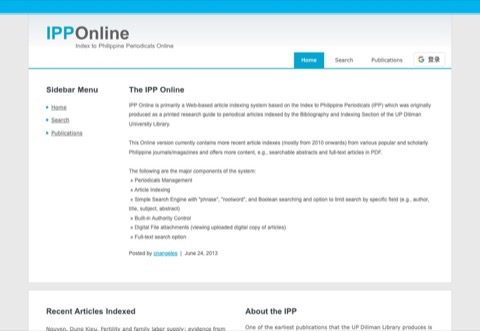
- KWF Diksiyonaryo ng Wikang Filipino (菲律宾语委员会《菲律宾语词典》在线版)The KWF Diksiyonaryo ng Wikang Filipino is an online Filipino dictionary published by the Komisyon sa Wikang Filipino (KWF, the Commission on the Filipino Language, under the Office of the President), the national language agency of the Philippines; the footer states that copyright belongs to KWF. The agency is responsible for standardizing and promoting the national language, so this dictionary is one of the authoritative sources for checking official word forms, spelling and definitions of Filipino (based on Tagalog). The site, with a Filipino-language interface, offers a word of the day and cultural notes, and links to related resources from the same agency, including a Filipino-English dictionary, the Aklatang Balmaseda library, language resource repositories for Philippine languages and Infomats Pangwika; iOS and Android apps are also available. The page also announces an upcoming Bikol–Filipino dictionary and thesaurus. For readers studying language contact in Philippine Chinese communities, loanwords (such as words of Hokkien origin), and the compilation and translation of Filipino-language documents, it can serve as a tool for checking current standard word forms.
Coverage, how to use, and notes
Coverage It contains Filipino headwords and definitions, and the page is in Filipino. The homepage does not state the total number of entries or the period covered; please check the website. The site also lists entry points to a Filipino-English dictionary, language resource repositories and the Aklatang Balmaseda library, and the Bikol–Filipino dictionary is marked as coming soon.
How to use Visit the homepage and enter a headword using the search icon or the Maghanap link; searches work through a URL parameter (?query=), so query links can be constructed directly. No registration is needed. The site has the pages Tungkol sa DWF (About), Gabay (Guide), Feedback and Makipag-ugnay (Contact); read the guide first to understand the format of entries. For mobile use, the App Store and Google Play apps linked on the homepage are available. The number of entries and any bulk download method are not stated on the homepage.
Notes The interface and definitions are mainly in Filipino, so some knowledge of the language is needed; the homepage does not state the total number of entries and offers no bulk export. It is a normative dictionary and does not specifically record regional dialects or historical word forms; for dialects and archaic words, use other dictionaries and corpora alongside it.
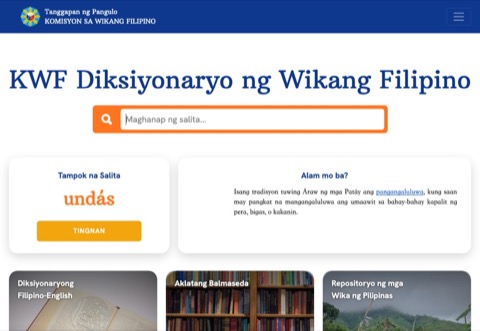
- Philippine E-Journals (菲律宾电子期刊平台)Philippine E-Journals (PEJ) is an online journal platform that gathers scholarly publications of Philippine universities and professional associations, where abstracts, full texts and links to related research materials can be consulted. The official homepage states that copyright belongs to KITE Digital Educational Solutions and notes exclusive distribution by CE-Logic. The UP Diliman library page explains that the repository is hosted by C&E Publishing and can be accessed both on campus and remotely off campus (including login through OpenAthens), and that it is a subscription-based institutional resource. Homepage statistics show 291 journals, 33,231 articles, 49,097 authors and 156 publishing institutions, with 184 institutional subscribers. For researchers who want to find articles in local Philippine journals (including social sciences, humanities, education and management), this is an important channel for learning about local Philippine scholarship beyond international databases.
Coverage, how to use, and notes
Coverage According to homepage statistics: 291 journals, 33,231 articles, 49,097 authors and 156 publishers. It covers multiple disciplines, including management, education, and the humanities and social sciences; the homepage mentions that some journals are indexed in Web of Science or Scopus, for example Asia-Pacific Social Science Review and Philosophia. The chronological range is not stated on the official homepage.
How to use On the official site, journals can be browsed alphabetically, and abstracts and full texts can be searched; there are also an author directory, ranking pages, a list of new journals and issues, and an FAQ page. The page provides login and registration. For most users, access is usually through the subscription of their institution's library; UP Diliman users can access it on campus or remotely through OpenAthens. Individual journals are open access.
Notes The homepage does not explicitly say whether the platform as a whole is free; full texts usually require an institutional subscription, with a few journals open. Please first confirm with your institution's library whether it subscribes. When searching, English keywords are recommended (such as Chinese Filipino, Tsinoy, migration).
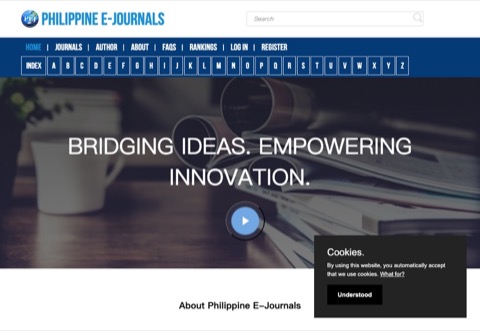
- Philippine Social Science Council Data Portal (菲律宾社会科学理事会数据门户)This portal was built by the Philippine Social Science Council (PSSC) and describes itself as a one-stop open-access platform for Philippine social science data. PSSC is an association of academic institutions in the Philippine social sciences. The portal organizes socioeconomic data scattered across institutions into lists of databases by theme, provides tutorials on data visualization (Datawrapper), and accepts data contributions from institutions and individuals. For readers studying the Philippine economy, labour, education, health, poverty and related topics, it is an entry point for finding first-hand statistics and survey data: one can see which databases exist under each theme and who publishes them, then go to the original source. For those studying the socioeconomic conditions of Philippine Chinese communities or making Southeast Asian regional comparisons, these open data can serve as a starting point for background statistics and quantitative analysis. The portal also links to the Philippine Statistics Authority (PSA) central data catalogue and explains that open data from government surveys, censuses and administrative records are in some cases directly accessible and in others require application to the agency.
Coverage, how to use, and notes
Coverage The website lists 41 databases under All Databases, organized by categories such as economy, education, health, labour, poverty, security and tourism. The time span, language and variables of each database are determined by its source institution and are not described uniformly on the homepage; please check each database page.
How to use Open the homepage, browse by category or enter All Databases to see every database, then open an individual entry to see its source and download method. The page does not mention a registration requirement. Its documentation page (docs/public-use-files) explains that some data in the PSA central data catalogue can be obtained directly and some require an application. To contribute data, follow the prompts on the page and contact the site via its contact page.
Notes The portal is a compilation and navigation tool; data ownership and terms of use are as set by each source institution; some data may require application to the original institution; databases are updated to varying degrees, so check data years before use.
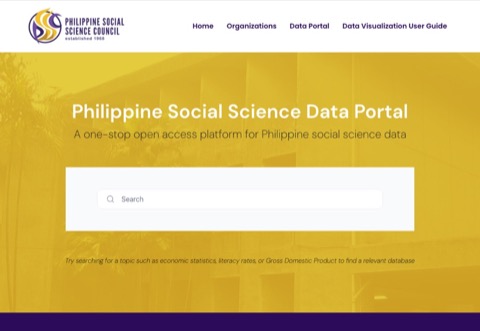
- Philippine eLib (菲律宾电子图书馆(Philippine eLib))Philippine eLib is a collaborative digital library project funded by the Philippine government's e-Government Fund, with partner institutions the National Library of the Philippines (NLP), the University of the Philippines (UP), the Department of Science and Technology (DOST), the Department of Agriculture (DA) and the Commission on Higher Education (CHED). The website states that its content includes a union catalogue of the holdings of the five partner institutions, digitized Philippine materials (Filipiniana, including theses and dissertations), special collections and research outputs of the partners, and online resources and electronic database subscriptions. Search functions include quick search, basic search, advanced search and browsing by subject. For readers studying Philippine history, society and Chinese issues, it provides a single access point for searching the holdings of several domestic institutions and digitized Filipiniana, and is especially suited to finding local theses and publications of government and research bodies. The NLP website also lists PH ELIB as a resource access point.
Coverage, how to use, and notes
Coverage The union catalogue covers the holdings of the five partner institutions; digital content includes digitized Filipiniana, theses and dissertations, special collections, research outputs and electronic database subscriptions. The date range, languages and quantities are not stated on the homepage; please consult the website.
How to use Go to www.elib.gov.ph and search using quick search, basic search or advanced search, or browse by subject, and use the 'Book Cart' to temporarily save results. The website has 'Membership', 'Register' and 'Login' options, but the homepage does not state which functions require registration, who is eligible or whether fees apply. It is advisable to try searching and browsing without logging in first, and to check the website's instructions when full texts are needed.
Notes The homepage does not state registration conditions or access rights; full-text downloads may vary by user status, and some electronic databases are subscription resources. Please consult the website.
- Saliksik: UPD Journals Online (Saliksik:菲律宾大学狄利曼校区期刊在线平台)Saliksik is the online platform for in-house journals of the University of the Philippines Diliman (UP Diliman), managed by the university's Research Dissemination Office (RDUO-OVCRD). The official site describes it as a free online service for journals from UP Diliman units, bringing these journals together in one repository while providing journal editors with tools for handling the editorial workflow. On the platform, journals can be searched by journal name, publishing unit, ISSN or description, and publications can also be searched separately. Humanities and social science journals listed on the homepage include Ang Agos, a creative writing journal; anthropozine, an anthropology and sociology journal (published by the H. Otley Beyer Museum of Anthropology); Alipato, a basic education journal; and Asian Studies, founded in 1963. For readers studying Philippine society, anthropology, literature and Asian studies, this is a central entry point for finding journals of Philippine local universities.
Coverage, how to use, and notes
Coverage Includes journals published by UP Diliman units, covering the humanities, anthropology and sociology, education, Asian studies and more. The languages of journals listed on the homepage include English and Filipino. The platform's total number of journals and start and end years are not stated on the official homepage; please refer to the official site.
How to use After entering the homepage, search journals by journal name, publishing unit, ISSN or description, or search specific publications. Each journal page then leads to specific issues. The official homepage does not state whether all full texts can be downloaded; please check journal by journal. For inquiries, contact the Research Dissemination Office (see the official contact page; 8981-8500 local 4048).
Notes The homepage does not state download conditions for each journal's full text; some journals also have separate websites. The UP Diliman main library page calls the platform a free repository, but the latest issues of some journals may be subject to separate subscription rules.
- TUKLAS (UP Libraries Resource Discovery Tool) (TUKLAS(菲律宾大学图书馆资源发现系统))TUKLAS is the resource discovery system shared by the libraries of the campuses of the University of the Philippines, which the page calls the 'UP Libraries' Resource Discovery Tool'. From one interface it searches multiple types of material at once, including books, journal articles, theses and dissertations, maps, music, electronic resources and visual materials, and it can also be browsed by classification from A (General Works) to Z (Library Science). The homepage also places three databases at the same entry point: the Index to Philippine Periodicals (IPP), the Index to Philippine Newspapers (IPN) and the union catalog Buklod. For readers studying Philippine history, the Chinese in the Philippines, overseas Chinese communities, and Philippine society and politics, it is one of the main entry points for finding locally published Philippine materials, local theses and dissertations (UP system holdings) and leads to Filipiniana bibliographies; it is also suitable for checking bibliographic records first and then deciding whether to visit in person or request document delivery. The UP Diliman main library also lists TUKLAS as the first tool on its search tools page.
Coverage, how to use, and notes
Coverage The homepage lists nine UP collections: Baguio, Cebu, Diliman, Manila, Mindanao, Open University, Pampanga, Tacloban and Visayas. Resource types include books, articles, theses and dissertations, maps, music, electronic resources and visual materials; it also includes IPP, IPN and the Buklod union catalog. The specific chronological span and total number of records are not stated on the official homepage; please refer to the official site.
How to use Open the official homepage. You can search in all fields or limit to title, author, subject, call number or ISBN/ISSN; an advanced search is also available. Results can be filtered by resource type (for example theses and dissertations); classification browsing, search history, Book Bag, search tips and FAQ pages are also provided. Whether a holding can be read in full text online depends on the specific record; for physical materials, follow each library's rules to visit or contact a librarian. The homepage provides an 'Ask a Librarian' consultation entry.
Notes The homepage does not state eligibility for use or whether login is required; some electronic resources may be limited to UP users. It consists mainly of locally published Philippine materials; there is no separate classification entry for Chinese-related topics, so keywords (such as Chinese, Tsinoy, Filipino-Chinese) are needed.
Libraries & archives
- Archivo de la Universidad de Santo Tomás (AUST) (圣托马斯大学档案馆)The Archivo de la Universidad de Santo Tomás (AUST) is the official archive of the University of Santo Tomas (UST) in Manila, responsible for preserving the university's records. UST was founded by the Dominicans and is one of the oldest existing universities in Asia. The website says its core holding is the 1611 founding document (Foundation Act). The holdings also include papal bulls and royal decrees, materials related to the Dominicans and the Catholic Church, cultural and historical materials from various regions, and Rare Filipiniana. For readers studying the history of the church, of Dominican missions and education, and the social history of the Spanish colonial period in the Philippines, this is an entry point to first-hand material that can be consulted on site. The collections page of the website lists series by volume, such as Libros, Becerros, Folletos and Libritos, and states the number of extant and missing volumes in each. The website does not say whether the archive holds records on Chinese people or parish records, so researchers of Chinese and religious communities should first inquire with the archive.
Address 5/F Miguel de Benavides Library Building, University of Santo Tomás, España Boulevard, Sampaloc, Manila 1015, Philippines View on map ↗
Coverage, how to use, and notes
Coverage The collections page lists five groups of holdings: Libros (429 volumes), Becerros (58 volumes), Folletos (224 volumes), Libritos (777 volumes), and Rare UST Press (rare books and pamphlets from the 17th to the early 20th century, arranged by date). The homepage also lists university charters, manuscripts, photographs and campus publications, student records, papal bulls and royal decrees, and Rare Filipiniana. The material is mainly in Spanish, Latin and English; please check the website and the archive for specifics.
How to use The collections page lets you browse the holdings groups online. To consult originals, contact the archive: tel. (632) 8553-1611 ext. 8330, or (632) 8740-9702; the email address is obscured on the website against scraping and must be viewed on the page; it can also be reached through its Facebook page ArchivoUST. Neither the collections page nor the homepage states opening hours, appointment procedures or fees, so confirm with the archive before visiting. The homepage notes that on 16–18 November 2026, because of the 49th ASEAN Summit, the UST Manila campus will have no classes and offices will be closed; please check the latest office arrangements before visiting.
Notes The website does not publish opening hours, appointment procedures or copying rules; whether the archive holds parish registers or material relating to Chinese people is not stated, so please inquire with the archive first.
- Asian Center Library, University of the Philippines Diliman (菲律宾大学迪利曼分校亚洲研究中心图书馆)The Asian Center Library belongs to the Asian Center of the University of the Philippines Diliman (UP Asian Center) and provides documentary support for the center's Asian studies and Philippine studies programs. According to a 2015 announcement by the center, the library was founded in 1956, and its Asian studies holdings are organized by four regions: Southeast Asia, Northeast Asia, South Asia and West Asia. The library has several special collections directly relevant to Southeast Asian and Chinese studies: the China Book Center, the Dr. Peter Boomgaard Southeast Asia Collection, and a digital version of the F. Landa Jocano collection; it also provides a list of titles and authors of Asian Center master's theses and doctoral dissertations from 1963 to 2012. For readers studying Southeast Asian regional history, the social and economic history of Indonesia and the Dutch East Indies, and Asian studies in the Philippines, this is a collection with a clear focus and a booking channel for outside researchers.
Address Hall of Wisdom, GT-Toyota Asian Cultural Center, Magsaysay Avenue corner Katipunan Avenue, University of the Philippines Diliman, Quezon City 1101, Philippines View on map ↗
Coverage, how to use, and notes
Coverage According to the library website: the China Book Center covers Chinese history, politics, literature, culture, economics and science, with 880 titles and 1,627 items as of 2021; it is closed-stack and must be requested in advance at the help desk. The Boomgaard Southeast Asia Collection has about 1,500–2,000 volumes, mainly in English and Dutch, focusing on Indonesia and mainland and maritime Southeast Asia, and includes colonial-period statistical materials from 1600–1950 and a handwritten card catalogue. The F. Landa Jocano collection provides PDFs of some monographs; the theses list gives titles of Asian Center master's and doctoral theses from 1963 to 2012. Online journals, e-books and databases mostly require login with a UP email account through OpenAthens.
How to use A reservation is required for on-site visits: the website states that walk-in visits are not accepted; you must first email the address on the website's contact page and obtain an approval letter before going, and entry requirements are in the library's Service Advisory. Opening hours are Monday to Saturday, 9:00–18:00, with no lunch break. Outside readers include alumni, international students and faculty, researchers and visiting scholars, graduate students of other institutions, and government and private researchers, but materials cannot be borrowed. According to another library page, outside researchers are accommodated only on Fridays, and their research topic must be related to Asian studies or Philippine studies; these rules may change, so please rely on the latest announcement. Telephone: 8 981 8500 local 3579.
Notes Closed-stack materials must be requested in advance; online resources mostly require a UP account; the days and conditions for outside readers are not worded identically on different pages, so please confirm by email first; the collection does not emphasize Philippine Chinese topics, and Chinese-related materials must be checked through the catalogue.
- Kaisa Heritage Center (Chinben See Memorial Library) (菲华历史文化中心(施振民纪念图书馆))The Kaisa Heritage Center is a cultural institution established by the Philippine Chinese community organization Kaisa Para sa Kaunlaran, located in Intramuros, Manila. Its website presents it as a lasting home for the historical and cultural heritage of the Chinese in Philippine life, documenting the Chinese influence on Philippine history, society, culture and politics. According to the 'Cultural and Educational Work' page, the center houses the Chinben See Memorial Library, a specialized library of research materials on the Chinese in the Philippines and elsewhere, with books, periodicals, magazines and other research materials, as well as a photograph and document archive and a microfilm section. This thematic collection on the Chinese community offers another point of access beyond the catalogues of Philippine national institutions, and is useful for readers studying Philippine Chinese society, Chinese associations, Sino-Philippine relations, and local oral and family materials.
Address 32 Anda corner Cabildo Streets, Intramuros, Manila, PH 1002 View on map ↗
Coverage, how to use, and notes
Coverage The website states that the holdings comprise books, periodicals, magazines and other research materials, a photograph and document archive, and a microfilm section, on the Chinese in the Philippines and the rest of the world. The number of volumes, date range and languages are not stated on the website; please consult the website and the library.
How to use The website does not state opening hours, eligibility for use or reservation procedures. It is advisable to first contact the center at the telephone numbers listed on the website, (63-2) 85276083 or 85266796, to confirm whether it is open that day and what identification is required, and to describe your research topic and the types of material you wish to consult before visiting. The page does not mention an online search system.
Notes The website does not list opening hours, a catalogue of holdings or rules of use, and does not state whether it admits outside readers; be sure to make contact and confirm first.
- National Library of the Philippines (菲律宾国家图书馆)The National Library of the Philippines (NLP) is the country's national library; its website describes it as the repository of the nation's printed and recorded cultural heritage. It also serves as the national bibliographic and publications authority, with services including reader services, legal deposit, ISBN, ISSN, ISMN, copyright and CIP. For researchers of Philippine history, its value lies in the concentrated holdings of Philippine publications and Filipiniana, making it an on-site entry point to printed matter, government publications, periodicals and manuscripts from the Spanish and American colonial periods. The website has a 'Digital Collections' section offering part of its digitized holdings, and links to the online public access catalogue (OPAC), exhibitions, research guides, Philippine eLib, the ASEAN Digital Library and the NLP e-resources portal. For readers studying the Philippine Chinese or the history of the Philippines and Southeast Asia, it is a place to find locally published periodicals, statistics and official publications, to be used alongside archives and sources held by other institutions.
Address T.M. Kalaw St., Ermita, Manila, Philippines 1000 View on map ↗
Coverage, how to use, and notes
Coverage The website homepage states that its function is to preserve the nation's printed and recorded cultural heritage, and provides access points to digital collections, the OPAC, exhibitions, research guides, PNB, Philippine eLib, ASEAN DLIB and NLP publications. The size, date range and languages of the holdings of individual divisions (such as Filipiniana, and Rare Books and Manuscripts) are not stated on the homepage or the Digital Collections page; please consult the website.
How to use Online: go to web.nlp.gov.ph and search via 'Digital Collections' or the OPAC. The Digital Collections page says materials are provided as PDF or JPG; it recommends opening PDFs in the browser with Adobe Acrobat Reader, or downloading them first if they do not open. The page does not mention any registration requirement. On site: the address is given on the website. Opening hours and reader registration requirements are under 'Service Hours' and 'Readers' Services' on the website and are not listed on the homepage; please check or call before visiting. Switchboard number given on the website: (632) 5314-2100.
Notes The homepage and the Digital Collections page do not list opening hours, reader identification requirements or specific holdings figures for the special collection divisions; please verify before visiting. Only part of the holdings has been digitized, and many print materials must still be consulted in person.
- Ortigas Foundation Library (奥尔蒂加斯基金会图书馆)The Ortigas Foundation Library is a Philippine research library established by the Ortigas Foundation, which was founded in 1996 to promote research on Philippine history, art and culture. The website states that the library holds more than 36,000 books, serials, images and documents on Philippine history, some dating back to the 17th century. The holdings are divided into a main collection reading room and a rare books room, the latter housing old, rare and fragile materials. The website also lists finding aids for special collections such as the Zaide Family Papers, the Morton J. Netzorg Collection and the ROJR Stereoviews Collection, as well as an Image Bank Database. It is an open research library run by a private foundation; although modest in size, it is a worthwhile supplement to the national library and university libraries for researchers looking for old Philippine books, images and stereoviews.
Address 2nd Floor, McKinley Parking Building (above Unimart Supermarket), Club Filipino Avenue, Greenhills Shopping Center, San Juan, Metro Manila, 1502 Philippines View on map ↗
Coverage, how to use, and notes
Coverage The website states more than 36,000 books, serials, images and documents on Philippine history, the earliest dating to the 17th century; a main collection and a rare books room; finding aids for the Zaide Family Papers, the Morton J. Netzorg Collection and the ROJR Stereoviews Collection; and an image bank database. The language distribution and the size of each special collection are not stated on the homepage; please consult the website.
How to use The 'Contact Us' page states that the library currently accepts walk-in visits; the page does not mention a reservation requirement. Opening hours are Tuesday to Saturday, 9:00–18:00; closed on Sundays and holidays. You may first browse the special collection finding aids and the image bank on the website to check whether the materials you need are available. For questions, email via the website's contact page or call the number listed on the website. The website also offers library research assistance and paper conservation services.
Notes The homepage does not mention an online catalogue and does not explicitly state any special collection on the Spanish colonial period; please visit or write to ask about the exact composition of the holdings. Opening hours may change; please consult the website.
Museums & memorials
- Bahay Tsinoy, Museum of Chinese in Philippine Life (Kaisa Heritage Center) (华人在菲律宾生活博物馆(Bahay Tsinoy/嘉应遗产中心))Bahay Tsinoy is a museum presenting the life and history of the Chinese in the Philippines, located inside the Kaisa Heritage Center in Intramuros, Manila. The center opened in 1999 on the initiative of Kaisa Para sa Kaunlaran, with initial funding from Dr. Angelo King and the remainder raised from the Philippine Chinese community; Kaisa's offices are also housed on the same premises. The museum has a gallery of rare prints and photographs, the Ching Ban Lee ceramics gallery, and the Jimmy Ongking Hall, which hosts the permanent exhibition 'Tsinoys in Nation Building'. The building also houses the Research and Data Bank Center and the Chinben See Memorial Library. For readers studying Philippine Chinese society, the history of Sino-Philippine trade and Chinese identity, the museum offers objects and images as well as documents compiled by the local Chinese community itself, making it one of the most important on-site entry points for Philippine Chinese studies in Manila.
Address 32 Anda St. cor. Cabildo St., Intramuros (near Manila Cathedral), 1002 Manila, Philippines View on map ↗
Coverage, how to use, and notes
Coverage According to the website: the galleries cover prints and photographs of former Chinese occupations and Binondo street scenes, ceramics from centuries of Sino-Philippine trade, and a permanent exhibition on the Chinese contribution to Philippine nation building. The Research and Data Bank Center holds existing research materials, clippings, microfilm archives, old Chinese-language newspapers and a nationwide database of Chinese tombstones. The Chinben See Memorial Library holds about 8,000 books and documents on the Philippines and overseas Chinese, as well as a Filipiniana collection and rare books of nearly 200 years of history. The exact date range and language distribution are not stated on the website.
How to use On-site visit: the website lists opening hours as Tuesday to Sunday, 10:00–17:00, with admission of P100 for adults and P60 for students (the website notes these remain unchanged until the 'Contemporary Gallery' opens); groups of 30 or more can book a guided tour by email or by telephone at (02) 8527-6083. The website does not state borrowing or reservation rules for the library and data bank center; readers planning to consult books, old newspapers or the tombstone database should first contact the museum via the website's contact page to confirm opening hours and conditions of access. The website also offers online exhibitions and short videos for preliminary orientation.
Notes On the website menu, the link labels for 'Visit' and 'Contact' are swapped relative to the page contents; please rely on the website for the address and opening information. How outside readers may consult the library and data bank is not stated on the website; ticket prices and opening hours may change.
Other
- Filipinas Heritage Library on Google Arts & Culture (Filipinas Heritage Library 谷歌艺术与文化专页(菲律宾遗产图书馆数字展览))The Filipinas Heritage Library is a specialist library of Philippine history, culture and art on the sixth floor of the Ayala Museum in Makati City, part of the Ayala Foundation system. It has a partner institution page on Google Arts & Culture, where digitized old photographs, paper documents, books and press clippings from its holdings are made freely available as items and online exhibits. Exhibits on the page include War Through the Eyes of the Child, Women and War and Manila Reborn, as well as themes on the Pines Hotel and Baguio and the road to dignity. Images of the Pacific War and the Battle of Manila are especially concentrated. For readers studying Philippine urban history, Second World War history and the history of everyday life, it is a high-resolution image resource that can be used without visiting the library, for classroom display, image comparison and finding leads. The library's digitized photograph and music collections are also listed on the page, which also mentions that opening up digitized rare books is under way.
Coverage, how to use, and notes
Coverage According to the page: 231 items and 5 online exhibits. Items are mainly photographs (161 marked), with some paper items, books, press clippings and a few paintings. Common tags include Pacific War and Battle of Manila; places are mostly the Philippines, Manila and Baguio. For digitized rare books and the full scope of the holdings, please check the library's website.
How to use No registration is needed; open the page and browse by item or exhibit, using the filter tags (medium, date, place, person, etc.) to narrow results. To consult full texts or material not yet online, contact the library through its website and online catalogue; visiting conditions and opening hours are as stated on the website.
Notes The page is a selected showcase of the holdings and does not represent the whole collection; reuse of images must follow the terms of use of the platform and of each item.
Myanmar2
Archives & historical document databases
- Myanmar Law Library (缅甸法律图书馆)The Myanmar Law Library is a website whose stated aim is free access to Myanmar legal knowledge, providing full-text PDFs and full-text search of Myanmar legal documents. Its content is divided into sections including the President's Office, Laws and Regulations, Case Law, International Law, Law Journals, Legal News and Agendas, Legal Websites and Ancient Myanmar Law, and it also has thematic entry points organized by subject (such as investment, companies, property, labour, contracts, intellectual property, banking, telecommunications, insurance, taxation and construction). The site also provides a list of links to the websites of the Myanmar government and related institutions. For researchers of Myanmar's legal history, institutional history, foreign investment and economic policy, and minority and nationality systems (issues of Chinese status and property often involve such regulations), it allows quick location of the original texts of laws and case law, and can also serve as a source of leads on legal change from the colonial period to the present. The website's content is published under the Creative Commons Attribution-ShareAlike 4.0 International License.
Coverage, how to use, and notes
Coverage The homepage states that it holds 1,396 PDF files and 130,900 full-text searchable pages. Sections include Laws and Regulations, Case Law, International Law, Law Journals and Ancient Myanmar Law. The exact date span is not stated on the homepage; the introduction of the Online Burma/Myanmar Library says it contains laws since 1946, but few recent laws (please consult the website). The languages are mainly English and Burmese.
How to use Browse via the 'Law Library' and 'Topics' menus or the site map, or use the search box on the page for full-text search; the 'Legal Websites' section lists external government and institutional websites. Files are PDFs that can be opened and read directly; no registration is required. When citing, it is advisable to record the year of promulgation and the version of the original document.
Notes The homepage does not state the operating institution, and the content of the site's 'Who are we' page was not verified; legal updates may not be timely and coverage of recent laws is incomplete, so for legal practice or formal citation please rely on official gazettes and original texts.
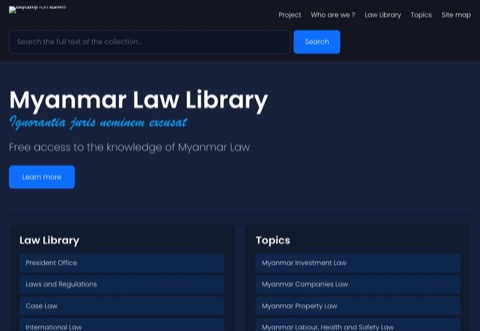
Libraries & archives
- Universities' Central Library (UCL), Yangon (仰光大学联合中央图书馆)The Universities' Central Library (UCL) is the central research library of Myanmar's higher education system, located on the main campus of Yangon University. The website states that it grew out of the library of the University of Rangoon (founded in 1929), renamed the Universities' Central Library in 1964 under the Department of Higher Education; a new building was completed in 1980, it was separated from the Yangon University library in 1987, and another building was added in 1992. The website states that it holds Myanmar's largest collection of books, palm-leaf manuscripts and folded paper (parabaik) manuscripts. For Southeast Asian studies, UCL's value lies in its Burmese- and English-language books, journals (including nineteenth-century journals), a large number of theses, and a union catalogue searchable online. Those studying Myanmar society, religion, history and colonial-period documents can treat it as an important entry point to local scholarly materials. The site also has an institutional repository of digitised rare holdings, including coloured parabaik, special collections of several scholars, palm-leaf manuscripts and 1855 photographs by Linnaeus Tripe. UCL also maintains UCMAL, the union catalogue of Myanmar university libraries. The library also provides reading, reference, microfilm and copying services.
Address Universities' Central Library, corner of Adipati (Chancellor) and Sagaing Road, Yangon University (Main) Campus, University Avenue, Kamayut Township, Yangon, Myanmar View on map ↗
Coverage, how to use, and notes
Coverage Holdings listed on the website include: Burmese and English books and journals (about 1,500 journal titles, including nineteenth-century material); Burmese manuscripts, about 15,000 bundles of palm-leaf manuscripts and 4,000 bundles of parabaik; more than 24,000 theses from Yangon University and Mandalay University; more than 15,000 e-books in Myanmar social sciences and digitised rare materials; and the union catalogue UCMAL, covering about 369,000 books and 60,000 theses from 28 university libraries. The institutional repository includes special collections such as those of Dr. Thaw Kaung, Dr. Than Tun, U Pe Maung Tin and Dr. Htin Aung. For the exact date ranges covered, please consult the website.
How to use On site: opening hours are Monday to Friday 9:30–16:30, and lending hours are Monday to Friday 9:30–16:00. There is a general reading room (over 100 seats), a general reference room (30 seats) and 5 research cubicles, with limited photocopying and thesis scanning, microfilm and conservation services. The website does not state registration or appointment requirements; before visiting, confirm through the website's 'Ask a Librarian' or contact page. Online: use the website's online catalogue (OPAC), the union catalogue UCMAL and the institutional repository section, clicking a specific collection to view its contents.
Notes The website lists no telephone number or email address, and does not state the conditions for obtaining a reader's card or whether all repository items are publicly accessible. The website's address gives no postal code; the Yangon University website lists the university's postal code as 11041 (Kamayut Township). Conditions in Myanmar change considerably; before travelling, rely on the website and the library's replies.
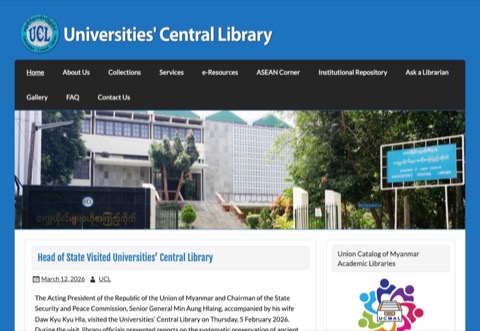
Cambodia11
Newspapers & news archives
- Khmerica (SOSORO Digital Library) (Khmerica(SOSORO柬埔寨法文数字图书馆))Khmerica is a mainly French-language Cambodian digital library operated by the SOSORO Museum (Preah Srey Içanavarman Museum of Economy and Money), which is under the National Bank of Cambodia. It was originally launched in the 2000s by a French cultural cooperation project; from around 2020 it was for a time inaccessible, and according to the website, SOSORO committed to resuming operation in January 2025. The site holds French-language periodicals published in Phnom Penh and about twenty books, and plans to add images, maps, postcards and audio and video. These French-language periodicals record Cambodian politics, economy and society in the post-independence Sihanouk period and the peace reconstruction of the 1990s, and are full-text searchable primary sources for studying modern Cambodian history, nation-building, foreign relations and the activities of Chinese communities in these periods. French-language periodicals often carry reports on Chinese merchants, Chinese schools and associations, but the site has no separate Chinese theme, so one must search on one's own.
Coverage, how to use, and notes
Coverage The first batch of periodicals listed on the website: Cambodge d'aujourd'hui 1958–1964 (33 issues), Réalités cambodgiennes 1963–1969 (66 issues), Cambodge 1967–1969 (154 issues), Le Mékong 1993–1995 (25 issues), Cambodge Soir 1995–2007 (2,767 issues, about 18,000 pages) and Cambodge Soir Hebdo 2007–2010 (152 issues), all published in Phnom Penh; there are also about twenty books. The materials are mainly in French.
How to use Go to sosoro-khmerica.org; the interface is in French, English and Khmer. Full-text search is supported, and results can be filtered by document type, periodical, period, author, year of publication, date range and place of publication; results can show where the keyword appears in the document. The document viewer has a download button. The website does not mention any registration requirement.
Notes The website states that the platform has only just been relaunched, the search engine is still being improved, and some content (such as the periodicals list) is incomplete; check OCR accuracy yourself. The website does not detail download terms and usage restrictions; confirm them before citing or reusing.
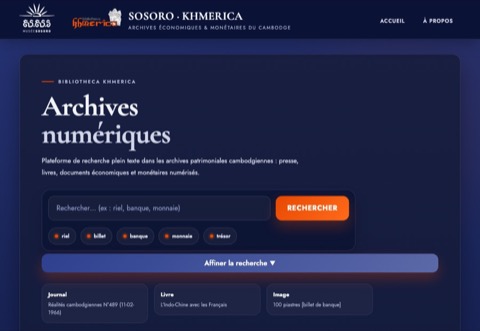
Archives & historical document databases
- Documentation Center of Cambodia (DC-Cam) Databases (柬埔寨档案与文献中心数据库)The Documentation Center of Cambodia (DC-Cam) is an independent Cambodian research and archival institution based in Phnom Penh. It has long collected, organised and preserved documents from the Democratic Kampuchea period (1975–1979) and is one of the most frequently cited sources for Khmer Rouge research. Its database site offers search entry points by type, covering biographies, bibliographies, photographs and geographic information (prisons, execution sites, mass graves, memorials). Some databases derive from the collaboration between the Yale Cambodian Genocide Program and DC-Cam, and the site indicates copyright ownership. For researchers of Southeast Asia, it is possible to search directly for catalogues and some images of primary materials from the Khmer Rouge period, such as internal documents, meeting minutes, telegrams and interrogation records, and to verify information on victims, cadres and places. For researchers of the Chinese in Cambodia, these materials help in understanding the background of forced relocation, identity purges and ethnic treatment in 1975–1979, but Chinese are not classified separately, so one must select materials using search terms and personal-name clues. The site is also an entry point for gauging the size and processing progress of DC-Cam's physical archive.
Coverage, how to use, and notes
Coverage Centred on the Democratic Kampuchea period (April 1975 to January 1979), with some related documents from before and after. Content types include biographies, bibliographies and original documents, photographs, video and audio, and geographic survey data. DC-Cam describes its holdings as very large, only part of which is online; the number of entries in each database keeps changing, so please consult the website for exact numbers and updates.
How to use Go to databases.dccam.org and search each database by type (documents, photographs, persons, geography, etc.) using personal names, place names, document numbers or keywords; the search interface differs between databases, so each must be tried in turn. The main site dccam.org provides project descriptions, publications (such as the PDF of Cambodia's Hidden Scars) and contact information. Browsing generally requires no registration; the site does not state uniform conditions for downloading and reuse, so check the copyright notice before citing. For paper archives contact DC-Cam; for problems accessing the website, contact the IT coordinator listed on the site.
Notes The database interfaces are dated and structures differ between databases; search results are mainly in English and in Khmer transliteration, and many people share the same name, so cross-checking is needed. The online catalogue is not the whole collection; for the number of entries and what can be downloaded, please consult the website.
- ECCC Archive (Extraordinary Chambers in the Courts of Cambodia) (柬埔寨法院特别法庭(红色高棉法庭)档案库)The Extraordinary Chambers in the Courts of Cambodia (ECCC), commonly known as the Khmer Rouge Tribunal, tries serious crimes of the Democratic Kampuchea period. Its archive is the official repository of the tribunal's case files; the website FAQ states that it holds more than 2 million pages of documents in Khmer, English and French, including tens of thousands of items of evidence and more than 1,350 decisions issued between 2006 and 2022. Case files marked 'Public' can be consulted online through the archive portal; those marked 'Confidential' are not put online. For researchers, trial transcripts, evidence documents, filings by the parties and trial videos can be obtained directly, making this an authoritative primary source for studying how the Khmer Rouge regime operated, forced relocation, and the persecution of minorities (including Chinese, Cham and ethnic Vietnamese). Because these materials were produced in judicial proceedings, they are often used to cross-check other archives and oral sources. The website also provides search tutorials and a user guide in PDF.
Coverage, how to use, and notes
Coverage The categories listed on the homepage include: all and latest documents; Cases 001, 002, 003, 004, 004/01 and 004/02; court rulings; filings by the prosecution, defence and civil parties; trial transcripts; evidence; and trial videos. The languages are Khmer, English and French, but which languages a given document is in should be checked on the website. Only documents classified as public can be viewed online.
How to use Go to archive.eccc.gov.kh/en and browse by case or document category, or use the search function; the website provides video search tutorials and a user guide. Logging into 'My Session' lets you save search results; the website states that sessions expire after one month. To view paper case files, make an appointment through the archivist's email address listed in the website FAQ; this is limited to public documents. The address of the physical resource center is given in the FAQ: Building 40, Russian Federation Blvd (110), Mittapheap, 7 Makara, Phnom Penh, with free entry.
Notes Confidential documents are not available online; the website FAQ states that public documents may be used for non-commercial purposes with source attribution. The explanation on the search page is brief, so it is best to read the user guide first. The material is voluminous and mainly legal documents, so users need to distinguish the different nature of evidence, filings and decisions.
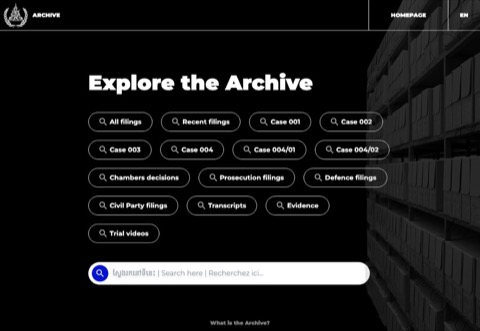
- National Archives of Cambodia (បណ្ណសារដ្ឋានជាតិនៃកម្ពុជា; 柬埔寨国家档案馆)The National Archives of Cambodia is under the General Department of Royal Affairs and National Archives of the General Secretariat of the Council of Ministers, and is the core institution preserving Cambodian government records. Its website states that its holdings cover government archives from the French colonial period to the present, including colonial administrative records, maps, drawings, and photographs, as well as post-independence Cambodian archives, Democratic Kampuchea-period archives, archives related to the 1979 genocide trial, newspapers, publications, microfilm, audiovisual materials, and archives of the United Nations Transitional Authority in Cambodia (UNTAC). The site has an online catalogue entry and pages explaining eligibility, research preparation, document consultation and reproduction, research facilities, researcher regulations, and the reading room. The site also mentions that many colonial-period archives have been digitized to protect the fragile originals. For researchers of protectorate-period administration and society, the management of Chinese immigrants and merchants, Cold War and civil-war politics, and post-Khmer Rouge justice and memory, this is the most direct primary-source repository of official documents; used together with the relevant fonds of the Archives nationales d'outre-mer (ANOM) in France, the two complement each other.
Coverage, how to use, and notes
Coverage According to the site, the holdings amount to about 2,145 linear meters, divided into 14 fonds, extending from the French colonial period (1863–1954) to the contemporary era. Content types include colonial administrative archives, maps and drawings, photographs, post-independence (1954–1970) archives, Democratic Kampuchea-period (1976–1978) and 1979 trial archives, newspapers and publications, microfilm, audiovisual materials, and UNTAC archives. Colonial-period archives are mainly in French; for the exact language composition, please consult the site.
How to use On the website, search through the Online Catalogue entry; the site advises reading the guidance on research preparation before searching. Before consulting materials on site, read the site pages on who may use the archives, researcher regulations, and consultation and reproduction, and contact the archives by the telephone numbers listed on the site (+855 23 85 676 868, +855 92 772 182, +855 96 270 4200) to confirm appointments, opening hours, and reproduction rules. The homepage does not list the building address or opening hours; please consult the site or inquire by telephone.
Notes Some sub-pages of the site may show server errors when accessed; please try again later. The site does not describe item by item how extensively the online catalogue covers the holdings or which archives have digital images; please consult the site. Arrangement of the holdings is ongoing, so before on-site research, contact the archives in advance to confirm that the target fonds can be consulted.
- Open Development Cambodia (ODC) – Legal documents (开放发展柬埔寨:法律文件库)Open Development Cambodia (ODC) is a platform that describes itself as a private non-profit open data/open knowledge media organization; its website states that it is not a commercial research service and is not operated by any government or intergovernmental body. Its website has English and Khmer interfaces, and it organizes Cambodian legal documents on DataHub (based on CKAN), to which the website's Legal documents section links. The documents in the repository include laws, royal decrees, sub-decrees, proclamations, decisions, instructions, notices, and circulars, mostly as original PDFs, and can be filtered by document type, language, topic, institution, and license. For researchers of Cambodian land tenure, investment and economic policy, ethnic minorities and natural resource governance, and the national regulatory system, this is a rare open portal where official documents can be searched and downloaded in the original. Original material produced by ODC itself is licensed under CC BY-SA 4.0, while the copyright of news summaries belongs to the original sources.
Coverage, how to use, and notes
Coverage According to the DataHub page, there are 3,657 Cambodian legal records in total. By document type: sub-decrees 1,537, proclamations 713, laws 390, decisions 153, royal decrees 133, instructions 116, notices 108, circulars 86, and others. By language: Khmer 3,589 records, English 733, French 1, Vietnamese 1. The format is mainly PDF (3,654 records). Topics include laws and regulations, land classification, and economy and business. For the time span of each document, please consult the individual entry.
How to use From the Legal documents section of the ODC website, enter DataHub, where you can search by keyword on the legal records page and filter by document type, language, topic, institution, license, and format; results can be sorted by relevance, name, or last modified. No registration is needed, and PDFs can be opened or downloaded directly. When citing, record the document number, date of promulgation, and the ODC entry page.
Notes ODC states that it cannot guarantee the accuracy and completeness of third-party information, and the English versions are mostly unofficial translations, so formal citations should follow the official Khmer gazette text. The page has no date filter. License labeling is inconsistent, with about 2,100 records showing not specified; please check each record before republishing or reuse.
Scholarly databases & search tools
- Angkor Database (吴哥数据库)The Angkor Database is an online resource on Angkor and ancient Khmer civilisation, developed since 2016 and describing itself as the largest and most comprehensive online resource of its kind. The website footer states that it is a social responsibility project of the Templation Angkor Resort in Siem Reap, which also has a physical library in Siem Reap. The site's content includes indexed and annotated books and publications, online documents, photograph and film collections (such as Archimages, Devata.org and Khmer Art Worldwide), author biographies, maps and plans, external links and a glossary, organised by themes such as archaeology, architecture, religion, dance, music, conservation and colonialism. For those studying Cambodian history, the scholarly history of the French colonial period and documents related to French Indochina, it is a practical entry point for finding colonial-period publications and research leads, and the site links to PDFs of some older French works, such as BEFEO-related documents. The site also has entries on translations of Zhen La feng tu ji (A Record of Cambodia), which can serve as a lead to Chinese and Cambodian historical documents.
Coverage, how to use, and notes
Coverage Mainly Angkor and ancient Khmer civilisation, extending to modern Cambodia. The website does not give the total number of documents. Content types are books and publications, online documents, image collections, author profiles, maps, links and a glossary. The languages are mainly English and French; please check individual entries.
How to use Go to angkordatabase.asia and use the search bar on the homepage or the search page, or browse by tag or theme. The website does not state fees, licensing or reuse terms; most entries are bibliographic records with commentary, and some link to PDFs hosted externally or by third parties, so check the source and copyright before downloading.
Notes The site is maintained as a social responsibility project funded by a private resort and is not an official archival institution; the materials focus on archaeology and art history, with limited coverage of modern political documents. Users must judge for themselves the legality and stability of external PDFs.
- Insight: Cambodia Journal of Basic and Applied Research (CJBAR) (《Insight:柬埔寨基础与应用研究期刊》)CJBAR is a bilingual academic journal published by the Research Office of the Royal University of Phnom Penh (RUPP), aimed at academia, policy, and practice, with two strands: Insight A covers the humanities, social sciences, development studies, education, and languages, and Insight B covers natural sciences and technology. For Southeast Asia area researchers, Insight A is an entry point to research by Cambodian scholars on social, educational, linguistic, and development issues; submissions must come from Cambodia or contribute to the development of Cambodia, ASEAN, or the Greater Mekong Subregion. The website states that the journal is open access, free for readers, with article processing charges borne by the RUPP Research Office. The journal is indexed on platforms such as CABI, AGRIS, Crossref, Google Scholar, and Semantic Scholar. Since authors may write in English or Khmer and must provide bilingual abstracts, it also lets researchers unfamiliar with Khmer judge the relevance of articles from the abstracts. The natural science content of the journal falls outside the scope of this site, so only Insight A needs attention.
Coverage, how to use, and notes
Coverage From 2019 (Volume 1) to Volume 8, Issue 1 in 2026 (published 30 June 2026), two issues per year (January–June, July–December); Volume 8, Issue 2 is listed as forthcoming online. The languages are English or Khmer, with a bilingual abstract for each article. The number of articles is not summarized on the site; please consult the site.
How to use From the homepage, go to All volumes & issues to browse by volume and issue, or use the site search by keyword; its articles can also be found through Google Scholar and Crossref. Articles can be read and downloaded online without registration. Before submitting, consult the site's Aims and Scope, Open Access policy, and Publication Charges pages. For citation, use the DOI or citation information on the article page; for the specific license, see the site's Content License page.
Notes The journal is multidisciplinary and contains many natural science and technology articles, so choose the Insight A strand when searching; the homepage does not state the specific Creative Commons (CC) license type, so please consult the site's Content License page; there is no content before 2019.
Libraries & archives
- Documentation Center of Cambodia (DC-Cam) and Queen Mother Library (柬埔寨档案与文献中心(金边)及太后图书馆)The Documentation Center of Cambodia (DC-Cam), located in Phnom Penh, is an important physical archival institution for studying the history of the Khmer Rouge period. Its official website describes the Queen Mother Library, run under the center, as a public education project whose holdings fall into three parts: books and documents donated by Ambassador Julio A. Jeldres (more than 3,000 books and documents, plus photographs, films and audio recordings); the DC-Cam archive (stated on the website to exceed 1.7 million pages, concerning the Khmer Rouge and related documents); and the audiovisual archive (stated on the website to exceed 100,000 hours, mainly interviews with Khmer Rouge victims). Its value lies in direct access to original materials that cannot be fully put online, and to oral interview recordings. For scholars of Southeast Asian history, genocide and transitional justice, it is one of the most concentrated sources of thematic materials in Phnom Penh; for research on the Chinese in Cambodia, interviews and archives can be searched for the experiences and oral testimonies of Chinese communities in 1975–1979, but the website has no separate theme for Chinese, so one must search on one's own.
Address Maison 11, Street 256, Sangkat Chakto Mukh, Khan Daun Penh, Phnom Penh, 120207, Cambodia View on map ↗
Coverage, how to use, and notes
Coverage Holdings include the Jeldres collection (books, documents, photographs, films, audio recordings), the DC-Cam archive (documents and records related to the Khmer Rouge) and the audiovisual archive (mainly interviews with victims). The figures given on the website are: more than 3,000 books and documents in the Jeldres collection, more than 1.7 million pages in the DC-Cam archive, and more than 100,000 hours in the audiovisual archive. The website does not state the languages of the holdings; please consult the website.
How to use The office hours listed on the website are Monday to Friday 07:30–17:00 (local time); closed on weekends and national holidays. The website does not state the appointment procedure, borrowing rules or reading-room regulations, so it is advisable to email or telephone first: the contact email and telephone number of the Director of the Archives are on the contact page at dccam.org. Before going, state your research topic and the materials you need.
Notes The website gives the address of the Queen Mother Library as Maison 10 or Maison 11, listing both house numbers; confirm before setting out. The opening hours are the institution's office hours and are not necessarily the library's reading hours; rely on confirmation by contact.
- Hun Sen Library OPAC (Royal University of Phnom Penh) (洪森图书馆在线目录(金边皇家大学))The Hun Sen Library is a university library on the campus of the Royal University of Phnom Penh, and its online public catalogue (Koha OPAC) is open for searching its holdings. The catalogue pages show collection categories including Cambodiana (Cambodian materials), Education Resource Collection, Loan/General Collection, Reference, Reserve and Serial, and also list electronic resources such as e-books, videos, articles and digital media. For researchers of Cambodia, the catalogue can be used to find Khmer-language and English books and periodicals held by a Cambodian university, to trace holdings of theses and publications, and to prepare for planned on-site consultation. The catalogue supports keyword, library location, serial and authority record searches as well as advanced search, and citations can be exported to RefWorks and EndNote Web. After logging in, users can renew items, create lists and save searches. Full results from some databases are shown only to logged-in users. The library is also connected to a unified search platform through the e-library entry on the RUPP website.
Coverage, how to use, and notes
Coverage The catalogue lists collection categories including Cambodiana, Education Resource Collection, Loan/General Collection, Reference, Reserve and Serial; the website pages do not give total holdings, so please check the website. Languages include Khmer and English.
How to use Go directly to lms.hsl.rupp.edu.kh and search by keyword, library location, serial or authority record, or use advanced search; results can be filtered by collections such as Cambodiana. Bibliographic searching requires no login; logging in requires a library card number and password, and registration eligibility is not stated on the pages. Please confirm with the library before visiting in person. The library pages show opening hours of Monday to Friday 7:30-17:00 and Saturday 8:00-16:00, closed on Sundays and public holidays; please check the website for the latest information.
Notes The catalogue pages give no postal code and do not state borrowing or entry rules for external readers; some electronic resources require login; descriptions on collection pages (such as Cambodiana) are brief, so specific holdings must be confirmed by searching the catalogue.
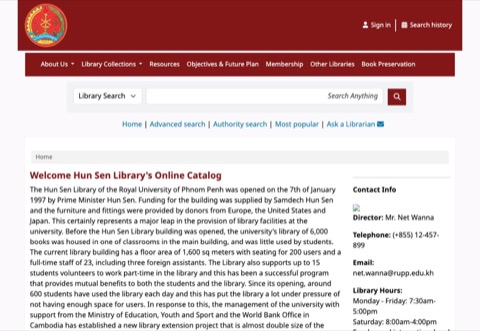
- Queen Mother Library, Documentation Center of Cambodia (DC-Cam) (柬埔寨文献中心太后图书馆)The Documentation Center of Cambodia (DC-Cam) is a non-profit institution based in Phnom Penh. It was established in 1995 as a project affiliated with Yale University and became an independent legal entity in 1997; its core mission is to collect and preserve historical materials of the Khmer Rouge period (1975–1979) and to promote public awareness. Its official library page states that the Queen Mother Library is oriented toward public and youth education, for public viewing and study. The library also holds books and documents collected by Ambassador Julio A. Jeldres, DC-Cam's own archives, personal photographs of the Father King Sihanouk, and books, medals, certificates and personal items donated by the Queen Mother. For readers studying Southeast Asian regional history, Sino-Cambodian relations during the Cold War, the Democratic Kampuchea regime and its victim groups, it is one of the few institutions in Cambodia where bulk primary documents can be accessed in person. DC-Cam's archive catalogue also lists categories such as bulletins of Democratic Kampuchea's overseas embassies, files of the Lon Nol regime (1970–1975) and Khmer Rouge historical documents, and includes Vietnamese-language documents. The website's sections also list a 'Chinese Language Research' project, but for its specific content please consult the website.
Address Maison 11, Street 256, Sangkat Chakto Mukh, Khan Daun Penh, Phnom Penh, 120207, Cambodia View on map ↗
Coverage, how to use, and notes
Coverage According to the official library page: the holdings include more than 3,000 books and documents, of which at least 2,800 boxes of documents come from Ambassador Jeldres; the DC-Cam archive exceeds 1.7 million pages concerning the Khmer Rouge; the audiovisual archive exceeds 100,000 hours, mainly audio and video recordings of interviews with Khmer Rouge victims; photographs come mainly from Sihanouk's personal collection, covering 1950 to 1991, along with materials collected between 1981 and 2019. Archive document categories include biographies, confessions and lists of the killed and missing, diaries, Democratic Kampuchea policy documents, telegrams, microfilm catalogues and S-21 prisoner lists. The materials are mainly in English and Khmer, with some in Vietnamese; please check the website for specific languages.
How to use For the on-site address see the website. The office hours listed on the website are Monday to Friday 07:30–17:00 (local time); closed on weekends and public holidays. The website does not say whether these are also the public reading hours, so contact first to confirm before going. Consultation must follow the two documents listed on the website, the Regulations for Public Information Room User and the procedures for accessing documents held by DC-Cam; the website's archive page does not state the specific steps for appointments or registration. For archive enquiries, contact the Director of the Archives, with contact details on the website. To search online first, use DC-Cam's data portal databases.dccam.org.
Notes Contact persons, telephone numbers and address details differ slightly across pages of the website (one page lists Maison 10 in its contact section), so confirm by telephone or email before going; older pages listed a Public Information Room at 66 Sihanouk Boulevard, and the current address on the website prevails. The website does not state lending, copying and fee policies. Materials on Khmer Rouge victims are distressing in content, and some documents may be subject to access restrictions.
Museums & memorials
- Tuol Sleng Genocide Museum (吐斯廉种族灭绝博物馆(S-21))The Tuol Sleng Genocide Museum is located in Phnom Penh, on the original site of S-21, the Khmer Rouge interrogation and detention center, and is operated by the Cambodian government; its website is tuolsleng.gov.kh. The site was originally Preah Ponhea Yat High School, built in 1962, and covers about 600 m by 400 m. The website states that between 1975 and 1979 an estimated 15,000 to 20,000 people were held here and about 1,720 Khmer Rouge personnel worked at S-21; when Phnom Penh was liberated only 12 prisoners survived, 4 of them children. The museum preserves the cells and prisoner photographs and displays paintings by the survivor-artist Vann Nath (1946–2011). The website's 'Collections' section lists 'Archives and Research' and a 'Restoration Laboratory', and links to the online archive site archives.tuolsleng.gov.kh; the website states that free admission tickets are offered to researchers in the cultural and educational fields. For readers studying the history of the Democratic Kampuchea period, transitional justice and the politics of memory, it is an important site for field visits; the website has no specific description of materials on ethnic Chinese victims of that period.
Address St. 113, Boeung Keng Kang III, Boeung Keng Kang, Phnom Penh 12304, Cambodia View on map ↗
Coverage, how to use, and notes
Coverage The website states that the museum includes permanent, temporary and travelling exhibitions, and that the site's buildings and the objects in the museum are protected by law. It preserves S-21 prisoner documents and thousands of prisoner photographs (displayed in the museum). The website does not state the total size of the collections or the number of archival items; please consult the website. Exhibits are mainly in Khmer and English; for other languages please consult the website.
How to use Open daily 8:00–17:00, including public holidays. Tickets are sold only at the museum entrance, payable in cash (riel or US dollars): free for Cambodian citizens, USD 5 for foreign adults, USD 3 for children aged 10–17 (ID required), free for children under 10; audio guides cost USD 5 for non-Cambodians, and live guides are by donation. The website states that photography is permitted for non-commercial personal or research purposes, while commercial use requires permission. Researchers can apply to the museum for free entry; for how to arrange this, please consult the website. To consult the museum's archives, first see its online archive site or contact the museum; the website does not state reading-room appointment rules.
Notes Tickets, opening hours and prices may change; the website gives slightly different age ranges for children in two places (10–17 and 10–18), so rely on what is stated on site. The content in the museum concerns severe atrocities, so visitors should be mentally prepared. The website's 'Archives and Research' page does not state the rules for consulting materials on site.
Laos3
Archives & historical document databases
- Buddhist Archive of Photography (佛教摄影档案(琅勃拉邦))The Buddhist Archive of Photography is a photographic archive established in 2005 in Luang Prabang, northern Laos, which collects and organizes historical photographs taken and kept by monks over about 120 years. The website names the British Library, the National Library of Laos and the Buddhist Heritage Project as long-term research partners. The site has sections for historical photographs, exhibitions, texts, videos and galleries, as well as an overview of past and current research. Photographs taken by monks record rituals, architecture, people and daily life from within the temple, and are a rare primary source for the social history of Lao Buddhism, the city and religious life of Luang Prabang, and visual culture; they can be used alongside manuscript collections.
Coverage, how to use, and notes
Coverage The website states that it holds about 35,000 historical photographs, taken and kept by monks over a span of about 120 years. The start and end years, the numbers by category and the proportion digitized are not stated on the website homepage; please check the website.
How to use From the website homepage, browse the sections for historical photographs, exhibitions, texts, videos and galleries. The homepage does not explain how to apply to use images or whether on-site consultation is possible; the site also has a Help Us page and a copyright page, which should be read before using images, and the archive should be contacted as the website directs.
Notes The homepage does not state the operating institution, search function or download rules; only part of the collection is visible online, so do not assume all images can be obtained. Permission from the rights holder is required for citation or publication.
- Official Gazette of the Lao PDR (Laogazette) (老挝官方公报网站(老挝法律公报在线))This website is the official online edition of the Official Gazette (ຈົດໝາຍເຫດທາງລັດຖະການ) of the Lao People's Democratic Republic, operated by the Lao Ministry of Justice; the footer copyright is dated 2013, and the site is linked to the gazette of the National Institute of Justice and the promotion of the LaoLaw app. The site publishes legal instruments currently in force classified by type of law (Constitution, laws, Civil Code, Penal Code, decrees, regulations, orders, instructions and so on), by central ministry and agency, and by province and Vientiane Capital, and separately lists superseded old regulations and draft laws open for public comment. For researchers of the Lao state system, land and investment rules, religious and ethnic policy, and the domestication of foreign treaties, this is the authoritative primary source for legal texts; for readers studying regional law and governance in Southeast Asia, China-Laos relations, and the business environment of ethnic Chinese merchants in Laos, it can also serve as a starting point for checking official norms. Official texts are Lao-language PDFs; English translations are also provided on the pages, but the English versions are unofficial translations.
Coverage, how to use, and notes
Coverage The page shows about 1,483 legal instruments currently in force and about 299 old regulations that have been superseded but applied during their period of validity. Categories include the Constitution, laws, decrees, regulations, orders, instructions and rules, as well as central and provincial legislation. There are also sections for draft laws open for comment (usually not less than 60 days), announcements and forms. Official texts are in Lao, and English translations are unofficial. The starting year of coverage is not stated on the website; please check the website.
How to use Open the website directly to browse and search; no account is needed. Results can be filtered by type of law, issuing body or province and sorted by title, responsible agency, effective date or publication date; there is a legislation statistics page and an online table of the full list of laws. The official version is a PDF that can be viewed, printed or downloaded; Word texts are also available for reference but are not official versions. The site also offers a mobile gazette app and the LaoLaw app. When looking for English translations, it is advisable to first check the Lao title or law number on the site and then compare with the English version.
Notes The Lao text prevails and English translations are unofficial; Word files are for reference only. The site also has a member registration area whose functions are not described on the website. The old regulations section only includes documents that applied during their period of validity, which does not equal colonial-era or pre-1975 documents; historical research needs to look elsewhere. For the site's server stability and update progress, please check the website.
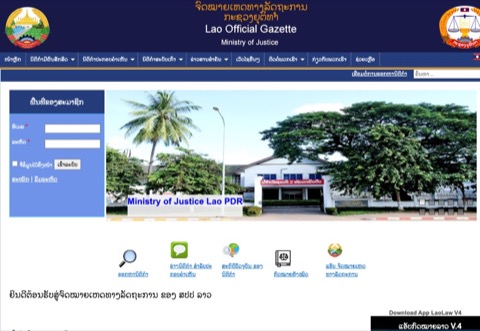
Scholarly databases & search tools
- Lao Citation Index (LCI) (老挝引文索引)The Lao Citation Index (LCI) is an online search platform for Lao domestic scholarly publications, aiming to collect, preserve and provide search access to Lao research papers and scholarly publications, and to raise the visibility of Lao researchers and their work at home and abroad. The footer of the website states that the data come from the National University of Laos and Souphanouvong University and gives a contact email; the page also mentions plans to link with the ASEAN Citation Index and share data. Lao domestic journals have long lacked a unified entry point and are mostly published in Lao, with limited coverage in international databases. For researchers of Lao society, education, law, economy and regional relations, LCI offers a way to search local Lao scholarship by journal, subject and year, and also to understand the research orientations and the cooperating journal network of Lao academia.
Coverage, how to use, and notes
Coverage It includes papers from cooperating journals; the website has a Journals section and states that three new journals were added in the third quarter of 2025, with emphasis on expanding the social sciences and engineering. The numbers of articles, journals and authors on the home page are dynamic placeholders and show no actual figures, and the website does not state the languages or the start and end years covered; please check the website.
How to use Open csjp.nuol.edu.la/lci, search by keyword or full text, and filter by publication year range, journal or subject; View All Articles lets you browse all articles, and the Journals section lists the cooperating journals. For submissions, follow each journal's own author guidelines and submit to the relevant journal; institutions that want to connect their own e-journal platforms must contact LCI directly. The interface navigation is in English and the introductory text is in Lao, so Lao keywords can be used when searching for Lao-language papers. The website does not state whether bulk export is possible; please check the website.
Notes The statistics on the home page are placeholders, so actual scale should be judged from search results; the website does not give the full name of the operating institution, the languages covered or whether full texts are freely downloadable, so please check each journal page before use.
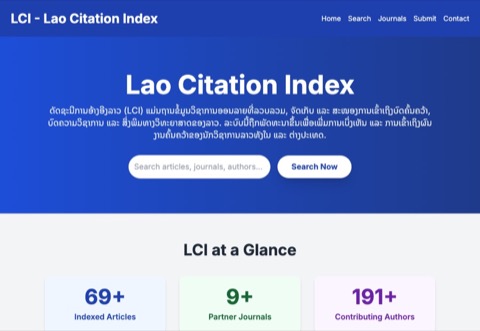
Brunei8
Newspapers & news archives
- Pelita Brunei Archive (Arkib): Official PDF Archive of the Government's Malay Weekly (《directory Pelita Brunei》官方存档(文莱政府马来文周报 PDF 存档))Pelita Brunei is a Malay-language news website run by Bahagian Pelita Brunei under the Information Department (Jabatan Penerangan), Prime Minister's Office of Brunei; its content covers domestic news, sports, international affairs, religion and features, and it also has supplements and columns. The site navigation has an Arkib (archive) section that lists PDF files of each issue of the newspaper by issue date, which readers can open and read directly without logging in. For those studying contemporary Brunei politics, royal and religious affairs, official discourse, public policy and social developments, this is first-hand local-language press material provided directly by the official publisher and can be used alongside English-language press and Chinese-language materials. For studies of ethnic Chinese in Southeast Asia and regional studies, it can supplement reporting on ethnicity, migration, education and foreign relations from the Bruneian official perspective, and is especially suitable for work that needs to check government announcements, official events and Malay-language expressions. The page can be filtered by date range and sorted by title or date. Because it is a government news agency publication, it should be cross-checked with other sources when used.
Coverage, how to use, and notes
Coverage The archive page provides PDFs of each issue in list form; the latest entries shown on the page are issues from October to November 2026; whether it goes back to earlier years, and the earliest year available, are not stated on the website pages, so please check by paging through the website. The language is Malay (Bahasa Melayu). The content type is whole-issue PDFs of the weekly newspaper.
How to use Go to the website pelitabrunei.gov.bn and click Arkib in the navigation, or open the /arkib page directly. The page lists the title and date of each issue; the Tarikh field can be used to set a date range filter, the Tajuk or Tarikh column headings can be clicked to sort, and Next page leads to earlier issues. Click a title to open the PDF; the page does not require login or payment. If full-text search is needed, please open the PDF and check for yourself whether it has a text layer, and if necessary download it and search with a reader. When citing, it is advisable to record the issue date and the archive page URL.
Notes On the page, the title of some links differs by one day from the listed date (for example the title reads 28 Oktober 2026 while the date shows 27 October); before citing, rely on the issue date inside the PDF. The website does not clearly state copyright and reuse terms; please read the website's notices before republishing or downloading in bulk. The starting year and completeness of the archive have not been verified. The content is from official media and should be cross-checked with other sources.
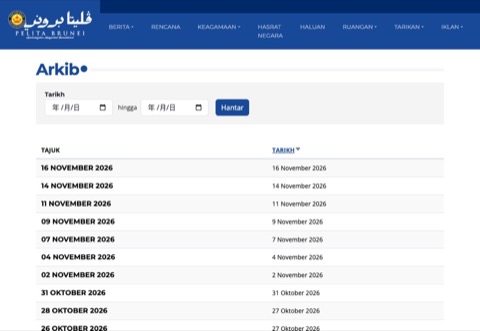
Scholarly databases & search tools
- Brunei Index (文莱索引(文莱出版物联合索引))Brunei Index is a union index page for Brunei materials on the website of the Universiti Teknologi Brunei (UTB) Library. The website states that it brings together publications about Brunei and from Brunei held by libraries in Brunei, helping readers find books, articles, newspapers and research materials on Brunei's history, culture and development. The participating institutions listed on the page include the Brunei Library Association, Dewan Bahasa dan Pustaka, Institut Teknologi Brunei, Pusat Sejarah Brunei, Universiti Brunei Darussalam, Universiti Islam Sultan Sharif Ali (UNISSA) and UTB, with the aim of supporting research and study and preserving Brunei's knowledge heritage. Since local Brunei sources are scattered and there is no unified bibliography, this page can serve as a guide for finding Brunei-related materials by institution, including as a source of leads when looking for publications on Brunei's Chinese community.
Coverage, how to use, and notes
Coverage The scope covers Brunei-related materials held by Brunei's national, university and government libraries; the page links to each participating institution's resources separately and provides a search entry into the UTB catalogue with Brunei materials as the condition. The page does not state the total number of records or the chronological span; please check the website.
How to use Open the URL to view it; no registration is required. The page lists each institution's Brunei materials links (including cloud folders and documents) and the UTB OPAC search entry for Brunei materials; first identify the holding library from the institution list, then follow the corresponding link to search or download. UTB Library contact details are on the page: telephone (+673) 246 1020 ext. 6091; for email, see the website's contact page.
Notes The page is marked UPDATING IN PROGRESS, so its content is still being updated, and whether some links remain valid long-term should be confirmed by users. It is an index and navigation page, not a unified full-text database; the actual conditions for obtaining materials depend on each library.
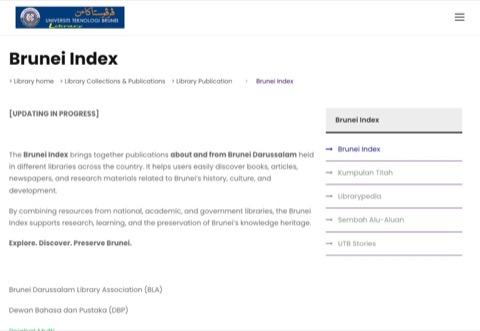
- Repository@UBD (文莱大学机构知识库)Repository@UBD is the digital institutional repository of Universiti Brunei Darussalam (UBD), linked from the UBD Library. Its homepage states that it holds examination papers, theses, manuscripts, rare materials and more, with categories including theses, manuscripts, Brunei-related materials and MIB. At the time of checking, the homepage showed a total of 3,647 items, including images, videos and theses. For readers studying Brunei society, history, culture and the Malay Islamic Monarchy (MIB), it is one of the few places to search online for output and rare materials of Brunei's local universities; its master's theses, maps and working papers can serve as a starting point for understanding local research topics and existing literature. For topics such as the Chinese in Brunei and Chinese-language education, keywords can be used to look for local theses here.
Coverage, how to use, and notes
Coverage According to the type statistics on the homepage, at the time of checking there were: about 281 articles (Article and Articles combined), 70 books, 131 Dissertations, about 682 master's theses, 1 doctoral thesis, 163 maps, 39 conference papers, 36 reports, 98 working papers and 1,264 Other. Languages and chronological span are not stated on the website homepage; please check the website.
How to use After opening the URL, use keyword search or advanced search, or browse by issue date, author, title, subject or type; the page also has a Communities page for viewing the sub-repositories. Login is optional (email accounts or UBD email login are supported). The homepage provides statistics on most viewed, most downloaded and downloads by country. When searching for theses on the Chinese in Brunei, try keywords such as Chinese, Brunei Chinese and Mandarin, together with a type filter for master's theses.
Notes The homepage does not say whether the full text of all items can be downloaded without logging in; some items may be restricted, so please confirm on the individual item page. The type field contains duplicates (such as Article/Articles and two spellings of Master's Thesis), so each needs to be checked separately when filtering by type.
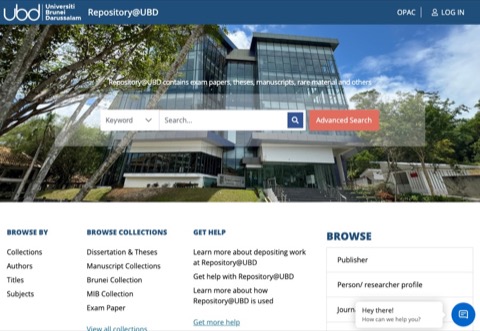
Museums & memorials
- Brunei History Centre (Pusat Sejarah Brunei) (文莱历史中心)The Brunei History Centre (Pusat Sejarah Brunei) is a national history institution in Bandar Seri Begawan, which Brunei's official tourism website describes as a cultural heritage centre for researching, preserving and presenting Brunei's national history. The centre displays old cannons, daggers and ceremonial objects, and has a gallery showing shipwreck relics recovered from Brunei's coastal waters. For readers studying the Chinese overseas and regional history, Brunei's historical narratives, maritime trade relics and royal-related objects are an on-site entry point for understanding the background of contacts between northern Borneo and China and other parts of Southeast Asia. It should be noted that the official tourism website page gives only an introduction, address and opening hours, and does not list library holdings, archives or search services; it is therefore better suited as a visiting site for understanding Brunei's local historical narrative and object displays than as a place for systematically searching Chinese-related documents. For specific research needs, it is advisable to contact the centre beforehand by telephone or through its social media account to ask whether research enquiries or access to materials are available.
Address Jalan James Pearce, Bandar Seri Begawan, BS8610, Brunei View on map ↗
Coverage, how to use, and notes
Coverage Content verifiable on the official page: old cannons, daggers, ceremonial objects and a shipwreck relics gallery, with the theme of Brunei's national history. The size of the collection, chronological span, languages and whether it has a library or archive section are not stated on the official page; please check the website.
How to use Visit in person. The opening hours listed on the official tourism website are: Monday to Thursday 8:30–16:15, closed on Friday, Saturday 8:30–16:15, Sunday 8:30–12:00. The page does not say whether an appointment is required, nor does it show whether the centre is currently open as normal; before setting out, call +673 2240166 or confirm via its Instagram account @pusatsejarahbrunei. The page suggests getting there by public bus or ride-hailing.
Notes The page cited comes from the official website of Brunei's tourism board, not the centre's own website; the centre's own domain could not be opened normally at the time of checking because of a certificate problem. Opening status and displays may change; please rely on the latest official notices.
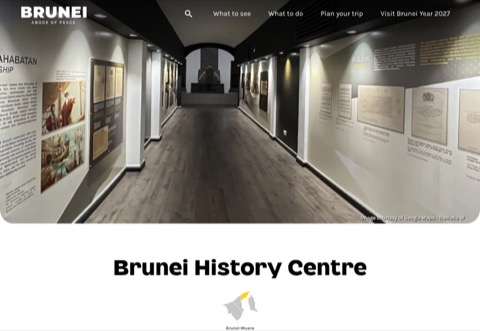
Institutions & societies
- Institute of Asian Studies, Universiti Brunei Darussalam (UBD-IAS) (文莱达鲁萨兰大学亚洲研究院)The Institute of Asian Studies (IAS) was established in January 2012 at Universiti Brunei Darussalam as the university's interdisciplinary research institute for Borneo and Southeast Asian studies. The website states that it emphasizes research that is relevant, academically rigorous and multidisciplinary, and it connects several units including the Academy of Brunei Studies, the Faculty of Arts and Social Sciences, the School of Business and the Faculty of Science. The institute is a founding member of the Southeast Asia Studies Alliance (SEASIA) and the Borneo Studies Network (BSN), and the secretariat of the Borneo Studies Network is also based at the institute. It runs a Wednesday seminar series, workshops and conferences, maintains a working paper series and a newsletter, and publishes the book series Asia in Transition with Springer. The website also lists visiting scholars and research contacts, and the institute admits master's and doctoral students in Asian studies. For scholars of Brunei, Borneo and regional Southeast Asian issues, it is an important window for engaging with local scholarship, obtaining working papers and learning about academic events.
Address Institute of Asian Studies, Universiti Brunei Darussalam, Jalan Tunku Link Gadong, BE1410, Negara Brunei Darussalam View on map ↗
Coverage, how to use, and notes
Coverage The research focus is Borneo and Southeast Asia, covering the region's history, socio-cultural and ethnolinguistic diversity, and political, economic and environmental issues. The website homepage shows the working paper series (e.g. Nos. 94 and 95), the newsletter and book series information; the total number of papers, chronological range and library-type holdings are not stated on the website; please check the website.
How to use Enter the website to browse announcements, working papers and publications; no registration is required. For an on-site visit or to attend a seminar, first contact the institute by the telephone numbers listed on the website, +673 246 0922/0923 (ext. 2585/2586), or by email (see the website's contact page), to confirm the event schedule and how to enter the campus. The website does not state whether external visitors need an appointment; please check the website.
Notes This is a research institute, not a library or archive open to the public, and it has no holdings catalogue that outside readers can search. The university website showed a maintenance notice during checking, and some pages (including the university library page) could not be confirmed at the time, so the library is not included in this entry.
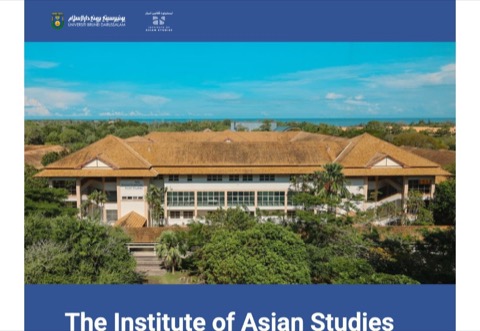
Other
- BRULAW (Attorney General's Chambers, Brunei Darussalam) (文莱法律库 BRULAW(文莱总检察署))BRULAW is a legal database provided by the Attorney General's Chambers of Brunei under the Services section of its website, and is the official entry point for searching Brunei statutes. Official information from the Attorney General's Chambers states that its law production unit BRULAW was established in 1988 and is responsible for reprinting and publishing the revised Laws of Brunei. The online edition lets users browse Acts and Orders alphabetically from A to Z, each opening as a PDF text; the page also has a New Legislation section and a Laws Revision Orders section, and provides a full-year list by year of Part II of the Government Gazette. For readers studying Brunei, this site gives direct access to the official texts of statutes other than constitutional documents, as well as subsidiary legislation and notices, for checking provisions, revision history and publication dates. It is suitable for studying Brunei's state institutions, its system in which religion and law operate in parallel, nationality and immigration rules, company and commercial regulations, and the legal environment involving Chinese communities. Among official first-hand legal texts of Brunei, it is the most direct and free public entry point.
Coverage, how to use, and notes
Coverage It includes Brunei's current laws (Acts and Orders) as well as subsidiary legislation, notices and appointments; the page shows the 2026 Laws Revision Orders (Nos. 1, 2 and 3) and newly published legislation for 2026. The full-year list page of Part II of the Government Gazette lists the years 1998 to 2026. Texts are provided as PDFs, mainly in English; whether the revised editions and historical versions of each law are complete, please check the website. Old colonial-era ordinances and gazettes before 1998 are not within the scope of this list.
How to use Go to the Attorney General's Chambers website (agc.gov.bn) and click BRULAW in the Services menu at the top; no registration is needed. The top of the page has an A-Z alphabetical index for browsing by the first letter of the law's name and opening the PDF; the INFO tab gives instructions for use; See All at the end of the New Legislation section leads to the full-year list of Part II of the Government Gazette (Government Gazette Part II - All Year), from which a year can be selected. Legal texts can be downloaded and saved directly. When searching, you need to know the English name or first letter of the law; when citing, distinguish the chapter number of the law (CAP.) from the gazette subsidiary legislation number (S number). The Chambers also has a law library, which mainly serves its own staff; the public must apply and be approved by the Attorney General, so please check the website.
Notes The online PDFs are for reference; before citing or using them for legal purposes, please check them against the gazette and the latest revisions. The website currently has no cross-law full-text search box, so browsing by letter is required. Printed copies of the Laws of Brunei, Brunei Constitutional Documents and Brunei Law Reports are sold through the law library; prices and availability are in the website's price list. The 2026 page shows several emergency and revision notices, so please pay attention to effective dates when consulting them.
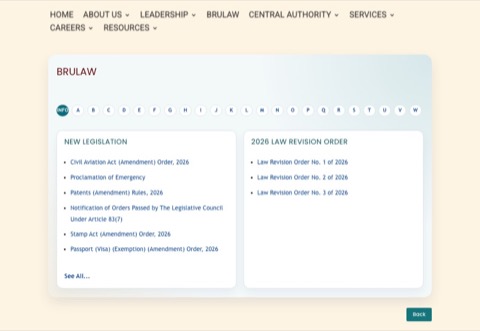
- Judgments (Judiciary of Brunei Darussalam) (文莱司法部门判决书库)The Judgments section of the website of the Judiciary of Brunei Darussalam publishes written decisions of Brunei's courts at all levels. The page describes them as written decisions made by the courts of Brunei and notes that the content is still under development. Entries are listed from newest to oldest. Each gives the case name and parties, the case number (in a format such as HCCS/76/2021), the hearing or judgment date, a bracketed summary of the issues, and a PDF link to the full document. Courts are labelled High Court, Intermediate Court and Court of Appeal, and document types include judgments, decisions, rulings and sentencing. For Southeast Asian regional studies, this is official primary material on Brunei's judicial practice, usable for research on commercial and contract disputes, land and inheritance, criminal sentencing, and government-citizen relations. The same site also offers practice directions and circulars and the annual Legal Year e-book series, which help place individual cases in their institutional context.
Coverage, how to use, and notes
Coverage Publication dates on the page are concentrated between August and November 2026, while decision dates go back to 2017. Some earlier decisions were posted later, so the listing is not complete year by year. Documents are PDFs, and the site has Malay and English interfaces. The Publications page also lists annual Legal Year e-books for 1984 and 2000–2026 (2004 and 2017 missing), with 2027 marked as forthcoming. Whether Syariah court documents are included is not stated on the site; please check the site.
How to use Go to judiciary.gov.bn and open the Judgments page; no registration is required. There is a 'Search for:' box at the top of the page where you can enter party names, case numbers or keywords, and you can page back through 'Older Entries' at the bottom. Click the PDF link in an entry to read or download it. For practical guidance, see Practice Directions and Circulars under Information; the annual Legal Year volumes can be downloaded from the Publications page. When citing, record the case number, court and decision date, because the website posting date is not the decision date.
Notes The site describes itself as still under construction and it is not a complete historical case-law database. For earlier decisions (e.g. the 1980s–2000s), consult printed sources such as the Brunei Law Reports. The search function is a simple keyword box, with no advanced filtering by year or court.
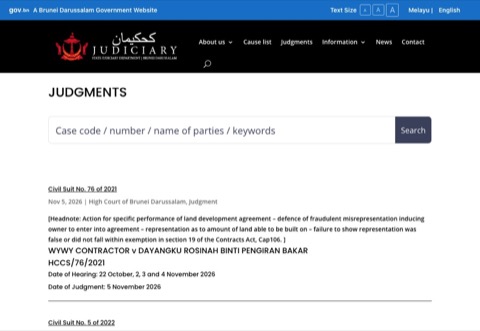
- Southeast Asia: A Multidisciplinary Journal (SEAMJ) (《东南亚:多学科期刊》(文莱大学文学与社会科学院))Southeast Asia: A Multidisciplinary Journal is a peer-reviewed academic journal published by the Faculty of Arts and Social Sciences (FASS) of Universiti Brunei Darussalam (UBD), founded in 1999, with a focus on Southeast Asia and covering the arts, social sciences and humanities. According to the Emerald page, it is now published by Emerald Publishing under Diamond Open Access, with no article processing charges for authors; it uses double-anonymous review, with at least two reviewers per article. The journal publishes manuscripts in both English and Malay, which is helpful for readers who want to learn about Brunei scholarship on regional and Brunei issues and about Malay-language academic writing. It is not a journal devoted specifically to Brunei, but because it is published by a local Brunei university, it is an important outlet for finding research by Brunei scholars and papers on Brunei topics.
Coverage, how to use, and notes
Coverage The subject is Southeast Asian regional studies, with disciplines covering the arts, social sciences and humanities; topics outside the region may also be included if a paper is significant for the region. Founded in 1999; at the time of checking, the current issue was Volume 26, Issue 2 (12 November 2026). For publication languages, see the website (English, Malay). For specific volumes, issues and article counts, please check the website.
How to use On the journal page on Emerald Insight, issues can be browsed and read online without a subscription; searching is possible within the journal page, or use Google Scholar with keywords such as Brunei and Brunei Chinese together with the journal name. Early volumes and issues were originally provided on the UBD Faculty of Arts and Social Sciences website; please check the website for its current status.
Notes At the time of checking, the certificate of the UBD site could not be verified and the official UBD page could not be opened, so the information above comes mainly from the Emerald page. The journal is a general regional journal, and not every issue has a Brunei theme.
Timor-Leste6
Archives & historical document databases
- Tribunais de Timor-Leste – Legislação Antiga (Courts of Timor-Leste) (东帝汶法院网站“旧法例”栏目)The official website of Timor-Leste's court system, tribunais.tl, has a section called Legislação Antiga (Old Legislation), which collects colonial-era legal texts that are no longer in force but remain important for understanding the origins of Timor-Leste's legal system. The section lists entries of the Boletim Oficial de Timor (Official Gazette of Timor) for 1883–1975, the 1867 Portuguese Civil Code (five volumes, published 1870 to 1876), the original 1966 Portuguese Civil Code, Ordinance No. 22869 of 1967 on the code's application in the Portuguese overseas territories, and an English version of the Indonesian Penal Code, presented in a numbered table with download links. The site also has sections for Edições do Tribunal de Recurso (Court of Appeal publications), other publications, and Buscar Acórdãos (search judgments). For researchers of Portuguese colonial law, the historical layers of Timor-Leste's law, and the development of civil law and land systems, this provides directly downloadable primary texts.
Coverage, how to use, and notes
Coverage Entries on the Legislação Antiga page include: Boletim Oficial de Timor 1883–1975 (listed); the 1867 Portuguese Civil Code, volumes 1–5 (1870–1876); the 1966 Portuguese Civil Code; Ordinance No. 22869 of 1967; and an English translation of the Indonesian Penal Code. The page is in Portuguese. The website does not state the page counts or total volume of each item.
How to use Go to www.tribunais.tl, choose Legislação Antiga under the Legislação menu; the page is a numbered table, and clicking Download gives a PDF; no registration is required. Judgments can be found through the Buscar Acórdãos search entry on the home page.
Notes On checking, the Boletim Oficial de Timor (1883–1975) on the Legislação Antiga page shows only entries and no download links; whether full text is available should be confirmed on the site. The page does not list United Nations Transitional Administration regulations; for these, use the Ministry of Justice legal reference library instead.
Scholarly databases & search tools
- Diálogos (Universidade Nacional Timor Lorosa'e) (《对话》期刊(东帝汶国立大学))Diálogos is an open-access peer-reviewed journal published by the Faculty of Philosophy and Human Sciences of the National University of Timor-Leste (UNTL), covering philosophy, the social sciences and the humanities, with one issue per year since 2016. The website gives the online ISSN as 2789-2182 and the print ISSN as 2520-5927, states that content is licensed CC BY 4.0, and declares that no article processing charges are levied. The site has English and Portuguese interfaces, and articles are published in Portuguese and English. For Timor-Leste studies, the journal is a scholarly outlet run by a Timorese university itself, offering research by local scholars on religion, society, education, language, history and other topics, and complementing secondary literature that comes mainly from Australian and Portuguese scholarship. It is also useful for understanding research topics and writing in Timor-Leste's own humanities and social sciences. The website currently shows the latest issue as Volume 11 (2026), themed Práticas religiosas e dinâmicas sociais (Religious Practices and Social Dynamics), published on 17 November 2026.
Coverage, how to use, and notes
Coverage Annual, published since 2016; the website currently shows Volume 11 (2026) as the latest. Content consists of articles and editorial pieces in philosophy, the social sciences and the humanities, in Portuguese and English. Articles are listed by issue with authors and page numbers. The total number of articles and whether all issues are online should be checked on the site.
How to use On the website, browse issues through the Archive, or use the site search; each article page offers a free PDF download. The site provides RSS/Atom feeds and has user registration and login, but reading and downloading do not require login. Submission instructions are on the Submissions and author information pages. For citation, use the metadata and DOI information given on the article page (as actually displayed).
Notes Whether earlier issues are all online should be checked in the website archive; in the English interface, some articles are still in full Portuguese text.
Libraries & archives
- Sala Leitura Xanana Gusmão (Xanana Gusmão Reading Room) (夏纳纳·古斯芒阅览室(图书馆与博物馆))Sala Leitura Xanana Gusmão is a free public library, museum and community space in Dili, which its website says was founded by Kirsty Sword-Gusmão in June 2000. It offers books and multimedia materials for the public (including children's books), an online searchable catalogue, free internet access, and a set of audiovisual materials on the history of Timor-Leste; it also holds permanent and temporary exhibitions and organizes events combining art, music, culture and current affairs. For Southeast Asian studies, it is a useful on-site entry point for learning about Timor-Leste's history, society and contemporary culture when visiting Dili, and its online catalogue can be used to look up titles beforehand. The library is not an institution specializing in Chinese studies, and its website does not mention any thematic collection on ethnic Chinese; such enquiries should be directed to the library separately.
Address Rua Belamino Lobo 1, Lecidere, Bidau, Dili, Timor-Leste View on map ↗
Coverage, how to use, and notes
Coverage The website says the library holds books, multimedia materials, an audiovisual collection on Timor-Leste's history, and permanent and temporary exhibitions. The total size of the holdings, the proportion of languages and the date range are not stated on the homepage; please consult the website and the online catalogue.
How to use The website is xananagusmaoreadingroom.com, where the catalogue can be searched online first. The website gives opening hours as Monday to Saturday 9:00-17:00, closed on Sunday; the premises are open to the public free of charge, no entrance or membership fee is listed, and there is a separate membership page. The homepage lists no telephone number or email, only an online enquiry form; venue hire has a separate booking page. No appointment is needed to consult general materials; for specific materials or group visits, it is advisable to contact the library beforehand through the online form.
Notes The homepage lists no telephone number; the telephone numbers and street names given on third-party sites are inconsistent, so please rely on the address on the official website. Opening hours may change; please check the website before visiting.
Institutions & societies
- Centro Nacional Chega! I.P. (国家 Chega! 中心)Centro Nacional Chega! is the Timor-Leste national institution responsible for preserving and disseminating the memory of the 1974-1999 conflict, and is a continuation of the work of CAVR. Its website has a news section titled 'Pesquiza & Arquivu Istoriku' (Research and Historical Archive), as well as sections on historical sites, personal and family memories, a map of historical sites, and Chega! recommendations. It offers downloads of the Chega! report (all volumes), Per Memoriam Ad Spem, and the Chega! Popular booklets in Tetum and English. The site also has a library portal and a museum section. According to the site's news, the centre worked with the National Archives of Indonesia (ANRI) and UNESCO to run archive restoration, digitization and disaster management training for 38 civil servants from 31 August to 4 September 2026, and noted that Timor-Leste does not yet have an archives law. Another report says its Chega! Archive Centre opened in June 2026 in the former Balide/Comarca prison area in Dili. For researchers of transitional justice, memory politics and oral history in Timor-Leste, this is the main official entry point.
Coverage, how to use, and notes
Coverage All volumes of the Chega! report and the public-facing Chega! Popular booklets (Tetum, English) can be downloaded. The site also contains historical-site and memory content related to 1974-1999; the size, dates and catalogue of the archive centre's holdings are not stated on the homepage, so please consult the official site.
How to use Open the website and browse the menu sections such as Downloads, historical sites and memory, the library (Asesu Biblioteka) and the museum. Reports and booklets can be downloaded directly. To consult the archive centre's holdings, ask about appointments and application procedures through the site's contact page; for specific rules, please consult the official site.
Notes The full street address, opening hours and an online archive catalogue could not be verified on the homepage, so no location entry is created; please contact the centre to confirm before visiting in person. The site is mainly in Tetum, Portuguese and English, and its page structure may change.
- La'o Hamutuk (Timor-Leste Institute for Development Monitoring and Analysis) (拉奥哈穆图克(东帝汶发展监督与分析研究所))La'o Hamutuk is a non-governmental research and monitoring organisation in Timor-Leste. Its website says it monitors, analyses and reports on the major international institutions and systems involved in Timor-Leste's reconstruction and development, and argues that major decisions should be made democratically and transparently by the people of Timor-Leste. The site publishes a large amount of primary analytical material, including the Bulletin and the popular series Surat Popular, research reports, policy briefs, annual and mid-year reports, submissions and open letters to Parliament and the Government, and the radio programme Radio Igualdade. The site also has topic indexes covering the state budget, the Petroleum Fund, petroleum and mining projects, maritime boundaries, the Strategic Development Plan, debt and donor meetings, and a Reference Index that collects documents from other organisations. Content is mainly in Tetum and English, with some in Portuguese. For researchers of Timor-Leste's political economy, energy, international relations and aid policy, this is a commonly used local primary source.
Coverage, how to use, and notes
Coverage The website was recently updated through November 2026; the earliest material visible in the indexes dates from 2012. Languages are mainly Tetum and English, with some Portuguese. The total volume is not stated on the site.
How to use Use the site search linked from the home page (covering the website and blog), or browse through the topic index, the Reference Index and the updates page. Most documents can be read or downloaded online without registration. Contact details are on the website.
Notes The organisation has a clear stance, so its material should be compared with government and international organisation documents when used.
Other
- Parlamento Nacional de Timor-Leste (东帝汶国民议会官方网站)The official website of Timor-Leste's National Parliament (Parlamento Nacional), parlamento.tl, has Portuguese and Tetum interfaces and publishes legislative and parliamentary material. The law section lists the Constitution, the parliamentary election law, the law on the organisation of Parliament (LOFAP), the regulations on members' remuneration, and a full list of legislation. The SIGEIP system allows searching of legislative procedures and parliamentary activity; the plenary section provides meeting agendas and, through Canal Parlamento, live broadcasts and archived videos of plenary sessions. The site also links to an online library, an electronic document repository, a parliamentary journal, the rules of procedure and a members' handbook. For scholars of Timor-Leste's political institutions, legislative process, parliamentary debate and policy topics such as ASEAN integration, this is the official entry point to first-hand parliamentary records. The site gives the parliament's address as Palácio do Parlamento, Rua Formosa, Díli.
Coverage, how to use, and notes
Coverage The home page lists: the Constitution and main laws, the legislation list, SIGEIP legislative procedure search, plenary agendas and video archive, the online library, the electronic document repository and the parliamentary journal. The home page does not state the start and end years or the quantity for each section; please check the site. Languages are Portuguese and Tetum.
How to use Go to www.parlamento.tl and choose the Portuguese or Tetum interface; consult the list of laws under the Legislação section, use the SIGEIP system to search legislative progress, and view agendas and session videos under the Plenário section. The sections listed on the home page can be browsed without registration.
Notes On checking, the online library linked from the home page (biblioteca.parlamento.tl) showed a certificate error, so its availability could not be confirmed; please check the site. No section named Diário (journal of debates) was seen on the home page.
Mainland China14
Archives & historical document databases
- CADAL Qiaopi Collection (CADAL侨批数据库(大学数字图书馆国际合作计划))CADAL (China Academic Digital Associative Library) is a digital resource platform jointly built and shared by university libraries in China, and the resource overview on its homepage lists 'qiaopi' (overseas Chinese remittance letters) as a separate category. According to the Duke Kunshan University Library, CADAL and Shantou University began a qiaopi thematic database in 2010, which was completed and opened to the public in 2012, and is described as the world's first digitized thematic qiaopi database. Qiaopi are letters and remittance receipts sent home by overseas Chinese, combining the nature of correspondence and accounts, and were inscribed on UNESCO's Memory of the World Register in 2013. For research on Chinese in Southeast Asia, qiaopi record the family relations, remittance networks, occupations and transnational social ties of Chinese labourers and merchants in Nanyang, and are primary materials for studying links between emigrant home regions such as Chaoshan, southern Fujian and Guangfu and places such as Malaya, Singapore, Thailand and Indonesia. The database provides images of the originals, which can be used alongside newspapers, archives and oral materials.
Coverage, how to use, and notes
Coverage The resource overview on the website homepage shows about 50,065 items in the qiaopi category. According to the Duke Kunshan University Library, the content is digitized images of original qiaopi held by private and archival institutions in China and abroad. The specific date range, distribution of places of origin and catalogue fields are not stated on the homepage; please consult the official site.
How to use Go to the CADAL website (cadal.edu.cn) and find the qiaopi entry in the resource overview or related thematic sections. The homepage has registration and login entries, and you may need to register an account before use; for specific conditions and reading and download permissions, please consult the website. When searching, try keywords such as place of dispatch, place of receipt, firm names and personal names, and read the research literature on the Memory of the World qiaopi archives to understand the background of the materials.
Notes The homepage does not state the conditions of use or download restrictions for the qiaopi database. It could not be verified whether the size of Shantou University's own qiaopi database is the same as the figure given here; when citing quantities, please use the figure currently shown on the website.
- China Memory Project (National Library of China) (中国记忆项目网)The China Memory Project website (中国记忆项目网) was built by the National Library of China, which holds the copyright. Its aim is to collect, preserve and present the collective memory of the Chinese people, and it is one of the more systematic oral history and audiovisual recording platforms in mainland China. The site organizes content into 'People', 'Special Topics' and 'All Resources': the people section focuses on scholars and experts, with entries that carry video, images and location markers; the special topics include the Oral Traditions Collection Project of Ethnic Minorities with Small Populations and the Northeast Anti-Japanese United Army, among others. According to reports, the National Library has carried out resource building on the Northeast Anti-Japanese United Army topic since 2012 and has accumulated a large number of interviews through oral history interviews and audiovisual recording. For research on Southeast Asian Chinese and regional studies, the platform can serve as an entry point for understanding oral history collection methods in mainland China, memory of ethnic and local cultures, and oral materials related to the War of Resistance against Japan, and can be used in comparison with topics such as emigrant home communities (qiaoxiang) and cross-border ethnic groups. The site also has a public submission entry, 'Open Your Memory', which solicits memories of vanishing or changing traditions and daily life.
Coverage, how to use, and notes
Coverage Content is mainly personal memories of contemporary China, oral traditions of ethnic groups, and audiovisual oral accounts on special topics, which include the oral traditions collection of ethnic minorities with small populations (the page introduction mentions 28 such ethnic groups) and the Northeast Anti-Japanese United Army. Resource formats include video, images and audio recordings. The homepage gives no statistics on total volume, time span or languages; please consult the website.
How to use Access it at memory.nlc.cn. You can browse 'People', 'Special Topics' and 'All Resources' from the top navigation, or use the site search, and click an entry to open the 'Memory Details' page to view video and images. The pages provide login or registration and submission functions, and some functions may require registration. For the conditions of download, reproduction and citation, please read the 'User Guide' and 'Legal Terms' in the footer.
Notes The homepage does not use 'oral history' as a unified category name, so you need to enter a special topic or detail page to determine the type of material. Content directly related to Southeast Asia is limited; the main value lies in methodological reference and comparative material from the mainland China side. Whether materials can be downloaded and reused should be checked in the website's terms.
Scholarly databases & search tools
- China Academic Social Sciences and Humanities Library (CASHL) (中国高校人文社会科学文献中心)CASHL (China Academic Social Sciences and Humanities Library) is a platform for sharing foreign-language humanities and social science literature among universities. The website's homepage has entry points for resource categories such as books, journals, open access resources and databases, offers services such as document delivery, book lending and search-and-retrieval on request, and includes a list of member libraries, a master lecture series and in-depth services for large special collections. For research on Southeast Asian Chinese and regional studies, it can help readers at mainland Chinese universities find and obtain foreign-language journals and books on Southeast Asian studies, which is especially useful when local holdings are insufficient.
Coverage, how to use, and notes
Coverage The homepage provides category entry points such as books, journals, open access resources and databases, and does not give the total number of foreign-language journals or books; the number of member libraries is also not listed on the homepage. For the specific scope, periods and languages, please consult the category pages on the website.
How to use The page indicates that login is required and provides a registration entry. University readers first select their own library and then log in on that library's login page. After logging in, they can search journals and books and submit requests for document delivery, lending, or search-and-retrieval. For the specific application procedures, fees and time limits, please see the website's service instructions or ask your own library.
Notes The service is mainly for readers at universities belonging to member libraries; whether users from non-member libraries can use it should be checked on the website. Document delivery and search-and-retrieval may be charged, with rules as stated on the website and by your own library.
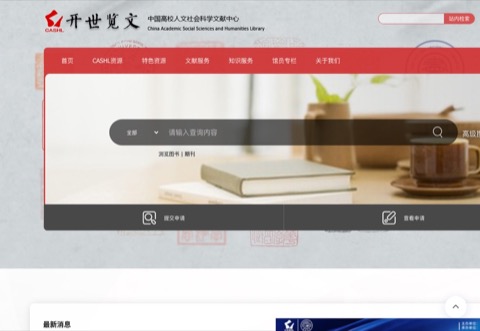
- China Doctoral Dissertations Full-text Database and China Master's Theses Full-text Database (CNKI) (中国博士学位论文全文数据库与中国优秀硕士学位论文全文数据库(中国知网))These two databases are published by China National Knowledge Infrastructure (CNKI) and are among the most widely used sources for full-text searching of dissertations in mainland China. The website's product page states that they were established with the approval of the General Administration of Press and Publication, and are the first serial electronic database of Chinese doctoral and master's dissertations edited and published in full text, updated daily. For research on Southeast Asian Chinese and regional studies, they can be used to search doctoral and master's dissertations from mainland Chinese universities and research institutes on topics such as overseas Chinese, the history and politics of Southeast Asian countries, China–ASEAN relations, Chinese-language education, and language and culture, and the dissertations' bibliographies can be used to trace primary sources and research history.
Coverage, how to use, and notes
Coverage According to the CNKI product page: doctoral dissertations total more than 480,000 and master's dissertations more than 4.81 million; the database includes 507 doctoral degree-granting institutions and 787 master's degree-granting institutions, and cooperates with 139 research institutes with degree-granting authority; more than 400,000 items are added each year, of which about 30,000 are doctoral and about 360,000 master's. The product page does not state the starting year; please consult the website. Content covers all disciplines, so users need to filter for humanities and social science dissertations and those related to Southeast Asia.
How to use Through CNKI, enter the dissertation database and search by subject, title, keyword, author, supervisor, degree-granting institution and so on, and filter by discipline, year and institution. When searching for Southeast Asian Chinese topics, you can combine terms such as 华侨, 华人, 东南亚, 马来西亚 and 新加坡. Most users access it through the institutional subscription of their university or library, and individuals can also use account services; permissions such as full-text download and citation export depend on the institution or account type.
Notes Full text requires an institutional subscription or payment, so please first confirm availability with your library. The CNKI domain redirects to different entry points depending on the visitor's region; for verification, the product introduction was read through the international version page. The scope of open access and the starting year of dissertations should be checked on the website; some dissertations may not provide full text for reasons of confidentiality or author authorization.
- National Center for Philosophy and Social Sciences Documentation (NCPSSD) (国家哲学社会科学文献中心)The National Social Sciences and Humanities Literature Center (国家哲学社会科学文献中心) was built by the Library of the Chinese Academy of Social Sciences and is a public-interest academic literature platform open to society. The usage guide on the website says it is open to the whole of society, and the pages list no paid items. The platform includes Chinese journals, foreign-language journals, collected series (jikan), ancient books, foreign-language books and journals funded by the Social Science Fund, and offers keyword search, advanced search, and filters by core journals and subject classification. It also has navigation pages for databases, external resources, academic websites and social science research institutions. For research on Southeast Asian Chinese and regional studies, it is one of the main entry points for journal articles and collected series in the humanities and social sciences from mainland China. It can be used to find domestic scholars' research on overseas Chinese in Southeast Asia, ASEAN, China–Southeast Asia relations, and area and country studies, and the collected series and ancient books sections can supplement materials. Note that it is mainly a platform for academic journals and collected series rather than a database of modern newspapers; the website does not mention newspaper resources, so it should be used as an entry point to journal literature, not as a primary-source press archive.
Coverage, how to use, and notes
Coverage The usage guide states that the platform provides Chinese journals, foreign-language journals and ancient books, and reports more than 25 million records. The homepage also lists types such as collected series, foreign-language books and priority-published papers. The website lists no newspaper resources and gives no breakdown of quantities by document type; please consult the website for the scale of each type.
How to use After visiting the website, you can use keyword search and advanced search directly, and filter by core journals and subject classification. The website states that you must register with a mobile phone number or email on the registration page and log in to use functions such as online reading and full-text download. Full-text download of Chinese journal articles is available only to registered users; foreign-language journals and ancient books are online reading only, with no download. Some databases cap the number of simultaneous users, and you must wait when the cap is reached. For searching, you can combine keywords such as Southeast Asia, overseas Chinese, ethnic Chinese, ASEAN, Singapore and Malaysia.
Notes The usage guide states that foreign-language journals and ancient books can only be read online, and some databases limit concurrent users. The platform does not include newspapers; for Republican-era periodicals and newspapers, please consult specialized databases. For the exact scope of coverage, please consult the website.
- Southeast Asia Research Center (Nanyang Research Institute), Xiamen University: Databases and Retrieval Guide (厦门大学东南亚研究中心(南洋研究院)资料库与检索导航)The website of the Center for Southeast Asian Studies at Xiamen University (the footer address is Nan'an Building, Xiamen University, and the page also mentions the Nanyang Research Institute) has a 'Southeast Asia Databases' section that brings together navigation to the centre's own databases and external databases. The self-built part includes indexes of Southeast Asia and overseas Chinese; a full-text database and index of dissertations on Southeast Asia and overseas Chinese studies in China; a full-text journal database of the Nanyang Research Institute; a compilation of important Southeast Asia references (Chinese and English); and Southeast Asia regional development reports and overseas Chinese development reports (including population data tables and Chinese business data tables). The external database navigation is organized into Southeast Asian economic statistics, Nanyang information retrieval, overseas Chinese information retrieval, South China Sea information, East China Sea information and international relations research databases, and gives access notes for commercial databases such as ProQuest, Archives Unbound (Gale), the Adam Matthew Digital series and the Old Maritime Customs database of modern Chinese historical sources. For readers studying Chinese in Southeast Asia and Nanyang history, this is a starting point that gathers indexes, dissertations, reports and leads to external resources, suited to first mapping out what materials exist before deciding where to consult the originals.
Coverage, how to use, and notes
Coverage Self-built resources include indexes, full-text dissertations and their index, full-text journals, reference compilations and development reports. The number of items, date range and update time are not stated on the page; please consult the official site. The external databases are mostly commercial or institutional subscription resources, and the page provides navigation only.
How to use From the centre's homepage, enter the 'Southeast Asia Databases' section and choose a sub-database by material type. The 'External Database Navigation' lets you find entry points for Nanyang information and overseas Chinese information retrieval by topic. Whether each sub-database requires the campus network or an account varies; please check the notes on each section page. The website also has a 'Center Library' section listing catalogue search, new book recommendations and a periodical list.
Notes Some sub-page links may be broken or require campus network access. The external commercial databases require institutional subscriptions, and the website serves only as navigation.
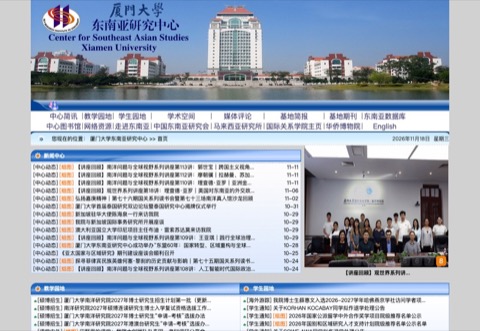
- Southeast Maritime Frontier Research Database (Xiamen University Library) (东南海疆研究数据库(厦门大学图书馆))The Southeast Maritime Frontier Research Database is a distinctive database built by the Xiamen University Library, marked on the library's 'Knowledge Resource Port' database page as a special collection funded by the Ministry of Education's CALIS project. The page states that its resource types include e-journals, e-books and original archives, and its disciplines cover economics, law and politics, history (Chinese and world history), environmental science and engineering, military affairs, area studies and general humanities and social sciences. Xiamen University has long been strong in Fujian-Taiwan, Southeast Asian and overseas Chinese studies, and the library has a regional studies resource centre; this database can serve as an on-campus entry point for searching literature on Fujian-Taiwan, maritime frontiers, and Southeast Asia and overseas Chinese. For readers working on the history of overseas Chinese in Nanyang, maritime transport and area studies, it can be used together with the databases of Xiamen University's Center for Southeast Asian Studies: find leads first, then trace the original sources.
Coverage, how to use, and notes
Coverage Resource types are e-journals, e-books and original archives; for disciplinary scope see above. The database page does not state the total number of records, date range or language composition; please consult the official site.
How to use Access it from the database page of the Xiamen University Library 'Knowledge Resource Port'; the platform link is lib.xmu.edu.cn/asia. The page marks access as controlled by IP range with no limit on concurrent users; off campus, it can be used via 'smart access' or WebVPN, subject to the library's regulations on the use of digital resources.
Notes Access depends on Xiamen University's IP addresses or off-campus authentication; readers without the relevant account may be unable to enter the platform, and this check could not directly open the platform homepage either; please rely on the library's page notes.
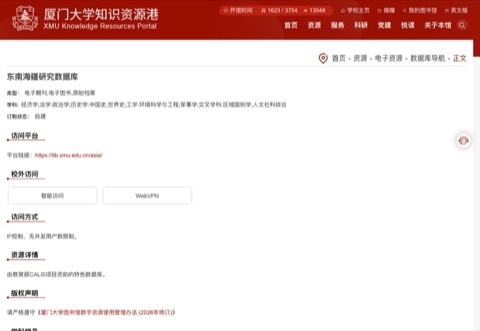
Research methods & tools
- Chinese Huiguan GIS (华人会馆地理信息系统(马来半岛华人同乡会馆GIS))Chinese Huiguan GIS is a continuously updated geographic database and interactive map of Chinese huiguan (association halls), compiled by Luo Zhenhong (Zhenhong Luo), a doctoral candidate at Huazhong University of Science and Technology. The site uses a timeline (1601 to 2026) to show where Chinese huiguan were founded, relocated, continued or disappeared, and uses spatial distribution to show the historical evolution of Chinese migrant community organizations. Its earlier introduction concentrated on the Malay Peninsula and Singapore: 721 huiguan founded since the 17th century, recording name, year of founding, dialect group and geographic coordinates. According to the site's current pages, the database has expanded to more countries and regions, and each record includes the huiguan name and type (locality-based, kinship-based, trade-based and so on), founding period, place of origin, region, surname or trade, address, survival status, source and coordinates; doubtful entries are marked as pending verification. The interface offers Chinese-English switching and supports exporting an index, printing or PDF, and PNG export. For readers studying Southeast Asian Chinese associations, clan and native-place halls, dialect group distribution and migration networks, it is both an entry point for finding huiguan and directly usable for spatial analysis and visualization. The academic source cited on the site is a related paper published in Heritage Science in 2026.
Coverage, how to use, and notes
Coverage The range in the early introduction is peninsular Malaysia and Singapore, with 721 Chinese native-place huiguan founded since the 17th century. The site now says the database has expanded to more regions, but the numbers and country counts on the Chinese and English pages are inconsistent (e.g. the Chinese page says 3,165 spatiotemporal records involving 15 countries and regions, while the English page says over 1,700 sites and 10 regions); when citing numbers, use the pages as shown at the time. The timeline runs from 1601 to 2026, and the interface is in Chinese and English.
How to use Visit chinesehuiguan.com directly; no registration is needed. In the map layers, filter by huiguan type, dialect group, region and other conditions, use the timeline to see distribution in different years, and click markers on the map to view the huiguan name, founding year, dialect group, address and other information. The toolbar supports saving or importing schemes, exporting an index, printing or PDF export, and PNG export. When citing, it is advisable to note the access date and the data source fields. To report errors or supply additional information, use the contact method provided on the page.
Notes Statistics differ between the site's language versions; the site states that some entries are pending verification or doubtful, and mentions AI-assisted retrieval followed by manual review. The site does not state a licence for the data; confirm before reposting or reuse.
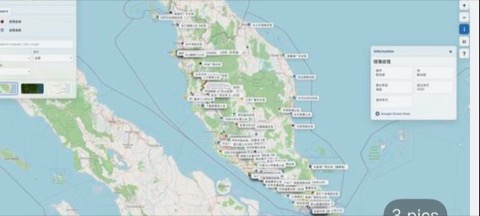
- CCL Corpus Retrieval System, Center for Chinese Linguistics, Peking University (北京大学CCL语料库检索系统)The CCL Corpus Retrieval System is built by the Center for Chinese Linguistics at Peking University and is provided in the 'Online Resources' section of the Center's website. It is one of the online corpus search tools commonly used in Chinese linguistics. The Center's website currently lists two entry points: the 'CCL Corpus' and the 'CCL Corpus of Chinese Minority Languages', located respectively on the main site and the /m/ sub-path of cclcorpus.pku.edu.cn. The news section of the Center's website shows that the 'Peking University CCL2026 Corpus Retrieval System' officially went online on 22 October 2026, indicating that the system is still being updated. For research on Southeast Asian Chinese and regional studies, Chinese corpus search can be used to check the actual usage of words, grammar and examples, for example comparing vocabulary in written Mandarin with word choices in overseas Chinese, and can provide reference corpora of mainland Chinese for studies of dialects, lexical history and language contact. Before use, it is advisable to read the corpus descriptions and statement of use within the system to understand the composition, period coverage and citation requirements of each sub-corpus.
Coverage, how to use, and notes
Coverage The website's entry points list two corpora: the 'CCL Corpus' and the 'CCL Corpus of Chinese Minority Languages'. The specific names, time spans, languages, word counts and update contents of the sub-corpora are not given on the official pages that could be verified; please consult the website.
How to use First open the website of the Center for Chinese Linguistics at Peking University (ccl.pku.edu.cn), choose 'CCL Corpus' or 'CCL Corpus of Chinese Minority Languages' under 'Online Resources' to reach the search page, or visit cclcorpus.pku.edu.cn directly. Whether registration is required, the search syntax, limits on the number of results and whether results can be exported should be checked in the help and statement of use within the search system, as stated on the website. When searching, it is advisable to start with a single character or word and then add contextual restrictions gradually; when citing corpus examples, give the corpus name, version (such as CCL2026) and search date.
Notes The search page relies on scripts to load, and some instructions are visible only after entering the system. Scale, login requirements and download restrictions could not be verified on the accessible official pages; please consult the website. Search results may differ between old and new versions, so it is advisable to state the version when citing in papers.
Libraries & archives
- National Library of China (NLC) (中国国家图书馆)The National Library of China is China's national repository of books. Its main library is located on Zhongguancun South Street, Haidian District, Beijing, and it also houses the National Museum of Classics. Under the website's 'Digital Resources' section, the 'Modern Books' (近代图书) database provides online access to Republican-era documents; the website states that it contains Republican-era books, periodicals, newspapers and legal resources, which can be read online. The library also provides online reading of digital resources such as books, ancient books, theses, periodicals and audio-visual materials through the Reader Cloud portal, and lists purchased resources such as electronic newspapers and electronic periodicals. For research on Southeast Asian Chinese and regional studies, the library's Chinese periodicals, newspapers and Republican-era documents can be used to find reports and publications from the Republican period on overseas Chinese, overseas Chinese affairs, Nanyang trade, and Southeast Asian politics and international relations, and can be used in comparison with Chinese-language newspapers in Malaya, Singapore and elsewhere. The website's holdings statistics show that as of December 2025 the collection included 9,336,364 volumes (items) of Chinese periodicals and 241,965 bound volumes of Chinese newspapers, plus 103,830 electronic periodical titles and 5,109 electronic newspaper titles. Republican-era periodicals and newspapers are not counted separately.
Address 北京市海淀区中关村南大街33号,邮编100081;中国 View on map ↗
Coverage, how to use, and notes
Coverage According to the website's holdings statistics (as of December 2025): periodicals total 16,656,697 volumes (items), of which 9,336,364 are Chinese and 7,320,333 foreign-language; newspapers total 354,161 bound volumes, of which 241,965 are Chinese and 112,196 foreign-language; electronic periodicals number 103,830 titles and electronic newspapers 5,109 titles. The statistics page does not list separate figures for Republican-era periodicals and newspapers; Republican-era paperback books are counted among general books.
How to use Online, you can reach Modern Books and the Reader Cloud portal through 'Digital Resources' on the website to read Republican-era books, periodicals, newspapers and legal resources online; the Reader Cloud portal requires login, and you can register with a mobile phone number or other methods. Some purchased resources may be restricted to certain access environments; please follow the website's instructions. The website's pages explain the procedures for on-site reading, including library cards, opening hours, reservations and entry requirements; please check them before visiting. The homepage states that the Ancient Books Library has been closed since 2 April 2024, so please consult the website for where Republican-era periodicals and newspapers can be consulted in physical form.
Notes The website states that the Ancient Books Library has been closed since 2 April 2024. The website gives no figures for the extent of digitization or the proportion readable online for Republican-era periodicals and newspapers; please consult the website. Access rights to purchased electronic newspaper resources vary by resource.
- World Overseas Chinese Documentation Center, Jinan University Library (世界华侨华人文献馆(世华馆,暨南大学图书馆))The World Overseas Chinese Documentation Center, abbreviated as Shihuaguan, is located in the library of the Shipai Campus of Jinan University and covers about 1,700 square meters. Jinan University is one of the oldest institutions of higher education for overseas Chinese in mainland China, has long enrolled overseas Chinese students, and has carried out overseas Chinese studies; the Center is where the university collects and displays overseas-Chinese-related documents. According to the official cultural venue introduction, the Center includes a document reading area, a folk document display area, and a History and Culture Exhibition Hall of Overseas Chinese; the stacks and exhibitions are on the sixth floor of the library, and the offices are on the seventh floor. For readers studying Southeast Asian Chinese society, qiaoxiang (emigrant home villages), and overseas Chinese history, it allows consulting overseas-Chinese-related books and folk documents and visiting related exhibitions in one place, and it is an academic base for understanding the links between Guangdong qiaoxiang and Nanyang. Jinan University also has an Institute of Overseas Chinese Studies, whose website provides thematic databases of overseas Chinese images, videos, overseas Chinese community conditions, and documentary information, which can be used together with the Center's physical collections; some of these digital platforms require account login, and readers should ask the library about access permissions.
Address 暨南大学石牌校区图书馆六楼,广州市天河区黄埔大道西601号,邮编510632(Library Building, Shipai Campus, Jinan University, 601 Huangpu Avenue West, Guangzhou 510632, China) View on map ↗
Coverage, how to use, and notes
Coverage The official introduction lists three types of spaces: a document reading area, a folk document display area, and a History and Culture Exhibition Hall of Overseas Chinese. The official website does not state the total number of volumes in the collection or its chronological span, and gives no breakdown of items related to Southeast Asia; please refer to the library's announcements.
How to use Hours given on the official cultural venue page: the document reading area and folk document display area are open Monday to Thursday and Sunday 8:00–22:30, and Friday 8:00–12:00; the History and Culture Exhibition Hall of Overseas Chinese is open Monday to Thursday 8:30–17:00 and Friday 8:30–12:00. Group visits must be booked through the General Office of the Jinan University Library at 020-85220287, and the page also provides a reservation QR code; the page does not state entry and reading procedures for individual readers, so please call beforehand or check notices on the Jinan University Library website. You may first search the collection catalogue on the library website before deciding what to consult.
Notes Access rights of off-campus readers to the university library are not stated on the official page; be sure to confirm before visiting. Opening hours are worded slightly differently on different official pages; please refer to the latest notice. The library website has a section for notices such as temporary closure of the Center; please check it before setting out.
Museums & memorials
- Jimei Ao Garden and Tan Kah Kee Memorial Museum (集美鳌园与陈嘉庚纪念馆)The Jimei Ao Garden scenic area is located in Jimei District, Xiamen, and is a memorial site for the overseas Chinese leader Tan Kah Kee. It includes Ao Garden, the Tan Kah Kee Memorial Museum, Tan Kah Kee's former residence, Guilai Garden, Guilai Hall, Kah Kee Park, and Kah Kee Cultural Square, covering about 185,000 square meters. According to the scenic area introduction by the Xiamen Culture and Tourism Bureau, Ao Garden was built in 1951 under Tan Kah Kee's direction and features rich stone carvings; the Tan Kah Kee Memorial Museum opened in 2008 and presents his life and social influence. Tan Kah Kee ran rubber and gutta-percha businesses in Singapore in his early years, long supported Chinese education in Malaya and Singapore, founded Jimei School in his hometown in 1921, and settled back in China in his later years. He is one of the central figures for understanding the commerce, education, and homeland ties of modern Nanyang overseas Chinese. For researchers of Southeast Asian Chinese, this is an on-site place to learn about Tan Kah Kee and about Kah Kee culture and Kah Kee architecture, and it can be read alongside Tan Kah Kee materials related to Singapore and Malaysia. The area lies within the Jimei School Village and can be visited together with the old Jimei School building complex, to see how overseas Chinese-funded education was realized in the spaces and architecture of the home village.
Address 厦门市集美区鳌园路24号(No. 24 Aoyuan Road, Jimei District, Xiamen, China);邮编官网未列出,请以官网为准 View on map ↗
Coverage, how to use, and notes
Coverage The scenic area includes the Ao Garden stone carving groups, the exhibitions of the Tan Kah Kee Memorial Museum, Tan Kah Kee's former residence (reopened on 20 October 2024 after conservation, repair, and interior restoration), as well as Guilai Hall and Kah Kee Park. The official introduction does not list the number of items in the museum's collection or the volume of documents available for consultation; please refer to the museum's announcements.
How to use The scenic area page of the Xiamen Culture and Tourism Bureau gives the inquiry telephone number 0592-6681600. The page does not state opening hours or reservation methods; please call or check via the museum's official account before visiting. The sites can be visited in sequence following Tan Kah Kee's life: Ao Garden stone carvings, the memorial museum, the former residence, and Guilai Hall. Researchers who wish to know how to consult materials held in the museum are advised to call in advance and state their purpose.
Notes Opening hours, ticket prices, and reservation policies are not stated on the official page, and third-party information online (including another street number) is inconsistent; the address in this entry is taken from the official page of the Xiamen Culture and Tourism Bureau. The page does not list a postal code. The site is mainly for exhibition and architectural visits and is not a document-retrieval resource.
- Palace Museum Digital Cultural Relics Library (故宫博物院数字文物库)The Palace Museum Digital Collection (故宫数字文物库, digicol.dpm.org.cn) was built by the Palace Museum and is the museum's public platform for searching its collection digitally and viewing images; the footer states that the copyright belongs to the Palace Museum. The page allows filtering of objects by category, period and colour, and provides an entry to the general catalogue of the collection, the Palace Museum's ancient scripts digital platform, and thematic sections such as the zodiac and the oracle bones of Yinxu. The footer also has links to 'Image Services', terms of use and a privacy policy, indicating that the use of images is subject to separate rules. For research on Southeast Asian Chinese and regional studies, the platform can be used to view objects, paintings, calligraphy and images related to the Ming and Qing courts, tribute, export trade and maritime exchange, as comparative material for research on the history of China–Southeast Asia contacts, art history and material culture.
Coverage, how to use, and notes
Coverage The page shows browsing by 25 categories and 21 periods, with several special topics and an ancient scripts platform. The total number of objects and the number of images already online are not given on the homepage; please consult the website.
How to use Visit digicol.dpm.org.cn and browse using the category, period and colour filters, or enter from the general catalogue or the ancient scripts platform. No registration or login requirement appears on the homepage. If you need to use images, please read 'Terms and Conditions' and 'Image Services' in the footer for authorization and application procedures.
Notes The homepage does not state the image download formats or conditions for reuse; for publication or commercial use, please follow the website's image service rules. The platform consists mainly of the Palace Museum's own collection, and material directly related to Southeast Asia must be searched for and filtered by users.
Institutions & societies
- Institute of Overseas Chinese Studies, Jinan University (暨南大学华侨华人研究院(国际关系学院/华侨华人研究院))The Institute of Overseas Chinese Studies at Jinan University is a Key Research Base of Humanities and Social Sciences of the Ministry of Education (Overseas Chinese Studies), jointly administered with the School of International Relations. According to the Base Introduction on its official website, Jinan University's research on Southeast Asia and overseas Chinese can be traced to the Department of Nanyang Cultural and Educational Affairs established in 1927. The Institute for Overseas Chinese Studies was founded in 1981 and was one of the earliest specialized overseas Chinese research institutions in China; it was approved as a Ministry of Education key research base in 2000; the Institute of Overseas Chinese Studies was established in 2006; and it merged with the School of International Relations in 2011. The Institute publishes two academic journals, Southeast Asian Studies and Overseas Chinese Studies, and co-established the Overseas Chinese Documentation Center with the university library. The website has sections such as Overseas Chinese News and Research Outputs. The Resource Platform section on the homepage lists an overseas Chinese image database, a video database, an overseas Chinese community conditions database, and a thematic database of overseas Chinese documentary information. For readers studying Southeast Asian Chinese society, overseas Chinese history, and overseas Chinese affairs, it offers a way to follow academic developments and publications, track related journals, and find entry points to thematic document resources.
Coverage, how to use, and notes
Coverage The website includes sections on the Institute's profile and organizational structure, research teams, base news, overseas Chinese news, research outputs, social services, and talent cultivation. The Resource Platform lists four thematic databases: overseas Chinese images, videos, overseas Chinese community conditions, and overseas Chinese documentary information. The homepage does not state the period covered, size, or languages of each database; please refer to the official website and each database's page.
How to use Open the official website homepage, enter Research Outputs or Overseas Chinese News from the navigation bar to browse public content, and find the entry points to the thematic databases in the Resource Platform section of the homepage. Some databases may require on-campus authentication or login; whether they are publicly accessible should be checked on each database's page. Their search and download functions have not been verified here. For contact details, see the Contact Us page on the website. The postal address listed on the website is 601 Huangpu Avenue West, Guangzhou, postal code 510632.
Notes The homepage lists only the names of the Resource Platform databases and does not state their size or access conditions. The library-side overseas Chinese thematic databases may redirect to an identity authentication page when accessed; readers should rely on the notices published by the website and the library.
Taiwan36
Newspapers & news archives
- National Library of Public Information – Newspapers (國立公共資訊圖書館「報紙」專區) (国立公共资讯图书馆报纸数字资源(含《台湾日日新报》整合平台))In its Digital Collections > Resource Type > Newspapers section, the National Library of Public Information (NLPI) lists its digital newspaper resources. The one most relevant to Taiwan history and colonial-period research is the Taiwan Nichinichi Shinpo and Han-wen Nichinichi Shinpo Integrated Platform. According to the official description, it provides nearly 3 million keyword indexes covering persons, events, times, places and objects, includes about 150,000 full-page images of the Taiwan Nichinichi Shinpo, and marks the position of more than 3 million headlines within the full-page images, so readers can jump directly from a headline to the corresponding image and view the century-old newspaper more precisely, completely and clearly. The Taiwan Nichinichi Shinpo was the most widely circulated Japanese-language newspaper in Taiwan during the Japanese colonial period, with a separate Chinese-language edition, and is an important primary source for studying Taiwanese society, colonial administration, economy and culture in that period, as well as the movement of people and public opinion between Taiwan, Nanyang and South China. The same section also lists the Taiwan News Smart Network (TaiZhiWang), which provides headline indexes, summaries and some full-page images of postwar newspapers, including the United Daily News, Economic Daily News, China Times, Liberty Times, China Daily News and Commercial Times; and the UDN Knowledge Base (United Daily News, Economic Daily News, Good Reading Weekly). These resources are accessed through the library's digital resources portal.
Coverage, how to use, and notes
Coverage The section lists three types of newspaper resources: (1) the integrated platform for the Taiwan Nichinichi Shinpo and Han-wen Taiwan Nichinichi Shinpo (about 3 million keyword indexes, about 150,000 full-page images); (2) the Taiwan News Smart Network (headline indexes and summaries, some full-page images, covering politics, society, finance, sports, entertainment and supplements); and (3) the UDN Knowledge Base (United Daily News, Economic Daily News and Good Reading Weekly, including national and local editions). The official page does not state the start and end years of the Taiwan Nichinichi Shinpo platform; please refer to the official website.
How to use Go to the NLPI website, find the section via Digital Collections > Resource Type > Newspapers, and then enter each resource through the Digital Resources Portal. The official website states that access requires logging in with a library card account; those without a card can apply online. For the Nichinichi Shinpo platform, search the index by keyword first, then open the corresponding full-page image directly from the headline. Whether images can be downloaded, exported or obtained in bulk is not stated; please refer to the official website and terms of use.
Notes Access requires logging in with a library card account. According to search results, library cards and digital library cards are mainly issued to citizens of the Republic of China; whether overseas readers can obtain one should be confirmed with the library, and this was not verified on the newspaper section page. The TaiZhiWang page says it includes 14 newspapers, but only 11 are actually listed; please refer to the official website. The United Evening News ceased publication on 2 June 2020. The portal homepage returned no content when retrieved, so the specific login procedure could not be verified.
Archives & historical document databases
- Archives Information System, National Human Rights Museum (國家人權博物館檔案史料資訊系統)The Archives and Historical Materials Information System of the National Human Rights Museum is the museum's portal for searching archives and historical sources. Its homepage centers on compensation case files for improper martial-law-era trials of rebellion and communist-spy cases, and offers keyword search, directory browsing, category browsing and advanced search. The homepage statistics show 8,847 compensation case files, involving 972 places of origin, 541 charges, 488 types of sentences, 207 places of detention and execution, 6 types of compensation and 179 legal provisions; the trial and execution years run from year 36 to year 80 of the Republic of China (about 1947 to 1991). The site also provides downloadable digital datasets of judgments (XLSX and ODS formats), while full-text images in the political archives section link to an external site of the archival authority. The system is directly valuable for research on political persecution in Cold War Taiwan, the White Terror, the relations between Waishengren and Benshengren, and political ties between overseas Chinese and Taiwan. It also allows comparison with Cold War political trials and transitional justice archives in Southeast Asian countries, and is a gateway to primary materials that combine oral history, trial documents and statistical data.
Coverage, how to use, and notes
Coverage Mainly compensation case files of improper martial-law-era trials of rebellion and communist-spy cases; the homepage statistics show 8,847 cases, with trial and execution years from year 36 to year 80 of the Republic of China. Digital datasets of judgments are also available for download. The language is Traditional Chinese. For other types of materials, please consult the official site.
How to use On the official homepage, search by keyword, or narrow results through directory browsing, category browsing and advanced search; the homepage also lists popular search terms. Members can log in to use search history or a personal folder; the page does not say whether ordinary searching requires registration. The site provides a system manual (PDF), reading service and archive application instructions and a copyright statement; consulting and copying original archives must follow the site's instructions.
Notes Some archives contain personal information, and access and citation are subject to restrictions; not all full-text images are available online, so please consult the official site.
- Executive Yuan Gazette Online (行政院公報資訊網) (行政院公報資訊網)The Executive Yuan Gazette Information Network is provided by the Executive Yuan Gazette Editing and Printing Center, with the footer copyright attributed to the National Development Council, and is used to browse and search Taiwan's government gazettes. The gazette is the official publication in which Taiwan's central government promulgates laws, administrative rules, and personnel and policy information, and is a basic primary official source for studying policy history. On the day of consultation (18 November 2026), the website showed the current issue as Volume 032, No. 213, with a cumulative total of 5,456 issues and 167,615 items. Researchers can browse by volume and issue, functional section (such as Finance and Economics), type (such as laws and regulations, administrative rules), topic, governance and services, or enter keywords to search gazette titles, official document numbers, subjects, explanations, keywords and full texts. The site is useful for tracing the formulation of Taiwan's policies on overseas Chinese affairs, immigration, education, foreign trade and regional matters, or for verifying the promulgation date and document number of a regulation. The site also has an open data download area, convenient for text analysis.
Coverage, how to use, and notes
Coverage A cumulative total of 5,456 issues and 167,615 items (figures as of the consultation date, 2026-11-18). The start and end years are not stated on the homepage; please refer to the website's content scope page. The content is mainly Chinese-language official gazette material.
How to use The homepage provides keyword search and advanced search; users can also browse step by step by volume and issue, functional section, type, topic, governance and services. Searches can cover titles, official document numbers, subjects, explanations, keywords and full texts. The website offers login and membership options via MyEGOV, Facebook or Google accounts; whether login is required for searching and browsing is not stated on the page, so please refer to the official website. Datasets can be downloaded from the open data area.
Notes Gazette formats differ across periods, so check how early content is covered first. The gazette reflects only information published at the Executive Yuan level; legislative and judicial documents must be searched separately.
- National Archives Information Network (國家檔案資訊網) (國家檔案資訊網)The National Archives Information Network is the portal for searching the catalog of national archives and applying for them online, provided by the National Archives Administration of Taiwan's National Development Council (the competent authority for national archives); the page footer names the National Archives Administration, National Development Council. Researchers can search, in one portal, the catalogs of national archives transferred from various agencies; some archives offer full-text images (audio) for online viewing, while the rest must be applied for through the prescribed procedure. The homepage also provides restriction options such as political archives and lists thematic catalogs such as the 228 Incident and Major Political Events. For research on Taiwanese government documents, postwar political and administrative history, and official documents related to overseas Chinese and regional relations, this is one of the most direct entry points to primary archival catalogs. The homepage has smart recommendations, popular keywords and a tag cloud, and links to the Archives Resource Integrated Search Platform, which helps locate archival leads across agencies and systems. Users can first confirm online that an archive exists and what the access conditions are before deciding whether to apply, saving the cost of travel.
Coverage, how to use, and notes
Coverage On the day of consultation, the homepage showed 3,212,755 publicly available pages of full-text images (audio) and 28,385,310 digitized pages; catalog statistics showed 24,154 records for the 228 Incident and 1,453 for Major Political Events. The time span, languages and full range of fonds are not stated on the homepage; please refer to the official website.
How to use On the homepage, use Simple Search or Advanced Search, optionally adding restrictions such as political archives; smart recommendations and popular keywords can also help narrow the scope. The application process listed on the website has five steps: search archives, log in as a member, add to My Archives Cart, fill in the national archives application form, and submit the application; the member center shows application records and the pending application list. Whether login is required for ordinary catalog searches is not stated on the homepage; please refer to the official website.
Notes Publicly available full-text images are only a portion of the digitized pages, and most archives require an application; archives involving personal privacy or restricted use are handled according to regulations. The figures on the homepage are updated continuously; please note the date of consultation when citing.
- Taiwan Cultural Memory Bank (TCMB) (国家文化记忆库)The Taiwan Cultural Memory Bank is a digital cultural materials project promoted by Taiwan's Ministry of Culture in 2017 and continued by the National Museum of Taiwan History from 2021. The website states that it has accumulated over 2 million records, organized by theme into 9 major categories, and connects to more than 10 source databases (as of 2025). The categories include People and Groups, Arts and Humanities, Society and Politics, Folklore and Religion, Industry and Economy, Space, Region and Migration, and Ethnic Groups and Languages. Searches can be made by keyword, category, and data type (images, video, audio, documents, 3D), and an OpenAPI is also provided. For research on Southeast Asian Chinese, its usefulness lies mainly in folk images, oral accounts, community memory, and migration themes, such as leads on veterans' dependents, new immigrants, and cross-border groups, suitable for comparative research or as supplementary material. The introduction page of the website does not specifically list overseas Chinese or Southeast Asian content; users need to search and confirm for themselves.
Coverage, how to use, and notes
Coverage It has accumulated over 2 million records, classified into 9 major categories, with data types including images, video, audio, documents, and 3D. The content centers on Taiwan's everyday culture, local knowledge, and contemporary issues; the chronological span and the amount of Southeast Asia-related material are not stated in the website's introduction, so please refer to the website.
How to use Enter keywords on the website's search page, or filter by category (such as Space, Region and Migration or Ethnic Groups and Languages) and data type. You may try terms such as 南洋, 東南亞, 印尼, 越南, 華僑, and 新住民. The website provides favorites and tagging functions and an OpenAPI. Before citing or reusing materials, please read the Data Licensing Guidelines.
Notes The Ministry of Culture's old address memory.culture.tw currently cannot be resolved; the website notice states that the old and new sites will be integrated into a unified entry point, so please use tcmb.culture.tw. Licensing terms vary by material.
- Taiwan Digital Archives (臺灣數位典藏資源)Taiwan Digital Archives is an integrated portal that brings together the digitization results of many collecting institutions in Taiwan; a link at the bottom of the page points to the Academia Sinica Center for Digital Cultures, one of the main operating units. The site integrates thematic exhibitions, collection catalogues, historical maps and cultural-theme content. It can be searched through quick and advanced search of the collection catalogue, browsed by theme or object category, and offers a timeline and entry points to thematic exhibitions. It also has pages for copyright statements, licensing notes, open data and terms of use. For researchers, its value lies in searching across institutions at once for digital collections of old photographs, maps, archives, artifacts and audiovisual materials in Taiwan. It is a suitable starting point for searching Taiwan sources and can be compared across regions with Southeast Asian collections, such as colonial-period maps and images related to qiaoxiang (emigrant home villages) and overseas ties.
Coverage, how to use, and notes
Coverage Integrates digital resources from multiple collecting institutions, including thematic exhibitions, collection catalogues, historical maps and cultural-theme content; the homepage gives no total count, and for periods and languages please consult the official site.
How to use On the official homepage, use quick search or advanced search to look up the collection catalogue, browse by theme or object category, or start from the timeline and thematic exhibitions. For download and reuse conditions of specific materials, open the corresponding licensing notes, open data and terms of use pages, and follow the rules of each collecting institution.
Notes The homepage text appeared garbled at the time of retrieval and does not state fees or licensing details, so please consult the actual official pages; licensing differs among collecting institutions, and each item must be checked before citation or reuse.
- Taiwan History Archives Resource System (臺灣史檔案資源系統) (臺灣史檔案資源系統)The Taiwan History Archives Resource System is provided by the Archives of the Institute of Taiwan History, Academia Sinica, and is the portal to the online catalog and image services of the institute's archival holdings. The holdings are described by archival levels of fonds, series, file and item, and fall into three major categories: personal papers and collections, family and private documents, and institutional and organizational archives. The specific quantity mentioned in the system introduction is the Governor-General's Office of Taiwan Official Documents Compilation (Taiwan Sotokufu Koubun Ruisan), with more than 250,000 official documents; these official documents from the Japanese colonial period are core primary sources for studying Taiwan's colonial administration, laws and society. Searches can use fields such as title, identifier, organization name, family name, personal name, place name, land name and subject, and can be limited to fonds, series, file or item. For research on colonial rule, land and family documents, or official-document leads related to Chinese migration and foreign relations, the system provides a catalog that can be traced back to the originals.
Coverage, how to use, and notes
Coverage Covers three major categories: personal papers and collections, family and private documents, and institutional and organizational archives, including the Governor-General's Office of Taiwan Official Documents Compilation with more than 250,000 official documents. The specific fonds names, total number of records and date range are not listed in the system introduction; please refer to the official website.
How to use In Collection Search, users can choose all fields or search by title, identifier, organization, family, person, geography, land and subject; the search level can be set to item, file, series or fonds. Newly opened and popular searches are available, as is a search history function. There are three forms of access: online viewing (most institutional and organizational archives; login is required to view images), on-site viewing with printing (most personal papers and collections, and family and private documents), and on-site viewing with transcription (materials involving personal privacy or rights issues).
Notes Restrictions arise from the Archives Act, the Personal Data Protection Act, the Copyright Act, collection agreements, donation consent forms, digital archiving collaboration projects and digitization progress. Whether images can be viewed online depends on the form of access for each fonds. The registration requirements for login are not stated on the page.
- Taiwan History Digital Library (THDL) (台灣歷史數位圖書館)Taiwan History Digital Library (THDL) is a digital library of primary sources on Taiwan history, offering full-text and metadata search. According to the site, the system was built by Dr. Du Xiechang (Tu Hsieh-chang) and the Digital Archives and Automatic Reasoning Laboratory of the Graduate Institute of Computer Science and Information Engineering at National Taiwan University, and the page copyright is credited to the Research Center for Digital Humanities, National Taiwan University. The core materials are three collections: the Danxin Archives, the Ming-Qing Taiwan Administrative Archives and Old Land Deeds; the site states that full-text records now exceed 100,000. Besides the databases, the site provides three kinds of research tools: reference tools (digitized common reference works for online lookup), search and analysis tools (advanced functions for the library's materials) and relation-mining tools (automatic reconstruction of relations among documents). For research on Southeast Asian Chinese and the region, Qing-period administrative archives and contracts from Taiwan reflect land reclamation by Fujian and Guangdong migrants, lineage and land relations, commerce and local governance, which can be compared with studies of the formation of Chinese communities in Southeast Asia and of transoceanic migration networks. The site also offers ready-to-use examples of digital humanities methods such as full-text search and document-relation mining.
Coverage, how to use, and notes
Coverage Includes three databases: the Danxin Archives, the Ming-Qing Taiwan Administrative Archives and Old Land Deeds, consisting mainly of administrative archives and private contract documents from Taiwan in the Qing period and the periods before and after it. The site states that full-text records exceed 100,000. For finer period breakdowns and record counts per database, please consult the official site.
How to use Open the official homepage and click 'Enter' to access the system; you can run full-text or metadata searches on the three databases and use the site's reference, search and analysis, and relation-mining tools. The documents are mostly in Traditional Chinese and traditional document character forms, so search with Traditional characters and try variant characters and different spellings of place names. For bulk download and reuse, please read the site's notes.
Notes The homepage does not state fees or licensing terms; please follow the official site and each database's notes for use and citation. The documents use archaic characters, so search results should be checked against the original images.
- Taiwan Memory (臺灣記憶)Taiwan Memory is a thematic digital collection portal on Taiwan built by the National Library. It integrates Taiwan-related digitized materials from the library and many partner institutions, including old newspapers and periodicals, historical photographs, rare books and documents, maps, audiovisual materials, oral histories and local documents. The homepage shows a total of about 5.28 million digital objects (the live figure on the page prevails). Besides browsing by collection category, the site offers a Taiwan chronicle of major events, a story map, entry points for browsing by geographic location and timeline, and thematic columns such as 'Person of the Day', which suit those who start from a place or a time period when looking for primary sources. For research on Southeast Asian Chinese and the region, sources on migration between Taiwan and Southeast Asia, overseas Chinese affairs, postwar overseas Chinese education and Taiwan's southward policy are often scattered across Taiwan's old newspapers, official gazettes and local documents. This portal can serve as a starting point for surveying Taiwan's holdings before moving to specific collections. It also helps in comparing how local-history resources are built in Taiwan and in Malaysia and Singapore.
Coverage, how to use, and notes
Coverage Mainly Taiwan-related digitized collections, including newspapers and periodicals, images, maps, audiovisual materials, documents and thematic materials. The website gives no unified statement of the period covered or the language composition; please consult the official site. The homepage showed a total of 5,284,355 digital objects (at the time of the query). A separate 'co-built and shared resources' section includes materials provided by partner institutions.
How to use Go directly to the official homepage to browse; no registration is required. You can browse by category under 'Collection Resources' or use advanced search, which supports AND, OR and NOT and the fields Chinese title, subject, description, source, publication, named persons and all fields, with an optional fuzzy search (synonymous characters). Browsing by geographic location and timeline and the story map are also available. Whether an object can be downloaded and reused depends on its own licensing terms; the site provides an authorization application guide and a copyright statement, which should be read before use.
Notes The homepage does not state clearly whether everything is free of charge; downloading and reuse must follow the licensing rules of each object. Searching is mainly in Traditional Chinese, so try keywords in both Traditional and variant characters and turn on fuzzy search.
- Taiwan Studies Digital Library (National Taiwan Library) (臺灣學數位圖書館(国立台湾图书馆))The Taiwan Studies Digital Library is operated by the National Central Library of Taiwan (formerly the Taiwan Provincial / Central Library Taiwan branch system) and centrally provides digitized images of Japanese colonial-period documents together with search services. For Southeast Asian and Nanyang studies, its value lies in the 'Southern Materials': the library's Southern Materials originate from the Southern Materials Library founded in 1940, cover Japan, China, Korea and Nanyang during the Japanese colonial period, and consist mainly of Japanese-language survey reports and published books. They are an entry point to primary materials on Japanese surveys of Nanyang (Southeast Asia), industry, colonial governance and overseas Chinese society during the southward expansion policy. Besides the Southern Materials, the system also holds Japanese colonial-period periodicals and books, Taiwan local gazetteers, Taiwan photo albums and a map database, which includes maps of Nanyang, Southeast Asia and other regions. Researchers can use these from the angles of Taiwan-Nanyang connections, Japanese imperial surveys of Southeast Asia, overseas Chinese affairs and trade, and can also read the periodical materials alongside Chinese- and Japanese-language materials from Malaya, Singapore, Indonesia and elsewhere.
Coverage, how to use, and notes
Coverage According to the homepage, there are over 300 Japanese colonial-period periodical titles with 291,745 digitized items; plus 24,828 volumes of colonial-period books, 10,212 Taiwan photo album items, 866 volumes of Taiwan local gazetteers and 1,624 items in the map database. The Southern Materials total 14,232 volumes and 4 items, of which 12,568 entries have been digitized, mainly Japanese-language survey reports and published books. For the reference dates of the various figures, please consult the official site.
How to use On the homepage, use the keyword search box, or enter the 'Resource Search' page to search by category; instructions are on the site's 'User Guide' page. The homepage offers three entries: account login, account registration and 'continue as guest'; which functions (such as high-resolution image viewing and download) require login is not stated on the homepage, so please consult the site's instructions. When searching for Nanyang-related materials, it is advisable to use Japanese kanji terms such as 南洋, 南方, 蘭印, 馬來, 比律賓 and 華僑, and to narrow the range by date and publisher.
Notes The Southern Materials are mostly in Japanese, and some use pre-war old character forms; the openness of images, licensing and download restrictions are subject to the website and library rules. The statistics are updated as digitization progresses.
Scholarly databases & search tools
- Academia Sinica Min and Hakka Dictionary and Literature Corpus (中央研究院閩客語辭典與文獻語料庫)The Academia Sinica Database of Southern Min and Hakka Dictionaries and Texts was built by the Institute of Linguistics, Academia Sinica (the page copyright and contact point is the institute's Digital Language Resources Studio). It has two sub-databases, Southern Min and Hakka, offering search of historical texts in romanization and of early dictionaries. The Southern Min part includes church documents (such as the Taiwan Church News), collections of folk literature, and folk drama (such as the Jiajing and Wanli editions of Lijing ji). The Hakka part provides search of the Hakka-English Dictionary and the Hakka-French Dictionary. These materials are valuable for studying the historical development of Southern Min and Hakka, church romanization documents and the language of drama. Because Southern Min and Hakka are also important dialects among Southeast Asian Chinese communities, the database can serve as comparative material for studying the vocabulary and writing traditions of Min and Hakka varieties in Nanyang. The search interface supports multiple romanization displays and Boolean search, and results can be exported.
Coverage, how to use, and notes
Coverage The scope listed on the Southern Min text search page includes: the Taiwan Church News (collected in periods between 1885 and 1968), Christian Doctrine, and the Sacred Edict; collections of Taiwanese folk literature from Taichung County and Taoyuan County; the folk dramas Lijing ji (Jiajing and Wanli editions), Tongchuang qinshu ji, Jinhua nü and Su Liuniang; and works such as a nursing textbook on internal and external medicine. The Hakka dictionary search page lists the Hakka-English Dictionary and the Hakka-French Dictionary. The website does not state the total size; please consult the website.
How to use From the home page, choose the Hakka or Southern Min section; each has a Chinese and English background page. Both text and dictionary search offer simple search and advanced search, with a selectable search scope. Advanced search supports AND, OR and NOT, and Southern Min texts can be limited by word distance (within 4, 8 or 12 characters). The Hakka dictionary can be searched by Hakka romanization, Chinese character or definition, with matching modes of string contains, begins with and ends with. Romanization can be shown with numeric or Unicode tone marks, and the page provides a special-character keyboard. Results can be exported, and dictionary results can be viewed as original images. The page does not mention registration.
Notes The sections differ in scope and size, and the website gives no total figures. For some pages, the detailed operating instructions must be opened separately.
- Laws & Regulations Database of The Republic of China (全國法規資料庫) (全國法規資料庫)The Laws and Regulations Database of the Republic of China (Taiwan) is maintained by the Laws and Regulations Database Task Force of Taiwan's Ministry of Justice and is the official portal for searching current laws and regulatory orders in Taiwan. The site states that it provides only the latest information on laws and regulations and data retrieval, and does not offer legal consultation. The homepage has sections for Central Laws and Regulations, Judicial Interpretations, Treaties and Agreements, Cross-Strait Agreements and Comprehensive Search, and publishes the latest news on laws, regulatory orders, administrative rules, local regulations and draft regulations. For those studying Taiwan's overseas Chinese affairs and immigration, nationality, education, religion, cross-strait relations and foreign treaties, it allows checking the original text of provisions and their amendment history, and is a basic source for verification when citing Taiwanese law. The site has an English version and also provides API documentation (Swagger), suitable for researchers who need to obtain legal data in bulk. The Treaties and Agreements and Cross-Strait Agreements sections are especially useful for studying bilateral agreements between Taiwan and Southeast Asian countries, but which treaties are included should be checked against the search scope description on the website.
Coverage, how to use, and notes
Coverage Categories listed on the homepage include Central Laws and Regulations, Judicial Interpretations, Treaties and Agreements, and Cross-Strait Agreements, as well as laws, regulatory orders, administrative rules, local regulations and draft regulations in the latest news. For the full search scope, see the website's page on the scope of legal data retrieval; no speculation is made here.
How to use From the homepage, choose Central Laws and Regulations, Judicial Interpretations, Treaties and Agreements, Cross-Strait Agreements or Comprehensive Search; search by regulation name or keyword. There is an English link at the top right of the page, along with the website user manual (PDF), API documentation and the government website open data declaration. No registration is needed for searching (no login requirement appears on the homepage). Read the API documentation first if programmatic access to data is needed.
Notes The website explicitly states that it does not provide legal consultation; it is not a database of court judgments, and judgments should be sought through the relevant systems of the Judicial Yuan. The completeness of historical versions and amendment history, and the method for bulk download of full texts, should be checked on the official website.
- National Statistics, R.O.C. (Taiwan) (中華民國統計資訊網(行政院主計總處))National Statistics, R.O.C. (Taiwan) is the main entry point for official statistics in Taiwan, built and maintained by the Directorate-General of Budget, Accounting and Statistics, Executive Yuan. The site brings together official statistics on the economy, prices, employment, population, and social indicators, among which the Population and Housing Census section is the most important for research on Taiwan's population, ethnic groups, and migration. This section contains result summaries and general reports of past censuses. For example, the general report of the 2020 (year 109) census covers the education, work, commuting to work or school, migration, ethnicity, housing, and living conditions of the resident population. The site also provides a statistical data query system, OpenData datasets, a national statistics portal, and an English version (eng.stat.gov.tw). For research on overseas Chinese and Southeast Asia, Taiwan is an important destination for migrants from Southeast Asia, including migrant workers and foreign spouses. Census figures such as the non-national resident population and the number of migrant workers can be used in comparative studies of population flows between Taiwan and Southeast Asia, and as a reference for the demographic structure of Chinese societies. The data come from an authoritative official source and can be cited directly.
Coverage, how to use, and notes
Coverage The main content is in Traditional Chinese, with an English version also available. The population section is divided into static population statistics, vital statistics, population migration statistics, and other population statistics. The Population and Housing Census section contains the preliminary results and general report of the 2020 (year 109) census, as well as result summaries of earlier censuses. For example, the year 109 general report states that the resident population was about 23.830 million, of whom 919,000 were non-nationals (including 701,000 migrant workers). For which years and tables are available for each census, please refer to the website's census section.
How to use After entering the homepage, select Population and Housing Census under the DGBAS statistics section to view the results and reports of each census; under Statistical Data Query, you can use the DGBAS query system, OpenData datasets, and the national statistics portal. Population data can be reached through the subcategories of the Population section. Some reports are PDF attachments that can be downloaded directly. If more detailed data are needed, first consult the statistical tables in the census section and query system, then decide whether to apply separately. When searching, it is advisable to also use Chinese keywords (such as 常住人口, 族群, 迁徙). Contact information is on the Contact Us page under Information Services on the website.
Notes The census general report page itself mainly provides press release PDFs; the download location of the appendix statistical tables should be sought separately within the section. For the application conditions and fees of microdata (individual-level) census data, please refer to the website and DGBAS announcements; it should not be assumed that they can be freely downloaded. The definitions used in earlier censuses (such as resident population) have changed, so definitions must be checked before making comparisons across periods.
- Open Government Data Platform (政府資料開放平臺)The Open Government Data Platform (data.gov.tw) is the unified portal for publishing and searching Taiwan government datasets, maintained by the Ministry of Digital Affairs. Government agencies at all levels upload their public datasets here, and users can browse by topic, search, and download. The page offers filtering by file format; example datasets are in formats such as CSV, TXT, and ZIP, and the site has an API Service Datasets entry and an M2M section. For research on Taiwan's population and ethnic groups, this is a convenient way to find open data from agencies such as the Department of Household Registration and the Department of Statistics of the Ministry of the Interior, for example datasets on the indigenous population by statistical area, population indicators, and age and sex statistics (some in XML format). When studying Southeast Asian migrants in Taiwan (foreign spouses, migrant workers, cross-border marriages, and so on), relevant open data provided by agencies can also be searched here. The platform unifies the metadata and licensing statements of data from various ministries, which makes it easier to check sources, update frequency, and conditions of use in research.
Coverage, how to use, and notes
Coverage It includes datasets opened by Taiwan government agencies at all levels, including general datasets and API service datasets. The total number is not stated on the website homepage; please refer to the website. Data on population and ethnic groups are scattered across agencies, such as datasets of the Department of Household Registration and the Department of Statistics of the Ministry of the Interior, and the Directorate-General of Budget, Accounting and Statistics of the Executive Yuan.
How to use After opening the website, enter keywords in the search box (such as 原住民人口, 人口統計, 外籍配偶), then filter by providing agency, file format, topic, and other conditions. On a dataset page you can view the description, update frequency, and licensing method, and download the data. For programmatic access, use the API service datasets entry. Browsing and downloading generally do not require login; the page has a member login, and for specific functions please refer to the website. Contact information is given on the website.
Notes The update frequency of each dataset varies, and some are updated irregularly, so the data date must be checked before use. Fields and statistical definitions differ among agencies. Some datasets are in XML format and must be converted by the user. If CSV is needed, it can be sought separately on the relevant agency's dedicated platform.
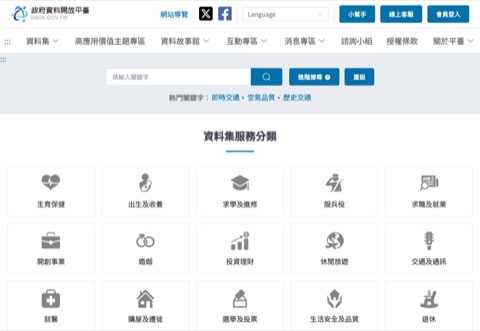
- Population Statistics Section, Department of Household Registration, Ministry of the Interior (內政部戶政司 人口統計資料專區)The Population Statistics Section is on the website of the Department of Household Registration, Ministry of the Interior, Taiwan, which maintains it, and provides population statistics based on the household registration system. The section lists a guide to the population statistics database, population statistics, and population data (GIS), and has a Future Population Projections link pointing to the population projection query system of the National Development Council. The homepage also publishes monthly analyses of household registration statistics, for example the analysis for October 2026. Household registration statistics and censuses are complementary: the census is conducted every ten years, while registration statistics are updated monthly, making them suitable for tracking changes in Taiwan's population size, age and sex structure, migration, and marriage. For research on overseas Chinese and Southeast Asia, they can be used to understand background data such as Taiwan's demographic structure and new residents (including spouses from Southeast Asia), and to cross-check census results. The site also has an English version for non-Chinese readers.
Coverage, how to use, and notes
Coverage Population statistics based on Taiwan's household registration, including population data, GIS population data, and an entry to future population projections. For which years, tables, and update cycles are available, please refer to the website's section.
How to use Open the website of the Department of Household Registration, enter the Population Statistics Section under Topic Information, and then choose subpages such as the Population Statistics Database Guide, Population Statistics, and Population Data (GIS). Future population projections lead to the query system of the National Development Council. For specific tables and download formats, please check within each subpage. Contact information is in the website footer and contact page; the switchboard number is 1996.
Notes The section homepage itself does not directly list table files, so you need to go into the subpages to find them. Household registration statistics reflect the registered population, which differs in definition from the census's resident population, so the two should not be mixed directly. The website has no separate section for topics such as the indigenous population or foreign spouses; related data can be found at the Department of Statistics of the Ministry of the Interior or on the open data platform.
- Revised Mandarin Chinese Dictionary (Ministry of Education) (教育部重編國語辭典修訂本)The Ministry of Education's Revised Concise Dictionary of Mandarin (重編國語辭典修訂本) is an online Mandarin Chinese dictionary published by Taiwan's Ministry of Education; the copyright belongs to the Ministry of Education of the Republic of China, and the page footer lists the address of the National Academy for Educational Research. The website describes it as a 'historical language dictionary' that records the course of language use and suits language researchers; for primary and secondary school study or teaching, the page recommends the Mandarin Small Dictionary or the Concise Edition of the Mandarin Dictionary instead. The page gives the version as 2021 and links to the editorial notes, user guide, FAQ, English version, member login and the dictionary public licensing site. For research on Nanyang Chinese, it can serve as an authoritative reference for the standard Taiwan Mandarin forms, pronunciations and definitions, for comparison with Malaysian and Singaporean Chinese in vocabulary and usage.
Coverage, how to use, and notes
Coverage Dictionary entries of modern and early modern Mandarin vocabulary, with editorial notes and a user guide. The home page does not state the number of entries; please consult the website.
How to use From the home page, use the search box, and see the user guide, FAQ and site guide for search methods. There is an English version switch, as well as member functions and a feedback entry. For licensed use, see the dictionary public licensing site linked from the home page; the page itself only states that the copyright is reserved and does not describe download or licensing terms.
Notes The home page does not give detailed instructions for the search function or explain how to download. For licensing terms, please consult the dictionary public licensing site and the website.
- Statistics, Ministry of the Interior (內政部統計處(內政統計))The Department of Statistics, Ministry of the Interior, is the statistical entry point of Taiwan's Ministry of the Interior, and its website has a Statistics Section topic page. Its services include About Statistics and Statistical Reports, as well as public services such as the Interior Statistics Big Data Platform, the Statistical Query Website, and a rent query system, and it publishes weekly statistical bulletins. On population and ethnic groups, the Department of Household Registration and the Department of Statistics jointly publish the number of resident indigenous people, which covers resident indigenous people annotated in household registration and is released monthly; the Department's bulletins have listed the population structure and distribution by county and city of the 26 indigenous peoples. The Monthly Bulletin of Interior Statistics provides entries to the latest and historical monthly reports of various kinds, and the Land and Population table in the Interior International Indicators is available in three formats: PDF, EXCEL, and ODF. For scholars studying Taiwan's indigenous peoples, population structure, and migration, this is an important source of official statistics; the data are authoritative and updated quickly, and can be cross-checked against censuses and household registration statistics.
Coverage, how to use, and notes
Coverage It covers statistics of interior affairs; those relevant to this topic include population, indigenous population, and international indicators on land and population. For the specific issues and years of the weekly statistical bulletins and the Monthly Bulletin of Interior Statistics, please refer to the website.
How to use After opening the Department of Statistics website, select entries such as Statistical Reports, the Statistical Query Website, and the Interior Statistics Big Data Platform under Business Statistics; monthly reports can be viewed on the Monthly Bulletin of Interior Statistics page, for latest or historical issues. Indigenous population data can also be searched on the Open Government Data Platform among the datasets provided by the Department of Statistics. Download formats depend on the table; please check on the specific page. Contact information is in the website footer and contact page; the service hotline is 1996.
Notes The statistical query system (statis.moi.gov.tw) could not be opened directly at the time of checking; please enter it through the entries on the Department of Statistics website. The e-book version of the Monthly Bulletin of Interior Statistics has been discontinued; please use the monthly report entries provided on the website instead. The indigenous population annotated in household registration is not the same as self-identification or ethnic survey results, so please note the definition when citing.
- Taiwan Genealogy Union Catalog (National Central Library) (臺灣家譜聯合目錄(國家圖書館))The Taiwan Union Catalog of Genealogies is a bibliographic search system under the National Central Library's Rare Books and Special Collections website, used to search Chinese genealogies (clan genealogies) held by collecting institutions in Taiwan. It brings the genealogy catalogues of multiple institutions into a single search entry, so researchers can learn where the genealogy of a given surname or region is held, and in what edition, without checking each library separately. For research on Southeast Asian Chinese, the ancestral-home genealogies, lineages and migration records of many Min and Yue migrant families often need to be traced first through such a union catalogue before locating the original book or images. Genealogy prefaces and postscripts, editorial notes, lineages and clan rules are basic materials for studying lineage organization, ancestral-home identity, transnational migration networks, and the relationship between native-place associations and kinship organizations. The catalogue offers simple and advanced search; advanced search can query fields such as prefaces and postscripts and seals, and can filter for whether images are available. Note that it is a bibliographic catalogue rather than a full-text database, and most entries require further consultation at the holding library or at a collection with images.
Coverage, how to use, and notes
Coverage According to the page, about 28,846 Chinese genealogies are currently held in Taiwan, with data from 11 collecting institutions, including 14,481 records from the National Central Library, 9,356 from the Library and Documents Division of the National Palace Museum, and 1,923 from the Fu Ssu-nien Library of the Institute of History and Philology, Academia Sinica. The content is genealogy bibliographic data, mainly of Chinese genealogies; the date and region of each entry should be checked in the search results.
How to use Open the URL to search; the page does not require login. Simple search lets you choose among all fields, title, romanized title, author or compiler, publisher, subject and holding location; advanced search allows custom fields (such as call number, title, author, category, edition, preface and postscript, and seals), combined with AND, OR and NOT, and can be limited by image availability and holding location. It is advisable to search first by surname plus hall name or ancestral-home place name, then use the holding location to decide which library to visit. For whether images can be downloaded and the conditions of use, please consult the website and the rules of each library.
Notes The page gives its last update as 15 October 2020, so holdings may have changed. This is a union bibliography, not full text. The page does not state whether access is free or the terms for image licensing; please consult the website.
- Taiwan Taiwanese Common Words Dictionary (Ministry of Education) (臺灣台語常用詞辭典(教育部))The Dictionary of Frequently-Used Taiwan Taiwanese (臺灣台語常用詞辭典) is an online dictionary of Southern Min (Taiwanese) built by Taiwan's Ministry of Education, formerly called the Ministry of Education Dictionary of Frequently-Used Taiwanese Southern Min Words (教育部臺灣閩南語常用詞辭典); reports indicate it has been renamed. The website provides headwords, example usages and audio files, and can be searched by Taiwanese headword, Taiwanese example sentence, corresponding Mandarin or Mandarin full text, and browsed by category, phonology, radical and stroke count, with voice search; the appendices include notes on Tâi-lô romanisation and editorial notes. For research on the Chinese in Nanyang, Hokkien in Malaysia and Singapore and Taiwanese Southern Min belong to the same Southern Min language family, so the dictionary can serve as an authoritative reference for checking vocabulary, characters, pronunciation and romanised spelling, for interpreting Southern Min texts, songs and oral history materials; but it describes the usage and standards current in Taiwan.
Coverage, how to use, and notes
Coverage The content is common vocabulary of Southern Min as used in Taiwan, with headwords, example usages and audio files. The total number of entries is not stated on the website home page; a third-party source says about 20,000 entries, for reference only, so follow the official website.
How to use Search directly from the home page; no registration is needed. Options include headword pronunciation, corresponding Mandarin and full text, and the category, phonology, radical and stroke indexes can be browsed. The 'detailed description' page offers downloads of the data file (kautian.ods) and compressed archives of headword and example-sentence audio (WAV, MP3); the website does not mention an API.
Notes It follows Taiwan's standard characters and Tâi-lô; Southern Min in Malaysia and Singapore differs in vocabulary, loanwords (Malay, English) and pronunciation and should not be equated with it directly. The page does not state the licensing terms of the dictionary itself; confirm them before reuse.
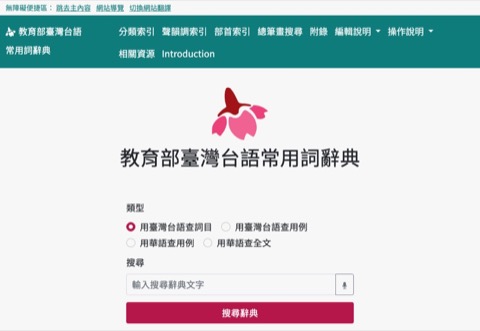
- Taiwan Hakka Dictionary (Ministry of Education) (臺灣客語辭典(教育部))The Taiwan Hakka Dictionary (臺灣客語辭典) is an online Hakka dictionary compiled by Taiwan's Ministry of Education. According to the Ministry of Education website, the dictionary includes Taiwan Hakka literature and common spoken vocabulary, with more than 22,000 entries; headwords carry pronunciations in six accents (Sixian, Hailu, Dabu, Raoping, Zhao'an and Southern Sixian), with audio files and example sentences. The website lets users select an accent and search by headword pronunciation, corresponding Mandarin or full text, and provides an on-screen keypad of tone marks to assist input. For research on the Chinese in Southeast Asia, Hakka communities in Malaysia and Singapore are important both linguistically and in clan organisations; this dictionary can be used to check Hakka vocabulary, pronunciation and characters and to compare accents. The Dabu, Raoping and Zhao'an accents have some connection with the origins of Hakka in Southeast Asia and the Chaoshan region, but specific correspondences should follow the research literature.
Coverage, how to use, and notes
Coverage About 22,000 headwords (according to the Ministry of Education website), with pronunciations in six accents, audio files and example sentences. The website home page does not list the total number of entries, so follow the official website.
How to use From the home page, select an accent, then search by headword pronunciation, corresponding Mandarin or full text; the tone-mark keypad can be used for input. The home page also has links to 'Hakka resource downloads' and 'Hakka learning resources'. No registration is needed.
Notes The dictionary is a language reference work; the Ministry of Education says it is for preserving literature and the history of word usage, and it is not a teaching standard. Coverage is mainly Taiwan Hakka; vocabulary, loanwords and pronunciation of Hakka in Malaysia and Singapore need separate comparison. Download and usage conditions are not stated on the home page, so follow the official website.
Research methods & tools
- Academia Sinica Balanced Corpus of Modern Chinese (Sinica Corpus) (中央研究院現代漢語平衡語料庫)The Academia Sinica Balanced Corpus of Modern Chinese (also known as the Sinica Corpus) is one of the most frequently cited part-of-speech-tagged balanced corpora of modern Chinese (written Taiwan Mandarin) in Taiwanese scholarship. It was built by Academia Sinica, and the website links to the Institute of Linguistics and the Institute of Information Science. The corpus is word-segmented and POS-tagged, and can be used for empirical research on word frequency, collocation, lexical usage and grammatical phenomena. For research on Chinese in Southeast Asia, it can serve as a reference corpus of written Taiwan Mandarin for comparing vocabulary and usage with Malaysian and Singaporean Chinese, and for comparative work on Chinese varieties, language contact and Chinese-language education. The site shows the current version as 4.0 and states that academic users must apply for access; an online query function for the general public was opened in 2013. For the search interface and application procedure, please consult the website.
Coverage, how to use, and notes
Coverage According to the website, version 4.0 contains 19,247 articles, 1,396,133 sentences, 11,245,330 word tokens, 239,598 word types and 17,554,089 character tokens. The articles date from 1981 to 2007, and the language is modern Chinese (traditional characters). The material is mainly written language; for the genre distribution, please consult the website.
How to use On the website, use the left-hand navigation and the description pages to find the corpus introduction, online query and index coverage pages. The site states that academic users must apply for access and mentions that the query function for the general public has been open since 2013; whether an account is required is not stated on the page, so please consult the website. When searching, start from lexical items or POS tags and examine examples and collocations; when citing, state the corpus version (4.0). The pages use Big5 encoding; if text appears garbled, switch the browser encoding to Big5.
Notes The corpus ends in 2007 and does not reflect recent neologisms or internet language. It consists mainly of Taiwan written language and is not equivalent to Malaysian or Singaporean Chinese. For full corpus download and conditions of use, please consult the website and the application rules.
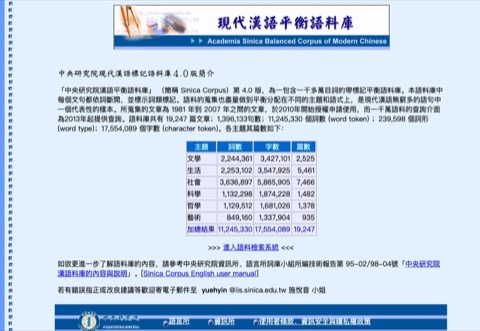
- Taiwan Historical Maps (Academia Sinica GIS) (臺灣百年歷史地圖)Taiwan Historical Maps in Century (臺灣百年歷史地圖) is a historical map geographic information platform under an Academia Sinica-related domain. Its homepage lists about 22 regional entries: Taipei, Taichung, Tainan, Kaohsiung, Keelung, Tamsui, New Taipei, Changhua, Chiayi, Hualien, Taoyuan, Yilan, Hsinchu, Pingtung, Kinmen, Lukang, Puli, Hakka Liudui, Xiuguluan River, Penghu and Taitung, plus a separate island-wide entry (twhgis). Taking Keelung as an example, its WMTS service page lists 22 maps dating from 1854 to 1971, including the Japanese-period 1:20,000 Taiwan Hobo maps (Meiji edition, 1904), the Keelung urban renewal plan map (1907) and 1962 aerial photographs. The service can be connected to GIS software such as QGIS, ArcGIS Desktop (10.1 or above) and OpenLayers. For research on Southeast Asian Chinese and the region, Taiwan Hobo maps and urban plan maps are typical materials for studying colonial urban expansion and the forms of ports and settlements. They can also be set alongside historical maps of Singapore and Malaya for comparison and used as practice material for spatial analysis in the digital humanities.
Coverage, how to use, and notes
Coverage The homepage lists about 22 regional entries; the Keelung page lists 22 maps dated 1854 to 1971. For the map types, dates and numbers in other regions, please consult each regional page; the homepage does not state the building institution or licensing terms.
How to use Enter the homepage and choose a regional entry to browse online. To use the maps in GIS software, open a regional page (such as Keelung) to find the WMTS service address and follow the connection instructions for QGIS, ArcGIS, OpenLayers and other software listed on the page. For whether maps can be downloaded and the conditions for reuse, please check the relevant page or contact the maintaining unit.
Notes The homepage does not state the building institution, usage instructions or licensing terms; some layers have projection problems in certain software, as noted on the page, so please consult the official site.
Libraries & archives
- Academia Historica (國史館) (國史館)Academia Historica is Taiwan's institution for national history and archival holdings, with its Taipei site on Changsha Street. The official homepage uses Archives, Historical Materials and Artifacts as a category linked to the Archives, Historical Materials and Artifacts Search System, and lists thematic portals including the Lee Teng-hui Presidential Database, the Presidents Database, the Chiang Ching-kuo Presidential Database and the February 28 Incident Archives Database. For those studying postwar Taiwanese political and diplomatic history and the relationship between overseas Chinese and Taiwan, Academia Historica is one of the commonly used sources of official archives and historical materials. The institution has reading rooms, with different service hours at the Taipei and Xindian sites; exhibition halls are also open to the public. Whether the archives you need can be viewed online or require a visit depends on the holdings and degree of openness, so check the online catalog first and then arrange access according to the official website's guidance. The full functions and scope of the search system could not be opened and verified for this entry; please refer to the official website.
Address 100006臺北市中正區長沙街一段2號(No. 2, Section 1, Changsha Street, Zhongzheng District, Taipei City 100006, Taiwan) View on map ↗
Coverage, how to use, and notes
Coverage Thematic databases listed on the official homepage include the Lee Teng-hui Presidential Database, the Presidents Database, the Chiang Ching-kuo Presidential Database and the February 28 Incident Archives Database, along with special exhibition information on artifacts on Indigenous themes. The total size and date range of the holdings are not stated on the homepage; please refer to the official website.
How to use Click Archives, Historical Materials and Artifacts Search System on the official homepage to enter the online catalog; thematic databases are also linked from the homepage. Reading room hours are Monday to Friday: 9:30–17:00 at the Taipei site and 9:30–16:30 at the Xindian site; exhibition halls are open Monday to Friday and on special opening days 9:30–16:30, with closure days indicated by the red dates on the web page. Whether an appointment is required is not stated on the homepage; please call 02-23161000 to ask.
Notes The search system URL involves redirects, so it is safer to enter via the official homepage in a browser. The full address of the Xindian site is not provided on the homepage. The Taiwan Governor-General's Office archives held by the Taiwan Historica (Nantou) have a separate portal, which could not be verified for this entry.
- Archives Administration, National Development Council (National Archives) (国家发展委员会档案管理局(国家档案馆))The Archives Administration is the competent archival authority under Taiwan's National Development Council and is also responsible for preserving and opening national archives; it is commonly called the National Archives, and its premises are in Linkou District, New Taipei City. Its website offers sections on visiting services, exhibitions and events, archival applications, learning resources, records management, and cultural creative publications, and centrally links to the National Archives Information Network, the Archives Resource Integrated Search Platform (ACROSS), and the agency archives catalogue search site. For researchers studying political, diplomatic, and migration relations between Taiwan and Southeast Asia and overseas Chinese, this is the place where Taiwan government archives are physically preserved and can be applied for, suitable for visiting after finding leads in the online catalogues. According to the website, as of 31 October 2026 the national archives holdings measured about 32,184.58 meters in length. On-site visits, reading rules, and application procedures are subject to the website's announcements.
Address 新北市林口區檔案館路1號,台湾 View on map ↗
Coverage, how to use, and notes
Coverage It holds national archives transferred by Taiwan's agencies in accordance with the law, about 32,184.58 meters as of 31 October 2026. For content categories, periods, and access restrictions, please refer to the National Archives Information Network catalogue and the website's explanations; content specifically concerning Southeast Asian overseas Chinese must be searched for by the user.
How to use First search the catalogue using the National Archives Information Network or ACROSS, note the file numbers and titles, then apply for access following the procedure under Archival Applications on the website. The website shows opening hours of Tuesday to Saturday 09:00 to 17:00, closed on national holidays and the continuous Lunar New Year holiday, with additional temporary closure announcements. Whether reservations are required and the reading rules should first be checked on the website or by telephone; the switchboard is (02) 8995-3700.
Notes Opening days, temporary closures, and access rules may change; be sure to check the latest announcements on the website before visiting. Some archives are restricted or require an application.
- Archives, Institute of Modern History, Academia Sinica (中央研究院近代史研究所檔案館)The Archives of the Institute of Modern History, established by the Institute of Modern History, Academia Sinica, is an important archive in Taiwan for the study of modern and contemporary China's foreign relations. Its holdings are mainly diplomatic archives: beginning in 1955, the Ministry of Foreign Affairs gradually transferred diplomatic archives from the late Qing to the Beiyang period to the Institute, including the archives of the Zongli Yamen, the Ministry of Foreign Affairs (Waiwubu), and the Beiyang government's Ministry of Foreign Affairs; Ministry of Foreign Affairs archives of the Nationalist Government period are also held. For researchers of Southeast Asian Chinese, the diplomatic files in the overseas Chinese category can be used to understand contacts between the Chinese government, legations and consulates, and overseas Chinese societies, such as negotiations on protecting overseas Chinese, overseas Chinese status and treatment, and official correspondence of overseas Chinese affairs agencies. The search system is free to use, and most archives can be consulted in the reading room. Note that these archives are not a Southeast Asia-themed collection; Southeast Asia-related materials are scattered across different categories, and diplomatic archives on Southeast Asian overseas Chinese are also held at other institutions, so they must be cross-checked with other archives.
Address 115201 台北市南港區研究院路二段128號 View on map ↗
Coverage, how to use, and notes
Coverage The Waiwubu archives comprise 2,278 volumes, dated from 1689 to 1943 and mainly concentrated in 1901 to 1912, in 37 series, including materials kept by legations abroad and files on commerce and taxation. It also holds the archives of the Zongli Yamen, the Beiyang government's Ministry of Foreign Affairs, and the Nationalist Government's Ministry of Foreign Affairs, as well as files on missionary cases and the Sino-French negotiations on Vietnam. The website also compiles Overseas Chinese materials in the Archives' diplomatic files and the Overseas Chinese materials section of the Catalogue Compilation of Diplomatic Archives. For the specific number of Southeast Asia-related volumes, please refer to the search system.
How to use First search for free in the website's Collection Search System (archivesonline.mh.sinica.edu.tw), then visit and request files following the Reading Notice. Opening hours are Monday to Friday 9:00 to 17:00, closed on weekends and national holidays; file retrieval hours are 9:00 to 12:00 and 13:30 to 16:30, and from 12:00 to 13:30 the reading room is open for reading only, with no file retrieval. Digitized personal archives can be used on site, while cataloged but undigitized archives must be read on site. The website's Guide to Diplomatic Historical Sources and Diplomatic History Research can serve as an introduction. Whether reservations and identification are required, and the rules on photography and copying, should be checked on the Reading Notice page or by calling +886-2-27898284.
Notes Materials on Southeast Asian overseas Chinese history are relatively limited at this archive and should be used together with archives held by other institutions such as Academia Historica and the Archives of the Ministry of Foreign Affairs; for the scope of digitization and online licensing rules, please refer to the website.
- Archives, Institute of Taiwan History, Academia Sinica (中央研究院臺灣史研究所檔案館) (中央研究院臺灣史研究所檔案館(臺灣歷史檔案資源網))The Archives is the archival holding and service unit of the Institute of Taiwan History, Academia Sinica, and the website is titled Taiwan History Archives Resource Network. The website lists Collection Search, Selected Collections, Services, Visitor Information and News, and brings together several digital systems: the Taiwan History Archives Resource System, the Taiwan Historical Documents Full-Text Database, the Taiwan Governor-General's Office Staff Directory System, the Taiwan Governor-General's Office Passport System and the Taiwan Studies Ancient Books Database; there is also the Taiwan Archives Collection System, available only within the institute's network domain. For scholars studying official personnel, entry and exit records and official documents of Japanese colonial-period Taiwan, as well as Taiwanese ancient books and private documents, users can first search the catalog online and then visit in person to consult originals or copies. The Archives' digital systems and online catalogs are common entry points to official documents of the colonial period in Taiwan, while access conditions for physical holdings vary by fonds.
Address 11529 臺北市南港區研究院路二段 128 號 人文社會科學館南棟 11 樓(Taiwan 11529, Taipei City, Nangang District, Academia Road Section 2, No. 128, Humanities and Social Sciences Building South Wing, 11F) View on map ↗
Coverage, how to use, and notes
Coverage The digital systems listed on the website are the Taiwan History Archives Resource System, the Taiwan Historical Documents Full-Text Database, the Taiwan Governor-General's Office Staff Directory System, the Taiwan Governor-General's Office Passport System and the Taiwan Studies Ancient Books Database. The scale and date range of each system are not stated on the website homepage; please refer to the official website.
How to use First search through Collection Search on the website or within each digital system, then consult Visitor Information and Services for on-site access procedures. Whether an advance appointment is required, the application procedures and the copying rules are not stated on the homepage; please refer to the Services and Visitor Information pages, or call (02) 2652-5181. The website showed opening hours of 09:00–17:00 on the day of consultation.
Notes The Taiwan Archives Collection System is limited to the institute's internal network domain; for most systems the form of image access varies by fonds (see the entry for the Taiwan History Archives Resource System).
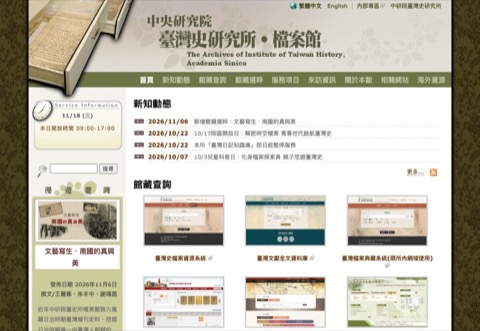
- National Taiwan Library (国立台湾图书馆)The National Central Library of Taiwan is a public library in Taiwan whose collections are strong in Taiwan studies literature, and it provides 'Taiwan Studies' research resources and digital collection services. For researchers of Southeast Asia and Nanyang, its distinctive feature is the 'Southern Materials' preserved from the Southern Materials Library founded in 1940: these mainly Japanese-language survey reports and published books concern Japan, China, Korea and Nanyang during the Japanese colonial period, and are important primary materials for studying pre-war Japanese surveys of Southeast Asia, colonial economy, overseas Chinese affairs and regional exchanges; the digitized portion can be searched through the library's Taiwan Studies Digital Library. The website homepage lists services including catalogue search, electronic and digital resources, periodicals and newspapers, reader card application, interlibrary loan, reference consultation, floor guide and transport directions, and provides an entry to Taiwan studies research resources. Researchers who want to consult the physical Southern Materials originals, old Japanese colonial-period volumes, or conduct systematic research can first screen with the online catalogue and digital system, then visit the library under its rules.
Address 235066 新北市中和區中安街85號(85 Zhongan St., Zhonghe Dist., New Taipei City 235066, Taiwan) View on map ↗
Coverage, how to use, and notes
Coverage According to the digital library page, the Southern Materials number 14,232 volumes and 4 items, of which 12,568 entries have been digitized, mainly Japanese-language survey reports and published books; there are also digital collections of Japanese colonial-period books, periodicals, Taiwan local gazetteers, photo albums and maps. The full size of the physical holdings and other Nanyang-related collections are not listed on the homepage; please consult the official site.
How to use First use the catalogue search system and the electronic resources entry on the website, then search the digitized materials through the Taiwan Studies Digital Library. Before visiting, it is advisable to check the website's reader card application, floor guide, opening hours and transport notes, and to confirm through the reference consultation service whether old volumes and special collections require an appointment, the consultation rules and copying restrictions, as announced by the library. The website's announcements occasionally post system maintenance notices, so check before accessing.
Notes The Southern Materials are mostly pre-war Japanese-language documents; please confirm with the library the rules for consulting and copying old paper volumes; opening hours are subject to the website's announcement on the day.
- National Taiwan University Library – Japan and Southeast Asia Study Collections (国立台湾大学图书馆(日本与东南亚研究特藏))The National Taiwan University Library has a 'Japan and Southeast Asia Special Collection', part of its special collection resources. The English page on the website explains that this collection is divided into two main parts, Japanese studies and Asian studies: Asian studies covers the languages, history, geography, industry and resources of Asia and the Pacific region, and its 'Southeast Asia' part covers South China, Southeast Asia, the Pacific islands and Oceania; the page specifically mentions the 'Otto Scheerer Collection', consisting of books on Philippine dialects, history, geography and ethnology. For scholars studying early colonialism and regional knowledge production in Southeast Asia, Philippine languages and ethnography, and how Taiwanese academia accumulated research materials on the south, these are important leads that can be consulted on site. Readers can search through the library catalogue, the Discovery search system and NTU Library MetaCat, or browse on the 'Special Collections' page. The address, enquiry telephone number and opening hours of the NTU Library main library are published on the website.
Address No. 1, Sec. 4, Roosevelt Rd., Taipei, Taiwan, R.O.C. 106 View on map ↗
Coverage, how to use, and notes
Coverage The website page states that the topics cover Japanese studies (including Meiji-period editions) and Asian studies (East Asia, Southeast Asia), with a date range roughly from early Japanese history to the Second World War. The page does not state the number of items, language composition or a complete bibliography; for details see the Chinese page of the website and the library catalogue.
How to use Search through the NTU Library catalogue, Discovery or MetaCat, or enter from 'Special Collections' on the website. The English page does not explain how special collections can be consulted or photographed, or how outside visitors may enter; please first read the website's 'Entry Notice', or confirm with the information desk (tel. 02-33662326), the circulation desk (02-33662353) or the email listed on the website's contact page. The main library's opening hours are published separately for semesters and winter/summer breaks, and temporary changes are subject to website announcements.
Notes The English page does not list the number of items or the languages; the specific location of the special collections and the conditions for consulting them must be confirmed separately with the library. The website also lists branch libraries and departmental libraries, whose opening hours differ from the main library.
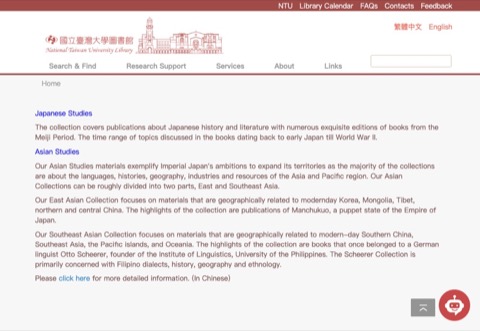
Museums & memorials
- Collections Portal, National Museum of Taiwan History (國立臺灣歷史博物館典藏網)Dian Cang Wang (典藏網, the Collections Website) is the collection display and search site of the National Museum of Taiwan History, used to present and manage the museum's holdings. The site is divided into Featured Collections (special collections, important antiquities, general antiquities, the Memory of the World national register, popular items), Thematic Zones (such as 'Taiwan's 25 Witnesses to the World', 'Visible Taiwan History', a treasure box of collection stories and an audiovisual zone) and Collection Resources (Open Data, 3D digitization, e-books). The items shown include maps and charts, old documents and letters, printed matter, clothing, coins and medals, and daily-use objects. For searching, it offers collection search, category browsing, and site-wide and full-text search. A separate 'Collection Licensing' section explains the application method and procedure. For research on Southeast Asian Chinese and the region, Taiwan's maps, old documents, trade goods and everyday objects can be used to study maritime trade, migration and material culture. The site also suits comparison with the digital collections of museums in Malaysia, Singapore and elsewhere in Southeast Asia, to see how Taiwan presents historical objects through open data and thematic curation.
Coverage, how to use, and notes
Coverage Mainly the holdings of the National Museum of Taiwan History, covering maps and charts, old documents and letters, printed matter, clothing, coins and medals, and daily-use objects; the homepage does not list the total number of items or the full classification, so please consult the official site. Open Data, 3D digitization and e-book resources are also available.
How to use After entering the site, search through collection search and category browsing under 'Collection Search', or use site-wide search and full-text search; the thematic zones suit introductory browsing. To use item images in publications or exhibitions, apply through the 'Collection Licensing' section using its application notes, operation guide and 'Start Application'; the page also provides case lookup and FAQs. For specific licensing terms, see the 'Data Licensing Rules' and the 'Online Copyright Statement'.
Notes The homepage can be browsed free of charge, but the fees and the scope of reuse are not clearly stated; commercial use and publication require prior licensing application. For on-site visit information, please consult the museum's official website.
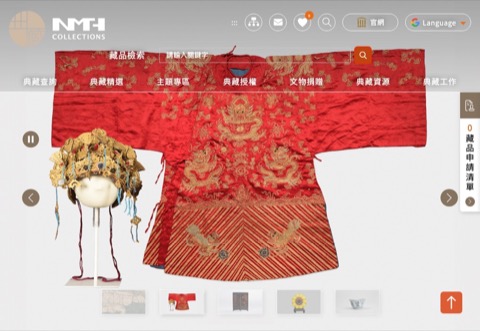
Institutions & societies
- Asia-Pacific Regional Studies Center (CAPAS), Center for Humanities and Social Sciences, Academia Sinica (中央研究院人文社会科学研究中心亚太区域研究专题中心)The Center for Asia-Pacific Area Studies (CAPAS) is part of the Research Center for Humanities and Social Sciences, Academia Sinica. Its website states that its research focuses on the societies, cultures, languages, religions and ethnic relations of the Asia-Pacific region, as well as political, economic and social transformation and development. The center runs research programs on border-crossing and mobility, maritime history, development and population, and comparative religious dialogue, and its website offers Asia-Pacific publications, the Asia-Pacific Studies Forum and major research outputs. The center's page also lists the annual Taiwan Southeast Asia Regional Studies Conference (the 2026 call for papers is themed From the New Southbound Policy to the Indo-Pacific Outlook) and links to the Taiwan Association for Southeast Asian Studies. For those who want to follow developments in Taiwan's Southeast Asian studies community, submit papers or attend conferences, or contact relevant scholars, this is a reliable official entry point. The center's office is located on the Academia Sinica campus in Nangang, Taipei; the website gives its address, telephone number and email.
Address 11529 臺北市南港區研究院路二段128號 View on map ↗
Coverage, how to use, and notes
Coverage Sections listed on the website include Asia-Pacific publications, the Asia-Pacific Studies Forum, major research outputs (including books and a dataset on Taiwan's Indigenous peoples), highlights of past events, and call-for-papers information for the annual Southeast Asia regional studies conference. The page does not show a library or archival holdings, nor does it state the number of publications; please refer to the website.
How to use Browse publications and event information on the website. To attend the conference or inquire about collaboration, contact the center by telephone at +886-2-2782-2191, fax at +886-2-2782-2199, or by email (see the website's contact page). The center's page does not state whether the office receives visitors, so please contact them to confirm before visiting. To consult books within Academia Sinica, see the page of the Joint Library of Humanities and Social Sciences (email on the website's contact page; telephone (02) 2782-1693 ext. 208); for admission rules for readers from outside the institution, please refer to that library's website.
Notes The center is a research and academic exchange unit; its website shows no dedicated library or archive. Its research focus covers the Asia-Pacific and is not limited to Southeast Asia. English-language material on the website is limited, and some sections are mainly in Chinese.
Other
- Joint Library of Humanities and Social Sciences, Academia Sinica (中央研究院人文社會科學聯合圖書館)The Joint Library of Humanities and Social Sciences is a library of Academia Sinica, located on the Nankang campus. Services listed on the website include borrowing (library card application, reservations and recalls, renewals, mobile renewal), interlibrary cooperation (domestic and international borrowing and copying on behalf of users), research resource acquisition suggestions, book and periodical donations, institutional repository, special collections image system, databases, e-journals, e-books and new book alerts, along with facilities such as study carrels, multipurpose rooms, and photocopying and printing. Readers can search Academia Sinica's holdings, including books, journals, electronic resources and audiovisual materials, through the Library Resources Search System. For Southeast Asian Chinese and regional studies, it is suited to researchers connected with the humanities and social science institutes within the Academy, for finding monographs, journals and databases in the humanities and social sciences in Taiwan, with interlibrary cooperation available for obtaining materials from other libraries. The website does not list holdings numbers; the specific collection strengths and Southeast Asia-related holdings must be searched through the catalog system.
Address 台北市南港區研究院路二段128號,11529,臺灣 View on map ↗
Coverage, how to use, and notes
Coverage Books, journals, electronic resources and audiovisual materials, with databases, e-journals, e-books, an institutional repository and a special collections image system. The number of holdings and date range are not stated on the official homepage; please refer to the official website.
How to use First search holdings through the Library Resources Search System on the website, then check pages such as Opening Hours, Library Card Application, and Reservations and Recalls to confirm entry and borrowing rules. The homepage showed opening hours of 08:30 to 17:00, noting that the hours shown on the page on the day apply. The telephone is +886-2-2652-5284, and the email is on the website's contact page. Before visiting, it is advisable to confirm entry and borrowing conditions for external readers by phone or email.
Notes The homepage does not state whether an appointment or a card is required to enter; please confirm the rules for external readers with the library first.
- National Bibliographic Information Network (NBINet) (全國圖書書目資訊網)The National Bibliographic Information Network (NBINet) is maintained by the National Central Library, with the page footer stating copyright belongs to the National Central Library. The site navigation includes About NBINet, Cooperative Cataloging, Bibliographic Search and List of Member Libraries, and provides a link to the NBINet Union Catalog, the portal for searching the bibliographic records and holdings of cooperating libraries in Taiwan. Readers studying Southeast Asian Chinese and regional issues can use it to search, across many Taiwanese libraries at once, Chinese and Western-language monographs on Southeast Asia, overseas Chinese, Malaysia, Singapore, Indonesia and similar topics, see which libraries hold them, and then decide which library to borrow from or whether to request interlibrary loan. This is especially useful when planning a trip to Taiwan to consult books, since confirming where holdings are located saves time. This entry records only what was verified on the official homepage. The list of member libraries, the number of bibliographic records and the types of materials are not listed on the homepage; please refer to the List of Member Libraries and About NBINet pages on the official website.
Coverage, how to use, and notes
Coverage A union catalog of book bibliographic records and holdings of the National Central Library of Taiwan and its cooperating libraries. The scope, number of member libraries, time span and languages are not stated on the official homepage; please refer to the official website.
How to use Open the website, enter keywords in the search bar on the homepage and click Start Search, or enter the NBINet Union Catalog for further searching. Chinese keywords such as 东南亚 (Southeast Asia), 华侨 (overseas Chinese) and 马来西亚华人 (Malaysian Chinese) are suggested, combined with English titles or authors to find foreign-language books. After finding a record, you can view the holding location and call number at each member library, and then ask the holding library about borrowing rules or apply for interlibrary loan. The homepage does not require login or registration; for specific functions please refer to the official website.
Notes The homepage does not state the scale of coverage or fee policies; borrowing and interlibrary loan rules differ among libraries and must be confirmed with the holding library.
- National Central Library (Taiwan) (國家圖書館(臺灣))The National Central Library is Taiwan's national library, and its homepage provides several search portals: the Collection Resource Discovery System (library catalog), the National Bibliographic Information Network (NBINet union catalog), Electronic Resources Search, the Periodical Literature Information Network, the Taiwan Electronic Theses and Dissertations System, and the Taiwan Humanities and Social Sciences Citation Index database. Together these portals cover books, periodicals, theses and citation searches in Taiwan, and are a starting point for surveying Taiwanese academic literature. For Southeast Asian Chinese and regional studies, the library's catalog and theses systems are suited to finding Chinese-language monographs, journal articles and theses published in Taiwan on Southeast Asia, overseas Chinese and related regional studies, and to confirming which materials need to be consulted in person. The homepage also lists the addresses of the Southern Branch and the OPEN LAB. This entry records only what was verified on the homepage. The size of the collections, special collections, opening hours and rules for obtaining a reader card are not stated on the homepage; please refer to the relevant pages of the official website.
Address 100201臺北市中正區中山南路20號,臺灣 View on map ↗
Coverage, how to use, and notes
Coverage Search resources listed on the homepage include the library catalog, the national union catalog, electronic resources, periodical literature, theses and dissertations, and the citation index. The number of holdings, date range and details of special collections are not stated on the official homepage; please refer to the official website.
How to use On the homepage choose the relevant portal: Collection Resource Discovery System for the catalog, National Bibliographic Information Network for national bibliographic records, Periodical Literature Information Network for journals, Taiwan Electronic Theses and Dissertations System for theses, and Taiwan Humanities and Social Sciences Citation Index database for citations. Before visiting in person, confirm the opening hours, reader card application and in-library rules on the official website. Some portals (such as the Periodical Literature Information Network) may not open directly depending on the network environment; try again later or enter through the homepage link.
Notes At the time of verification, the pages of the Periodical Literature Information Network and the Taiwan Humanities and Social Sciences Citation Index database did not display body text, so please refer to the official website for how to use them; the main library, the Southern Branch and the OPEN LAB are different locations.
- National Chi Nan University Library – Southeast Asian Studies Special Collection (国立暨南国际大学图书馆(东南亚特色馆藏))The Library of National Chi Nan University is located in Puli Township, Nantou County. Under 'Special Collections' on its website there is a 'Southeast Asian Studies' section that gathers the library's Southeast Asia-related books into two search entries, Chinese and foreign-language, so readers can search directly in the catalogue without assembling classification numbers or keywords themselves. There is also a page titled 'NCNU Library: Local Southeast Asian Studies' containing an 'Introduction to the Southeast Asian Studies Special Collection' and bibliography browsing and searching, along with a page introducing the 'Southeast Asian Studies Project (ROC Year 91)'. For researchers who want to systematically find Chinese- and foreign-language books on Southeast Asia held by Taiwanese universities, this is a thematically pre-organized entry point, suited to preliminary literature surveys, bibliographic checks and confirming holdings before visiting. The library's opening hours, contact details and address are given on the website homepage. Whether outside readers may enter, borrow or obtain a card is not stated on the homepage and must be confirmed with the library.
Address 545301 南投縣埔里鎮大學路500號(500 Daxue Rd., Puli Township, Nantou County 545301, Taiwan) View on map ↗
Coverage, how to use, and notes
Coverage The website lists two catalogue search entries, 'Southeast Asia Special Collection (Chinese)' and 'Southeast Asia Special Collection (Foreign Languages)'; the foreign-language part is delimited by classification number ranges (including history and geography classes such as DS). Neither the homepage nor the section pages state the number of volumes, date range or language composition; please rely on the website and catalogue search results. There is also a 'Southeast Asian Studies Project (ROC Year 91)' page, whose details should be checked on the website.
How to use From the library website homepage, find 'Southeast Asian Studies' under 'Special Collections' and click the Chinese or foreign-language special collection to get catalogue results with a preset search; you can also go to the 'Local Southeast Asian Studies' section to see the special collection introduction and bibliography browsing. The results can be further filtered by title, author, subject and so on. Before visiting, it is advisable to confirm the entry and borrowing rules for outside visitors via the reader services email (see the website's contact page) or by telephone at 049-2910960 ext. 4371. The opening hours listed on the website are Monday to Friday 8:30-21:30, Saturday and Sunday 9:00-17:00, closed on national and university holidays.
Notes The section pages are marked with a 2003 copyright, and some pages (such as the Year 91 project) are older, so their content may no longer be current. The website does not publish the size of the holdings. The catalogue entries are preset searches; please check for yourself whether the results cover all Southeast Asia-related books.
- Overseas Community Affairs Council – Chronicle of Overseas Chinese Affairs (Qiaojian Lishi) (侨务委员会“僑見歷史”僑務發展大事記)The Chronicle of Overseas Chinese Affairs is a timeline page under the Qiaojian Lishi (Overseas Chinese History) section of the website of Taiwan's Overseas Community Affairs Council. It lists important events in Taiwan's overseas Chinese affairs in chronological order, divided into six periods: before the Republic of China to Republic year 20, years 21–40, years 41–60, years 61–80, years 81–100, and year 101 to the present. Entries include dates and event descriptions, and some are accompanied by historical photographs and captions. The content begins in the 53rd year before the Republic of China, when the Qing government established a labor recruitment bureau to protect Chinese laborers going abroad, and the page shows that it ends on 15 November of Republic year 112 (2023); later events are not included. Categories covered include policy and legislation (such as the Nationality Law and the Regulations on Overseas Chinese Identity Certification), organizational history, overseas bases, conferences and activities, education and culture, and economy, trade, and services. For researchers of Southeast Asian Chinese, it is a concise chronology for understanding the evolution of Taiwan's overseas Chinese policy and can serve as a lead for finding primary laws, archives, and policy texts; it is not itself a primary archive.
Coverage, how to use, and notes
Coverage The time span runs from the late Qing (53rd year before the Republic of China) to November 2023, mainly in Chinese. The content consists of event entries and some photographs and is not full-text archival material; the number of events is not stated on the website.
How to use After opening the page, browse by the six periods, note event names, names of laws and regulations, and years, and then search for the corresponding original texts in the National Archives Information Network, legal databases, and similar sources. The page requires no registration and can be read directly.
Notes This is editorial content in the form of a chronology; check primary sources before citing it. The page does not cover events after 2023.
- Taiwan Dissertations and Theses Knowledge Value-Added System (NDLTD) (臺灣博碩士論文知識加值系統)The Taiwan Electronic Theses and Dissertations System (Value-Added Knowledge System for Taiwan Theses and Dissertations) was built by the National Central Library, and the library's website lists it as the Theses search portal. The system page is titled Free Full-Text Database of Master's and Doctoral Theses, and is used to search doctoral and master's theses from universities across Taiwan. For research on Southeast Asian Chinese and regional studies, its value lies in letting users find at once the theses written in Taiwan on Southeast Asia, overseas Chinese, Malaysian and Singaporean society, overseas Chinese affairs and Southeast Asian international relations, both in Chinese and in foreign languages, for example research from departments of overseas Chinese studies, Southeast Asian studies, history, political science, sociology and anthropology at Taiwanese universities. Theses often include fairly full literature reviews and bibliographies, which can be used to understand the research trajectory of Taiwanese scholarship on Southeast Asia and to trace primary sources through the references. Before searching, the system may require entering a CAPTCHA; the page explains this is to maintain service quality given the large number of users. This entry records only what was verified on the official page. The years covered, total number of theses and full-text authorization rules should be checked on the official explanation page.
Coverage, how to use, and notes
Coverage Mainly bibliographic records and some full texts of doctoral and master's theses from tertiary institutions in Taiwan. The start and end years, total volume, disciplinary distribution and participating universities are not stated on the official homepage; please refer to the official website. Theses are mainly in Chinese, with some in foreign languages.
How to use Open the official website to search; no login is needed. On first entry or during heavy use, a CAPTCHA may appear and searching can continue after entering it. Search with keywords such as 东南亚 (Southeast Asia), 华侨 (overseas Chinese), 马来西亚 (Malaysia), 新加坡 (Singapore) and 印尼华人 (Indonesian Chinese), then narrow the scope using fields such as thesis title, graduate student, advisor, university and department, thesis keywords and abstract; results may differ between traditional and simplified Chinese keywords, so try both. Access to full text depends on the authorization status of each thesis; some provide only the bibliographic record and abstract, and must be obtained from the holding university library or through interlibrary cooperation. When citing, copying the permanent link given by the system is recommended.
Notes Some theses do not offer online full text because of author authorization restrictions; the system may show a CAPTCHA; the specific years and number of records covered are not stated on the official homepage.
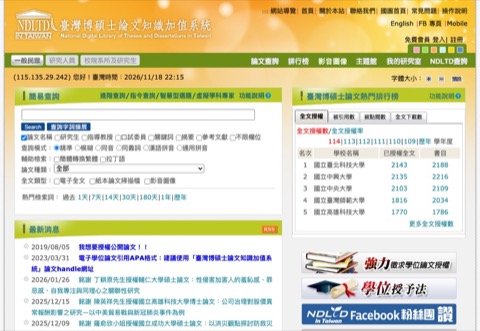
Hong Kong & Macao39
Newspapers & news archives
- Old HK Newspapers (Hong Kong Public Libraries Multimedia Information System) (香港旧报纸(香港公共图书馆多媒体资讯系统))Old Hong Kong Newspapers is a thematic collection in the Hong Kong Public Libraries digital collections. It was formerly part of the library's Multimedia Information System (MMIS) and has now been merged into the library's Digital Collections platform. It contains digitized early Hong Kong newspapers that can be searched online, with page images available for viewing. According to the description, the titles include Chinese-language papers such as the Hong Kong Commercial Daily (香港工商日報), Wah Kiu Yat Po (華僑日報) and Ta Kung Pao (大公報), as well as English-language papers such as the China Mail, Hong Kong Telegraph, Hong Kong Daily Press and Hong Kong Sunday Herald, spanning the mid-19th century to the late 20th century. Old newspapers are basic sources for studying Hong Kong politics, economy, society, culture and the Chinese community; Wah Kiu Yat Po, the Commercial Daily, Ta Kung Pao and others also report extensively on Chinese society in South China and Southeast Asia and on links with the qiaoxiang (emigrant home villages), and can be compared with newspapers from Singapore and Malaysia. The system can be searched by keyword, date and newspaper title, which is convenient for researchers tracing events, persons and advertisements. Note that the official site redirected to a queue page during verification and could not be fully opened; the content above is based on public descriptions, search results and links on the Hong Kong Public Libraries e-resources page. Please check the official site for the years covered by each title and current terms of use.
Coverage, how to use, and notes
Coverage According to the description, the collection includes Chinese and English newspapers from early Hong Kong to the late 20th century, including the Hong Kong Commercial Daily, Wah Kiu Yat Po, Ta Kung Pao, China Mail, Hong Kong Telegraph and Hong Kong Daily Press; some titles have missing issues. Because the official site could not be opened, the start and end years of each title cannot be listed; please refer to the official site.
How to use Enter the Old Hong Kong Newspapers collection from the Hong Kong Public Libraries Digital Collections portal (the old address mmis.hkpl.gov.hk/old-hk-collection now redirects to the new platform). The page offers a search box for keywords, and results can be narrowed by newspaper title and date; results are shown as page images. When searching, try both traditional and simplified characters, alternative renderings of personal names and old place-name spellings, since OCR of old newspapers may not be fully accurate. Some resources may require a library card login or may be available only on terminals inside the library; please see the official instructions.
Notes The official site could not be opened during verification because of a queuing mechanism, so the years covered by each title, search functions and access conditions have not been verified. Some titles have missing issues, and the hit rate of full-text search in old newspapers depends on OCR quality.
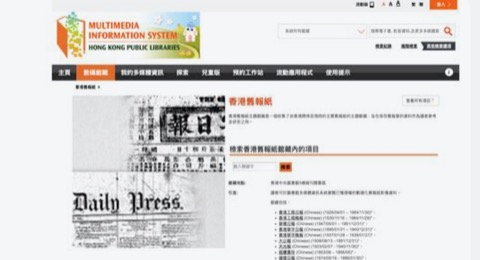
- Chinese Clippings Database (HKBU Library) (华人剪报资料库)The Chinese Newspaper Clippings Database (华人剪报资料库) is built by the Hong Kong Baptist University Library and brings together early and modern newspaper clippings related to Chinese people collected by the library from various sources. According to its introduction, the Overseas Chinese Newspaper Clippings Database was established by the Contemporary China Research Section of the HKBU Library (now the Special Collections and Archives section), with a focus on overseas Chinese affairs, remittances, investment, emigrant home areas, reception of overseas Chinese visiting China, resettlement of returned overseas Chinese and education of overseas Chinese students. The clippings come from materials collected by the Union Research Institute, mainly Chinese, Hong Kong and Taiwan newspapers published from 1950 to 1971, together with periodicals from 17 Southeast Asian countries, about 230 Chinese newspapers and more than 40 Chinese periodicals. The official page states that the database holds more than 200,000 indexed clippings, with original texts provided within the limits of copyright. Topics visible on the official page include overseas Chinese (1950–1971), conditions in Hong Kong and Macao (1950–1973), higher education in China, Taiwan cultural issues, and contemporary China (1992–1998) collected by the library itself. For readers studying Cold War-era Chinese society in Southeast Asia, overseas Chinese policy and opinion in the Chinese-language press, it offers a thematic search entry that avoids going through newspapers one by one. The site once showed a total of 239,698 clippings, 361 newspapers and 101 cities, consistent with the official wording of more than 200,000; please rely on the figures currently displayed on the site.
Coverage, how to use, and notes
Coverage According to the introduction, the overseas Chinese clippings were published from 1950 to 1971, in Chinese, covering 287 newspapers and periodicals with 33,765 articles in total, with full-text images of the clippings. The newspapers were published in places including mainland China, Hong Kong and Macao, Taiwan, Singapore, Malaysia, Vietnam, the Philippines, Indonesia, Myanmar, Cambodia, Thailand, Japan, the United States and Canada. The official page states that the whole database has more than 200,000 indexed entries, divided into several thematic sub-collections, among which the overseas Chinese sub-collection covers 1950–1971. Figures such as 287 titles and 33,765 articles have not been verified item by item on the site.
How to use Go to https://digital.lib.hkbu.edu.hk/newsclipping/index.php and search from the homepage search box by author, column name, title or content summary, or browse by sub-collection (such as current affairs, film, culture and education), newspaper and city. It is advisable to try both traditional and simplified Chinese keywords, as well as variant spellings of place names, organisation names and personal names; search within the overseas Chinese sub-collection first, then widen to the whole database. The official page does not say whether registration is required or whether bulk export is possible; please check on the entry pages.
Notes The official page notes that original texts are provided only within the limits of copyright, so some clippings may have an index only, without full-text images. The clippings come from the Union Research Institute collection, and coverage is shaped by the selection of clippings at the time, mainly Chinese, Hong Kong and Taiwan newspapers. During checking, the site returned a 403 once and opened normally another time; please be aware of possible access instability.
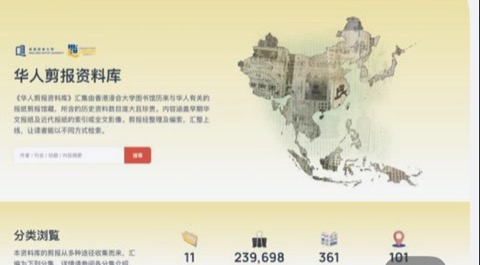
- Christian Weekly (Hong Kong Chinese Christian Churches Union) (基督教週報(香港华人基督教联会))Christian Weekly is a weekly newspaper published by the Hong Kong Chinese Christian Churches Union, first issued on 30 August 1964; its website states that its aim is to report Christian news, nurture believers' spiritual life and proclaim Christian truth. According to the Special Collections and Archives unit of the Hong Kong Baptist University Library, the weekly records the activities of Hong Kong churches and Christian organizations and also carries articles on Christian life and education, theology and faith, and Christian activities in Taiwan and China; 2,572 issues were digitized in 2014, and the digital edition is available through the weekly's website. For readers studying Hong Kong churches and Christian communities, it is a long continuous source offering an internal church perspective, useful for tracing congregational activities, Union affairs, developments in church institutions and figures in church circles. The website also provides current-issue content, links to all issues and article search, which facilitate retrospective searches by topic.
Coverage, how to use, and notes
Coverage According to the Baptist University Library page, 2,572 issues have been digitized; the Baptist University page does not state the year range. The weekly began in 1964, and the current issue on the official website is No. 3247 (15 November 2026). The language is mainly Traditional Chinese. For the full contents of each issue, please refer to the 'links to all issues' on the official website.
How to use Visit the weekly's official website and browse issues through the 'links to all issues' on the page, or use 'article search' to look up keywords. The weekly's page at the Baptist University Library Special Collections and Archives also provides an entry to the digital edition. The official website also has subscription and retail information. When searching, use Traditional Chinese keywords such as names of congregations, organizations and people.
Notes The weekly is a publication of a church body itself, so its stance and choice of material reflect a church perspective; when using early issues, please check that the digitized images of the issue are complete and legible. For specific copyright and reproduction rules, please consult the official website.
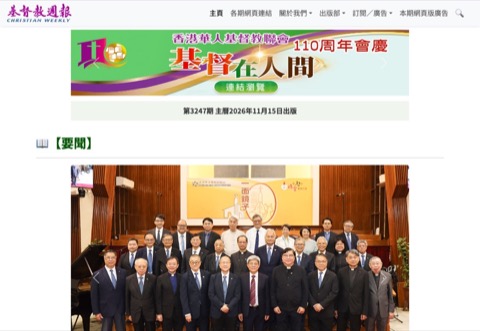
- Hong Kong Journals Online (HKJO) (香港期刊在线(香港大学图书馆))Hong Kong Journals Online is part of the University of Hong Kong Libraries' digital collections and provides full-text images of academic and professional journals published in Hong Kong. The site is one of the projects digitizing Hong Kong historical materials and includes English and Chinese publications on subjects such as law, medicine and public health, education, and history and geography, with the earliest journals dating back to 1872. For area studies readers, these journals are primary material on the legal system, public health, education and scholarly communities of colonial and postwar Hong Kong; Hong Kong was also a key hub for the movement, remittances and trade networks of Southeast Asian Chinese, so these journals can be cross-checked with periodicals and archives from Malaya and Singapore. The website states that new titles and issues will be added as publishers grant permission. The site offers two ways to browse, by subject (nine categories) and by title; each title has its own catalogue record, suitable for reading a journal volume by volume over the years, and users can also search by keyword or creator and then filter by resource type, language, subject, publisher and so on.
Coverage, how to use, and notes
Coverage The website states that it includes more than 60 journals and over 491,290 images, with the earliest issues dating back to 1872; the title list shows about 70 titles, which does not fully match the figure in the introduction. The languages are English and Chinese, and the two counts overlap. The years covered vary by journal; please consult the catalogue record of each journal.
How to use From the University of Hong Kong Libraries' digital collections, enter HKJO and browse by subject or by all titles; lists can be sorted by title, date, volume and issue, or accession number, and 10 to 100 items can be shown per page. Search supports title, keyword and creator, and can be filtered by resource type, language, subject, creator, publisher and journal category. The page has a login entry, but the website does not state which content requires login; please consult the website.
Notes The page does not state access conditions, and some content may be restricted by copyright or licensing. The date ranges and missing issues vary by journal, so check the catalogue record of the journal before use.
- Periodicals Collection (Jornais de Recolha), Macao Public Library (館藏報刊資料庫 (Jornais de Recolha)(澳门公共图书馆馆藏报刊资料库))This database collects periodicals published in Macao's history and is provided by the Public Libraries of the Cultural Affairs Bureau of the Macao SAR Government on its special collections digital platform; it is one of the main entry points for browsing old Chinese and Portuguese newspapers of Macao online. The entry page offers calendar-style browsing by year or date and lists about 33 newspapers, with names shown in both Portuguese and Chinese, for example A Voz de Macau, Echo Macaense, Diario de Macau and O Clarim. The interface is available in Chinese, Portuguese and English. For readers studying Nanyang Chinese and regional history, Macao is an important node for early overseas Chinese mobility, Portuguese colonial governance, Sino-Portuguese relations, and wartime refugees and public opinion. These newspapers can be used to look into local social developments, Chinese associations, commercial advertisements, official notices and wartime news, and can also be read alongside contemporary periodicals from Hong Kong, Singapore and elsewhere. The library's digital collections introduction page also classifies this database as a periodicals collection, stating that it contains about 68,000 pages and 18 newspapers; that page and the entry page differ on dates and number of titles, so the actual list in the database should be taken as authoritative.
Coverage, how to use, and notes
Coverage The year options on the entry page run from 1931 to 1947, listing about 33 newspapers in Portuguese and Chinese. The library's official digital collections introduction page states that the database contains about 68,000 pages of periodical material and involves 18 newspapers, and describes it as covering the 18th to 19th centuries, which is inconsistent with the year options on the entry page; for exact dates and number of titles, please consult the website. The website does not state the start and end years of each newspaper or any missing issues.
How to use From the Digital Collections page of the Macao Public Libraries website, enter the Periodicals Collection, choose the interface language, then search by year or by date. Dates with an issue are shown as hyperlinks, and hovering shows the number of pages. The entry page does not mention keyword full-text search, so to find a specific event you need to determine the approximate date first and then browse issue by issue. The website does not state whether registration is needed or whether downloading is possible; please consult the website. The library also has databases usable only in the library, such as the Macao wartime press clippings database of the War of Resistance period, which is different from this database.
Notes The entry page offers only browsing by year and date and no keyword search. The library pages are inconsistent about the dates covered, so check for yourself. The poster database and the wartime clippings database on the library's special collections platform are marked as in-library use only; before use, confirm whether the materials you need are available online.
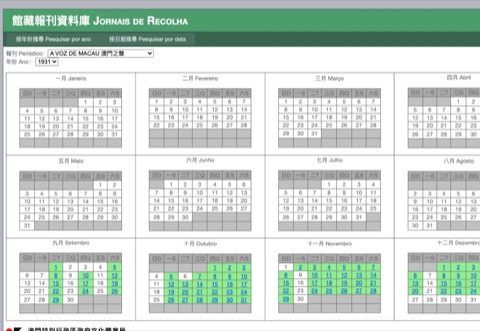
Archives & historical document databases
- Hong Kong Chronicles Institute – Hong Kong Chronicles e-book (香港地方志中心《香港志》电子书)The Hong Kong Chronicles Institute (香港地方志中心) is the body responsible for compiling the Hong Kong Chronicles (《香港志》). Its website provides the Hong Kong Chronicles as e-books and offers several content types, including articles, images, videos and audio. As seen on the site, the e-books are divided into 11 categories: General Survey, Chronicle of Events, Nature, Economy, Culture, Society, Politics, Biographies, Special Records, Appendices and Special Gazetteers, covering Hong Kong's natural environment, politics, economy, society, culture and notable persons. The site supports full-text search, with filters by section, Hong Kong Chronicles category and content type, sorting by publication date, and popular tags. Besides the e-books, it has sections such as 志在四方 (local gazetteer compilation elsewhere and links to local gazetteers), 志趣古今 (Hong Kong past and present, thematic articles, Chronicles Cinema), 志藏檔案 (oral history, images), 志在參與 (participation) and 志於我們 (about us); multimedia materials such as historical footage and audio records can give research more direct source material. The site is available in traditional Chinese and English. For readers studying Hong Kong's history and society and its links with South China and Nanyang, it is a systematic gateway to regional gazetteers and archives.
Coverage, how to use, and notes
Coverage Themes include Hong Kong's nature, politics, economy, society, culture and notable persons, organized into 11 categories; material types include articles, images, videos and audio. The site does not state the total number of volumes and only mentions that Hong Kong Chronicles: Nature has been published; please check the official site for the online status of other volumes.
How to use From the official homepage, click the entry for the Hong Kong Chronicles e-books, use full-text search, filter by section, category and content type (article, image, video, audio), and sort by date in ascending or descending order. You can also browse oral histories and images in 志藏檔案 and read thematic articles and videos in 志趣古今. The site also provides an application channel for using the Hong Kong Chronicles e-books for research or teaching purposes; please check the official site for the specific conditions.
Notes The site does not state whether the e-books are subject to fees or the conditions for reproduction; use for research or teaching requires application through the official channel. The online progress of each volume should be checked on the official site; the page is available only in traditional Chinese and English.
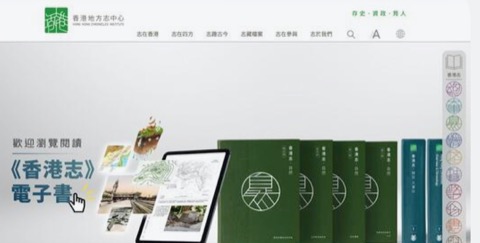
- Biblioteca Virtual de Macau (澳门虚拟图书馆)The Macao Virtual Library (澳門虛擬圖書館) is an online platform for Macao studies built and maintained by the Macao Foundation. According to the site, it was launched in 1999 as Macao's first online library and now uses big-data methods to integrate Macao publications, scholars and institutions researching Macao, and related academic news, serving as a cloud platform for Macao Studies (澳門學). The platform collects books, periodicals and papers related to Macao, with categories such as Subject Exploration and Classic Series, and the page states that thousands of Macao publications can be read in full text free of charge. Besides the book and periodical library, it has a scholars' section (scholar profiles and publications, with links to related disciplines or topics), institutions and organizations (local and overseas publishers, academic bodies and societies), academic news, online book exhibitions organized by theme, and sections for feature articles and book reviews, with an open call for contributions. For readers studying Hong Kong and Macao, South China, and Macao's Chinese society, it offers direct access to full texts and, through the linked information on scholars and institutions, a view of the networks and body of work in Macao studies. The site interface is available in traditional Chinese, simplified Chinese and Portuguese.
Coverage, how to use, and notes
Coverage Mainly Macao publications and books, periodicals and papers related to Macao studies, covering classic literature and more recent work across disciplines. The site says only 'thousands' and gives no exact number, and does not state the time span or language proportions; advanced search has a language field, so please refer to the official site.
How to use On the official homepage, enter a book or periodical title, article title, author or keyword in the search box; ticking the full-text collection option restricts the search to items readable in full. Advanced search supports combined queries by fields such as title, author/responsible party, publisher, publication date, language, keyword, abstract, series, category, copyright holder and ISBN/ISSN. The homepage also has popular searches and topic entries such as the Macao Basic Law, Macao Studies, One Country Two Systems and regional cooperation. From the scholars' section and institutions section, one can follow links to find other works by the same author or publisher. Reading full texts does not require visiting in person; whether registration is needed and whether downloads are allowed should be checked on the official site.
Notes Please refer to the official site for the size of the collection and the openness of each item; some materials may be subject to copyright restrictions. The content is centered on Macao, and materials directly related to Southeast Asia must be found by searching.
- HK GeoTiles (香港图砖——香港历史地图)HK GeoTiles (香港地圖磚服務) is an online service that converts historical maps and aerial imagery of Hong Kong into standard XYZ map tiles; its web map interface is labeled 香港圖磚——香港歷史地圖 (HK GeoTiles: Historical Maps of Hong Kong). According to the description, Hong Kong has a survey of the whole island drawn by the Royal Engineers in 1845, a 1904 boundary map of the Kowloon Peninsula and many postwar aerial photographs taken by the Hong Kong government, but these materials have long existed as static high-resolution map files of hundreds of MB or even several GB, which are hard for ordinary users and web developers to use directly. The service cuts these scanned maps into cloud tiles that load instantly, with the aim of being a digital public resource. The site footer states that the map data come from the Lands Department of Hong Kong and are openly licensed under CC BY 4.0; the site has map preview, datasets, API documentation and tutorials, the tutorials explain how to connect to QGIS, Leaflet and MapLibre GL JS, and a 1976 aerial imagery layer is listed, with the 1963 and 1982 layers marked as coming soon. For readers studying urban change, land use, ports and community space in Hong Kong, and Hong Kong's links with South China, it is a convenient tool for overlaying and comparing against modern base maps.
Coverage, how to use, and notes
Coverage According to the site, the map data come from the Lands Department of Hong Kong; a 1976 aerial imagery layer is listed, and the 1963 and 1982 layers are marked as coming soon. The 1845 island survey and the 1904 Kowloon boundary map are described in the introduction; for the full list, dates and number of layers, please refer to the Datasets page on the official site.
How to use Open the official site and use Map Preview to browse online, switching and overlaying historical layers from different periods against a modern base map. Developers and researchers can obtain XYZ tile URLs (in the format {z}/{x}/{y}) from the API documentation and connect to QGIS, Leaflet or MapLibre GL JS as described on the Tutorials page. Browsing requires no registration. When citing a layer, credit the Lands Department of Hong Kong as the data source and follow the attribution requirements of CC BY 4.0.
Notes During verification the subpages of the official site returned only titles, so the layer list and information on the builders could not be checked item by item; please refer to the official site. The tutorial states that the tiles are hosted on historicalwalkhk.com. Layers for some periods are not yet online.
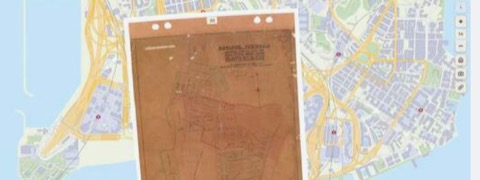
- Archives of Macao (Arquivo de Macau) – Online Catalogues and Official Gazette (澳门档案馆(档案目录与政府公报))The official website of the Macao Archives (formerly the Macao Historical Archives) provides online search entries for the archives catalogue, books catalogue, official gazette and Arquivos de Macau. Sections listed on the website include features of the archives, public records, overseas archives and videos, as well as the Official Gazette (1850-1999) and Arquivos de Macau (1929-1979). The site is available in traditional Chinese, simplified Chinese, Portuguese and English, and the home page also introduces special topics such as the archives of the Leal Senado (municipal council), photographs of Macao's cityscape, postcards of Macao and the Portuguese-speaking regions of Asia and Africa, and Chinese documents linked to Portuguese archival databases. Macao has been an important node in the maritime trade networks linking China with Portugal and Southeast Asia since the Ming and Qing periods; the official gazette reflects administration, decrees, personnel and social management, and is a useful reference for studying law and colonial administration in Portuguese Macao, Chinese society, cross-regional port networks and Sino-Portuguese relations. The books catalogue is provided on a separate subsite, so users can search first and then decide whether to visit in person.
Coverage, how to use, and notes
Coverage According to the website, online content includes the archives catalogue, books catalogue, Official Gazette (1850-1999) and Arquivos de Macau (1929-1979), plus sections such as overseas archives, public records and online exhibitions. For the total holdings and the specific dates and languages of each type of archive, please consult the website.
How to use Visit www.archives.gov.mo, choose a language version, then from the home page enter sections such as the Archives Catalogue, Books Catalogue (hosted at sls.archives.gov.mo) and the official gazette to search. The website also has a user guide section explaining search and usage rules. The opening hours listed on the website are Monday to Friday 09:30-18:30 and Saturday 13:00-18:00, closed on Sundays and Macao public holidays. Whether an appointment or registration is required, please consult the website.
Notes The website pages checked do not list the street address of the premises, so this entry is not listed as a physical site; before visiting, confirm the address and rules of use with the website or the archives. For the year range of the official gazette section, rely on what the website page indicates. There is a lot of Portuguese-language material, so it is advisable to search with both Portuguese and Chinese keywords.
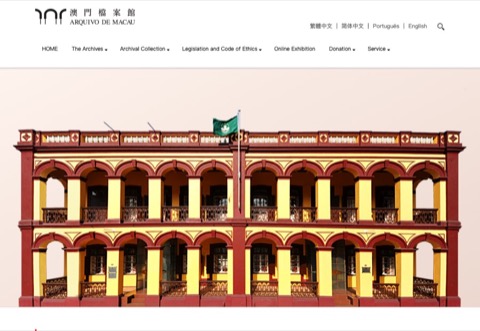
- Contemporary China Research Collection, HKBU Library (香港浸会大学图书馆当代中国研究馆藏)The Contemporary China Research Collection was established by the Hong Kong Baptist University Library in 1985, based on materials purchased from the Union Research Institute. Between 1950 and the 1970s, the Union Research Institute clipped about 230 Chinese-language newspapers and 40 periodicals published in mainland China, Hong Kong, Taiwan and Southeast Asia. The clippings are filed under broad subject headings, and many have been made into microfilm. The library's Special Collections and Archives now holds more than 4,000 pamphlets and over 3 million catalogued and indexed newspaper clippings and periodical articles. For researchers of the Nanyang, the Overseas Chinese subject file (1950–1971) and the Hong Kong and Macao file (1950–1973) can be used to trace how Chinese-language newspapers reported on and observed Southeast Asian Chinese society during the Cold War. Part of the indexes and original texts of this collection is searchable online through the library's Chinese clippings database; this entry introduces the overall collection behind it and other clipping indexes that can be consulted.
Coverage, how to use, and notes
Coverage According to the website, the clippings date mainly from 1950 to the 1970s. Indexed database subjects include: Overseas Chinese (1950–1971), Hong Kong and Macao (1950–1973), Higher Education in China (1950–1954), Taiwan Cultural Issues (1950–1954), and Contemporary China (1992–1998), which the library collected itself. The Chinese clippings database has indexed more than 200,000 clippings, with original texts provided online where copyright permits. The website states that the clippings come from Southeast Asian publications but does not list the individual Southeast Asian newspapers.
How to use Enter through the collection page on the website, where you can view the subject list and the microfilm list (PDF) and go on to the Chinese clippings database to search. Only texts with copyright permission are available online; for the rest, consult Special Collections and Archives. The website page does not state the physical address or the appointment procedure; please confirm through the library's Ask a Librarian service or contact page.
Notes This entry belongs to the same collection system as the Chinese clippings database already included on this site; please note that the online database is only part of the overall clippings collection. The specific titles and number of Southeast Asian newspapers are not listed on the website; please refer to the website.
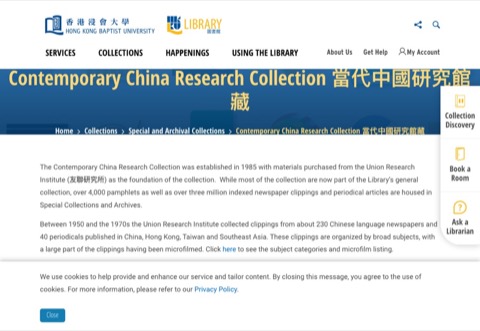
- Hong Kong History Digital Resources (HKU Libraries Special Collections) (香港历史数字资源(港大图书馆特藏))This is a guide page to digital resources on Hong Kong history compiled by the Special Collections of the University of Hong Kong Libraries. It brings together in-house databases, third-party databases and freely accessible open links, and is a practical entry point for research on Hong Kong source materials. The page has two parts: Databases and Open Access Links. The in-house databases include: Basic Law Drafting History Online (four of its sub-databases are open to the public free of charge); Hong Kong Laws Online of successive revised editions (1890, 1901, 1912, 1923, 1937, 1950 and 1964 editions, the 1964 edition updated to 1989); Hong Kong Government Reports Online (pre-war administrative reports, Legislative Council papers, proceedings, gazettes, Blue Books and so on); Hong Kong Journals Online; the Hong Kong War Crimes Trials Collection (46 trials, 123 defendants); the Luke Him Sau Architectural Collection (about 950 drawings relating to Hong Kong, Shanghai, Guangzhou, Macao and Taiwan); and more than 250 Chinese and English e-books from before 1950. The open links point to external resources such as Hong Kong Memory, Hong Kong Old Newspapers, the Hong Kong Literature Database and Gwulo. For readers working on colonial administration, legal history and Chinese society, this page saves the time of locating each entry point separately.
Coverage, how to use, and notes
Coverage The databases listed on the website cover types such as law, government documents, periodicals, war trials, architectural drawings and e-books, mainly from the mid-nineteenth to the twentieth century; the exact start and end years and size of each database should be checked on the corresponding page. The page also lists links to several external open resources.
How to use Enter from lib.hku.hk/hkspc/digital.html and choose a database by name; some entries give only a link to a catalogue. Click through to the sub-database page to search or browse. Databases marked on the page as HKU access only (such as Hong Kong Newspaper Clippings Online and The Last Governor Online) cannot be used by readers off campus.
Notes Some of the databases are restricted to HKU access, and a few entries give only a catalogue link. The website gives the year range of the government reports in two different ways (1853-1941 and 1842-1941); please check the page of each database.
- Hong Kong Memory (香港记忆)Hong Kong Memory is a website presenting Hong Kong's cultural heritage content; its footer shows that it is managed by the Leisure and Cultural Services Department. The homepage is in Traditional Chinese and has sections for thematic special collections, featured content, an interactive map and a site map, together with search and advanced search. The site gathers images, documents and other materials by theme, making it possible to approach the material through local, community and life-history perspectives. For the study of Southeast Asian Chinese and regional studies, its themes on Hong Kong civil society, Cantonese opera and popular culture, urban life and historical images can be compared with the Chinese societies and cultural history of Malaysia, Singapore and elsewhere, and it also serves as an entry point to Hong Kong's local history and social culture. Note that the homepage is mainly for thematic display and browsing, and is oriented toward cultural heritage and public history materials. It is not a repository of government documents or legal texts, and is best used alongside primary official sources such as government archives and gazettes.
Coverage, how to use, and notes
Coverage The homepage lists sections such as thematic special collections, featured content and an interactive map. The number of themes, the chronological span, the languages and the total volume of materials are not stated on the pages checked; please refer to the official website.
How to use After opening www.hkmemory.hk, use search and advanced search, or browse through the special collections, featured content or the interactive map. The pages offer day/night mode, font size adjustment and share buttons. Whether registration is required, whether downloading is possible, and the copyright rules for each item should be checked on the relevant thematic pages of the official website.
Notes Some homepage content is template text and the information on the page is limited; sub-pages such as About Us could not be opened for verification, so details on the sponsoring and partner institutions should be checked on the official website. The content is oriented toward cultural heritage display; when citing, follow the source and copyright statements on each thematic page.
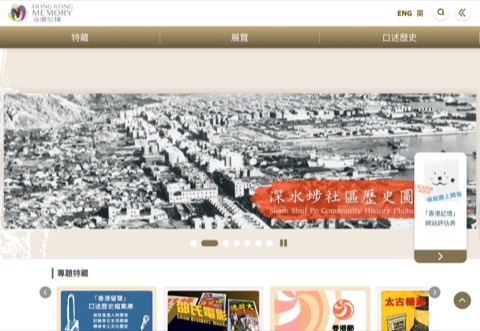
- Hong Kong Oral History Archives: Collective Memories (HKU Libraries) (香港口述历史档案:集体回忆(香港大学图书馆))The Hong Kong Oral History Archives are the outcome of an oral history project jointly run by the Centre of Asian Studies and the Department of Sociology of the University of Hong Kong, and the search entry is now provided through the digitisation project page of the University of Hong Kong Libraries. Between 2001 and 2004 the project completed about 200 oral history interviews (the English version of the website says over 200, the Chinese version says about 200). The interviewees come from different trades, ethnic groups, occupations and communities, and the content covers family, education, employment, migration, marriage and community life, and also includes people who experienced historical events first-hand. The search page is bilingual in Chinese and English; records can be searched by keyword or browsed by theme, with 10, 20 or 50 records displayed per page. For readers studying postwar Hong Kong social history, migration and family, trades and associations, and education and community life, it is one of the oral history sources commonly used in the field, and can also be used in comparison with oral history projects in Malaysia, Singapore and elsewhere.
Coverage, how to use, and notes
Coverage About 200 Hong Kong oral history interviews collected between 2001 and 2004, with interviewees from various trades, ethnic groups, occupations and communities; the content includes family, education, employment, migration, marriage, community life and first-hand experience of major historical events. The website pages are bilingual, but the languages used in the interviews are not stated; the language of each interview and the forms of material available should be checked on the record page.
How to use On the website, enter keywords in the search box (such as migration or women), or look up themes on the theme browsing page, then open an individual interview record. The website states that the archives are for academic, educational and non-profit use only, and the licensing terms prohibit excessive downloading. Whether recordings and transcripts can be consulted only on the premises should be checked against the statements on the website and the University of Hong Kong Libraries Special Collections; questions can be sent by email to the address on the website contact page.
Notes Use is restricted to academic, educational and non-profit purposes; please comply with the website statement, and when citing an interview give the project name, the interviewee and the reference number. The website also has a mirror address; it is advisable to rely on the pages at sunzi.lib.hku.hk.
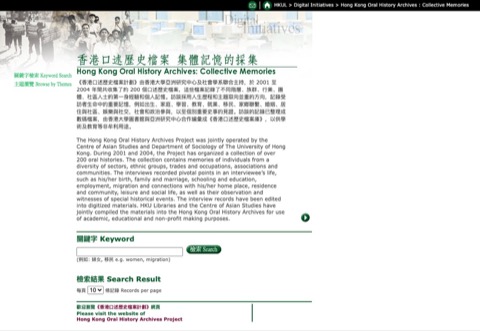
- Macao Memory (澳门记忆)Macao Memory is a large-scale cultural preservation project run by the Macao Foundation, together with its companion cultural and historical website. The website states that its aim is to collect and organise historical and cultural materials of Macao scattered in various places from ancient times to the present, digitise them for permanent preservation, and thereby promote the sharing of collective memory, public participation and academic research. The content is presented in multimedia form, covering archival documents, maps, newspapers and periodicals, calligraphy and paintings, photographs, postcards, stamps, songs, documentaries and interviews, in text, image, audio and video. The site is divided into sections such as Explore Macao, Selected Collections, Thematic Exhibitions and Interactive Zone. The interface is available in Traditional Chinese, Simplified Chinese and Portuguese, and the collections include Chinese and Portuguese materials as well as materials in other languages, such as early books. For readers studying Macao history, Sino-Portuguese relations, Macao's Chinese society and associations, and modern urban change, it brings scattered images, maps, newspapers and oral materials together in one searchable entry point, and is also suitable for comparison with studies of Hong Kong and Southeast Asian port cities.
Coverage, how to use, and notes
Coverage Macao-themed; includes archival documents, maps, newspapers and periodicals, calligraphy and paintings, photographs, postcards, stamps, songs, documentaries and interviews, presented as text, images, audio and video. Includes Chinese, Portuguese and other-language materials. The website does not publish the total number of items or the chronological range; please refer to the individual thematic and collection pages.
How to use Visitors can browse directly as guests without logging in. The site offers registration by email or mobile number; registered members must agree to the terms of use, the membership charter and the authorisation terms, and can take part in interactive features such as quiz games, image calls and voting. To find materials, browse by category under Explore Macao, enter Selected Collections or Thematic Exhibitions, or use the site search. When citing, record the item title, the provider and the page address, and note the authorisation statement of each item.
Notes The website's terms of service were revised with effect from 28 April 2025; please read the latest terms before reproducing or reusing content. Copyright ownership differs among items; please follow the statement on each item page.
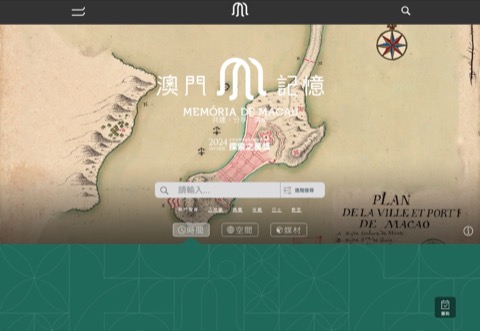
Scholarly databases & search tools
- Hong Kong Writers and Artists Biographical Database (HKBDB) (香港作家及艺术家传记资料库)The Hong Kong Biographical Database of Writers and Artists (HKBDB) was built by The Chinese University of Hong Kong Library as an extension of its Hong Kong Literature Database. Centered on figures in Hong Kong literature and the arts, it uses knowledge-graph and linked-data methods to organize biographies, pen names, organizations, places and events into structured data, with accompanying visualization tools. According to the description, as of May 2022 the database held about 125,000 personal names and 16,000 organization names, with data sources including Hong Kong Classical Poetry and Prose Collections: A Survey (香港古典詩文集經眼錄) and Biographical Sketches of Hong Kong Literary Writers (香港文學作家傳略). Users can search by name or browse by biographical category, and use features such as chronologies, social network graphs and family trees to view teacher-student, social and collaborative relationships among writers and artists from different angles. In the case of Jin Yong, for example, the person page leads to the original text of his 1952 translations. For readers studying Hong Kong literature, periodicals and networks of cultural figures, it is both a tool for checking basic biographical information and a way to trace connections between Hong Kong and the cultural circles of South China and Nanyang. Note that the text on the official homepage could not be read during verification; the figures and features above come from descriptive materials, so please refer to the official site.
Coverage, how to use, and notes
Coverage Mainly Hong Kong writers, artists and related organizations, together with authors of classical poetry and prose. According to the description, as of May 2022 it held 124,706 personal names and 16,174 organization names, with 1,796,773 named entities and 14,223,040 pieces of linked information in total; data sources include Hong Kong Classical Poetry and Prose Collections: A Survey and Biographical Sketches of Hong Kong Literary Writers. These figures may have been updated since; please refer to the official site. The interface is available in Chinese and English.
How to use Open the official homepage, choose a search type (such as person) to the left of the search box, and enter a name or pen name. On a person page, browse by biographical category and use the chronology, social network graph and family tree functions to view relationships; the homepage also has entries for popular searches, featured writers and artists, writers' manuscripts and selected works. You can look up a person first and then follow leads to works or documents back to the original sources. Whether bulk download or export is supported should be checked on the official site.
Notes When the beta version was released in 2022, access was restricted to the campus network or VPN; current access conditions could not be verified on the official site, so if the site cannot be opened, please check the notice from The Chinese University of Hong Kong Library. The figures are from 2022 and may have changed since.
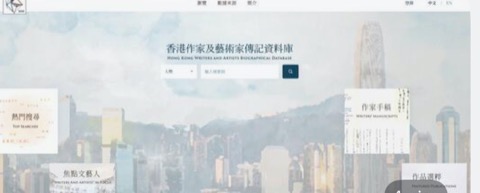
- Hong Kong Academic Library Link (HKALL) (港书网)HKALL (港書網) is a union catalog search and book-lending service operated by the Joint University Librarians Advisory Committee (JULAC) of Hong Kong, covering the libraries of eight University Grants Committee-funded universities. Through a single search interface, readers can query the book holdings of all member libraries at once and request loans of print books that their own library does not hold from other member libraries. According to JULAC, the holdings exceed 5 million titles, and it was among the first such projects to include a large number of Chinese-language books; requested books are generally delivered to the reader's own library for borrowing within 24 hours. This is especially useful for scholars of Hong Kong history, Chinese society, South China and Nanyang, since the Chinese-language and area-studies collections of the member universities can be compared on a single platform. Staff and students of the eight universities can visit each member library with a JULAC card. Non-member readers can first find holdings in the system, then, following the rules of each library, email the librarian of the holding library with a letter of introduction to apply for a temporary reading pass; according to the description, the University of Hong Kong generally approves temporary passes within one to two working days, valid for no more than one week and no more than one week in total within a year, and longer use requires a separate application for Circle of Friends. Please refer to each library's official site for specific policies.
Coverage, how to use, and notes
Coverage Print books in the libraries of eight University Grants Committee-funded universities in Hong Kong, with holdings of over 5 million titles (according to JULAC), including a large number of Chinese-language books. For the proportion of languages and updates, please refer to the official site.
How to use Enter the search interface from the HKALL page on the JULAC website, and search by keyword or use advanced search. Searching requires no login; after logging in, members can submit book requests and access their own university's online resources. Requested books are delivered to the member's own library. Off-campus readers can, after confirming holdings in the search, email the librarian of the holding library according to its rules to apply for a temporary reading pass; requirements differ among libraries, so please read their official sites first.
Notes The lending service is open only to staff and students of the eight member universities; off-campus readers can only search the catalog, and on-site use requires a separate, time-limited application. The system may change as the JULAC shared system is upgraded; please refer to the official site.
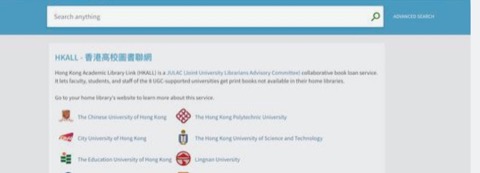
- DATA.GOV.HK (Open Data Portal, Digital Policy Office) (香港政府数据一线通(开放数据平台))DATA.GOV.HK is the official open data portal of the Government of the Hong Kong Special Administrative Region, developed and supported by the Digital Policy Office, which registers in one place the datasets made public by government departments and public bodies. The website provides a dataset search box, popular keywords, browsing by provider, and 20 topic categories, among which the Population category is the main entry for finding census and population statistics data. The main tables of the Census and Statistics Department's 2021 Population Census, district statistics, and the Build Your Own Tables service are all registered on the platform, with downloadable data files such as CSV; there are also API descriptions and a CKAN API guide for developers, and an RSS feed of files added or updated in the last 14 days. For researchers of population, ethnic groups, households, and urban space, its advantage is that structured data from many departments can be searched in one place, and metadata such as provider, update frequency, and format can be seen on dataset pages, which facilitates bulk retrieval and reuse.
Coverage, how to use, and notes
Coverage It covers data published by government departments, in 20 topic categories, including population, education, housing, employment and labour, community and social welfare, development and geographic and land information, and elections and legislation. The homepage does not show the specific numbers of datasets and providers; please refer to the website. Population datasets include census tables of the Census and Statistics Department (in Chinese and English versions).
How to use Enter keywords (such as census, population, ethnic) in the homepage search box, or go to Datasets or Providers to browse by agency, or go directly to the Population category. On a dataset page you can see the resource list, language versions, and formats, and can generally download directly. No registration is required. Please read the website's Terms and Conditions before use. For programmatic access, refer to the website's API description.
Notes Not all datasets are raw microdata; census datasets are mostly aggregate tables. The data file of some entries may merely be a link to an external tool (for example, the resource registered under Build Your Own Tables points to the census website). For the licensing conditions of each dataset, please refer to the platform terms and the individual dataset page.
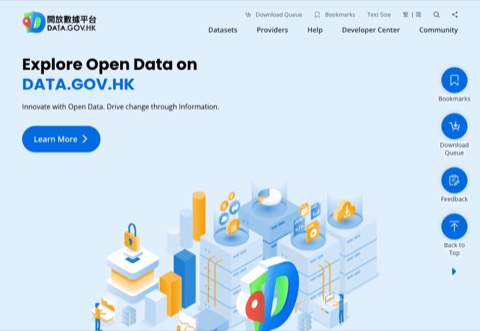
- Documentation of Christianity in Hong Kong Database (香港基督教文献数据库)This is a free online project built by the Hong Kong Baptist University Library for educational and research use. It is an index of where documents are held rather than a full-text collection: it records where primary sources and publications on Christianity in Hong Kong are located, and the official description gives its size as 500 documents. For readers studying Hong Kong churches, congregations and Christian organizations, its value lies in letting them quickly determine, by denomination, church body, congregation or institution, and holding location, where a given type of primary source is held, and then contact the relevant institution or approach it through the Baptist University Library's special collections. The database page offers basic and advanced search, with search fields including title, document type, subject, sub-subject, source denomination, source church body, source congregation or institution, location, publication year, language and remarks. It is suitable for preliminary scoping at the start of research on church or community history.
Coverage, how to use, and notes
Coverage Holding leads for 500 primary sources and publications on Christianity in Hong Kong. The official announcement does not clearly state the date range or language distribution; please check the database page.
How to use Enter the search page (the search system under libproject.hkbu.edu.hk) through the link given on the Baptist University Library announcement page, and use basic search or advanced search by denomination, congregation, location, publication year and other fields. Once a lead is found, contact the relevant institution according to the holding location in the record. Whether records can be exported depends on the page's functions; please check the page.
Notes This is an index, not full text; it only tells readers where materials are held. The announcement was published in 2013; please check the official website for the database's update status.
- Multi-function Chinese Character Database (汉语多功能字库)The Multi-function Chinese Character Database was built by the Research Centre for Humanities Computing at The Chinese University of Hong Kong. It is an online character database for teaching and research on Chinese characters and the Chinese language, launched in July 2014, with an enhanced version released in summer 2018. The website states that it provides information on character form, structure, origin and meaning, and allows filtering by Cantonese and Mandarin initials, finals and tones. It also includes tables of Cantonese syllables, initials and finals, is compatible with several romanization systems, and lists readings in other dialects. The centre's earlier resources, such as the Cantonese pronunciation and word-matching character database, belong to the same line of development. For readers studying Cantonese pronunciation, character forms and dialect characters, it is a rare database searchable directly by Cantonese phonology. It can also be used together with oracle bone and bronze inscription forms and the full-text search of the Shuowen Jiezi, and suits research in paleography and dialectology.
Coverage, how to use, and notes
Coverage The site offers All Characters and Common Characters views; the website does not give the total number of characters. Content includes ancient character forms (oracle bone, bronze inscriptions and component tables), component trees, explanations of form and meaning, full-text search of the Shuowen Jiezi, geographical text search of the Dushi Fangyu Jiyao, an idiom compilation, traditional-simplified conversion tables and readings in other dialects, with English-Chinese lookup.
How to use On the website, you can filter by Cantonese or Mandarin initial, final and tone, or use the radical index, stroke index, advanced search, Shuowen Jiezi full-text search and English-Chinese lookup. No login is required. When using the results, please note the website's copyright statement (the pages are marked all rights reserved).
Notes The website does not state licensing terms, so please contact the host institution before bulk use or reproduction. Some older pages (such as the old page of the Cantonese pronunciation and word-matching character database) use Big5 encoding, and browsers may display garbled text.
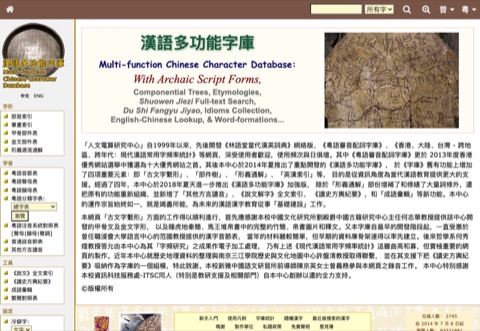
- The Corpus of Mid-20th Century Hong Kong Cantonese (HKCC) (二十世纪中叶香港粤语语料库)This corpus was built by The Education University of Hong Kong. It is based on the dialogue of mid-twentieth-century Hong Kong Cantonese films and is a dedicated resource for studying early modern spoken Cantonese, lexical change and grammatical development. According to the project website, the first phase was developed in 2012 with internal funding from the then Hong Kong Institute of Education, and the second phase in 2013 with support from the Research Grants Council's Early Career Scheme. The dialogue was transcribed into Chinese characters with ELAN, segmented, tagged for part of speech word by word, and annotated with Jyutping for each character. The search function supports full-text search and combined pattern search by character, Jyutping and part-of-speech tag, and there are browsable lists of words, characters, actors and films. For readers comparing postwar and contemporary Cantonese, or studying film speech, loanwords and written forms of Cantonese, this is a rare directly searchable corpus of historical spoken Cantonese.
Coverage, how to use, and notes
Coverage The website states that the second phase transcribed 60 films, with about 770,000 word tokens. The university's digital humanities outputs page states that the first phase has about 200,000 words from 21 Cantonese films made in Hong Kong in the 1950s, and that the two phases together cover 81 films. The two pages use different units of measurement and give no single unified total. The website does not state the exact range of years; please refer to the website.
How to use Access the corpus through the website (v2). You can use full-text search or word-pattern search, and browse by word, character, actor and film. The page has a My Account entry; whether registration is required is to be confirmed on the website. The first phase has a separate site, and its link can be found on the website. When citing, please consult the website's introduction page and the related publications.
Notes The corpus is drawn from film dialogue, so scripted lines differ from natural speech. The website does not give a standard citation format.
- UML Digital Resources Hub (University of Macau Library) (澳门大学图书馆数字资源平台(含澳门期刊论文索引与澳门报章新闻剪报索引))The University of Macau Library's digital resources platform focuses on Macao studies and brings together digital collections and indexes. The periodical-related ones are the Index to Macao Journal Articles, the Index to Macao Newspaper Clippings and the Title Index of the Macao Daily News Xuehai Edition. The Index to Macao Journal Articles lists publication details such as title, author, volume and issue, and pages for each article; one page of results shows titles in Chinese, English and Portuguese, and the page displays 59,182 results in total. The platform also includes collections such as rare books, Republican-era books from Guangdong, Hong Kong and Macao, and early sinology materials. For research on the Nanyang Chinese and regional studies, the Macao journal article and newspaper clipping indexes help locate material on Macao's Chinese society, overseas Chinese affairs, education and Sino-Portuguese relations, and are an important supplement for periodical searching in Hong Kong and Macao.
Coverage, how to use, and notes
Coverage The platform homepage lists three periodical-related indexes: the Index to Macao Journal Articles, the Index to Macao Newspaper Clippings and the Title Index of the Macao Daily News Xuehai Edition. The journal article index page shows 59,182 results with titles in Chinese, English and Portuguese. The start and end years and subject scope of each index are not stated on the homepage; other University of Macau Library pages have given the clippings index as covering 1988 to 1997, but please consult the official site. The Xuehai Edition index is a title index only, not full text of the newspaper.
How to use Go to libdigital.um.edu.mo and find the indexes under tabs such as Macao Studies and News. The journal article index can be browsed by journal title, author, issue date or article title, and sorted by title, author, date or publication information. The page does not show a login requirement. Most entries contain citation data only; when the full text is needed, look it up in the relevant collection or journal using the entry information.
Notes These are mainly indexes and generally do not provide full newspaper text; the date field is empty in some records; please check the coverage years and access rights of each sub-database page by page.
- words.hk Cantonese Dictionary (words.hk 粵典)words.hk (粵典) is an online Cantonese dictionary offering dictionary lookup, resource downloads and the accompanying Cantonese corpus section (粵文庫), as well as an English version, CantoWords. According to a 2022 paper in the ACL Anthology, the dictionary dataset contains more than 53,000 Cantonese entries, compiled by Chaak-ming Lau, Grace Wing-yan Chan, Raymond Ka-wai Tse and Lilian Suet-ying Chan through seven years of manual annotation; each entry includes Jyutping, part of speech, definition, English translation and example sentences. The site's data download page provides character frequencies, word frequencies, character-pronunciation tables, an entry table and an English index in JSON and CSV formats; the page states that the data are in the public domain and requires attribution. For researchers working on Hong Kong Cantonese vocabulary, written Cantonese and Cantonese natural language processing, it is both a lookup tool and an open lexical data source that can be obtained in bulk.
Coverage, how to use, and notes
Coverage More than 53,000 Cantonese entries (according to the 2022 paper; please check the website for current figures), with Jyutping, part of speech, definition, English translation and example sentences. The download page provides a character frequency table, a word frequency table, a character-pronunciation table, an entry table and an English index; the word frequencies cover only words that appear in the Cantonese corpus.
How to use Use the dictionary lookup on the homepage to search for characters and words; download JSON or CSV data from the site's resources or data page. The data page requires attribution to words.hk. The site has a user login function, but lookup and download pages do not require login.
Notes Neither the homepage nor the data page states who operates the site; please check the site's About page. Entries containing variant characters are marked with an asterisk in the data.
Research methods & tools
- Hong Kong Studies (EdUHK Library Subject Guide) (香港研究指南(香港教育大学图书馆))A Hong Kong studies subject guide built by the Education University of Hong Kong Library for the Department of Literature and Cultural Studies, classified under social sciences and maintained by the department's subject librarian, who welcomes suggestions from readers on topics or resources for Hong Kong studies. The homepage says the guide aims to provide useful, high-quality and up-to-date information. The content is divided into five subpages: books and e-books, journals, databases and articles, reference materials, and internet resources; topic tags cover Hong Kong culture, economy, history, politics and One Country, Two Systems. The homepage also mentions an oral history project. For readers who need to work through the Hong Kong studies literature step by step, from books and journals to databases and web resources, the guide offers a clear search path.
Coverage, how to use, and notes
Coverage Takes Hong Kong studies as its theme, covering culture, economy, history, politics and more. The homepage does not list specific resource names or quantities; for each type of resource, please see the corresponding subpage.
How to use After opening the official page, browse by the tabs at the top: Books and EBooks, Journals, Databases and Articles, Reference Materials, Internet Resources. The guide can be browsed without logging in; the library offers telephone, WhatsApp and Ask a Librarian enquiries, and contact details are on the official website.
Notes The homepage itself does not list specific resources, so each page must be browsed in turn; subscription databases and e-books may be limited to EdUHK staff and students; please check the official website.
- Hong Kong Studies (Hang Seng University of Hong Kong Library) (香港研究指南(香港恒生大学图书馆))An introductory guide to Hong Kong studies published by the Hang Seng University of Hong Kong Library, built on the LibApps platform and suited to readers new to Hong Kong studies who want to build a basic background framework. The homepage outlines Hong Kong's status as a Special Administrative Region, including its cession to Britain in 1842 and its return to China on 1 July 1997, and provides an entry for searching the library catalogue by subject term. The subpages cover the political and economic situation, the legal system, Hong Kong culture, Hong Kong history and research methods. The resources section lists statistical and yearbook resources such as the Hong Kong Annual Digest of Statistics, Hong Kong in Figures and the Hong Kong Yearbook, as well as profile materials from United Nations bodies, the Hong Kong government and the Hong Kong Trade Development Council, and country reports from various governments and international organizations. The guide is concise and better suited as a starting point for learning about Hong Kong's basic situation and finding background and statistical materials.
Coverage, how to use, and notes
Coverage Covers Hong Kong's geography, political economy, legal system, culture, history and research methods. The subject-term search is organized by topic (such as politics, education, tourism), period (19th century to post-1997) and area (Hong Kong Island, Kowloon, New Territories). For the size of the holdings, please check the official website.
How to use After opening the official page, read the homepage overview first, then enter the subpages. The 'Subject Term' section on the homepage links to the library's Primo catalogue, where you can search directly by topic, period and area. The guide itself can be browsed without logging in.
Notes The guide is introductory in nature with few primary sources; access to the full text of items found through the catalogue depends on Hang Seng University permissions; please check the official website.
- Jyutping Cantonese Romanization Scheme (Linguistic Society of Hong Kong) (香港语言学学会粤语拼音方案(粤拼))Jyutping is a Cantonese romanization scheme designed and released by the Linguistic Society of Hong Kong (LSHK), finalized at the end of 1993 after about a year of discussion. The scheme uses only letters and numerals, with no diacritics, so it can also serve as a Chinese computer input method, and it is now one of the most commonly used transcription standards in Cantonese dictionaries, corpora and teaching materials. The website page lists correspondence tables for initials, nuclei, codas, syllabic consonants and tones, with example characters, and provides a PDF of the finals table and the extended finals list (a and oet were added in 2018) as well as links to related FAQs. LSHK has a Jyutping working group responsible for maintaining and promoting the scheme and issuing guidance, such as the 2022 statement that tone numbers should be written as ordinary ASCII digits rather than superscript or subscript. Researchers reading or building Cantonese corpora and checking pronunciation annotations can rely on this official scheme.
Coverage, how to use, and notes
Coverage The page covers the full correspondence tables for Jyutping initials, nuclei, codas, syllabic consonants and tones. Tones are marked 1 to 6, for example fu1; the zero initial is left unmarked, for example aa. The website lists no word lists or audio.
How to use Browse the scheme pages on the website directly to consult the tables and PDF files. When annotating a corpus, you can standardize the format by placing the tone number at the end of each syllable. For special finals, see the extended finals PDF and the working group statements on the page. No registration is required.
Notes It is a transcription standard, not a dictionary or corpus. The page itself offers no character or word lookup and no audio; to look up characters, use it together with a character database or corpus.
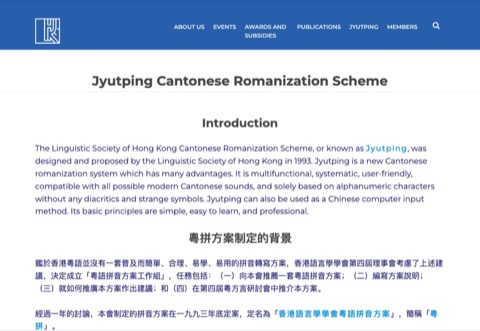
- LIVAC Synchronous Corpus of Chinese (LIVAC 汉语共时语料库)LIVAC is a corpus for comparing word usage across Chinese-speaking communities; the current interface on the official website is LIVAC 4.0. According to a City University of Hong Kong press release, it was developed by the university's Department of Translation and Linguistics and has operated continuously since 1995, covering print news media in places including Beijing, Hong Kong, Macao, Shanghai, Singapore and Taiwan; each year the university publishes a list of new Chinese words across the Chinese-speaking regions based on it. The query interface on the website allows comparison of the distribution and ranking of general words, personal names, place names, proper nouns, nicknames, loanwords and numbers across Beijing, Hong Kong and Taipei, for two periods, 1995–99 and 2015–19. For scholars studying the lexical features of written Chinese in Hong Kong and Macao and its differences from other Chinese-speaking regions, it is one of the few resources allowing cross-regional and cross-period comparison.
Coverage, how to use, and notes
Coverage The website interface shows: Beijing, Hong Kong and Taipei; two periods, 1995–99 and 2015–19; categories including general words, personal names, place names, proper nouns, nicknames, loanwords and numbers. Whether data for other regions (including Macao) and more years are openly available online, please check the official website.
How to use Open the website, select a region and period, and filter by word category to see the percentage distribution and ranking of each word across regions. The interface does not show any registration requirement or download/export function; please check the official website.
Notes The website homepage does not state the maintaining body or terms of use; information on the developing institution comes from a City University of Hong Kong press release. Corpus size figures are not stated on the website and so are not listed. Another page at nlp.chilin.hk returned 503 when checked.
- Law Guide: Hong Kong (HKU Libraries) (法律指南:香港(香港大学图书馆))The Hong Kong page of the Law Guide of the University of Hong Kong Libraries systematically lists ways to find Hong Kong case law, legislation and related background materials; the page shows its most recent update as 23 October 2026. The guide divides resources into case law (library law report series and digests, the Judiciary's judgments website, the Basic Law case database), legislation (Laws of Hong Kong, the Government Gazette, encyclopedic materials, the Electronic Legislation database, the Legislative Council bills database and Hansard, etc.), and historical and digital resources (Historical Laws of Hong Kong Online, Hong Kong Government Reports Online, Basic Law Drafting History Online). Many of these are official or open resources, such as HKLII, the Hong Kong e-Legislation database, the Judiciary website and the official Basic Law website. For readers studying the Hong Kong legal system, the Basic Law and colonial-period legislation, it helps quickly identify which type of source to use.
Coverage, how to use, and notes
Coverage Covers Hong Kong case law, legislation, gazettes, the Basic Law and related historical materials. The main tools listed on the page include Lexis+ Hong Kong, Westlaw Asia (subscription), HKLII, Hong Kong e-Legislation, the Judiciary's judgments website, the Basic Law case database (Chinese only), Historical Laws of Hong Kong Online, Hong Kong Government Reports Online and Basic Law Drafting History Online. For specific date ranges, please check each resource's website.
How to use Open the official page and click the links in the sections for case law, legislation, the Basic Law and historical digital resources. HKLII, Hong Kong e-Legislation, the Judiciary website and the official Basic Law website are public sites that can be used directly; Lexis+ Hong Kong and Westlaw Asia are available remotely only to HKU staff and students. The guide also provides FIND@HKUL search tips and an introduction to the Hong Kong legal system.
Notes Not all judgments are posted on the Judiciary website; copies of the rest can be requested from the court registry, possibly for a fee. The Basic Law case database is available in Chinese only. Subscription databases require HKU access.
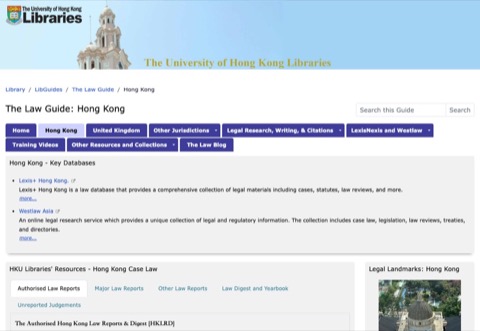
- PyCantonese (PyCantonese(粤语语言学与自然语言处理Python库))PyCantonese is an open-source Python library for Cantonese linguistics and natural language processing, developed by Jackson L. Lee. The official documentation states that it can be used to access and search corpus data, parse Jyutping, perform word segmentation and part-of-speech tagging, and offers several conversion tools, including characters to Jyutping, Jyutping to IPA, Jyutping to and from Yale romanization, Jyutping to TIPA, and character-to-pronunciation conversion. The bundled data includes the Hong Kong Cantonese Corpus (CC BY), which can be used directly for search practice and analysis. For Cantonese text analysis, phonetics research and teaching digital humanities methods, it lowers the barrier to processing Cantonese text, since researchers do not need to build their own segmentation and transcription pipelines. The official documentation gives the current version as v4.0.0 (March 2026), under the MIT license.
Coverage, how to use, and notes
Coverage Tool functions cover corpus reading and search, Jyutping parsing and conversion, word segmentation, part-of-speech tagging and stopword handling. The bundled datasets each have their own licenses; the types mentioned in the documentation include CC BY 4.0, GPL-3.0 and CC0 1.0. For the scope and size of the data, please refer to the official documentation.
How to use Install with pip install pycantonese, uv add pycantonese or conda; in JavaScript environments it can be used via Pyodide. Basic knowledge of Python is needed. The documentation pages provide descriptions and examples for each function. No registration is required, and the code and data can be downloaded and used directly.
Notes Python skills are required. Each dataset has a different license, so please check the license notes in the documentation before citing or redistributing. Versions are updated quickly, so please refer to the current documentation for features.
- hkmaps.hk (Hong Kong Historical Spatial Data Platform) (香港历史空间数据平台(hkmaps.hk))hkmaps.hk is a spatial data platform for Hong Kong historical research. It overlays georeferenced historical maps, aerial photographs, street maps and nautical charts on modern base maps for comparison, and uses a single search box to find contemporary place names, historical records and lots. The platform was built by the Spatial History Project of the Department of History at Hong Kong Baptist University in cooperation with the Government Records Service (GRS) of Hong Kong, Hong Kong Historic Maps and Mapping Hong Kong History. It is one of the outputs of the Research Grants Council-funded Hong Kong Historical Spatial Data Project and a development of the Historic Map Hong Kong project launched in 2016. Baptist University provides the technical infrastructure and historical GIS (HGIS) development, and the GRS assists with content and archival foundations. For urban history, the history of land and property rights, coastline change, and neighbourhood and community studies, it allows readers to compare the same location across different periods directly, combined with the 1938 street index and the property registration records of the wartime Japanese occupation. Its methods and data forms can also serve as a reference for historical GIS studies of Southeast Asian port cities.
Coverage, how to use, and notes
Coverage The website lists: maps from the 18th century to the 1980s (mostly at 1:5,000 or larger scales); aerial photographs from 1924 to 1982 (some colourised with artificial intelligence); pre-1997 government street maps (usually 1:600 or 1:1,200); historical nautical charts of Hong Kong waters; land records such as land grants, the 1938 street index, and property registration records of the Japanese occupation from 1942 to 1944; and overlay layers such as historical coastlines and old street names. The total number of maps is not stated on the website.
How to use Visit the website directly, enter a modern place name, an old place name or a lot number in the unified search box, then overlay historical maps or aerial photographs on the base map and compare them using transparency. The website states that there is a free version offering core functions, and a professional version adding measurement tools, a personal cloud workspace, and export and sharing functions. Use constitutes acceptance of the terms, which are provided in English only.
Notes The historical data are for archival research and general visualisation only; they are not certified survey products, a basis for statutory boundaries, or a navigation tool. Some maps are subject to copyright restrictions; the terms state that pre-1997 British government maps are generally limited to those published more than 50 years ago, unless they come from CSDI or the GRS. Cloud storage of user-uploaded data is not a permanent archive, and users must keep their own backups. The terms take effect from 1 September 2026; please read the latest version.
Libraries & archives
- Chinese Overseas Collection, The Chinese University of Hong Kong Library (香港中文大学图书馆海外华人特藏)The Chinese University of Hong Kong Library has a Chinese Overseas Collection on the 3rd floor of the University Library. The collection originated from the Overseas Chinese Resource Room of the university's Centre for Overseas Chinese Studies (1983–2000) and was merged into the library's core collection in 2002. According to the collection guide, the center's research team paid particular attention to gathering materials on Chinese in Southeast Asia and on their ancestral home communities (qiaoxiang), and the guide includes a thematic section on Southeast Asian Chinese during the Pacific War. For readers studying Nanyang Chinese society, links between overseas Chinese and qiaoxiang, and Chinese associations and dialect groups, its value lies in bringing together scholarly monographs, periodicals, reference works, pamphlets, newspaper clippings and primary qiaoxiang materials in one place. It can be read alongside collections in Singapore and Malaysia and is also suited to a preliminary literature survey before fieldwork or archival research in Southeast Asia. The collection is built and maintained by the Chinese University of Hong Kong Library, and the guide page offers a quick search for finding overseas Chinese materials by region or country.
Address Chinese Overseas Collection, University Library, The Chinese University of Hong Kong, Shatin, N.T., Hong Kong View on map ↗
Coverage, how to use, and notes
Coverage According to the website, the collection covers materials from the late 19th century to the present. Topics include business, economics, politics, society, education, ethnicity, culture, history, literature, travel, and native-place associations and dialect societies. Types of material include scholarly books, periodicals, reference works, pamphlets, newspaper clippings and primary qiaoxiang materials. The number of volumes is not stated on the website; please refer to the website.
How to use First open the collection guide page and use its Quick Search to find overseas Chinese materials by region or country, then search for specific titles through the library's LibrarySearch. Before visiting in person, please consult the special collections unit: the email listed on the guide page is on the website's contact page, and the telephone is (852) 3943-1922. Postgraduate students and faculty of the university can book a research consultation service through an online form. Opening hours, rules for visitors from outside the university, and photocopying conditions are not stated on the guide page; please refer to the website.
Notes The guide page does not list total holdings, opening hours or borrowing rules; it also does not say whether any of the clippings have been digitized, so this needs to be confirmed with the library. Hong Kong addresses generally do not use postal codes, and the address on the website carries none.
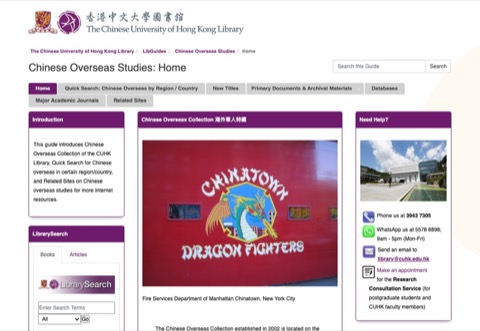
- Hong Kong Oral History Collection (Hong Kong Public Libraries) (香港口述历史特藏(香港公共图书馆))The Hong Kong Oral History Collection is located in the Central Reference Library on the 8th floor of the Hong Kong Central Library; it opened in October 2009 and is managed by the Hong Kong Public Libraries. The collection gathers books, periodicals and electronic resources on Hong Kong's past and present, with a focus on the oral histories and life stories of local residents, so that the public can learn about Hong Kong's cultural heritage and social diversity. The library also runs an online platform, Hong Kong Oral History Resources, as the web extension of the collection. Its sections include library resources (new arrivals, books, e-books, electronic databases), oral history resources (including Voices of Hong Kong, the Community Oral History Theatre Project, and a link to the Hong Kong Oral History Archives of the University of Hong Kong), activities related to Hong Kong studies, and selected online resources. For readers studying Hong Kong social history, community history and lived experience, it is both a physical reference resource and a navigation entry point gathering several oral history projects.
Address Central Reference Library, 8/F, Hong Kong Central Library, 66 Causeway Road, Causeway Bay, Hong Kong View on map ↗
Coverage, how to use, and notes
Coverage The collection gathers books, periodicals and electronic resources related to Hong Kong's history and present, with an emphasis on the oral histories and life stories of local residents. The website does not summarise the number of volumes; please refer to the library catalogue. The online platform lists three oral history projects and does not give a total number of items.
How to use For on-site use, go to the Central Reference Library on the 8th floor of the Central Library; the website states that the materials are for use within the library, and whether they can be borrowed is not stated. Online, start from Hong Kong Oral History Resources, search by keyword or click the book links, and filter by the oral history collection in the library catalogue (WebCat). Enquiries: telephone (852) 2921 0222, or use the online Ask a Librarian service. Please refer to the library website for opening hours.
Notes The website does not list any membership or registration requirements for using the physical collection; the licensing and conditions of use differ among the oral history projects, so please refer to each project page. The address follows the Hong Kong Central Library address listed on the Map Library page of the same library.
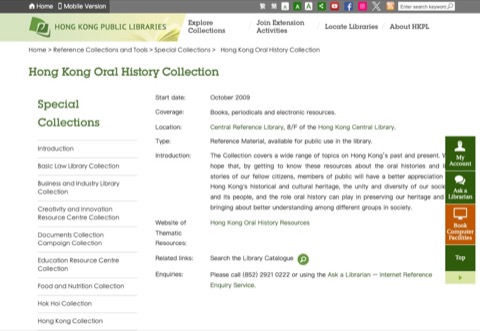
- Macao Public Library (澳门公共图书馆(大堂馆))The Macao Public Library is under the Cultural Affairs Bureau of the Government of the Macao Special Administrative Region; its predecessor was the Macao Central Library founded in 1895. According to its website, the library offers a public catalogue search and electronic resources such as e-books, electronic newspapers and periodicals, and databases. It has special collections including rare Chinese books, government gazettes and posters, as well as microfilms and audiovisual materials. For readers studying Macao history, Sino-Portuguese relations and Chinese society, its Macao documentation is the most notable: the website states a holding of about 90,000 volumes of Macao materials; the digitised collection database contains about 404 digitised rare-book e-books; and the Collection of Newspapers and Periodicals Database covers 18 titles from the 19th and 20th centuries, with about 68,000 newspaper page images. Back issues of newspapers and periodicals can also be requested for consultation. The library also provides a search for current periodicals and a list of current subscriptions. It is the physical entry point to local Macao sources and periodicals, and can be used together with the periodical article index of the University of Macau Library, or compared with Hong Kong's old newspaper resources to understand press and social links among coastal cities of South China.
Address 澳門崗頂前地3號 View on map ↗
Coverage, how to use, and notes
Coverage The website states about 90,000 volumes of Macao materials and about 404 digitised rare-book e-books; the newspaper and periodical database covers 18 titles from the 19th and 20th centuries with about 68,000 images. There are also special collections of rare books, government gazettes, posters, microfilms and audiovisual materials. For the list of titles and years, please refer to the official website.
How to use Start by searching the catalogue through the collection search system on the website, then consult the digitised collection database and the newspaper and periodical database. Back issues must be requested from the library; for opening hours and borrowing and visiting rules, please refer to the website or inquire by telephone ((853) 2856 7576 / (853) 2837 7117; email is on the contact page of the website).
Notes The website gives no separate explanation of an old-newspaper digitisation entry point; please confirm with the library the online or on-site conditions of use for the newspaper database. Macao addresses do not use postal codes.
- Public Records Office, Government Records Service (Hong Kong) (香港历史档案馆(政府档案处))The Hong Kong Public Records Office is part of the Government Records Service (GRS) of the Hong Kong SAR Government and is responsible for preserving and providing access to Hong Kong government records. The website's home page shows that the GRS website offers an online catalogue (@PRO, at search.grs.gov.hk) and Online Holdings, and has pages for group visits and FAQs. The building is the Hong Kong Records Centre at 13 Tsui Ping Road, Kwun Tong, Kowloon, and the website lists this address, telephone number and email in its contact information. For research on Nanyang Chinese and the region, Hong Kong was a hub of Chinese migration, remittances, entrepôt trade and colonial administration, and government records provide first-hand official records on the management of Chinese associations, immigration, labour, education and social policy; they are also suitable for comparison with the holdings of the National Archives of Singapore and the National Archives of Malaysia. Researchers can first search the catalogue online to learn the reference numbers and content descriptions of records, and then decide whether to go in person to consult them.
Address 3/F, Hong Kong Public Records Building, 13 Tsui Ping Road, Kwun Tong, Kowloon, Hong Kong View on map ↗
Coverage, how to use, and notes
Coverage The holdings are Hong Kong government records. The home page does not state the date span, quantity or language distribution; please consult the website. Besides the online catalogue, the website has an Online Holdings section.
How to use First, on the GRS website (www.grs.gov.hk), go to Online Catalogue (the @PRO catalogue at search.grs.gov.hk), use the search box with the option of exact match, or use advanced search. The catalogue page has a login entry; whether registration as a reader, appointments for records and daily quotas are required is not stated on the home page, so please check the website's access guidelines, or inquire by telephone (852) 2195 7760 or by email (see the website's contact page). Before visiting, confirm the opening hours and consultation rules.
Notes The address shown on the website is a contact address; the specific floor of the reading room and opening hours are not stated on the pages checked, so please consult the website. Hong Kong addresses have no postal code. Some records may be subject to closure periods or restrictions on use.
Museums & memorials
- Hong Kong Film Archive (香港电影资料馆)The Hong Kong Film Archive is under the Leisure and Cultural Services Department of the Hong Kong SAR Government and is responsible for collecting, preserving and researching Hong Kong films and related materials. The website states that its collections include audiovisual and electronic materials, Chinese and English publications, posters and stills. The Archive has a Resource Centre (3/F), where readers can search the collection through the online catalogue or computers in the Resource Centre. The Archive has long carried out oral history work, with the interviews released as publications and online videos, from which researchers can learn about filmmakers' careers. For topics such as the history of Chinese-language cinema, Cantonese films and Hong Kong film and television, and the links between the film industry and Southeast Asian Chinese markets, this is one of the few specialised official collections. The collection is not for loan; the public may read books and periodicals on the premises and may apply for a viewing card to watch audiovisual materials, and some closed-stack materials require an appointment.
Address 50 Lei King Road, Sai Wan Ho, Hong Kong Island East View on map ↗
Coverage, how to use, and notes
Coverage The website states that the Archive collects Hong Kong films and related materials, including audiovisual and electronic materials, Chinese and English publications, posters and stills. The total size of the collection, the chronological range and the number of oral history interviews are not summarised on the relevant pages of the website; please refer to the official website.
How to use The Resource Centre is on the 3rd floor and is open Monday and Wednesday to Friday 10:00 to 19:00, Saturday 10:00 to 17:00, Sunday and public holidays 13:00 to 17:00, and closed on Tuesday (except public holidays). The online catalogue can be searched online, or computers in the Resource Centre can be used. On borrowing: the collection is not for loan; watching audiovisual materials requires applying for an audiovisual materials viewing card; closed-stack materials require an appointment. Admission to the Archive is free, while film screenings are charged separately. Enquiries: telephone (852) 2739 2139, email on the contact page of the website, Resource Centre telephone (852) 2119 7360.
Notes Collection materials are not for loan; closed-stack materials require an appointment; opening hours are subject to the latest announcements on the website (special arrangements apply at Lunar New Year, Christmas Eve and so on).
Institutions & societies
- Chinese Temples Committee (华人庙宇委员会)The Chinese Temples Committee is the body responsible for supervising Chinese temples in Hong Kong. Its website shows that it manages 24 temples, of which 6 are declared monuments and 2 are Grade 1 historic buildings; the site lists them by category (directly managed, entrusted and registered temples), with locations including Wan Chai, Aberdeen, Shau Kei Wan, Kowloon City, Sham Shui Po, Tai O, Sai Kung and Cheung Chau. For readers studying Hong Kong popular religion, temple management and community organization, the site is the official entry point for checking temple names, categories and managing bodies. It also has sections on oral history, reading of morality books, scripture recitation, cultural talks and annual reports, which can serve as leads to the operation of temples and to community oral materials. The site is available in Traditional Chinese, Simplified Chinese and English. The website does not show an archive catalogue or detailed histories of each temple, so it is better used as a starting point; deeper research needs to be combined with inscriptions, government archives and fieldwork materials.
Coverage, how to use, and notes
Coverage A classified list of the 24 Chinese temples managed by the Committee (directly managed, entrusted, registered) and related sections: oral history, reading of morality books, scripture recitation, cultural talks and annual reports. The website does not state the time span or the quantity of materials; please check the official website.
How to use After entering the official website, use the temple category section to view the list and each temple's page, then enter sections such as oral history or annual reports to find textual and audiovisual materials. The site has Traditional Chinese, Simplified Chinese and English interfaces, and no registration is needed. The website notes that the Secretariat moved to Wan Chai in April 2026; for contact or visits, please use the latest address on the website's contact page.
Notes The website is not an archive catalogue, and its historical introductions to individual temples are brief. The Committee covers only the temples it manages or registers, which are not all temples in Hong Kong.
- Statistics and Census Service (DSEC), Macao SAR Government (澳门特别行政区政府统计暨普查局(DSEC))The Statistics and Census Service (DSEC) is the official statistical agency of the Government of the Macao Special Administrative Region, and its website is the primary entry for finding Macao's population, household, and census data. The homepage has nine statistical topics: population and households, society, labour force, tourism and MICE and gaming, prices, construction and real estate, trade and investment, industry overview, and national accounts, and provides a population statistics database, a time series database, a statistical release calendar, and statistical publications including the Yearbook of Statistics of Macao. In June 2022, the Service released the detailed results of the 2021 Population Census (the 16th Population Census and 6th Housing Census); the government press release shows that the total population in August of that year was 682,070, an increase of 23.5% over 2011, and states that the relevant data had been uploaded to the statistical geographic information system and the population statistics database. The website is available in Chinese, Portuguese, and English. For readers studying Macao's Chinese society, population ageing, households and housing, and regional comparison, this is the official primary source of Macao population data.
Coverage, how to use, and notes
Coverage The core is Macao's population and household statistics, with other topics including society, labour force, tourism, prices, real estate, trade, and national accounts. Population content includes the results of past population censuses or by-censuses and annual population statistics; for the years that can be searched, please refer to the individual databases and publications pages.
How to use After entering the website homepage, select Population and Households among the statistical topics to view statistical tables and press releases; for customized tables, use the population statistics database (see separate entry); publications such as the Yearbook of Statistics of Macao can be viewed or downloaded in the publications section; the release calendar shows when each set of data will be published. No registration is required. For the statistical enquiry telephone number and contact details, please see the website's contact page.
Notes The homepage also has a thematic website for the 2026 Population By-census, and whether the results of that census have been released should be checked on the website. The 2021 census thematic page (dsec.gov.mo/Censos2021) loads its content by script and in some environments shows only Loading; the population statistics database on the homepage or the government press release can be used instead. This entry does not include central bank financial statistics or general economic indicators.
Other
- Hong Kong Cultures Database (香港文化資料庫)Hong Kong Cultures Database (香港文化資料庫) is a personal blog-style resource site hosted on Blogger (hongkongcultures.blogspot.com), centered on local Hong Kong culture, literature, periodicals and publishing history. As seen on the site, articles are signed 馬吉 (Ma Ji), and the page gives no further information about the maintainer. The content consists mostly of reposted pieces, lecture notes, cultural commentary and literary retrospectives, covering the lives of writers and editors, literary periodicals (such as The Four Seasons 《四季》), martial arts fiction, obituaries, writers' collected works and records of independent cultural events, often with links to the original sources. It is not organized as rigorously as an academic journal but is rather a platform compiled and preserved over a long period by an enthusiast; it is useful for readers who dig into cultural details, trace forgotten cultural fragments or study the history of Hong Kong literature, periodicals and publishing, and can also serve as an entry point for finding leads. At the time of verification the site was still being updated, with the latest article dated November 2026. The site states that its materials are mainly reposted from the internet or provided by senior figures in the cultural world, are for reference only, asks readers to judge authenticity themselves, and requires that sources be credited when used; for academic citation it is therefore advisable to check against the original sources.
Coverage, how to use, and notes
Coverage Covers Hong Kong cultural figures and publications from many decades, mainly literature, periodicals, publishing and martial arts fiction; genres include reposted articles, lecture reports, interviews, obituaries and writers' collected works. The site does not state the total number of articles; the archive shows that the number of posts varies by year, with more in 2013–2014 and fewer in recent years. Mainly in traditional Chinese.
How to use Visit the URL directly; no registration is needed. The page has a search box on the right, and users can also browse through the tag index (categories such as writers, periodicals, publishers and literary societies) and the monthly archive, as well as a popular posts list, older-posts pagination and an Atom feed. Search with personal names or periodical titles as keywords, then follow the original links at the end of articles to check sources. Please credit the source when citing and check against the original text.
Notes This is a personal blog, mostly reposted material; readers must judge authenticity and errors themselves. The content is scattered and unsystematic; for academic citation, trace the original sources.
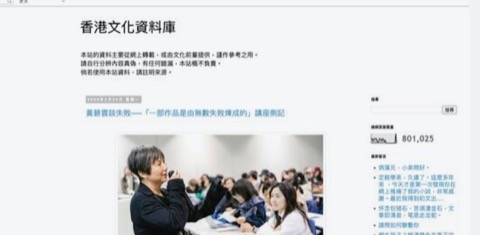
- Mychistory: Hong Kong History Column (知史“香港史”专栏)Mychistory (知史) is a popular history website in traditional Chinese with sections such as Mychistory Special Topics, Long Mychistory, Mychistory Masters Forum, Mychistory Videos, Mychistory Academy and New Historical Knowledge; Hong Kong History is one of its thematic sections. According to the description, the site is associated with organizations including the National History Education Centre (Hong Kong), a civil charitable body that promotes the idea of 'a Hong Kong heart, Chinese sentiment and a global outlook'; the website does not state clearly who operates it, so please refer to the official site. The Hong Kong History section carries short popular-science articles written by scholars and doctoral students, in accessible language while retaining academic character, on topics such as the opening of Hong Kong as a port, sources from the Japanese occupation period, military remains and local history, for example articles introducing primary sources from the Japanese occupation and Hong Kong's military remains. For beginning researchers it is an entry point for quickly learning about Hong Kong history topics and finding research ideas; for readers interested in links between Hong Kong, South China and Nanyang, it can also serve as background reading. The articles are short and cannot replace monographs and original archives; when citing, it is advisable to go back to the original documents on which the authors rely.
Coverage, how to use, and notes
Coverage Short articles on Hong Kong history, in traditional Chinese, arranged by publication date, covering sources from the Japanese occupation, military remains, and local and social history. The total number of articles in the section and their date range are not stated on the site; please refer to the official site.
How to use After entering the URL, choose Hong Kong History under Mychistory Special Topics in the homepage navigation to browse the article list in chronological order and open articles to read in full. The top of the page has a search box for keywords (such as Hong Kong opening as a port or Japanese occupation). The site also has sections such as Mychistory Masters Forum and Mychistory Videos as supplements. No account is needed to read; articles usually list the author and reference information at the end, which can be used to trace original sources.
Notes The articles are popular-science in nature; for academic citation, check the original sources. The site does not clearly state its operator or fee policy; please refer to the official site.
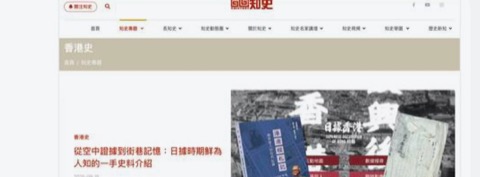
- 2021 Population Census (Census and Statistics Department, Hong Kong) (香港2021年人口普查专题网站(政府统计处))This is the 2021 Population Census thematic website built and maintained by the Census and Statistics Department of the Government of the Hong Kong Special Administrative Region, and the main entry for obtaining official results of Hong Kong's most recent population census. The homepage shows summary figures of the census; the page content shows a population of about 7.41 million and a median age of 46.3 years, and provides sections such as summary results, main tables, various publications, and district profiles. The publications section lists summary results, main results, and the technical report, as well as thematic reports on children, youths, the elderly, single-parent households, subdivided units households, Mainland people who had been in Hong Kong for less than seven years, and ethnic minorities, along with a thematic report on household income distribution and a thematic article on one-person households; most are provided in PDF, Excel, and CSV formats. The thematic report on ethnic minorities is of particular reference value for research on Hong Kong's ethnic composition, South Asian and other non-Chinese residents, and new immigrants and cross-boundary populations. For research on overseas Chinese and Southeast Asia, Hong Kong is an important node for Chinese migration, qiaoxiang networks, and people from Southeast Asia in Hong Kong (such as residents from the Philippines and Indonesia), and these official census data can serve as an authoritative basis for demographic background and comparative research.
Coverage, how to use, and notes
Coverage Mainly the 2021 Population Census, with content on topics including population, households, education, economic activity, housing, and internal migration; the main tables are divided into categories such as population, education, economic, household, housing, population groups, internal migration and relocation, and new towns. Publications include summary results, main results, the technical report, and several thematic reports, as well as district profiles. The website homepage does not mention other census years; for data of earlier years, see the Build Your Own Tables tool below.
How to use After entering the homepage, you can browse through sections such as Snapshot, Main Tables, Publications, and District Profiles. The main tables pages allow online viewing and downloading of statistical tables; most items on the publications pages can be downloaded in PDF, Excel, or CSV. For customized cross-tabulations, use Build Your Own Tables (see separate entry). The website is available in English, Traditional Chinese, and Simplified Chinese, and no registration is required. When citing, it is advisable to note the table number, release date, and the definitions in the technical report.
Notes The website provides aggregate statistical tables, and the homepage does not mention downloads of individual-level microdata; if more detailed data are needed, please check the Department's data request instructions. Statistical definitions (such as whether foreign domestic helpers are included) vary by table, so please read the notes to each table and the technical report.
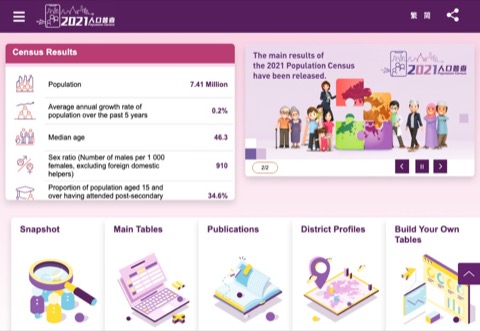
International & cross-regional130
Newspapers & news archives
- British Library Newspapers, Part VII: Southeast Asia, 1806–1977 (大英图书馆报纸数据库第七部分:东南亚报刊(1806–1977))British Library Newspapers is a series of databases of British Library newspapers published by Gale; Part VII is devoted to colonial-era and postwar newspapers and periodicals from Southeast Asia. Its source material comes from the British Library's Asia, Pacific and Africa collections, digitized and made full-text searchable online. Gale's official page states that this part contains 36 newspapers and periodicals, 10 of them from Burma, with the rest from Malaysia (15), Singapore (6), and Thailand (5). For Burma studies, English-language newspapers from British Burma and the early postwar period are basic sources on colonial administration, commerce, social life, and local political movements, material that previously relied largely on microfilm or on-site consultation. Because the Burmese titles sit on the same platform as the Malayan and Singaporean titles, contemporaneous reporting on Burma, Malaya, and Singapore can be compared through a single search interface, which also suits research on transregional Chinese commercial networks, migration, and comparative colonial administration. Note that the database consists mainly of English-language newspapers; Burmese-language and Chinese-language newspapers are not within its main scope, and Chinese-language materials must be sought elsewhere. This is a commercial database accessed through institutional subscription.
Coverage, how to use, and notes
Coverage Gale's website indicates 36 newspapers and periodicals covering 1806–1977: Malaysia 15, Singapore 6, Burma 10, Thailand 5. The source material comes from the British Library's Asia, Pacific and Africa collections. The titles of the 10 Burmese publications, their start and end years, and the completeness of volumes and issues are not listed individually in the product page content that was read; please consult Gale's website or your institution's database description.
How to use Individuals usually cannot access it directly and must log in through the subscription portal of their university or library. On the Gale platform, first use Advanced Search to limit by country of publication or title, then search the full text by keyword and date range, and browse individual issue pages. When searching for Burmese place names, try both old and new spellings such as Rangoon / Yangon and Burma / Myanmar, since the newspapers use the English spellings of the time and OCR may contain recognition errors. Whether downloading, printing, citation export, and text-mining tools are available depends on the institution's license; please consult your institution and the Gale platform. Gale's website offers trial requests, and institutional readers can ask their library whether it already subscribes.
Notes Institutional subscription is required; prices are not published on the website. The database is mainly English-language newspapers and does not include Burmese-language or Chinese-language titles. Please check the specific titles and years of the Burmese part on the website or in your institution's database description before deciding whether to use it. OCR text may contain errors; check against the original page before citing.
- Delpher: Digitized Dutch Newspaper and Book Platform of the Koninklijke Bibliotheek (Delpher(荷兰皇家图书馆数字化报刊图书平台))Delpher is a free platform built by the National Library of the Netherlands (Koninklijke Bibliotheek, KB) together with partner libraries, archives and research institutions. It allows full-text searching of digitized Dutch-language newspapers, books, magazines and radio news bulletins. For Southeast Asian studies, its value is that the newspaper section includes periodicals published in the Dutch East Indies (roughly present-day Indonesia), making it an important entry point to primary sources on Dutch colonial rule, Dutch East Indies society and local Chinese communities. Readers can use Dutch keywords to search colonial-period news reports, advertisements, official announcements and commentary, and can also search Dutch-language books from the seventeenth to the twentieth century for travel accounts, administrative reports and scholarly works. Dutch-language sources are often overlooked in studies of Chinese in Malaya and Singapore, but where trade, migration and movement of people to and from the Dutch East Indies are concerned, this collection can supplement English and Chinese materials.
Coverage, how to use, and notes
Coverage According to the website: about 2 million newspaper issues from the Netherlands, the Dutch East Indies, the Antilles, the United States and Suriname, dating roughly from 1618 to 1995; about 190,000 digitized books (seventeenth to twentieth century), plus about 800,000 Dutch-language books digitized by Google (sixteenth to nineteenth century); magazines covering roughly 1800 to 2000; and about 1.5 million pages of typed news bulletins from the Dutch news agency ANP (1937 to 1989). For the start and end years of individual titles, please refer to the website.
How to use Open the website to search; no account registration is needed. You can search newspapers, books, magazines and other categories separately, and use search operators and filters (such as period, region and title) to narrow results. Search terms are mainly in Dutch; old spellings (such as colonial-period spellings of Indonesian place names and personal names) require trying several variants. Search results can be saved, cited and downloaded. Much material can be read directly online, but some copyright-restricted content can only be viewed in the KB reading room.
Notes The full text is produced by OCR, and recognition errors are frequent in old newspapers, so use multiple spellings and verify manually. The interface and most content are in Dutch. Copyright-restricted material cannot be read in full online. For the specific titles included, please refer to the website.
- Early Chinese Periodicals Online (ECPO) (早期中文期刊在线(ECPO))ECPO was built by Heidelberg University in Germany. It began in cooperation with the Institute of Modern History, Academia Sinica (Taiwan), with funding from the Chiang Ching-kuo Foundation from 2012 to 2015, and later cooperated with the University of Washington to add literary and art periodicals. According to the website, it is an open-access database of Chinese periodicals from the late Qing to the early Republican period, currently centred on women's magazines and entertainment papers and still expanding. It provides page images and also structured annotation of advertisements, inserts, illustrations, persons and topics, which are often omitted in microfilm and full-text editions. The metadata is bilingual (Chinese and English) and includes keywords and biographical information on editors, authors and persons appearing in texts and images, so readers unfamiliar with Chinese can also use it. For research on Southeast Asian Chinese, these periodicals can be used to study gender, consumer culture, entertainment and popular publishing in modern China. They also suit comparison with supplements, advertisements and writing about women in Chinese-language newspapers in Malaya and Singapore, to trace how cultural trends moved across regions. The website also describes the project as a prototype, so users should note that features and content are still changing.
Coverage, how to use, and notes
Coverage The website states that it includes 4 women's magazines from the Women's Magazine database (1904–1937), about 22 entertainment tabloids (Tabloid database), and about 200 women's periodicals and some tabloids digitized by the Institute of Modern History, Academia Sinica, with literary and art periodicals being added. The period is mainly late Qing to the Republican era. Metadata is bilingual (Chinese and English). For the exact issues and start and end years of each title, please consult the website.
How to use On the website, you can browse by title through the publications page, or use advanced search to find items by person, topic, illustration and keyword and view how related entries are distributed across issues and titles. The website does not state whether registration is required. When citing, record the title, volume and issue, date and page number, and keep the entry page address.
Notes The website describes itself as a prototype project, so features and content may change. Coverage is mainly women's magazines and entertainment papers; it is not a comprehensive database of modern periodicals. The website does not specify the type of open licence or the terms of use; please consult the website.
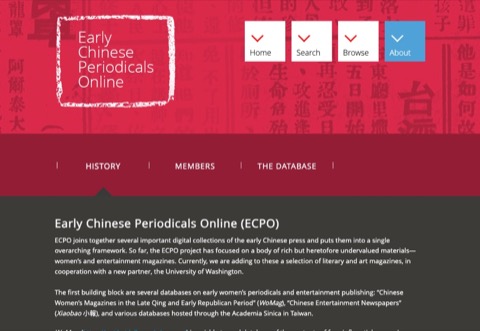
- Jawi Research Society in Japan (JRS-J): Qalam Article Database (日本爪夷文研究会(JRS-J)《Qalam》文章数据库)The Jawi Research Society in Japan (JRS-J) is linked to Kyoto University's Southeast Asian area studies institutions (CSEAS/CIAS). Its website is devoted to digitising Jawi periodicals in Malay and Indonesian and building a searchable database, in support of historical research on Islamised Southeast Asia. The core database introduced on the page is Qalam, a monthly that was first published in Singapore and later moved to Selangor, Malaysia, and was published from 1950 to 1969. The site states that about 94% of the magazine's articles have been collected and digitised, and transliteration from Jawi into Latin script is still in progress, so that readers can search Jawi articles together with Latin-script literature. The site also describes the idea of a cross-database search system: the originals remain with their holding institutions, which digitise and upload them themselves, and users search across databases through the search system. For researchers of postwar Muslim communities in Malaysia and Singapore, Malay literature and intellectual life, and religious thought, this is a rare article-level searchable database of Malay periodicals.
Coverage, how to use, and notes
Coverage The monthly Qalam, 1950 to 1969, with about 94% of articles collected and digitised and transliteration still in progress. The publications that the website lists as planned additions include Jawi Peranakan, Hiburan and Mastika from Malaysia, and al-Munir and Waktu from Indonesia; the database diagram also lists al-Imam (1906 to 1908), Pengasoh and Dian. Planned additions are not the same as being online; please refer to the official website.
How to use Enter from the database page of the website (yama.cseas.kyoto-u.ac.jp/jawi/eng/jawi/database.html), open the Qalam Article Database through the link on the page, and search by article. The page gives no step-by-step instructions, and does not say whether registration is required or whether downloading or exporting is possible; please refer to the official website. Because transliteration is not yet complete, hits in the original Jawi text and in the Latin transliteration may differ, so try both forms when searching.
Notes The website pages do not clearly state terms of use or registration requirements; please refer to the official website. Transliteration is incomplete, so some articles may not be found by search. The page information is presented in English and Japanese, while the periodical content is in Jawi, which requires corresponding language ability. The website is run by the society and its scale and update frequency are limited; only the database introduction page was verified for this entry, not each sub-database page.
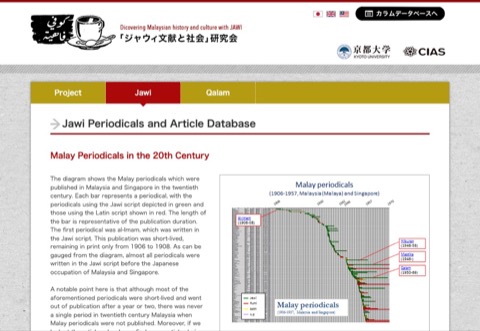
- KhmerPost USA Newspapers, 2007-2016 (Southeast Asian Digital Archive) (KhmerPost USA 报纸数字馆藏(东南亚数字档案 SEADA))This collection holds digitized PDFs of KhmerPost USA, an independent biweekly newspaper printed bilingually in Khmer and English for the Cambodian American community in the United States. The collection is hosted on the Omeka platform of the Southeast Asian Digital Archive (SEADA). SEADA's contact address belongs to the University of Massachusetts Lowell (uml.edu), and the page notes that the originals come from the UML 8 collection at the university's Lowell History Center, but the page does not explicitly name the operating institution. SEADA focuses on refugee and immigrant communities in Lowell and, besides Cambodian Americans, also covers other Southeast Asian groups such as those from Myanmar (Karenni, Karen, Kachin); its materials include photographs, oral histories, books, newspapers, magazines, videos, and research archives. This newspaper can be used to study public issues, community organizations, religious and festival life, bilingual media, and identity in the Cambodian diaspora, and can be compared with materials on the same platform such as publications of the Cambodian Mutual Assistance Association and oral histories. Most Khmer-language newspapers in Cambodia itself have no open digitized versions, so overseas Khmer-language periodicals like this are a rare sample of contemporary Khmer-language newspapers that can be read directly online. The resource has no direct connection with Chinese-language periodicals, but is useful to readers studying diaspora communities and ethnic media in Southeast Asia.
Coverage, how to use, and notes
Coverage The collection title gives 2007–2016, but the issues actually listed on the page run from October 2007 to September 2010, 144 items in total. The languages are Khmer and English. The page states that issues from 2013–2019 can be found on the publisher's website, with some issues missing; some issues have also been uploaded to the Internet Archive. SEADA as a whole has 22 collections, including publications of the Cambodian Mutual Assistance Association (Greater Lowell) (1997–2007).
How to use Open the collection page and click View all 144 items to browse all issues and view the PDFs online. SEADA supports keyword, Boolean, and exact-phrase searching across the site, with filtering by record type such as items, files, collections, and exhibits; advanced search works only for items. The page does not mention a registration requirement. When citing, record the issue date and the SEADA item page address. For issues after 2010, check the publisher's website and the Internet Archive, but please verify the links and completeness at those two places yourself.
Notes This collection is a newspaper of the Cambodian American community in the United States, not a newspaper from Cambodia itself. The year range in the collection title (2007–2016) does not match the range of issues actually listed on the page (2007–2010), and some issues are missing. The page does not state whether each issue is full-text searchable, nor the copyright and reuse conditions; please consult SEADA's policy page on use and takedown.
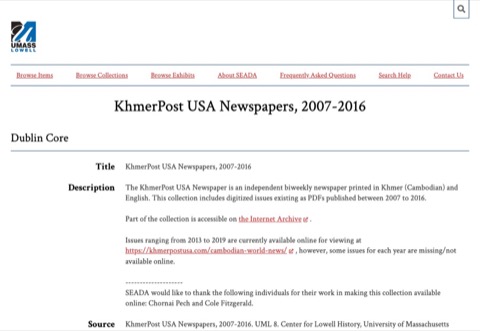
- Late Qing and Republican-Era Chinese Newspapers (Open Access), East View Global Press Archive (晚清及民国中文报纸数据库(开放获取))This database is hosted by East View's Global Press Archive project, and open access is made possible by funding from the Center for Research Libraries (CRL) and its member institutions. The website describes it as covering Chinese-language newspapers from the late Qing to the Republican period, published in more than twenty Chinese cities, with over 290 titles. Newspapers are primary material for studying local society, public opinion, commerce, political mobilisation and foreign relations in modern China. For research on the Nanyang Chinese, newspapers from emigrant home regions, port cities and trading ports can be compared with overseas Chinese-language periodicals, and used to look up overseas Chinese affairs, remittances, overseas Chinese donations, Nanyang trade, Southeast Asian current affairs and the activities of overseas Chinese in China. These newspapers were originally a commercial archive requiring a subscription and are now open to the public without institutional subscription, which is especially convenient for researchers without access to large library collections. Unlike databases that offer only article indexes, such archives provide page images and text, so the newspapers can be read in their original form. It should be treated as a regional newspaper sample collection, not a complete holding for any one city or newspaper.
Coverage, how to use, and notes
Coverage The website states that it includes over 290 Chinese-language newspapers from more than twenty cities in mainland China, roughly covering 1911 to 1949, with a total of over 450,000 pages. The website page lists the newspaper titles and a product description (downloadable). The exact start and end years, missing issues and size of each newspaper are not described one by one on the page; please rely on the title list on the website.
How to use Go to the resource page on the East View website, where you can download the title list and product description to first confirm whether a target newspaper is included, then proceed to search or browse. The page does not state whether registration is required, the search syntax, or whether bulk download or export is possible; please check the site. When searching, try simplified, traditional and older transliterated forms together, for example 南洋, 星洲, 槟城, 侨汇 and 华侨, and narrow by city and period. When citing, record the newspaper name, date and page, and save the search entry page.
Notes The page does not describe the search function or terms of use; the newspapers in the list are not complete collections of each city's press, and missing issues need to be checked by the user. The title list may differ from what can actually be searched; please check the site.
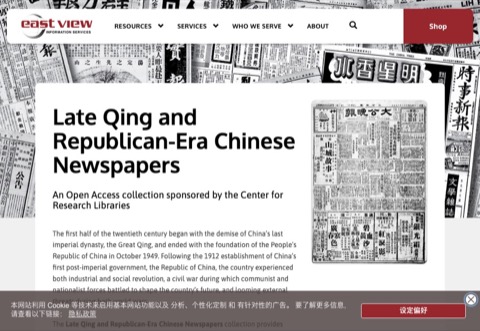
- PhilPeriodicals: Philippine Periodicals Online Exhibit (菲律宾旧报刊在线展览(PhilPeriodicals))PhilPeriodicals is an online exhibition and digital resource site on historical Philippine periodicals, hosted on the digital collections platform of the Universidad Nacional de Educación a Distancia (UNED) in Spain. The project was funded by the Flemish academic cooperation body VLIRUOS and carried out jointly by researchers from the University of Antwerp, the University of the Philippines and the University of Alcalá. Its project title is 'Strengthening digital research in the University of the Philippines system: digitization of rare Philippine periodicals (1850–1945) and digital humanities training', and it ran from 2018 to 2022. The site arranges articles, cartoons, literary works, advertisements and photographs from periodicals into thematic narratives, showing how Philippine society was recounted by those who lived it in the periodicals of the time, covering 1865–1965. The project also includes the 2021–2022 Global Minds sub-project, which deals with the representation of Chinese and Muslim minority groups and is directly relevant to readers studying images of the Philippine Chinese and colonial-era periodicals. Most of the materials come from University of the Philippines collections, with some scans from the University of Santo Tomas digital library, the Hemeroteca Municipal de Madrid, the Hemeroteca Digital of the Biblioteca Nacional de España, the library of the Augustinian seminary in Valladolid and the Biblioteca Virtual Miguel de Cervantes.
Coverage, how to use, and notes
Coverage The exhibition spans 1865–1965, while the digitized objects of the source project are rare periodicals from 1850–1945; the languages are English, Spanish and Tagalog (as stated on the About page). There is also a sub-project on the representation of Chinese and Muslim minority groups. The periodical titles, total number of issues and pages are not stated on the website; please consult the website.
How to use Go to fondodigital.uned.es/s/philperiodicals and use the 'Búsqueda' search box on the page or click 'Búsqueda avanzada' for advanced search; you can also browse by thematic narrative. The About page mentions that some complete periodicals are shared via Google Drive folders; the conditions of use of each source institution must be checked separately. Parts of the interface are in Spanish. The site's Disclaimer page sets out the conditions of use; it is advisable to read it before citing or reproducing materials.
Notes The About page states that some scanned periodicals are not yet online and that not all materials can be downloaded in full; the terms of use differ among source institutions and are not listed individually on the website; please consult the website. This is a thematic exhibition site and cannot replace searching a full-text database of the original periodicals.
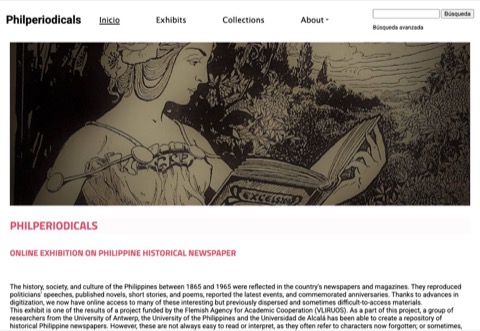
- Qalam Article Database (Kyoto University CSEAS) (《Qalam》杂志文章数据库(京都大学东南亚研究所))Qalam was a monthly in Jawi (Malay written in the Arabic script), launched in Singapore in 1950 for Muslim readers in the Malay world, which ceased publication after its founder died in 1969. This database collects articles from the magazine and provides romanised (Rumi) transcriptions. The official pages show the logo of the Center for Southeast Asian Studies (CSEAS), Kyoto University, and the logos of three partners, Klasika Media, Akademi Jawi Malaysia and Kota Buku; for the specific operator, follow the official website. The magazine circulated in Singapore, Indonesia, Malaya, Borneo and southern Thailand, and the site presents it as material for understanding Muslim activity and thought in the 1950s and 1960s. For readers studying postwar Malay-language publishing, Islamic thought, Malay nationalism and Jawi print culture in Malaysia and Singapore, it is a rare local-language periodical that can be searched directly without first having to read Jawi. Readers studying relations between the Chinese and Malay communities and postwar social thought in Malaysia and Singapore can also use it as comparative material. The site interface is available in English, Japanese and Malay.
Coverage, how to use, and notes
Coverage The magazine was published from 1950 to 1969; issues from 1951 and 1963 are visible in the site's examples. The content is articles from Qalam and their romanised transcriptions, with the originals in Jawi. The number of articles included and whether all issues are covered are not stated on the website home page, so follow the official website.
How to use On the website, use simple search (keywords) or advanced search, or browse by issue; the site also offers a word cloud function. Search results can be displayed 20, 50 or 100 per page. The interface can be switched between English, Japanese and Malay. The transcribed text is mainly romanised Malay, so search terms should use Malay spelling, and different spellings of the same word can be tried. The home page does not indicate that registration is required; download and export functions are not described on the home page, so follow the official website.
Notes The site mainly provides transcribed text, so when citing it is advisable also to check the original Jawi pages or library holdings. The official pages do not give full information about the operator, nor the database's update status and terms of use; follow the official website. The help page address may change, so enter from the home page.
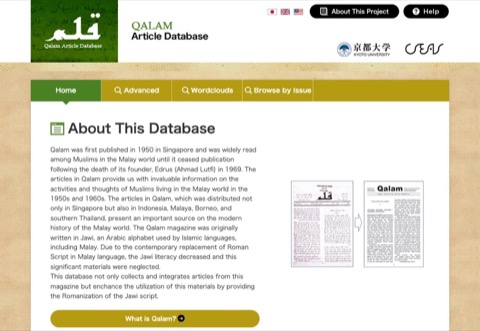
- Southeast Asian Newspapers (Open Access), East View Global Press Archive / Center for Research Libraries (东南亚报纸开放获取库(CRL与East View))Southeast Asian Newspapers is an open access newspaper collection supported by the Center for Research Libraries (CRL) and its member libraries and provided on East View's Global Press Archive platform, focusing on Southeast Asian periodicals from the end of Western colonial rule and the early period of independent states. It covers newspapers from Myanmar, Indonesia, the Philippines, Thailand and Vietnam, in languages including English, Dutch, French, Javanese, Spanish and Vietnamese. For Myanmar, the verified page lists only one title, The Burmese Review (bilingual English-Burmese, 1946–1948, per the CRL page description), so it is better used as a supplementary source for early postwar English-language Burmese periodicals than as a comprehensive collection of Burmese newspapers. Its value lies in allowing cross-national comparison with newspapers of other Southeast Asian countries on the same platform, for studying postwar political transition, nationalism and regional relations; the search interface allows filtering by language (including options such as Chinese and Malay), title and date, which facilitates cross-national comparison.
Coverage, how to use, and notes
Coverage The platform page shows 129 publications, 67,763 issues and 463,248 pages, with a time span from 1839 to 1976 (please consult the website). For Myanmar, only The Burmese Review (1946–1948) appears. Language options include English, Vietnamese, Thai, Indonesian, French, Malay, Chinese, Japanese, Spanish, Dutch, Javanese, Khmer and Tagalog.
How to use Enter the collection from East View's CRL Southeast Asian Newspapers page and use 'Search the Archive' or 'Advanced Search'; you can restrict the start and end dates, specify titles and choose languages, with results shown 25, 50 or 100 per page, and browse with 'Title Navigation', 'Date Navigation' and 'Map Navigation'. The page also has basic and advanced search guides. The collection is marked as open access; whether login or registration is required, and the terms for downloading, should be checked in the platform's terms of use.
Notes Burmese newspapers are very few in this collection and cannot replace Myanmar's own national periodicals; coverage of newspapers from different countries is uneven, and the CRL page advises relying on the current title list within the collection.
- Thai Newspaper Collection during World War II (Kyoto University CSEAS) (二战时期泰国报纸数字馆藏(京都大学东南亚研究所))This collection was compiled by the Center for Southeast Asian Studies (CSEAS), Kyoto University, and released on 7 September 2018. It contains three newspapers published in Thailand during World War II: Krungdeb Varasab Daily News, The Siam Rashdra Daily News and Lak Mueang. The page explains that the publishers of these newspapers no longer exist and that some issues are difficult to find even within Thailand. Digitization was carried out with the permission of the National Library of Thailand. The images were first made public in 2005 in Kyoto University's former digital library, and higher-resolution versions are now available in the Rare Materials Digital Archive of Kyoto University. For scholars studying wartime Thai politics, relations between Japanese occupation and Thailand, and wartime Chinese society and public opinion, this is a primary newspaper source that can be browsed online.
Coverage, how to use, and notes
Coverage Three newspapers: Krungdeb Varasab Daily News (RB00000072), The Siam Rashdra Daily News (RB00000073), Lak Mueang (RB00000074). The time range is given only as the World War II period; specific years, months and missing issues are not stated on the official page; the language is not explicitly stated on the page, so please refer to the official site.
How to use From this page, enter the Rare Materials Digital Archive of Kyoto University and browse by newspaper title or item number. The page does not mention registration. Before use, open each newspaper entry to confirm the actual volumes and issues and image quality; when citing, record the item number and the holding institution.
Notes The newspapers are scanned images; whether full text is searchable depends on each entry page. There are only three newspapers, so the scope is limited, and they should be used together with other sources such as the National Library of Thailand.
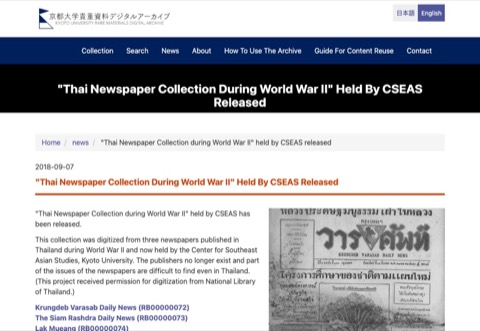
Archives & historical document databases
- Singapore-Malaya People's History Archive (星马人民历史资料室)The Singapore-Malaya People's History Archive (xingmarenmin.com) is a website that collects historical materials on Singapore and Malaya (the Malay Peninsula). According to the Chinese e-resources guide of the National University of Singapore Libraries, unlike official archives, it focuses on rescuing public or semi-public printed materials that are easily lost, and most of the historical books and periodicals it holds date from the 1950s to the 1970s. According to its materials catalogue, the site has a number of postwar Singapore-Malaya Chinese-language newspapers and literary periodicals, such as bound volumes of Shidai Bao, Xinwen Chunqiu, Gengyun Biweekly, Huangdi Biweekly, Malaya Students' Paper, Modern Literature and Art, Langhua, Jianshe, Chidao Poetry Journal and Wenyu Pictorial, with the surviving issues of each title indicated. The site's value is that these are first-hand non-official materials on Singapore-Malaya history in the 1950s to 1970s, and according to the description all are free to download without registration or login. For readers studying postwar Singapore-Malaya politics, society, left-wing culture, Chinese-language literature and student movements, this is material that is hard to find consolidated elsewhere outside the official archives.
Coverage, how to use, and notes
Coverage According to the NUS Libraries guide, most of the historical books and periodicals held date from the 1950s to the 1970s. Items listed in the materials catalogue include Shidai Bao (vols. 1-3, bound), Xinwen Chunqiu (issues 1-20), Gengyun Biweekly (issues 1-20), Huangdi Biweekly (issues 1-17, lacking issues 4, 5, 8, 12, 15 and 18), Malaya Students' Paper (issues 1-11), Modern Literature and Art (issues 1-9) and more than twenty others, mostly Chinese-language periodicals. The full scale of the website has not been verified; please rely on the official site.
How to use From the homepage, enter the Materials Catalogue and browse entries by category; once on an entry page you can download. According to the description, all resources are free to download without registration or login. The catalogue indicates the surviving issues of each title, so you can check for missing issues before downloading. It is advisable to browse the catalogue first and then look up items by keyword or title within the catalogue page; whether the site offers full-text search has not been verified, so please rely on the official site.
Notes The official website (xingmarenmin.com) has not been opened and checked directly; the information above comes from the NUS Libraries guide and screenshots of the materials catalogue. The site's scale, update frequency and download details should be confirmed on the official site. These materials are mostly scans of privately preserved copies and may have missing issues and scan-quality problems; when citing, please note the issue number and date of the original periodical.
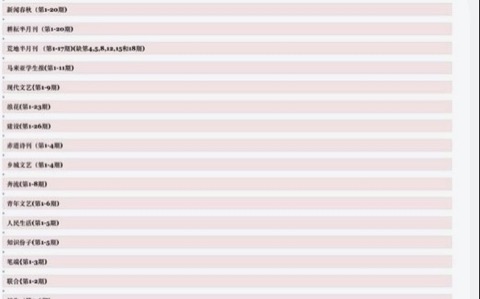
- Sejarah Melayu Library (马来历史图书馆)The Sejarah Melayu Library is an online library under Sabri Zain's personal website Sejarah Melayu, described as possibly one of the largest public online collections on the history of the Malay Archipelago and surrounding regions. The library provides books, academic papers and articles as electronic PDFs, divided into eight sections: General, Histories & Other References, Travelogue, Language, Fiction, Journals, Papers & Articles, and News & Dispatches. It covers general histories and reference works, accounts by travellers and explorers, dictionaries and grammars of Malay and related languages, novels set in the Malay Archipelago, academic journals, papers, and news and reports taken from historical newspapers, chronicles and gazettes. The Journals section includes digitised resources of the Journal of the Malayan Branch and the Straits Branch of the Royal Asiatic Society. The site has digitised a large amount of literature on Malaya from around 1900, with clippings dating back as early as 1783, and is suitable for scholars of Malayan history doing broad exploratory searches. The site's directory page (tree.html) confirms sections such as General, Histories & Other References, Travelogue and Language, and items such as the Straits Branch's Notes and Queries and The Selangor Journal; the site can currently still be opened. It is an old-style frame-based page maintained by an individual and is updated very infrequently.
Coverage, how to use, and notes
Coverage According to the site's introduction and page screenshots, the collection has nearly 3,000 electronic PDF books, academic papers and articles (the footer in the screenshot shows 2,245 records in total). The content is mainly in English, with some Malay and related language materials, and focuses on historical literature on Malaya from around 1900, with the earliest clippings dating back to 1783. The sections are General, Histories and Reference, Travelogue, Language, Fiction, Journals, Papers and Articles, and News and Dispatches. The exact number of items and date range should be checked in the site's actual directory; the site pages do not list totals item by item.
How to use Open the URL to enter the frame-based directory, click the + in the tree menu on the left to expand a section, then click a title to see its description. For a quick search, after listing all documents use the browser's in-page search (Ctrl+F) to search by book or article title. Click the PDF icon to read online, or right-click and save to download; file sizes range from under 1 MB to nearly 100 MB, and a PDF reader is needed. No registration is needed. To make contact, use the librarian link on the page.
Notes The site is maintained by an individual, has an outdated interface and no full-text search; its last update is said to have been in 2013, so new material is unlikely to be added. The total size of the collection should be checked in the site's actual directory. Users should pay attention to the copyright status of each item. Large files download slowly.
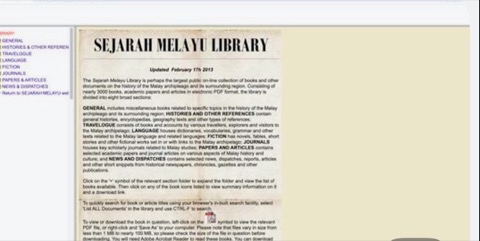
- Leiden University Libraries Digital Collections (莱顿大学图书馆数字特藏)A digital collections platform provided by Leiden University Libraries, which openly offers the library's digitized and born-digital collections, including manuscripts, archives and letters, rare books, maps and atlases, prints and paintings, photographs and oral histories. It is especially useful for Southeast Asian studies: the platform includes related collections of the Royal Netherlands Institute of Southeast Asian and Caribbean Studies (KITLV), such as Indonesian printed materials and special collections, Dutch East Indies literature, (Chinese) Malay popular fiction and Southeast Asian popular music, which can be used for research on colonial-era history, maps, images and literature. The platform uses an IIIF image viewer, allowing smooth zooming and page-turning of high-definition images, and can be browsed by theme, language, geographic region and collection source. The site notes that copyright-protected materials may have access restrictions, and copying and reuse must follow its terms of use. At the time, the site noted that the platform was migrating to a new system; all digital objects remain accessible but may be moved to a different page environment.
Coverage, how to use, and notes
Coverage Covers types such as manuscripts, archives and letters, rare books, maps and atlases, prints and paintings, photography and oral histories. Southeast Asia-related collections listed on the site include Indonesian printed materials, Indonesian special collections, KITLV Dutch East Indies literature, (Chinese) Malay popular fiction and Southeast Asian popular music. The library's subject guide says the platform has more than 500,000 digitized primary sources, reference works and born-digital materials; this figure is undated, and other official materials give different counts, so refer to the platform for the actual scale.
How to use Visit the platform directly; on the homepage search box, choose All collections or a particular collection and enter keywords, or browse via entries such as image collections, text collections, research guides, faculty collections and featured collections. When searching Southeast Asian materials, try keywords such as KITLV, Indonesia, Dutch East Indies, place names or personal names. Images are shown in an IIIF viewer and can be zoomed. No registration is needed to browse. Conditions for download and reuse vary by collection; please read the Terms of use linked on the platform, and credit Leiden University Libraries when citing.
Notes Some say materials without copyright restrictions can be downloaded under a CC-BY licence, but the specific licence could not be verified on official pages; actual terms follow each collection's page and the terms of use. The site notes that the platform is migrating to a new system, so URLs and page environment may change. Copyright-protected materials may have access restrictions.
- A Quarter Century of U.S. Support for Occupation in East Timor (National Security Archive Electronic Briefing Book No. 174) (美国国家安全档案馆《四分之一世纪的美国支持:东帝汶占领》电子简报册(第174号))The National Security Archive is a non-governmental research institute based at George Washington University that mainly publishes declassified US government documents obtained through Freedom of Information Act requests. Electronic Briefing Book No. 174 was edited by Brad Simpson, director of its Indonesia–East Timor Documentation Project, and released on 28 November 2005. It consists mainly of declassified US documents from 1963 to 1999, reflecting US policy during Indonesia's invasion and occupation of East Timor. The Archive had provided these documents to the Commission for Reception, Truth and Reconciliation in East Timor (CAVR). The page also links to an index of British documents, news reports, and the earlier Briefing Book No. 62, East Timor Revisited: Ford, Kissinger, and the Indonesian Invasion, 1975–76 (released 6 December 2001, edited by William Burr and Michael Evans, with seven PDFs). For scholars of regional politics in Southeast Asia in the Cold War context, the 1975 invasion, the 1999 referendum and the history of international relations, these are directly citable primary diplomatic documents.
Coverage, how to use, and notes
Coverage Briefing Book No. 174 has 39 numbered documents (No. 12 is split into 12a and 12b, making 40 PDFs), mainly US government documents from 1963–1999, on an English-language page. Briefing Book No. 62 has 6 numbered documents and 1 annex, covering July 1975 to June 1976, including the Ford–Suharto talks and the Ford–Kissinger meeting. The website does not give a full statement of the documents' languages.
How to use Open the briefing book page and click each numbered PDF to read and download; the page also carries the editor's introduction and notes. No registration is required. The page notes that Acrobat Reader is needed for the PDFs. When citing, give the briefing book number, document number and release date. The Archive's main site (nsarchive.gwu.edu) also has briefing books, thematic projects and research guides.
Notes Content on the site is copyrighted; the site states it may be used for educational and non-commercial purposes, and other uses require permission from the Archive. The Digital National Security Archive (DNSA) on the main site is a subscription database and is not part of the free open content. The briefing books are selected by the Archive's editors and are not a complete government record, so they should be cross-checked against other sources.
- ANU Asia-Pacific Map Collection: Brunei (BRN01 - General) (澳大利亚国立大学亚太地图收藏:文莱部分)The Asia-Pacific Map Collection of the Australian National University (ANU) Library scans published maps whose copyright has expired and places them in the ANU Open Research Repository (digital collections portal: digitalcollections.anu.edu.au). Brunei is one of the country-based sub-collections, coded BRN. BRN01 General holds general maps: the 1950s Brunei state report maps, mid-20th-century aeronautical charts (WAC sheets), the Sarawak series, and a 1972 large-scale 1:12,500 topographic map of Seria–Kuala Belait, among others. There are also the BRN02 map index and the BRN04 1:150,000 series, including the 1962–1963 FARELF (British Far East Land Forces) Brunei index map. Few historical maps of Brunei have been digitised and made public locally. These maps can be used to study the British protectorate period, the development of oil towns, and the military and geographical background around the 1962 Brunei revolt. They also suit comparison with oral history and old photographs for research on place names, settlements and coastline change. Images can be downloaded directly and carry clear copyright-status labels, which makes citation and publication easier.
Coverage, how to use, and notes
Coverage The BRN01 General sub-collection lists 10 maps on the website, all marked Open Access with copyright expired, dating roughly from 1948 to 1978, with scales from 1:12,500 to 1:3,600,000, covering Brunei and adjacent parts of Borneo. There are also the BRN02 map index and the BRN04 1:150,000 series (e.g. the 1962–1963 FARELF Brunei index map). According to the ANU Library, the parent Asia-Pacific Map Collection holds more than 30,000 maps, of which Brunei is a very small part. Exact numbers are as given on the website.
How to use Open the collection page; you can browse by date issued, author, title, subject and type, or use the search box. Click a map title to open its item page, then click Show more for full metadata. Item pages offer downloads: in the two items checked, there is a JPEG for general viewing and a TIFF labelled as a preservation copy, scanned at 300 dpi (file sizes vary by item). No registration is required to browse and download. For more Brunei sheets, continue searching the parent ANU Asia-Pacific Map Collection, and note the Borneo, Sarawak and Malaysia sub-collections outside BRN. The ANU Library page states that physical maps are managed by CartoGIS; contact the library before consulting them in person, and check the site for whether external visitors are admitted.
Notes Brunei-specific maps are limited in number and are mostly 20th-century published maps produced by British or American agencies; they do not include hand-drawn or cadastral maps from Brunei's official archives. Dates and scales are incomplete in the metadata of some items. Some ANU pages carry Indigenous cultural advice. Before republishing or publishing, check the copyright statement on each item page and cite the source as ANU requires.
- Atlas of Mutual Heritage (AMH) (共同遗产地图集(荷兰东/西印度公司相关地点图像数据库))The Atlas of Mutual Heritage (AMH) is a research-oriented digital catalogue of images and data on overseas places where the Dutch East India Company (VOC) and the Dutch West India Company (WIC) were active. The project began on 23 March 1996 with a VOC database only, added WIC information from 2004, launched a new website in October 2013, and released a new version in 2022. It was built in cooperation with institutions including the Nationaal Archief (Dutch National Archives), the Cultural Heritage Agency of the Netherlands (RCE), the Rijksmuseum in Amsterdam and the Koninklijke Bibliotheek (KB, Royal Library of the Netherlands), and was initiated and led by the art historian Martine Gosselink. AMH itself holds no physical objects; it brings together maps, coastal profiles, drawings, prints, paintings and views scattered across institutions on a platform searchable by place, and records the holding institution of each object. For research on Southeast Asian Chinese and the region, the early maps and town images that the VOC left of Batavia (now Jakarta), Malacca and other places are important visual sources for studying early colonial port cities, Chinese settlements and maritime trade networks. The site has Dutch and English interfaces and is open to other museums, libraries, archives and academic institutions, who are welcome to contribute image material.
Coverage, how to use, and notes
Coverage It includes maps, coastal profiles, drawings, views, prints and paintings of overseas places related to the VOC and WIC. According to the introduction page of Dutch Culture, the Dutch international heritage portal, the database holds 6,244 images from collections of several institutions in the Netherlands and abroad; that page lists 27 partner countries, of which those in Asia include Indonesia, India, Japan and Sri Lanka. Sample entries date from about 1595 to 1735. For the full number of holdings and the date range, please refer to the website and the latest version.
How to use Open the website atlasofmutualheritage.nl, choose the Dutch or English interface, and enter through the page's search function and place navigation. The website states that you can search by name or object number, and each object's data names the holding institution. No registration is required. Reuse of images depends on the specific source: the website states that many images are under Creative Commons licenses, and about 2,500 images provided by the Nationaal Archief and the Koninklijke Bibliotheek have also been uploaded to Wikimedia Commons. High-resolution images from the Rijksmuseum must be downloaded after registering an account in its online catalogue. Other objects follow the image ordering and publication rules of the institution that holds them.
Notes AMH is a catalogue and aggregation platform; it holds no objects itself and may not provide image files directly, so requests must be made to the holding institution when needed. Copyright and reuse conditions differ between entries and must be checked item by item before publication. The website does not give a total number of entries; the figure of 6,244 images cited here comes from the Dutch Culture introduction page.
- Cambodian Genocide Program (Yale University) (耶鲁大学柬埔寨种族灭绝项目)The Cambodian Genocide Program (CGP) was a genocide studies program under the MacMillan Center for International and Area Studies at Yale University; the page title reads 'CGP, 1994-2019', indicating a defined period of activity. The program studied the genocide under Khmer Rouge rule in 1975–1979, with the aim of collecting as much historical evidence as possible and helping to establish responsibility. The page explains that in 1996 the program was permitted in Phnom Penh to access about 100,000 pages of 'Santebal' (the Democratic Kampuchea security police) archives, which were microfilmed by Yale's Sterling Library and opened to scholars worldwide. The page also presents biographical and bibliographic records, photographs, documents and translations, and the Cambodian Geographic Database (CGEO), which includes villages, US bombing targets, prisons, mass graves and memorials. For studying the formation of Khmer Rouge archives, the scholarly origins of the databases and how to use the microfilm materials, it is an important background entry point.
Coverage, how to use, and notes
Coverage The page states that the content published as of January 2008 included 22,000 biographical and bibliographic records, more than 6,000 photographs, and documents, translations, maps and a list of CGP publications. CGEO covers about 13,000 villages, 115,000 US bombing targets of 1965–1975, 158 Khmer Rouge prisons, 309 mass graves and 76 post-1979 memorials. The number of microfilm reels is explained on a separate page of the website; please consult the website.
How to use Go to the CGP page at the Yale MacMillan Center and follow the page links to the database and microfilm descriptions. The microfilms must be consulted through the Yale Library; for how to apply, rely on the Yale Library website. The DC-Cam website also provides licensed copies of related databases, which can serve as an alternative entry point.
Notes The page does not state whether the project is still operating, nor whether the data can be downloaded; open the linked databases one by one to confirm whether they are still usable. The information mainly reflects the state of the data in the 2000s.
- Cambodian Oral History Project (Brigham Young University) (柬埔寨口述历史项目(杨百翰大学))The Cambodia Oral History Project was initiated by faculty, students and family history professionals of Brigham Young University (BYU) in the United States in cooperation with local church leaders, and formally began in January 2016. Its starting point is that many Cambodian family records were destroyed during the Khmer Rouge period (1975-1979), so local young people are organized to return to their home provinces and interview relatives over 50, mainly parents, grandparents, uncles and aunts. The project has two kinds of material: professional in-depth video interviews, and video or audio interviews recorded by the young people themselves, accompanied by old family photographs. The project website has an Interviews section open to the public, the home page states that more than 5,000 interviews can be browsed, and a blog reports on fieldwork progress, translation and indexing teams and other updates. For Nanyang and Southeast Asian studies, such family-based oral material can supplement official archives and trial documents, which say little about ordinary family experiences such as pre-war life, migration, war and post-war reconstruction, and offers leads for social history, memory studies and diaspora studies.
Coverage, how to use, and notes
Coverage Mainly oral histories of Cambodian families and communities, with interviewees mostly relatives over 50. The project began in January 2016, and the home page states that more than 5,000 interviews can be browsed; a 2025 blog post says that more than 400 more have been collected in Cambodia since January that year. Materials include video or audio interviews and family photographs. The home page and the About page do not clearly state the interview languages or whether transcripts and video are provided; please check the website.
How to use Open the project website home page and click Browse interviews or the Khmer-language button to enter the Interviews section. The About page introduces the project, personnel, related projects and books, and the interview process, and is worth reading first. The blog gives updates on collection progress, the team and newly added interviews. The home page does not explain search filters, download or citation rules; for citation or reuse, it is advisable to contact the project team through the Contact page to confirm.
Notes The website does not state interview languages, transcripts, availability of video or reuse terms; please verify before use. The material is family history in nature, collected by young people following a uniform process; when citing, give the project name and interview information, and be mindful of interviewee privacy. The project's managing unit has changed in recent years (it now belongs to BYU's David M. Kennedy Center for International Studies); please check the website.
- Casa Comum – Arquivo da Resistência Timorense (Casa Comum 平台:东帝汶抵抗运动档案)Casa Comum is the online access platform for the archives of the Fundação Mário Soares e Maria Barroso in Portugal. The website states that its holdings comprise more than 200 thematic collections, on topics including republicanism, the Estado Novo, colonialism and anti-colonialism, and the 25 April Revolution. Among them is the collection Arquivo da Resistência Timorense (Archive of the Timorese Resistance), shown on the page with 15,920 items. This collection can be regarded as an online entry point in Portugal to materials of the Archive and Museum of the Timorese Resistance (AMRT), and is valuable for scholars of Timor-Leste's decolonization, the resistance movement and related archives of the Lusophone world. The platform interface is in Portuguese, and original documents can be found across collections through advanced search.
Coverage, how to use, and notes
Coverage The whole platform contains more than 200 collections; the Timorese Resistance Archive collection shows 15,920 items. The website page does not state the start and end dates or the language composition of the collection; please check the website.
How to use Open casacomum.org, find Arquivo da Resistência Timorense in the collection list and enter it, or use the platform's advanced search (which can be limited to a collection). The interface is in Portuguese, and searching with Portuguese or Tetun keywords is recommended. Whether registration is required and whether items can be downloaded should be checked on each item page on the website.
Notes The homepage does not give the foundation's physical address; for on-site details, see its contact page. The collection description page offers limited introduction to content and dates, so items need to be browsed to judge for oneself.
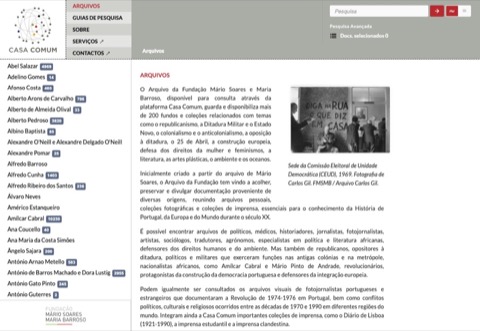
- Chinese-Indonesian Community documents collection from Java (University of Washington Libraries) (爪哇华裔印尼人社群文献数字馆藏(华盛顿大学图书馆))This is a digital collection released by the University of Washington Libraries in its ResearchWorks institutional repository (DSpace). It contains rare, fragile Sino-Malay materials from the libraries of two Chinese temples in Java. The project was carried out with Evi Sutrisno, an anthropology doctoral student whose research focuses on Confucianism among Indonesian Chinese. The first part comes from the Confucian temple in Surabaya (Boen Bio / Wen Miao, founded 1907), digitized in 2010–2011, mainly religious books and magazines; the page gives about 5,000 pages, including three private collections. The second part comes from Hok An Kiong in Muntilan, Central Java (founded 1898), digitized in 2014–2016, mainly popular Sino-Malay novels and magazines, about 12,500 pages. The materials reflect the religious life and reading culture of Indonesian Chinese communities from the 1900s to the 1940s and also concern Peranakan Malay-language publishing. They are valuable for research on Indonesian Chinese society, religion, literature and publishing history, and comparable primary sources are hard to obtain elsewhere.
Coverage, how to use, and notes
Coverage Includes materials from the temple libraries of Boen Bio in Surabaya and Hok An Kiong in Muntilan. The page gives about 5,000 pages (Surabaya, including three private collections) and about 12,500 pages (Muntilan). Languages are Chinese and Malay. The materials date from the 1900s to the 1940s. Content types are religious books, magazines and popular Sino-Malay novels. The page does not give the number of items in the project; please consult the official site.
How to use Enter the collection page through the permanent link and browse the sub-collections and items within ResearchWorks. The footer lists a user agreement and privacy policy; please read them before use. The page does not state whether individual files can be downloaded in bulk or give specific licensing terms; please check the item pages. Related follow-up projects (including UGM's digitization work after 2021) are described on the website of UGM's Center for Religious and Cross-cultural Studies (CRCS).
Notes The page does not state terms of use or reuse; please check the item pages and the user agreement before citing or republishing. The materials are mainly in Sino-Malay (old orthography) and Chinese, so reading them requires the relevant language skills.
- Clearing House for Archival Records on Timor (CHART) (东帝汶档案记录信息交流中心)CHART, which stands for Clearing House for Archival Records on Timor Inc., operates as the Timor Archives blog, with Michael Leach named on the page as chair. It is not itself a large physical collection; its main function is to guide researchers, explaining which institutions hold Timor-Leste-related archives and what documents each has, and it hosts a small number of digitized files. For Timor-Leste studies, where archives are scattered across Australia, Portugal and Timor-Leste itself, not knowing where to look is often the first hurdle, and this website serves as an introductory map. The website also has a Tetun-language section, a guide to sources on the Santa Cruz incident, and descriptions of collections held in Australian libraries. For regional studies researchers, it is a starting point for understanding the landscape of primary sources on Timor-Leste, and can also serve as a navigation page to collections held by overseas institutions.
Coverage, how to use, and notes
Coverage Collection leads listed on the page include: about 100 boxes of Jill Jolliffe papers and the Denis Freney papers at the National Library of Australia, the Kevin Sherlock Collection at Charles Darwin University, the Max Stahl video archive (Centro Audiovisual Max Stahl Timor-Leste in Timor-Leste, with a mirror at the University of Coimbra), and an exhibition of Santa Cruz documents on TiSA in Canada. Blog categories include Australian and Timorese collections, international collections, research, access, and tools and tips. For specific quantities, please check the website.
How to use Open the website directly and browse via menu sections such as Collections, Timorese Archives and Tetun, or by blog category (Access, Tools & tips, etc.). No registration is required, and PDFs and other files hosted on the site can be read and downloaded. To use the collections it points to in person, contact each holding institution separately to ask about opening and appointment rules.
Notes The site is a blog and is updated irregularly; the most recent article date visible on the page is 27 March 2024, and some sections are marked forthcoming. It is a guide rather than a search system, and original archives must be consulted at the holding institutions.
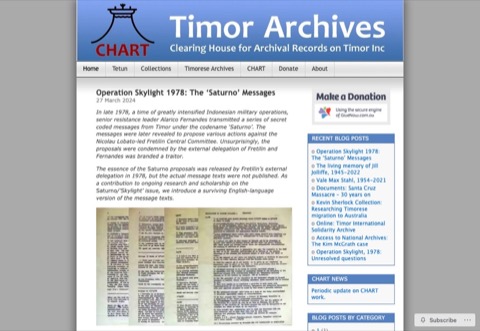
- Corpus of the Inscriptions of Campā (CIC) (占婆碑铭文集(CIC))The Corpus of the Inscriptions of Campā (CIC) is an online corpus of inscriptions built by the École française d'Extrême-Orient (EFEO) since 2009, hosted on the publishing platform of the Institute for the Study of the Ancient World (ISAW), New York University. Its aim is to update and continue the EFEO general catalogue of Campā inscriptions compiled by George Cœdès in the early 20th century, giving each inscription a unique C. number and progressively publishing known but unpublished inscriptions, newly discovered inscriptions and texts never translated, while re-checking earlier readings and correcting errors. Campā inscriptions are written in Sanskrit and Cam and are closely tied to the religious dedications of Campā kings, the founding of temples and monasteries, and land donations; they are core primary sources for the religious history of Hinduism, Buddhism and Cham society in south-central Vietnam. The site offers a search page and indexes of inscriptions and bibliography, is encoded to the EpiDoc and TEI standards, and gives translations mainly in English (with other languages also present), while print publication is mainly in French and Vietnamese. The site documentation is released under a Creative Commons Attribution license. The project is ongoing work released in stages, not a corpus completed in one go.
Coverage, how to use, and notes
Coverage Covers Campā inscriptions in Sanskrit and Cam. The numbering of the historical catalogue rose from 118 entries in 1908 to 200 after the 1942 supplement. The official site does not state how many entries the online edition will finally include or how many are currently online; the most recent update notice on the homepage dates from 2014.
How to use Open the official homepage and use the navigation menu to reach the inscriptions (index), bibliography or search pages. You can browse entry by entry by C. number and read the transliteration, critical apparatus and translation. No registration is required. The documentation is under a CC BY license; when citing, attribute according to the site's 'credits' and citation notes.
Notes The site is released in stages and entries vary in completeness; the homepage news stops at 2014, so please rely on the version and date shown on each entry page. The content is mainly linguistic and epigraphic editing, so basic knowledge of Sanskrit or Cam, or reliance on translations, is needed.
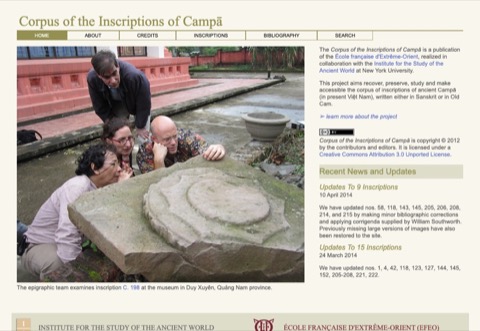
- DREAMSEA (Digital Repository of Endangered and Affected Manuscripts in Southeast Asia) (东南亚濒危与受损手稿数字仓库(DREAMSEA))DREAMSEA is a digital preservation project for Southeast Asian manuscripts; its website is dreamsea.co. The page of the Centre for the Study of Manuscript Cultures (CSMC) at the University of Hamburg explains that the project aims to preserve these manuscripts, often privately held and in fragile condition, and their contents, and that in 2021 it launched an open database as a reference source for Southeast Asian manuscripts. High-resolution images are made available online through cooperation with the Hill Museum and Manuscript Library (HMML) in Minnesota, USA. Indonesia is one of the main countries digitized, along with Thailand and Laos. For readers studying Indonesian religious texts, Islam and local belief traditions, and manuscripts held by monasteries and communities, it is a primary-source entry point where images of the originals can be viewed directly.
Coverage, how to use, and notes
Coverage According to the CSMC page at the University of Hamburg, more than 2,000 manuscripts from Indonesia, Thailand and Laos have been digitized since 2018. The database is described as open access. The official pages do not state here the manuscript languages, their distribution by region or the latest total; please consult the official website.
How to use Enter the project website through dreamsea.co and browse the project introduction and the manuscript database. High-resolution images are available online; for specific search fields and download and reuse terms, please consult the official website and the HMML page.
Notes The website's homepage is a large single page, and some pages show only titles when read automatically; accessing it directly in a browser is recommended. The manuscripts are mainly codex-type texts, not temple inscriptions or Chinese association archives. When using the images, please follow the copyright and usage notes on the website.
- DREAMSEA Repository (Digital Repository of Endangered and Affected Manuscripts in Southeast Asia) (DREAMSEA 东南亚濒危手稿数字库)DREAMSEA is a Southeast Asian manuscript digitisation project run jointly by the Center for the Study of Islam and Society (PPIM) at UIN Syarif Hidayatullah Jakarta, Indonesia, and the Centre for the Study of Manuscript Cultures (CSMC) at the University of Hamburg, funded by Arcadia. The project digitises privately held manuscripts on site where their holders are located and prepares detailed metadata for each manuscript; the images are published through the Hill Museum and Manuscript Library (HMML) HMML Cloud and can be viewed online in high resolution. For readers studying Javanese, Malay, Islamic and local writing traditions in Indonesia, this is an entry point to primary manuscript images, and it also helps in understanding the local textual environment and cross-cultural context in which Chinese communities in the Nanyang region lived. According to the CSMC project page, since December 2017 a total of 2,170 manuscripts and 129,478 pages from 56 collections in Southeast Asia have been digitised. The repository page has three sections, Manuscripts, About and Contact, and can be entered without logging in.
Coverage, how to use, and notes
Coverage According to the University of Hamburg CSMC project page: 129,478 pages, 2,170 manuscripts and 56 collections from across Southeast Asia; the repository's About page states that manuscripts in any script and discipline from the region are accepted. The repository's own pages do not list numbers or languages; please rely on the repository for the specific scope of the Indonesian part.
How to use From the repository homepage, click the Manuscripts section to browse manuscript records and images; the About page explains the project background and conditions of use. No registration is required. Text content in HMML Cloud is licensed under CC BY-NC 4.0, while images retain their own rights; the page requires that they not be copied or redistributed, and the details of image licensing should be confirmed with the holding institution.
Notes The CSMC page says the project was originally planned to run until 2025, while the repository's About page gives 2017–2022; please rely on the official site for whether the project is still adding material; some research notes that coverage is uneven across countries. Images may not be freely redistributed, so check the licence before citing or publishing.
- David K. Wyatt Thai Collection (Ohio University Libraries) (戴维·K·怀亚特泰国文献特藏(俄亥俄大学图书馆))The David K. Wyatt Thai Collection is a set of Thai studies materials acquired by Ohio University Libraries in 2005 and held by the Libraries' Center for International Collections. The website calls it a treasure trove of primary and secondary materials on Thailand, including rare Thai-language monographs, cremation volumes and manuscripts. The part offered online consists mainly of the diaries (1876–1887) and travel accounts of King Chulalongkorn (Rama V), whose travel accounts cover his journeys to India, Malaya, Singapore, Java, Europe and remote parts of Siam. The accounts concerning Singapore, Malaya and Java are directly useful for researchers interested in contacts between the Siamese king and the Straits Settlements and the Dutch East Indies. These digitized books are listed by the website under the digital archive section of the collections and are provided through the Internet Archive; they also appear in the Southeast Asian Digital Library (SEADL), hosted by Northern Illinois University, and can be accessed free of charge.
Coverage, how to use, and notes
Coverage The website states that 59 volumes are online, all books published in Thailand in the 19th century, of which 58 are in Thai and 1 is in English. The content consists mainly of King Chulalongkorn's diaries of 1876–1887 and his travel accounts of journeys to India, Malaya, Singapore, Java, Europe and parts of Siam. The website does not state the overall size of the special collection; please consult the official website.
How to use Enter from the Ohio University Libraries digital collections page, then follow the page's instructions to the corresponding volumes on the Internet Archive; the same materials can also be found in the Southeast Asian Digital Library (SEADL) at Northern Illinois University. Internet Archive pages can be read online and can usually be downloaded; for formats, see that page. Thai books must be searched with Thai keywords, while English volumes can be searched by English title. The website lists a contact person: Jeff Shane, Southeast Asia reference librarian (Center for International Collections). The official page does not state how to consult the offline special collection; please contact the library first to confirm.
Notes The online part is only a small portion of the special collection, mainly the king's diaries and travel accounts published in the 19th century, and does not include official documents or legal texts. The texts are mainly in Thai, and scan quality and searchability vary by volume.
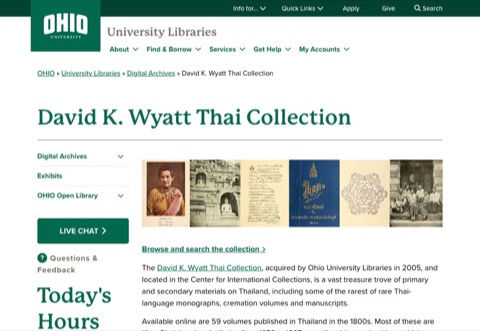
- Digital Indonesia (Cornell University Library) (数字印度尼西亚(康奈尔大学图书馆))Digital Indonesia is an online exhibition site of Cornell University Library's Echols Collection and the Southeast Asia Program, intended to present digitized Indonesian materials from Cornell and other sources to Indonesian-language readers. According to the Cornell Einaudi Center page, the project was announced around 2 February 2026, and more resources will be added over time. The site is maintained by the Echols Collection librarian team, partly funded by the Patrick and Ayu Walujo Library Fund, and is available in English and Indonesian. Featured collections currently listed are the Bandung Artist Collection, the Indonesian Music Archive, the Kroch Library Asian Rare Materials Archive, Southeast Asian Visions, the Claire Holt Archives and the Niels Douwes Dekker Photography collection. The site also lists 18 undigitized Cornell collections related to Indonesia, and three further special collections for which digitization can be requested. It is helpful for research on Indonesian art, music, photography, and the late colonial to early independence period; researchers of Indonesian Chinese may also follow leads through the photography and rare materials collections.
Coverage, how to use, and notes
Coverage The site is a curated entry point rather than a single database. The featured digital collections listed on the site are six: Bandung Artist Collection, Indonesian Music Archive, Kroch Library Asian Rare Materials Archive, Southeast Asian Visions, Claire Holt Archives, and Niels Douwes Dekker Photography. Another 18 undigitized collections are listed. The site does not give the total number of digitized items; please consult the official site.
How to use From the homepage, enter the featured collections to browse each digital collection page; the site has English and Indonesian interfaces. For undigitized collections, the site advises contacting the Southeast Asia digital librarian to request digitization; contact details are on the site. The homepage and descriptions can be browsed without registration.
Notes The site states that materials are for educational use; unless otherwise noted, images and text are protected by US copyright law, and reuse requires obtaining permission. The project is new and content is still being added. Materials directly related to Chinese topics must be found by searching through the individual sub-collections.
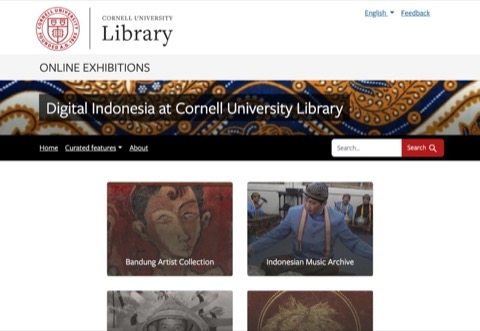
- Digital Library of Lao Manuscripts (DLLM) (老挝手稿数字图书馆)The Digital Library of Lao Manuscripts (DLLM) is an online image repository of indigenous Lao manuscripts, built through a collaboration between the National Library of Laos, the University of Passau (Germany) and the Staatsbibliothek zu Berlin, with funding from the German Research Foundation (DFG) and the German Federal Ministry for Economic Cooperation and Development (BMZ). The site is hosted on the CrossAsia platform of the Staatsbibliothek zu Berlin. Its inventory is based on surveys carried out in temples across the country from 1992 to 2004 under the Preservation of Lao Manuscripts Programme (PLMP), implemented by the Lao Ministry of Information and Culture and funded by the German Foreign Office. The materials are mostly Theravada Buddhist texts, often with Pali and Lao in parallel, and also include history, traditional law and customs, astrology, medicine, grammars and dictionaries, poetry and folktales. For scholars of religion, law, social history and writing traditions in Laos and the upper Mekong region, it is a rare entry point for viewing images of primary manuscripts online. The interface is available in English and Lao.
Coverage, how to use, and notes
Coverage The website states that it holds images of more than 12,000 texts; the page showed 12,168 searchable texts at the time. The texts mainly belong to the Lao, Lan Na and Tai Lue traditions, with a small number in Tai Nuea, Tai Dam and others. Coverage is geographically broad and spans a long period, involving multiple scripts and languages. The website notes that the Lao literary tradition can be traced back to the 15th/16th century, and that microfilming favored manuscripts more than 150 years old.
How to use Access the DLLM page on CrossAsia, or use the search interface at iiif.crossasia.org/s/dllm. Searches can be made by title, auxiliary search terms, language, script, category, writing material, place, date or PLMP number. Images can be browsed online, and the full set of images of a catalogued text can be downloaded. The Text View page has offered experimental searching of images within texts since 2011. For high-resolution images for publication, contact DLLM. Displaying Lao script on screen requires a Unicode Lao font.
Notes The website does not state a single usage license for the whole site; before reproduction or publication, contact DLLM and credit the rights holder as the website requires. Some grayscale images were digitized from microfilm, while color images were taken directly from the originals; since January 2012, manuscripts of the National Library of Laos have gradually been replaced with color images, and whether this is complete should be checked on the website. The site was first built in September 2009, so some descriptions may be outdated. Some sources mention about 86,000 texts from more than 800 temples; that is the total preserved by the PLMP, not the number digitized online.
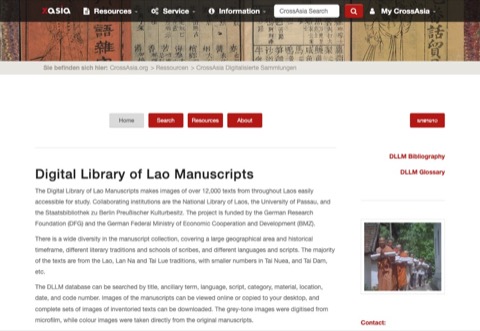
- Endangered Archives Programme EAP1432: Recalling a trans-local past: digitising Mon palm-leaf manuscripts of Thailand, Part 2 (濒危档案计划 EAP1432:泰国孟族贝叶经数字化(第二期))EAP1432 is a project funded by the British Library's Endangered Archives Programme and led by Dr. Patrick McCormick, digitizing manuscripts such as palm-leaf manuscripts held in Mon Buddhist monasteries in Thailand. The British Library's introductory article uses a Mon funeral book from Wat Koh in Samut Sakhon as an example to show that the project's materials come from monasteries. After digitization, the originals remain in the monasteries, and the images can be viewed free of charge on the British Library's EAP website. For the study of religion and community archives in Thailand, the value of these materials lies in their being primary texts long preserved within monasteries, which can be used to understand Buddhist rituals, funeral beliefs, and the transmission of writing and religion in Mon communities in Thailand. The Mon are not ethnic Chinese, but the project is a digitization practice for Thai monastery and community archives, and it also offers a reference for preserving the archives of Chinese clan associations and temples, making it suitable to read alongside research on Southeast Asian Chinese religion and communities.
Coverage, how to use, and notes
Coverage According to the British Library, the project digitized more than 900 manuscripts, about 38,000 folios, including 35 illustrated manuscripts. The sample material comes from Wat Koh in Samut Sakhon, a Mon funeral book of the 19th or early 20th century. For the list of other monasteries, the language composition, and the dates of individual manuscripts, please refer to the EAP website.
How to use Go to eap.bl.uk and browse under project page EAP1432, or enter EAP1432 and keywords (such as monastery name, Mon, Pali, parabaik) in the site-wide search box. Illustrated manuscripts can be searched separately on the site. Images can be viewed online free of charge, with no paid subscription needed. Before use, it is advisable to read the notes on each collection page to understand the numbering rules and levels of description, then open the manuscript files one by one. When citing, note the project number, collection number, and file number.
Notes The British Library's article mentions that the Wat Koh collection has not yet been fully cataloged, and the descriptions of many items are brief. The language of the text of a single manuscript is described inconsistently across descriptions, so it should be checked against the images. At the time of this verification the project page (eap.bl.uk/project/EAP1432) did not load; project information comes from the British Library's introductory article, so please refer to the official website.
- Endangered Archives Programme EAP250: Preserving East Timor's endangered archives, stage two (British Library) (大英图书馆濒危档案项目 EAP250:东帝汶濒危档案保存(第二阶段))EAP250 is a project funded by the British Library's Endangered Archives Programme and is the second phase of the Timor-Leste archive preservation project, following the earlier EAP032. It covers the original documents on which the report of the Timor-Leste Commission (CAVR) was based; these materials are regarded as the main written evidence on Timor-Leste's decolonization and related political, legal and military issues. The originals are held by the Post-CAVR Technical Secretariat, and copies are deposited at the British Library. The British Library's search system (searcharchives.bl.uk) already has series records for EAP250/1, for example Strategic Management, which the page shows as 501 TIFF images in English, Indonesian, Portuguese and Tetum (Latin script), with a link to view the digitized content online. For scholars of truth and reconciliation in Timor-Leste and the history of the occupation, this is an entry point to searchable primary materials held overseas.
Coverage, how to use, and notes
Coverage According to the search results, EAP250/1 includes series such as Strategic Management, Public Relations, Truthseeking and Victim Support. Taking Strategic Management as an example: dated 2010, 501 TIFF images, in English, Indonesian, Portuguese and Tetum. For the overall scale and the digitization status of all series, please consult the official site.
How to use Search for EAP250 at searcharchives.bl.uk, open each series record, and view the digitized content online via the thumbnails or links. The records list the access condition as restricted: contact British Library staff; for research use only; not available for consultation in the reading room, but digital copies can be viewed online.
Notes Some items are restricted, and the purpose of the research must be explained to the library. The opening-date field in the records appears to contain a typographical error; please confirm with the library. The project homepage (eap.bl.uk) displayed no content at the time of checking; please rely on the library's latest pages.
- Foreign Relations of the United States – Laos volumes (Office of the Historian) (《美国外交关系文件集》老挝卷(美国国务院历史学家办公室))Foreign Relations of the United States (FRUS) is an official compilation of diplomatic records edited and published by the Office of the Historian of the U.S. Department of State, and the website history.state.gov provides full text online. There are three volumes specifically on Laos: the Laos microfiche supplement for 1958-1960, Volume XXIV, Laos Crisis, for 1961-1963, and Volume XXVIII, Laos, for 1964-1968. Volume XXI for 1955-1957 and Volume XVI for 1958-1960 also include Laos in their titles. Among these, Laos Crisis was edited by Edward C. Keefer, with Glenn W. LaFantasie as general editor, and published by the U.S. Government Printing Office in 1994; it contains documents 1 to 491, arranged chronologically. For scholars of Laotian neutralization during the Cold War, the Geneva Conference, U.S. policy toward Laos and international relations in the Mekong region, this is a commonly used declassified primary source. The Laos tag page of the website collects the FRUS volumes that deal with Laos.
Coverage, how to use, and notes
Coverage The Laos tag page of the website lists 97 FRUS volumes involving Laos, ranging from 1945 to around 1980; the volumes devoted to Laos are the three mentioned above. The Laos Crisis volume contains 491 documents arranged by chapter in chronological order, beginning with the January to March 1961 transition between the Eisenhower and Kennedy administrations. The documents are in English and consist mainly of U.S. diplomatic telegrams, memoranda and meeting records. For the page counts and editorial notes of each volume, please check the website.
How to use Go to history.state.gov, use the Laos tag page or open the desired volume directly, browse by chapter and use the site search. The Laos Crisis volume page offers EPUB and Mobi e-book downloads. When citing, state the volume number, document number and editors. To find documents in the microfiche supplement, access them through the corresponding supplement page. No registration is required.
Notes FRUS is a selection from the U.S. government perspective, not Laos's own archives, and does not represent all declassified material. The documents included are editorially selected, and some contain excisions or notes on withheld material. Volumes were published at different times, and more recently declassified material may not yet be included.
- France-Vietnam: Shared Heritage Online (BnF) (France-Vietnam : des patrimoines partagés en ligne (BnF);法国—越南:共享遗产在线图书馆(法国国家图书馆))France-Vietnam: Shared Heritage Online Library is a thematic digital library in the 'Patrimoines Partagés' (Shared Heritage) series of the Bibliothèque nationale de France (BnF), built in cooperation with the National Library of Vietnam; the site also credits CIRAD as a partner. The site focuses on the period from the mid-19th to the mid-20th century, when French and Vietnamese histories were most closely intertwined, organizes documents by theme, and links entries to the originals in Gallica (the BnF digital library) and the digital collections of the National Library of Vietnam. Content types include periodicals (including Vietnamese-language newspapers), books and literature, and legal-deposit publications from colonial Indochina. For Vietnam studies it works as an editorially guided entry point: instead of searching blindly in vast collections, researchers can start from sections such as 'Government and Dynasties', 'Economic Life', 'Science and Society', and 'Thought and Beliefs', then jump to the primary sources. For studies of Southeast Asian Chinese and the region, administrative, economic (e.g. rice and rubber), and press materials from French Indochina are background sources for research on the Chinese in Vietnam, Cholon, and the colonial economy. The website is available in French and Vietnamese.
Coverage, how to use, and notes
Coverage The website states that it contains more than 2,000 documents on the shared history of France and Vietnam, with an editorial focus on the mid-19th to mid-20th century. Sections include Circulations, Traditions, Literature, Thought and Beliefs, Cultural Exchange, Government and Dynasties, Science and Society (including medicine, public works, and agricultural products such as coffee, tea, rubber, and rice), and Economic Life. Documents are mainly in French, with some Vietnamese materials; the specific language and date of each item should be checked on the item page.
How to use Visit the website directly; no registration is required. Use the site search on the home page, or browse section by section; pages offer grid and list views. Most item pages provide links to Gallica or the National Library of Vietnam digital collections (sach.nlv.gov.vn); when the full text is needed, follow the link to the original repository. The home page also offers a direct entry to Gallica search. The interface can be switched between French and Vietnamese. When citing, it is advisable to record both the permanent link in the original repository and the publication details of the document.
Notes This is a curated thematic library of about 2,000 documents and is not equivalent to the full holdings of Gallica or the National Library of Vietnam; systematic searching still requires going to the original repositories. Some external links to the National Library of Vietnam site may be inaccessible depending on the network environment. The website does not state a dedicated section on the Chinese (Hoa); relevant material must be selected from the economic, press, and other sections.
- Joel M. Halpern Laotian Slide Collection (乔尔·M·哈尔彭老挝幻灯片收藏)This is a collection of Lao images made openly available by the University of Wisconsin–Madison Libraries (UW–Madison Libraries) through the University of Wisconsin Digital Collections (UWDC). The collection consists of slides taken by anthropologist Joel M. Halpern, covering royal ceremonies, village life, American aid and so-called hill tribe communities in Laos, with a focus on Luang Prabang and northern Laos. The slides were later donated to the university library's special collections and are the starting point of the Lao component of the University of Wisconsin Southeast Asia digitization project (SEAiT). For those studying mid-20th-century Lao society in the kingdom period, ethnography, Cold War-era aid and everyday life, these field images are primary visual material that is hard to find elsewhere. The library page notes that the library generally does not own the copyright in these materials, so the rights statement for each item should be checked before use.
Coverage, how to use, and notes
Coverage The page states there are "slightly more than 3,000" images, taken in Laos in 1957, 1959 and 1969, almost all by Halpern. Digitization began in late 2003, metadata was completed in early 2005, and the collection description was last updated on 20 April 2007. The content consists of images and their captions; for specific languages and fields, please check the website.
How to use Open the Laos digital collection page of UW–Madison Libraries, where the collection can be searched or browsed by catalog. Searches can combine English terms such as place names (e.g. Luang Prabang) and subject terms (e.g. ceremony, aid). No registration is required. Rights information for each item is given on its record page and should be checked before copying or publishing. The page notes that the content may not fully meet current accessibility standards; an accessible version can be requested from library staff.
Notes This is a single scholar's field slides and reflects the photographer's perspective and period; it is not a systematic official archive. The collection description is old, so whether the page is still being updated should be checked on the website.
- Khmer Manuscript Heritage Project (Buddhist Digital Resource Center) (高棉手稿遗产计划(佛教数字资源中心))The Khmer Manuscript Heritage Project has been carried out by the Buddhist Digital Resource Center (BDRC) since 2019, with the goal of digitizing Cambodia's surviving manuscripts, many of which are endangered. The website explains that most of Cambodia's traditional manuscripts were destroyed in the 1970s and 1980s, and that the surviving texts concern Khmer literature, history, science, religion, and medicine. The project is funded by A Khmer Buddhist Foundation, with local partners Digital Divide Data and the Fonds pour l'Édition des Manuscrits du Cambodge (FEMC) of the École française d'Extrême-Orient (EFEO), which has worked on Cambodian manuscripts since 1990. The digitization results are available for image viewing through BDRC's BUDA platform, including black-and-white microfilm images taken by FEMC between 1991 and 2004. For scholars studying pre-colonial and colonial-period monastery texts, local social history, and religious and legal texts, this is the main online entry point to images of Cambodian manuscripts.
Coverage, how to use, and notes
Coverage According to the project page, 11,596 surviving manuscripts were digitized in about two and a half years, with more than 1.4 million archived pages, including 757,507 pages of images taken by FEMC between 1991 and 2004. The EFEO–Preah Vanarat Ken Vong Library holds more than 125,000 pages and is the largest manuscript collection in the country; Wat Phum Thmei holds 1,210 manuscripts, and the National Library holds about 524. For the date and language (Khmer, Pali, etc.) of each manuscript, please consult the individual entry.
How to use The project page states that the digitized manuscripts can be accessed free of charge through the website, and that the full archive is in the BDRC library (library.bdrc.io), hosted by the BUDA platform with an image viewer. The project page does not describe the specific search functions; after entering BUDA, search by manuscript name, holding location, or work title, and read the platform's usage instructions first.
Notes The project page does not state the licensing and reuse terms for the digital content; please consult the terms of use of BDRC or BUDA. This entry leans toward religious and literary manuscripts rather than government records, but is useful for research on religion, law, and local social history.
- Mapping Philippine Material Culture (菲律宾物质文化地图(海外馆藏菲律宾文物在线名录))Mapping Philippine Material Culture is an online platform built by Philippine Studies at SOAS (School of Oriental and African Studies, University of London). It brings together records of Philippine material culture scattered across museums and other institutions worldwide, presented as digitized items, collections and curated exhibits. The platform is built with Omeka and Curatescape and was designed and developed by Arkivox. The project began in early 2021 and, according to a SOAS announcement, focuses mainly on objects made, traded, used or ritually employed in the Philippines between about 1500 and 1950, drawing on earlier work to inventory Philippine artefacts held overseas. Many objects, photographs and documents that left the Philippines during the colonial period are now held by overseas institutions, and researchers often do not know where they are. The platform offers a single search entry point for tracing where a type of object survives, which institution holds it and where images come from. It may also be useful to scholars of colonial collecting history, material culture, maritime trade and objects associated with Chinese communities, such as ceramics and trade goods. The platform also has a section on repatriation-related projects.
Coverage, how to use, and notes
Coverage The platform covers digital records of Philippine material culture held by various institutions, including Items, Collections and Exhibits (the homepage shows 35 exhibits). The period covered is mainly about 1500 to 1950; objects made after 1950 and unprocessed natural specimens are out of scope. Most data and images are published with institutional permission, and some data are under Creative Commons licences. The homepage does not state the total number of items; please check the website.
How to use No registration is needed; simply visit the website. The homepage offers browsing of Items and Collections, an exhibit list, a 'view a random item' function, a Charts page and a Contributors page. You can browse by institution or collection first, then open an individual item to see images, descriptions and information on the source institution. Before citing or reusing images, check the copyright and licence stated on each item and, where necessary, contact the holding institution.
Notes The website notes that much of the material dates from the colonial period, and that titles, transcriptions and institutional names may contain inaccurate, derogatory or harmful wording; content does not represent the project's views, and the sensitive-content notice mechanism is not yet fully implemented. Items are mostly records rather than high-resolution downloads of originals; terms of use are as stated on each item.
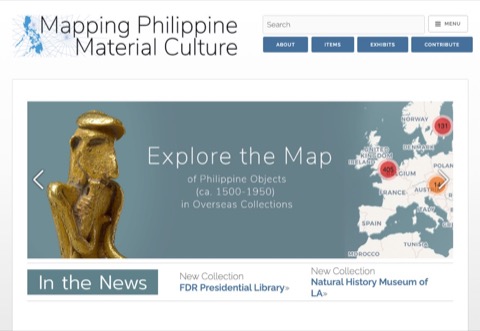
- Memory of Nations – Burma/Myanmar (Paměť národa) (民族记忆:缅甸口述历史见证人档案)Memory of Nations (Czech: Paměť národa) is an online archive of witness oral histories, founded jointly by Post Bellum, Czech Radio, and the Institute for the Study of Totalitarian Regimes (ÚSTR). The English version of the site has a Burma/Myanmar section, which currently lists 24 witness profile pages, each giving a name and year of birth, for example Aung Kyaw Moe (alias Bo Tauk, born 1964). The section's background is supporting Myanmar's democratization by preserving witnesses' oral memories; interviewees include former political prisoners who experienced repression first-hand. For Myanmar studies, these interviews can serve as primary material on political prisoners' experiences, the social history of the military-rule period, resistance movements, and human rights issues, and can also be compared with other oral history projects in the region. Note that the section page shows only entry points to witness profiles; for the language, transcripts, and video content of each interview, please open the individual entries. The site also has a login-only e-archive research area; this entry recommends only the publicly browsable part.
Coverage, how to use, and notes
Coverage The Burma/Myanmar section has 24 witness profiles (listed over three pages), arranged by name and year of birth. The site-wide statistics are 22,300 witnesses, 12,704 witness stories, 189,737 photographs, and 74,139 clips; these figures apply to the whole site, not to the Myanmar section. The languages and transcription of the interviews are not stated on the section page; please consult the site.
How to use On the English version of memoryofnations.eu, go to the Burma/Myanmar section, browse the witness list page by page, and open individual pages. The site interface is available in English, Czech, and Slovak. Public browsing requires no login; the e-archive research area requires registration or login, so please read the site's instructions before use. When citing, give the witness's name, the entry URL, and the access date.
Notes The Myanmar section is limited in scale (24 witnesses), the site does not explain how interviewees were selected, and the material comes mainly from a Czech project, so it cannot be taken as fully representative of Myanmar society. The section page shows only entry points to profiles; the depth of the content must be checked entry by entry.
- Myanmar Manuscript Digital Library (MMDL) (缅甸手稿数字图书馆(多伦多大学))The Myanmar Manuscript Digital Library (MMDL) is an open-access digital archive led by the Department for the Study of Religion, Faculty of Arts & Science, University of Toronto, with its collections hosted at the university's Robarts Library. According to a 2020 University of Toronto news release, the project was carried out over more than five years by a team of international scholars and volunteers who digitized, cleaned, catalogued, and organized the materials, with Associate Professor Christoph Emmrich responsible for the launch. The library holds manuscripts and rare printed books from libraries across Myanmar, on topics including Buddhist texts and doctrine, medicine, and astrology. The project aims to preserve Myanmar's textual heritage and provide equal access to scholars worldwide, including those in Myanmar; the site is designed with users with limited connectivity in mind, keeping download sizes small. The project has also established a partnership with the National Library of Myanmar and plans to add about 10,000 texts from the library's Pali palm-leaf collection. For readers studying Myanmar's religious history, monastic legal texts (such as Vinaya and kammavaca literature), local knowledge traditions, and the writing cultures of the pre-colonial and colonial periods, MMDL offers a free entry point for viewing images of the originals, and can also serve as a supplementary resource for research on Theravada Buddhist texts in Southeast Asia.
Coverage, how to use, and notes
Coverage The library holds manuscripts (including palm-leaf manuscripts and folded parabaik) and rare printed books from libraries across Myanmar, on topics including Buddhist texts and doctrine, medicine, and astrology, mainly Pali and Pali–Burmese texts. The news release states that the initial collection started with the holdings of the U Po Thi Library in Thaton and that about 10,000 texts from the National Library of Myanmar are expected to be added; the current total and the number and dates of items in each sub-collection could not be read from the site in this verification; please consult the site.
How to use At mmdl.utoronto.ca, browse or search manuscript entries by collection source and view images or download files online; the site is officially described as open to the world free of charge. The site uses a browser verification page, so a mainstream browser such as Chrome, Safari, or Edge with JavaScript and cookies enabled is recommended. Before citing or reusing materials, consult the site's terms of use. For detailed cataloguing of the U Po Thi Library holdings, see the relevant catalogues published by the Pali Text Society.
Notes The URL of this entry was confirmed from the University of Toronto's official news release; the site itself uses a human-verification page, so the collection list could not be read in this check; please consult the site for the size of the holdings and search functions. The site footer carries a copyright notice; open access does not mean unrestricted reuse. The content consists mainly of religious and literary manuscripts rather than administrative or legal archives, and is suitable as a supplement for research on texts and writing culture.
- Myanmar Photo Archive (缅甸照片档案馆)The Myanmar Photo Archive is a digital archive of historical Myanmar photographs, launched as a private project by the Austrian artist Lukas Birk; the website states that it is supported by the European Union. The site has English and Burmese interfaces and can be browsed by category, including Buddhism, film, fashion, female portraits, history, industry, male portraits and albums. It also has a search page, tag-based category lists, thematic articles, sections on exhibitions and publications, and a description of digitisation training. The About page states that the earliest images date to 1890. It also notes that before the 1950s most photo studios in Myanmar were run by foreigners, often of Indian origin, and that as the Indian-run studios declined, Chinese photographers took over a considerable part of the trade. Studio portraits, family albums and commercial images in the archive may therefore be useful for studying Chinese communities, daily life, dress and visual culture in Yangon and elsewhere, and can be cross-checked against written sources.
Coverage, how to use, and notes
Coverage The About page states that the earliest images date to 1890 and that the archive continues into the present century. The site does not state the total number of images or the number of Chinese-run studios; please consult the site. Categories include Buddhism, film, fashion, portraits, history, industry and albums. The site is available in English and Burmese.
How to use From the homepage, enter the 'archive' page and browse by category or tag, or use the search function. Terms of use, copyright and privacy rules for online images are on the site's 'Terms' and 'Copyright / Privacy' pages; read them before using or reproducing images. For physical archives or higher-resolution images, contact the project through the contact details on the site.
Notes The site does not publish the total number of images online; what is visible online is only part of the physical archive. Information on photographer, date and place may be incomplete; check item descriptions and terms of use before citing in scholarly work.
- Nom Foundation Digital Library (lib.nomfoundation.org) (喃字基金会数字图书馆)This digital library was built by the Vietnamese Nôm Preservation Foundation, with the aim of preserving and providing digitized texts of Vietnamese cultural heritage written in Chữ Nôm. The foundation is a US-based 501(c)(3) non-profit, and the website states that its work relies on grants and individual donations. The homepage lists three collections: the Hán-Nôm holdings of the National Library of Vietnam (NLV), and the collections of two temples, Thắng Nghiêm and Phổ Nhân. The National Library of Vietnam collection page is organized by the traditional four-part classification (classics, history, philosophy, and belles-lettres). For scholars of Vietnamese Hán-Nôm documents, Buddhist temple documents, and Chinese- and Nôm-script manuscripts, it is one of the few public entry points where digitized Hán-Nôm originals can be browsed online.
Coverage, how to use, and notes
Coverage The National Library of Vietnam collection page lists by the four-part classification: 68 items in classics, 371 in history, 399 in philosophy and 412 in belles-lettres, totaling 1,250 items (this figure is the sum of the category counts; the website does not give a total). There are also the collections of the two temples, Thắng Nghiêm and Phổ Nhân. The date span and breakdown by language are not stated on the website; please consult the website.
How to use Open the homepage and choose one of the three collections; the National Library collection page can be browsed by the four categories of classics, history, philosophy and belles-lettres, and the page also has a search box. No prompt requiring registration or login is visible on the page. The homepage does not state search syntax or download and export options; check the individual item pages. If you have questions, contact the foundation as prompted on the page; errors in the web application can be reported on Launchpad.
Notes The homepage does not state terms of use, licensing or citation format; before publication, please check the authorization of the original holding institution. The foundation decided to dissolve at the end of 2018; for the long-term maintenance of the site, please consult the website.
- Online Burma/Myanmar Library (缅甸网络图书馆)The Online Burma/Myanmar Library is one of the most commonly used open entry points for research on Myanmar, bringing together, in classified and annotated form, links and documents pointing to full-text materials on Myanmar. Content is organized by theme, for example Rakhine State, the International Court of Justice and Myanmar, climate change and women's rights. The 'latest content' section on the homepage also updates daily issues of official newspapers such as The Global New Light of Myanmar and Myanmar Alin, and the site holds United Nations reports and documents on human rights, health and conflict. The site also has a 'Historical Documents' category with subcategories including accounts of Myanmar written by travellers, diplomats, merchants and soldiers, socio-economic history documents, missionary memoirs and accounts, philatelic literature, and Burmese Royal Orders (1598–1885), which can serve as a starting point for colonial-era and earlier sources. For studies of Southeast Asian Chinese and regional studies, it is suited to finding national background on Myanmar, official documents and leads to historical sources, and then tracing the original source through the entries. The site interface is available in English and Burmese.
Coverage, how to use, and notes
Coverage The page describes itself as a classified and annotated library of links to full-text materials on Myanmar; the pages give two different figures, 'more than 50,000' and 'more than 60,000', so please consult the website for the actual size. The languages are mainly English and Burmese. Content includes historical documents (five subcategories, for example 44 traveller accounts, 9 missionary accounts and 1 entry for Burmese Royal Orders (1598–1885)), daily issues of official newspapers, and United Nations and human rights documents. The operating institution is not stated on the pages consulted.
How to use From the homepage, use 'Browse' to go through thematic categories level by level, or use 'Search' (including advanced search) to look up keywords; the site also has help/FAQ pages and offers a Burmese font download package. No registration is needed to browse. Most entries are links to external sites or PDFs; for downloading and citation, please go back to the terms of the original source. It is advisable to start with the 'Historical Documents' category for colonial-period accounts, and then supplement with searches using names of people and places.
Notes The pages do not state the operating institution or terms of use, and the footer only notes that copyright is reserved; most entries are external links that may become invalid as the original sites change, so when citing, please check the original source and record the date of access.
- Online Jiapu Search (FamilySearch) (FamilySearch 中国家谱在线检索)Online Jiapu Search is FamilySearch's search portal for Chinese genealogies (jiapu). FamilySearch describes it as the largest online collection of Chinese genealogies, and the official page states that the collection holds more than 65,000 genealogies. Readers can search by surname, ancestral village, hall name, founding ancestor's name or generation name, and the page also offers map-based browsing and video tutorials. For researchers of Nanyang Chinese, these genealogies can be used to trace overseas Chinese ancestral places, lineage descent, places of departure and clan networks, linking fieldwork and archival materials on Southeast Asian Chinese society with clan documents from the ancestral places. Compared with physical genealogy collections in institutions such as the National Library of Singapore, its advantage is that genealogy images can be browsed online, and searching by ancestral village and hall name suits research that starts from the ancestral place.
Coverage, how to use, and notes
Coverage The official page states that the collection holds more than 65,000 Chinese genealogies. The page does not state the date span, the distribution by province, or the number of genealogies from Southeast Asia; please refer to the website.
How to use Open the page and use its search portal to search by surname, ancestral village, hall name, founding ancestor's name or generation name, or browse by map. Viewing genealogies requires first registering a free FamilySearch account. When searching, it is advisable to try different spellings of surnames as well as the county, township and village names of the ancestral place.
Notes FamilySearch's Help Center notes that the organization has suspended access to some Chinese genealogy records following a review of privacy laws, contractual agreements and technical requirements; which records are affected and for how long is not stated officially. Please confirm on the website whether the genealogy you need is currently viewable before use. Most genealogies are clan documents from mainland China, not specifically Southeast Asian Chinese genealogies.
- Ons Land (Onsland.nl) (我们的国家(荷兰—荷属东印度—印度尼西亚共同历史平台))Ons Land (onsland.nl) is an online platform on the shared history of the Netherlands, the Dutch East Indies and Indonesia; the website states that it is operated by the Indisch Herinneringscentrum (Indisch Memorial Centre) in The Hague. According to the Koninklijke Bibliotheek (KB, the Royal Library of the Netherlands), the platform was built by the IHC, the KB and WO2Net, grew out of the Indies heritage digitisation project funded by the Dutch Ministry of Health, Welfare and Sport, and went online in October 2024. It brings together collections from more than 70 heritage institutions, archives and museums, with a focus on the Second World War, decolonisation and their aftermath. The site's content includes historical materials from archives and museums, thematic stories, maps, a timeline (1500 to the present), profiles of historical figures, oral histories and teaching materials, and it also offers family history searches. For researchers of modern Indonesian history, colonial-era society and postwar migration, it is a single entry point for finding documents, photographs and oral materials scattered across Dutch institutions.
Coverage, how to use, and notes
Coverage The website home page states more than 400,000 sources (400.000+ bronnen), while the KB's introduction at launch gave a figure of 250,000; the two differ in counting basis and date, so please check the website. Content spans from 1500 to the present, focusing on the Second World War, decolonisation and its consequences. The interface and content are mainly in Dutch. The participating institutions are listed on the website's Betrokken organisaties page.
How to use After opening the website, use the search box on the home page to search by name, place, event and so on, or use the people search to look up historical figures by first or last name and browse all historical figures. The site also offers a timeline, maps and thematic stories as browsing entry points. The page has a Mijn bundels (My collections) function, whose use is not explained on the home page. Conditions for downloading and reusing materials vary by source institution, so please check each item page. The contact email is on the website.
Notes The interface and most content are in Dutch. It is an aggregating platform; copyright and terms of use of the original materials are determined by each source institution. The home page does not say whether registration is required; please check the website.
- Open Development Myanmar DataHub (Laws and Library Records) (开放发展缅甸数据中心(法律与文献记录))The Open Development Myanmar data hub is an open data and open knowledge catalogue within the Open Development Mekong network; the site describes the organization as a private, non-profit open data and knowledge media group, not a government or intergovernmental body. The catalogue is built on the CKAN platform and holds datasets, literature records, legal documents, agreements, maps, and other materials, with topics including land, laws and regulations, economy and business, government, and the environment. For Myanmar studies, its Laws section can be filtered by country to show official texts such as Myanmar's constitutions, decrees, parliamentary acts, and notifications; most records link to the original PDF and indicate language, document type, issuing body, and license, making it easy to search for and download primary official documents. The literature records section holds metadata and links to originals for reports, statistics, and historical publications, and can serve as an entry point for tracing the evolution of Myanmar's laws and policy texts. The platform also covers other Mekong region countries and can be used for cross-national comparative research. For Southeast Asia area specialists and readers interested in Myanmar's politics, land, resource governance, and legal history, it is a free official-document portal that supports bulk searching and API access.
Coverage, how to use, and notes
Coverage The site shows about 14,791 records across the whole data hub: 1,146 datasets, 9,121 literature records, 4,319 laws, 165 agreements, 19 profiles of people or organizations, and 20 maps (all covering multiple countries; when no country is selected, Cambodian entries predominate). On the Laws page, the Myanmar filter shows 313 records; Burmese-language records number 144 and English 1,194 (both are whole-database figures). Common formats include PDF, HTML, CSV, XLSX, and WMS. The site gives no unified statement of the time span or the completeness of individual entries; please consult the site.
How to use At data.opendevelopmentmyanmar.net, use the search box and, in the left-hand filter panel, select Country as Myanmar, then narrow the results step by step by Language, Formats, Organizations, Topics, License, and Document Type (such as Law, Proclamation, Decision); results can be sorted by relevance, name, or last modified. Legal records usually provide PDF links that can be downloaded directly without registration. Users who need to retrieve metadata in bulk can use the CKAN API indicated on the page (see its API Docs). When citing, record the entry page URL, issuing body, and license information.
Notes Without a country filter, search results are dominated by Cambodian records, so Myanmar must be selected manually. The catalogue is a compilation, not an official gazette; for rigorous legal or historical verification using legal texts, check against the original issuing body or the official gazette. Many entries are marked License not specified; please verify the license of each entry before republishing or reuse. Coverage of colonial-era (British Burma) texts is not specifically described on the site; please consult the site search results.
- PARADISEC (Pacific and Regional Archive for Digital Sources in Endangered Cultures) (太平洋及区域濒危文化数字资源档案馆)PARADISEC is a digital archive whose purpose is to digitize and preserve, for the long term, recordings of small languages and small cultural communities before the original analog tapes deteriorate. It is jointly operated by the University of Sydney, the University of Melbourne and the Australian National University, with funding mainly from the Australian Research Council and, in recent years, the Language Data Commons of Australia. The official site explains that the archive initially focused on the Asia-Pacific and now holds materials from around the world, though mainly still from the Pacific region. For regional studies of Southeast Asia, it is one of the important entry points for finding first-hand recordings of endangered languages and oral traditions, and can be used in linguistics, ethnology, oral history and music research. Its catalogue system can describe multimedia collections and assign rights to other users, and it stresses that recordings should be accessible to those recorded and their descendants.
Coverage, how to use, and notes
Coverage The official site states that the collection holds about 20,500 hours of audio and 4,000 hours of video, totaling more than 320 TB and covering 1,460 languages. The materials are mainly from the Pacific region but not limited to it; the homepage does not list specific figures for Southeast Asia, so please search the catalogue by language or region.
How to use From the official site, go to the catalogue at catalog.paradisec.org.au to search the collections; access to each collection is set by its rights holders, and some content may require application or login, so please do not attempt to bypass this. To deposit your own field recordings, see the Deposit page on the official site (paradisec.org.au/deposit/). The homepage does not describe the search steps in detail; it is advisable to first browse the collection descriptions and access notes in the catalogue.
Notes Not all collections can be played or downloaded online, and access varies by collection; coverage of Southeast Asia needs to be checked item by item through searching.
- Perema: Digital Museum of Penan Culture (Cornell University Library Digital Collections) (Perema:本南人文化数字博物馆(康奈尔大学图书馆数字馆藏))Perema is an online feature in the Cornell University Library digital collections that presents old photographs of the Penan of Sarawak, taken by the photographer Hedda Morrison. The project was built through collaboration among the Penan community of Long Lamai in Sarawak, Cornell's Global Citizenship and Sustainable Development programme, Cornell University Library and Universiti Malaysia Sarawak, with Jeffrey W. Petersen and Katherine Reagan as collection curators, and received a Cornell grant in 2018. Elders and community members of Long Lamai provided captions for the photographs in interviews between 2017 and 2019, and the whole effort followed Penan cultural norms. The feature includes about 250 digitised photographs, selected from part of the Morrison collection. For readers studying Bornean Indigenous societies, ethnographic imagery, community-participatory archives and the reinterpretation of colonial-era images, it is a good example: the captions come from the communities concerned rather than from outside observers.
Coverage, how to use, and notes
Coverage About 250 digitised photographs from the Hedda Morrison collection (which holds more than 30,000 photographs, prints and negatives, of which about 750 items have been digitised). The content shows Penan activities and scenes of daily life, such as arriving by boat, making blowpipe bores and bartering, with captions provided by the community. For the dates of the photographs, please refer to each item's page.
How to use Open the Perema feature in the Cornell University Library digital collections to browse directly; there is also an accompanying online exhibition. The page does not state any registration requirement. Some images are currently not displayed. For permissions on using or reproducing images, the page directs users to consult Cornell's Rare and Manuscript Collections.
Notes The collection contains culturally sensitive material, such as images of deceased persons and potentially sensitive objects; please respect the community's cultural norms when using and citing it. Some images are temporarily unavailable. For reuse permissions, please rely on Cornell University Library's guidance.
- Philippine Photographs Digital Archive (University of Michigan Special Collections Research Center) (菲律宾照片数字档案(密歇根大学特藏研究中心))The Philippine Photographs Digital Archive is a digital archive built by the Special Collections Research Center of the University of Michigan Library, containing photographs from the university's Philippine history collections. According to the University of Michigan Library, the Philippine collections focus on 1899–1913, the period when Dean C. Worcester served on the U.S. Philippine Commission and in the colonial government. They include Worcester's letters, articles, official reports and clippings, letters, diaries and photographs of missionaries, soldiers and officials, and materials on the Philippine–American War, the Spanish–American War and the Japanese occupation. The more than 2,000 photographs show Filipinos, buildings and monuments in Manila, political and military figures, members of the American commission and army, and landscapes of Mindanao and the Lanao region. For readers studying Philippine society under American colonial rule, colonial imagery and ethnic representation, this is a primary visual source that can be browsed online directly; it should be borne in mind that the photographs were taken by colonizers and carry a pronounced perspective.
Coverage, how to use, and notes
Coverage According to the University of Michigan Library page, the collection has more than 2,000 photographs, with a core date range of 1899–1913; the related manuscripts and archives span a wider period (for example small manuscripts from 1619–1962 and the Worcester papers from 1834–1915). For the exact number of photographs and date range of the digital archive, please refer to the digital archive homepage.
How to use Access the digital archive from the University of Michigan Library's 'Philippine History' special collections page, or visit the digital archive URL directly, where you can browse and search; each photograph has a catalogue record. Rules for consulting the physical archives and manuscripts (registration, requesting materials, on-site use and reproduction) are on the university's Special Collections Research Center page; contact details of the Southeast Asia librarian listed by the library are on the library's special collections page. The same page also links to another digital collection, The United States and its Territories, 1870–1925.
Notes The photographs were taken by colonial officials, soldiers and others and carry a colonial perspective, so they should be read critically. For copyright and conditions of use, please refer to the notes on the digital archive page. The site restricts automated access; the content of this entry was verified against the official University of Michigan Library pages.
- Philippine Revolutionary Papers (University of Hawaiʻi at Mānoa Library) (菲律宾革命文件(夏威夷大学马诺阿分校图书馆))Philippine Revolutionary Papers (MANUSCRIPT-AP00001) is a set of manuscript documents held by the University of Hawaiʻi at Mānoa Library, with a full finding-aid record in the library's ArchivesSpace system. It consists of letters, military orders, government proclamations and invitations from the period of the Philippine Revolution (1896–1898) and the Philippine–American War (1899–1902). Authors include the first president, Emilio Aguinaldo, and Lt. Col. Joaquin Natividad Alejandrino, who served under General Manuel Tinio. The documents reflect military and civilian life in the Ilocos Norte area at the turn of the century, and are rare primary sources for readers studying revolutionary government documents and local society.
Coverage, how to use, and notes
Coverage Creation dates are given as 1898–1900; extent is 2.5 linear feet (3 flat boxes). Most documents are in Spanish with English translations; three letters in Ilocano await translation.
How to use View the collection description and finding aids on the page; it has a request form requiring name, email address and expected visit date, and you may also contact the librarian listed on the page (see the official site for contact details). The collection is held at Hamilton Library, University of Hawaiʻi.
Notes The page says the contents have been digitized but gives no link to the digital copies, and access terms are not stated, so please confirm with the library first. The University of Hawaiʻi eVols institutional repository also has a digital version under the same name, but that page could not be opened because of bot verification; please consult the official site.
- Reconceptualizing the Cold War: On-the-ground Experiences in Asia (RCW-Asia) (重新理解冷战:亚洲的在地经验(RCW-Asia 口述史档案))RCW-Asia is the website of the project Reconceptualizing the Cold War: On-the-ground Experiences in Asia. It aims to build an online oral history archive of the Cold War and decolonization in Asia, focusing on East, Southeast and South Asia, and uses oral interviews and archival research to explore ordinary people's memories of real and imagined wars. The site footer credits Masuda Hajimu of the National University of Singapore, and the site was designed and deployed by Syahrul Anuar. The homepage lists 12 featured collections; the one directly related to Malaysia is Reconsidering the Malaysian Left and Labor, 1960s-1970s, which consists of interview transcripts on the Malaysian left and labor in the 1960s and 1970s. Other collections concern the 1965-66 massacres in Indonesia, secret missions of Chinese veterans, leftist action in northern Thailand, Taiwan Strait fishermen, the Moro separatist movement in the Philippines, and overseas Chinese returnees. For readers studying the Malaysian left, the labor movement and the Cold War experiences of Chinese in Southeast Asia, it is an oral history resource for cross-comparison.
Coverage, how to use, and notes
Coverage The site is a regional oral history archive. Its homepage lists 12 collections covering East, Southeast and South Asia. The Malaysian collection consists of transcripts on the left and labor in the 1960s-70s. The homepage does not state the total number of interviews, the languages or the scale of transcription; please refer to the official site.
How to use On the site, use Search Map, Search Archive and Search Collections to find material; each collection has a Read More page. There are also a glossary, workshop pages and a contact page. The homepage does not describe registration, downloads or terms of use; please check the notes on each collection page before use.
Notes The Recently Added section of the homepage was empty at the time of checking. The homepage does not state the size or content details of the Malaysian collection; please check the collection page. The homepage does not list project members.
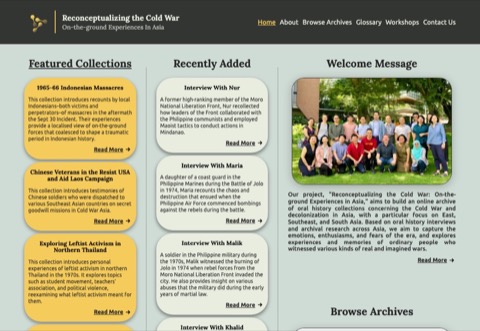
- Record Group 85: Philippine Mission records (Presbyterian Historical Society) (长老会历史学会:菲律宾传教团档案(RG 85))This is the finding aid page for the Philippines Mission records (Record Group 85) held by the Presbyterian Historical Society in the United States. The records were created by the Commission on Ecumenical Mission and Relations of the United Presbyterian Church in the U.S.A. and document the medical, educational and evangelistic work of its Board of Foreign Missions in the Philippines. For readers studying the history of Protestant churches in the Philippines, church schools and medical work, and religious and social change under American colonial rule, it is a body of first-hand material that can be used directly. The page is a detailed finding aid listing series, box numbers and folders, and noting that some items have digitized versions. The Society is located in Philadelphia, USA, and the records are open to researchers. The website does not say whether the material includes specific content on Chinese communities.
Coverage, how to use, and notes
Coverage Dates are 1903–1973, in 21 boxes (21 cubic feet). The records are arranged in four series: minutes (1911–1964), reports (1911–1972), correspondence (1904–1971) and miscellaneous (1903–1973). The content is mainly minutes, reports and correspondence. The website does not state the languages.
How to use First read the contents of the finding aid page to find the relevant series, box numbers and folders; the records are open to researchers. The page says some items are in the Society's Pearl digital collections, where RG 85 can be searched, but items marked Digital are not necessarily digitized in full folders. Box 1, folder 1 is the finding aid for these records and explains how minutes, reports and correspondence are numbered, which helps with locating material. For appointments and access arrangements for on-site research, check the Society's website.
Notes The material mainly reflects the perspective of an American mission agency; digitization covers only some items; on-site access is subject to the website's terms.
- Tag the Picture (Wereldmuseum Amsterdam) (标注图片(阿姆斯特丹世界博物馆印度尼西亚老照片平台))Tag the Picture is an open-source platform launched by the Wereldmuseum Amsterdam on 24 November 2022. It uses volunteers to add tags to the museum's historical photographs of Indonesia so that they can be searched. According to the museum's website, the collection holds about 500,000 historical photographs, most of them relating to Indonesia and most taken after 1850, reflecting interactions among Indonesians, Indo-Europeans and Europeans in the colonial and post-colonial periods. The platform was developed by Dr Melvin Wevers, Daily Creations and Zooma. The museum states that the Indonesian part is still being uploaded. For scholars of Indonesian social history, colonial visual culture and ethnic relations, it is an entry point to this large photographic collection and its tagging, and the tags will aid future retrieval.
Coverage, how to use, and notes
Coverage The museum's website states: about 500,000 photographs, mainly related to Indonesia, most taken after 1850; the Indonesian part is still being uploaded. The website also mentions that about 50,000 photographs from Bronbeek are planned for upload (this comes from another page of the museum's website; please rely on the official site).
How to use Access the platform via tagthepicture.nl; the museum's website provides a registration page (tagthepicture.nl/home). The platform is designed for volunteer tagging, and users must register following the page instructions before use. The museum states that the platform was initially available only in Dutch, with English planned from spring 2023; please check the official site for the current interface languages. Formal access to and ordering of collection photographs requires an account on the museum's collection database or contact with the collections department.
Notes When tagthepicture.nl was opened this time, only the page title could be read, so the platform's current functions and interface languages could not be confirmed one by one; the description relies mainly on the museum's website pages. Terms for reuse of the photographs were not verified; please rely on the official site.
- Traditional Music and Songs in Laos (Archives of Traditional Music in Laos, SEAsite Laos) (老挝传统音乐与歌曲(老挝传统音乐档案,SEAsite 老挝))This page is in the Laos section of the SEAsite site of Northern Illinois University and provides online recordings of traditional Lao music and songs. The website states that the recordings were collected by the Lao Traditional Music Archive project, housed in the National Library of Laos in Vientiane, together with the Lao-German research and development project. The project began in May 1999 and was initially funded by the German Research Foundation (DFG) and the German Agency for Technical Cooperation (GTZ), with close cooperation with the Museum of Ethnology in Berlin. The page is divided into four audio collections: Lao instrumental music, Lao traditional music, sounds of the khaen (bamboo mouth organ), and traditional songs and music of the Khmu. For scholars, teachers and students of Lao ethnomusicology, oral traditions, ethnic cultures and Southeast Asian music history, this is one of the few sources of Lao field recordings that can be listened to directly online, and it can be compared with ethnomusicological materials from other Southeast Asian countries.
Coverage, how to use, and notes
Coverage The project introduction page (as of May 2002) states that the archive holds 1,123 recordings of 25 ethnic groups, 1,690 minutes of video, 764 photographs, 135 musical notations, and illustrations and descriptions of 70 instruments. The online audio page lists only four audio collections; for specific numbers, please check the web page.
How to use Go to the music archive page and click the image of each audio collection to listen; the project introduction page also explains the project background and the scale of the holdings. No registration is required. The page states that the audio is for study use only and commercial use is prohibited. When citing, give the project name, the National Library and the web address.
Notes The page copyright is dated 2002 and the holdings figures are from a May 2002 count, which does not equal current numbers and does not mean all recordings are online. The page design is old and search functions are limited, so use is mainly by browsing. Audio is restricted to study use.
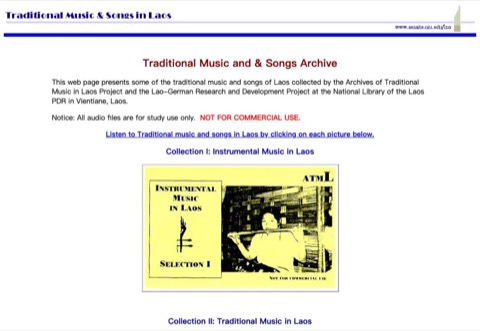
- UP Film Institute Audiovisual Archive Project (UCLA Modern Endangered Archives Program) (菲律宾大学电影学院视听档案项目(UCLA 濒危档案项目))This is the project page of the UCLA Library's Modern Endangered Archives Program (MEAP) for the audiovisual archive of the UP Film Institute, University of the Philippines. The project surveys, catalogues and clarifies rights for the holdings of U-matic videotapes and open-reel audiotapes, aiming to produce a publicly accessible inventory of the historical collection and to lay the groundwork for later digital preservation and public access. The page states that the Film Institute archive was founded in 1976. The open-reel tapes are mainly recordings of President Marcos and the First Lady's official activities rescued from Malacañang Palace after the 1986 People Power movement, including speeches, meetings, press interviews and seminars, and are first-hand sound material for studying politics, propaganda and media production in the Marcos period. The U-matic tapes include short films and documentary material from the UP Film Center as well as footage from the United Nations and related bodies. For scholars of contemporary Philippine political history, media history, and oral and sound archives, the inventory and the technical and legal reports offer both an entry point to the collection and a reference on audiovisual preservation and rights issues.
Coverage, how to use, and notes
Coverage According to the project page: 865 U-matic videotapes, produced 1927–2002, of which 557 (about 64.47%) come from the United Nations and related bodies; 2,463 open-reel audiotapes, dated 1963–1982, of which 2,367 (96.1%) are of Malacañang origin, including 800 speeches, 578 meetings, 568 press interviews, 402 seminars and 19 untitled. The page does not state the languages of the material; please check the website.
How to use On the project page, open the Collection Inventory (a spreadsheet) to look up information on specific tapes, and download the two PDFs, the Audiovisual Archive Survey Technical Report and the Legal Report. No registration is needed. The page currently states only that digitization and public access are goals and does not say that tape contents can be listened to or viewed online; to use the originals or the audiovisual content, contact the UP Film Institute or check the website for the latest information.
Notes The page provides inventories and reports, not an online playback platform. Recordings from the Marcos period involve rights and sensitive content; conditions of use and access are as stated on the project page and by the holding institution.
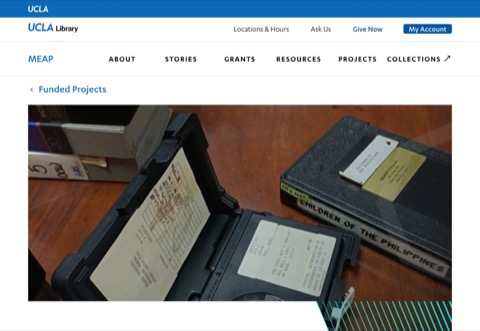
- United Nations Demographic Yearbook (联合国人口统计年鉴)The Demographic Yearbook is compiled by the United Nations Statistics Division and has been published since 1948, bringing together population and social statistics reported by official agencies of countries. The website states that the Division sends questionnaires every year to statistical agencies in more than 230 countries and areas. The contents include annual data on population size and structure, births, deaths, marriages, and divorces; there are also census data tables covering economic activity, educational attainment, households and housing, ethnocultural characteristics, language, foreign-born and foreign population, and so on. For those studying the population and ethnic structure of Southeast Asia, it provides cross-national comparable data compiled on a unified basis, and PDFs of past print yearbooks are available for retrospective use. It is suitable for regional comparison, for finding official population figures for a given country and year, or for finding leads to the original census reports of national statistical offices.
Coverage, how to use, and notes
Coverage The regular yearbooks are issued in volumes by year, from 1948 to 2025, with the page grouping them by decade. Some years have special topics, such as mortality, fertility, and international migration; there are also historical supplements for 1978 and 1997. The census data tables cover censuses from 1995 onward and are divided into categories such as basic population characteristics, education, ethnocultural characteristics, migrant stock, households, and economic characteristics. The completeness of national reporting varies; please refer to each table.
How to use On the website page, select a year to download the full-volume PDF for that year, or view individual tables. The pages for each year from 2021 onward provide separate tables and notes. Each table has a View data link that leads to the United Nations data portal for viewing and downloading data. The page also lists country metadata questionnaires organized by region, which can help to understand the census definitions of a given country. No registration is required. When searching for ethnic or language data, first look at the ethnocultural categories in the census data tables.
Notes Data are reported by countries themselves, and definitions, years, and completeness vary; ethnic classifications of different countries are not necessarily comparable. The census tables cover only censuses from 1995 onward; for earlier census data, consult past yearbooks or the reports of national statistical offices. Some older editions are out of print; please refer to the website.
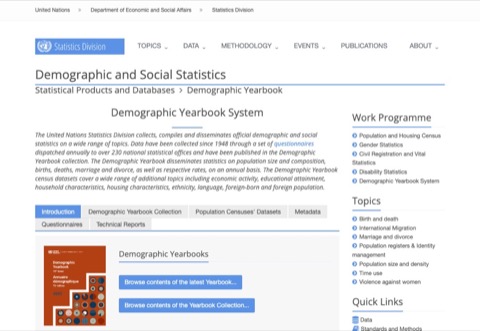
- Viet Stories: Vietnamese American Oral History Project (Viet Stories:越南裔美国人口述历史项目(加州大学尔湾分校))Viet Stories is an oral history project launched in 2011 by the School of Humanities at the University of California, Irvine (UC Irvine). It is based in the Department of Asian American Studies and mainly records the life stories of Vietnamese Americans in Southern California, with interviewees mostly first-generation refugees and immigrants. The project's courses train students to take part in interviewing. The oral history audio and video recordings are permanently preserved in the Southeast Asian Archive at the UCI Libraries and have been digitized for online access. Each interview is usually accompanied by a Vietnamese and/or English transcript, a content summary, a time index and a photo of the interviewee, and some also include materials provided by the interviewees. For research on refugee movements after the Vietnam War, diaspora communities, transnational memory, and the exile experiences of ethnic Chinese from Southeast Asia and Vietnam, it is a set of primary oral materials with transcripts that can be used alongside Vietnamese domestic archives and war-history sources. The project website states that, when using the materials, Viet Stories must be credited as copyright holder and the Southeast Asian Archive at the UCI Libraries as the source.
Coverage, how to use, and notes
Coverage Mainly oral history interviews with Vietnamese Americans in Southern California, in audio and video formats, in Vietnamese and/or English. The website does not state the total number of interviews. The collection finding aid (Viet Stories Project records, MS.SEA.069) lists interview recordings on discs and DVDs. Some interviews can be searched individually on platforms such as Calisphere. Whether interviewees include ethnic Chinese from Vietnam should be determined from the interview records.
How to use Enter from the project website sites.uci.edu/vaohp and link to the online interview collection through the Stories menu. You can also search for Viet Stories or specific interviewees' names on Calisphere or OAC (Online Archive of California) and read the finding aid for MS.SEA.069. Most interviews can be browsed online without registration. Some materials may have use restrictions and require an advance application to UCI Libraries Special Collections and Archives (see the website's contact page). When citing, indicate the copyright holder and source institution as the website requires.
Notes The website pages do not state the search functions or the total number of interviews; please consult the actual site. The interview collection's standalone domain could not be resolved at the time of checking, so it is advisable to enter through the website menu links or search via Calisphere and OAC. Some materials may be restricted. The content mainly reflects the Vietnamese American community in Southern California and does not cover Vietnam itself.
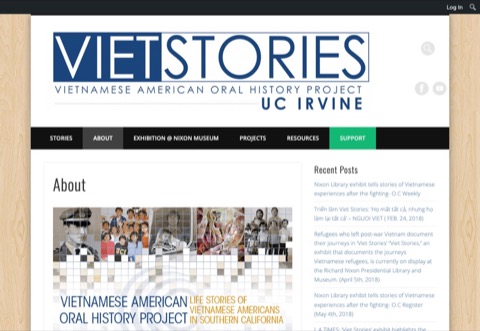
- Vietnamese Nôm Preservation Foundation (VNPF) (越南喃字保存基金会)The Vietnamese Nôm Preservation Foundation is a non-profit organization dedicated to preserving Chữ Nôm, the writing system used for Vietnamese language and literature for about a thousand years. The website states that the foundation has been dissolved, but the site remains online and retains basic text and language resources. The site hosts the Digital Library of Hán-Nôm, which includes Nôm texts from the collections of Thắng Nghiêm and Phổ Nhân temples, as well as digitized works such as the Tale of Kiều, Lục Vân Tiên, Chinh phụ ngâm, Hồ Xuân Hương and Đại Việt sử ký. It also offers a Nôm lookup tool, Nôm fonts, and dictionaries such as Nguyễn Trãi's Quốc âm từ điển, Taberd and Takeuchi, along with a Nôm bibliography and pages on the history, standardization and Unicode encoding of Nôm. The site has English and Vietnamese interfaces. It is a frequently cited introductory resource for research on pre-colonial Vietnamese literature, history and Hán-Nôm documents, and on the script's relationship with the Chinese cultural sphere.
Coverage, how to use, and notes
Coverage The site contains the Digital Library of Hán-Nôm, Nôm documents (from Thắng Nghiêm and Phổ Nhân temple collections), digitized texts of several literary and historical works, Nôm dictionaries and character lookup tools, a Nôm bibliography, and pages on the history of the Nôm script. The specific quantity and dates of the documents are not stated on the homepage; please consult the website.
How to use Visit nomfoundation.org and choose the English or Vietnamese interface. Enter the digital texts through the Digital Library of Hán-Nôm, look up Nôm characters with the Nôm Lookup Tool, and download the Nôm fonts provided on the site so characters display correctly. The site also has Terms of use and contact pages; please read them before reproducing or reusing content.
Notes The foundation has been dissolved and the site is in a preserved state, so content may no longer be updated and some links or tools may not work. Digitized texts cannot replace originals or authoritative critical editions; please verify the source when citing.
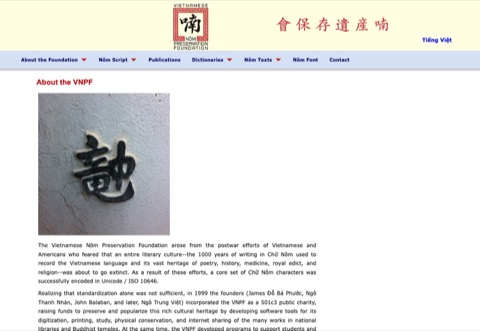
- Vietnamica – Rubbings Collection: Gallery & Database (Vietnamica 拓片库(越南碑铭拓片图库与数据库))Vietnamica is a research project on Vietnamese history funded by the European Research Council (ERC, 2019–2025) and led by Professor Philippe Papin of the École Pratique des Hautes Études (EPHE), France. Partners include the Institute of Han-Nom Studies, the Vietnam Academy of Social Sciences, Vietnam National University Hanoi, and the University of Social Sciences and Humanities in Hanoi. Its core material is rubbings of inscriptions on village merit (donation) steles from the 16th to 20th centuries, written in Chinese characters and Nôm, and it combines historical research with digital humanities methods. Its rubbings gallery and database (gallery.vietnamica.online) include stele rubbings made in Vietnam by the École française d'Extrême-Orient (EFEO) between 1910 and 1944; the originals are held at the Institute of Han-Nom Studies, Vietnam Academy of Social Sciences. Village stele inscriptions often record donations for building temples, communal halls, shrines, bridges and roads, as well as village organization, and are primary sources for studying Vietnamese religious sites, village communities, lineages and local society. The project website also has a map database, a digital library (including the Bulletin des Amis du Vieux Hué (BAVH), the Bulletin de la Société des Études Indochinoises (BSEI), survey and investigation reports, and Gouin's Vietnamese–Chinese–French dictionary), and its own publication series, with English, Vietnamese and French interfaces.
Coverage, how to use, and notes
Coverage The rubbings database contains 20,980 rubbings of steles made in Vietnam by the EFEO between 1910 and 1944; the originals belong to the Institute of Han-Nom Studies. The inscriptions are mainly in Chinese characters and Nôm, and the project studies village merit steles of the 16th–20th centuries. The website also has a digital library containing colonial-era periodicals and survey reports such as BAVH and BSEI, plus some reference works. The official site does not state the library's total holdings; please refer to the official site.
How to use Go to vietnamica.online and open Gallery & database under the RUBBINGS COLLECTION menu. You can search by number (Mã số), Gregorian year, administrative location (province, district, canton, village) and keyword; each page can show 10, 20, 50 or 100 entries, and pressing Enter after entering criteria starts the search. After opening an entry, you can zoom in and out in the image viewer. The map database and digital library are in the menu of the same website. The site does not require registration and does not state download or reuse terms; please check the official site before citing or republishing.
Notes The official site notes that some entries show 'image could not be loaded' or have no image. It does not state the database's metadata fields or reuse terms. The original steles are mostly in Han-Nom script, so the ability to read them or Han-Nom reference works is needed.
Scholarly databases & search tools
- Proletarian Library (无产阶级图书馆)Proletarian Library (library.proletarian.me) is a public e-book repository themed on left-wing thought, social history, cultural politics and Southeast Asian studies. The pages are mainly in traditional Chinese, with simplified Chinese also supported. The site has several sub-libraries: General Library, Chapter and Article Library, Southeast Asian Studies Library and Periodicals Archive. The Southeast Asian Studies Library page collects Chinese, English and Malay books and papers related to Southeast Asia, which can be downloaded by clicking an entry, with no account or registration needed. For readers working on Southeast Asian Chinese and regional studies, this page can serve as a supplementary entry point for finding and obtaining Chinese, English and Malay research literature, and is especially suitable for getting a preliminary sense of which books and papers exist on a topic. According to the current official page, the Southeast Asian Studies Library is marked as 2,503 items and the whole site holds 17,841 items, far exceeding the earlier claim of a few hundred books. The site also accepts book uploads from readers, reports of dead links and requests for additional books.
Coverage, how to use, and notes
Coverage The site homepage shows 17,841 items in total: General Library 12,130 items (left-wing thought, social history, cultural politics, in Chinese and English), Chapter and Article Library 1,920 items (journal articles and book chapters, in Chinese and English), Southeast Asian Studies Library 2,503 items (Chinese, English and Malay), and Periodicals Archive 1,288 issues (Taiwanese and Chinese-language left-wing periodicals). These are the figures shown on the page at the time of verification and change with uploads. The official website does not give the period covered by the Southeast Asian Studies Library.
How to use Open the homepage and choose Southeast Asian Studies Library from the Enter Sub-library menu at the upper right, or enter a title, author or keyword in the search box. A note next to the search box suggests pressing the search button at the upper right several times. Click an entry to download directly; the website does not indicate that registration is needed. If you need a bulk download of a certain type of text, you can apply by email as described on the site. Readers can also contribute books through the upload page (maximum 300 MB per file), or report dead links and request additional books by email.
Notes This is an e-book repository based mainly on reader uploads. The website does not state the copyright status of individual files, so when citing, please return to the formally published edition to check versions and page numbers, and pay attention to copyright rules yourself. The website notes that downloads may not work smoothly in some network environments (such as certain telecom or campus networks). Sub-library figures are updated at any time; please rely on the official site.
- ASEANstats Data Portal (东盟统计数据门户)The ASEANstats data portal is the entry point to regional statistics from ASEAN's official statistics website (ASEANstats), which also publishes ASEAN statistical publications under the name ASEAN Statistics Web Portal. The portal consolidates the official statistics of ASEAN member states into a unified framework to facilitate cross-country comparison. It covers categories such as social and demographic data, macroeconomics, foreign direct investment, international merchandise trade, trade in services, visitor arrivals, prices, transport, manufacturing and Sustainable Development Goals (SDG) indicators, and offers an overview of ASEAN key statistics. The main site also regularly releases e-books such as the ASEAN Statistical Yearbook, the ASEAN Economic Community Chartbook and ASEAN Statistics Leaflet. Recent publications include ASEAN Key Figures 2025 (which newly adds data for Timor-Leste) and the ASEAN SDG Indicators Progress Report 2025 (assessing progress toward the 2030 targets over 2016–2023). For readers studying the regional economy, population, trade and investment patterns of Southeast Asia, it is a first-hand source of comparable official figures for ASEAN as a whole and for its member states, and it can also supply background data for regional studies such as China–ASEAN and Malaysia–Singapore comparisons.
Coverage, how to use, and notes
Coverage Official statistics organized by ASEAN member state, covering social and demographic data, macroeconomics, foreign direct investment, international merchandise trade, trade in services, visitor arrivals, prices, transport, manufacturing and SDG indicators. The homepage does not state the overall time span or the country coverage of each indicator; please refer to the individual dataset pages. Publications include annual statistical yearbooks, key figures booklets and SDG progress reports.
How to use After entering the data portal, browse dashboards and indicators by category. The main site aseanstats.org provides an online database from which Excel files on trade, foreign direct investment, tourism, population and other data can be downloaded, as well as interactive chart dashboards. No registration or login requirement was seen. The e-book publications can be read directly on the main site. When citing, it is advisable to record the download date and the version used.
Notes At the time of checking, some indicator cards on the portal homepage showed a loading failure, and the category links rely on scripts to load, so you may need to refresh the page or use the download entry on the main site aseanstats.org instead. Data are provided by the statistical agencies of member states, and their definitions and update times may not be consistent; please refer to the notes on the official site.
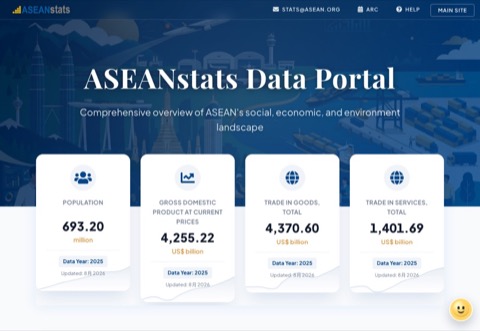
- Archipel (OpenEdition Journals / Persée) (《Archipel》(岛群世界跨学科研究期刊))Archipel is an interdisciplinary journal on the Insulindian world, focused on historical and social research; its geographical scope is not limited to the Indonesian archipelago and the Malay Peninsula but extends to the island world from the Philippines to Madagascar. The journal alternates regular issues (varia) with thematic issues (dossiers thématiques) and also carries book reviews and academic news. The website shows that it was founded in 1971 and lists affiliations with institutions such as Inalco, CASE, EFEO and EHESS; issues 1 to 87 (1971–2014) are held on Persée, and from issue 88 (2014) the journal is online on OpenEdition Journals, with the latest issue listed on the website being issue 111 (2026). For readers studying Indonesia and the Malay world, it is one of the important journals of French-language regional scholarship, covering the history, society, language, Chinese and other ethnic groups of Indonesia and the Malay world, and it supplements English- and Indonesian-language literature with French research perspectives.
Coverage, how to use, and notes
Coverage From 1971 to the present, about 111 issues; issues 1–87 (1971–2014) are on Persée (the page shows 87 issues and 2,049 documents), and from issue 88 (2014) on OpenEdition Journals. Mainly in French, with English titles and abstracts for articles. Content is history- and society-oriented research on the Insulindian world.
How to use From the OpenEdition website, find articles from issue 88 onward by issue or via the search box; browse earlier volumes on the Archipel journal page on Persée. The website provides full-text access; the Persée page shows a barrière mobile (moving wall) label but does not explain its specific meaning, so please check each issue's notes on the website. Tables of contents can be browsed without registration; the login area is for institutional subscribers.
Notes Mainly in French; English readers can start with the English abstracts. Issues are split between two platforms, so searches must be run on each separately. The website pages do not state whether all issues are fully open access; please check the indication on each article page.
- Archipel (Persée) (《Archipel》(Persée 平台收录的印度尼西亚与岛屿世界研究期刊))Archipel is a biannual journal that has published historical and social research on the world of Insulinde since 1971. Its scope covers the Indonesian archipelago and the Malay Peninsula, extending outward to the Philippines and even Madagascar. The journal page on the Persée platform shows that it holds 87 issues and 2,049 documents from 1971 to 2014; the current publisher is Éditions de la FMSH, and the eISSN is 2104-3655. The platform allows browsing issues by year and provides a table of thematic issues and an author index. For the study of Indonesia and the Malay world, this journal has accumulated decades of articles in history, sociology and anthropology on topics such as ports, trade, ethnicity, language and colonial history; it helps readers understand French-language scholarship on Indonesia and neighbouring regions and offers leads for finding primary periodicals and archives. The journal also often carries articles on local-language publications and colonial-era society, complementing Dutch and Indonesian digital newspaper databases, and is suitable as a tool for literature tracing and searching.
Coverage, how to use, and notes
Coverage The Persée page shows coverage from 1971 to 2014, with 87 issues and 2,049 documents. The subject is the island world of the Indonesian archipelago, the Malay Peninsula and surrounding areas, with history and social research as the main disciplines. The languages of each issue, the degree of full-text openness, and whether issues after 2014 are included should be checked on the website.
How to use Open the journal page on Persée (persee.fr/collection/arch); you can browse issues by year, view the list of thematic issues and the author index, or use the site search to find titles, authors or keywords. The page displays a Barrière mobile (moving wall) label but does not state the specific number of years; which issues can be read in full text directly should be checked on the website. When searching, use French, English and Indonesian keywords together, for example Chinois, Insulinde, Java and presse, and then trace primary materials further through the bibliographies.
Notes The website page does not clearly state its fee policy or licensing terms; the page gives the time range as 1971–2014, and newer issues are not necessarily available in full text on this platform; the articles are mostly secondary studies, not original periodicals.
- Austronesian Basic Vocabulary Database (ABVD) (南岛语基本词汇数据库)ABVD is an online comparative database of basic Austronesian vocabulary, edited by Greenhill, Blust and Gray; the paper Greenhill, Blust & Gray (2008) in Evolutionary Bioinformatics is commonly cited as its reference. Each language has about 210 basic lexical items, covering verbs, body parts, colours, numerals and kinship terms, making it possible to compare different languages within the same wordlist framework. Indonesia is one of the areas where Austronesian languages are most concentrated, and many languages such as Javanese, Sundanese, Minangkabau and Balinese belong to this family, so the database is a commonly used entry point for examining language relationships, lexical borrowing and language contact in Indonesia. For readers studying the linguistic environment of Chinese communities in Southeast Asia and regional varieties of Malay and Indonesian, it can also be used to look up cognates and basic vocabulary of neighbouring Austronesian languages. The site can be browsed by language, word, wordlist and collaborator, offers a download page, and its content is licensed under CC BY 4.0. The website also provides a 'random word' function and links to the source code of its application built on the clld framework.
Coverage, how to use, and notes
Coverage The homepage shows a total of 1,982 languages, mainly Austronesian, and notes that the Austronesian family has about 1,200 languages; the lexical entries total 349,637, with about 210 basic items per language. The number of wordlists for individual Indonesian languages is not listed separately on the homepage; please check by language in the Languages section.
How to use From the homepage, browse through the menu items Languages, Words, Wordlists and Collaborators. To look up Indonesian languages, search by language name or region on the Languages page, then open a language to view its wordlist and items. For bulk use of the data, go to the Download page to see the downloadable content. No registration is required. When citing, it is advisable to cite Greenhill, Blust & Gray (2008) and state the access date.
Notes The compilers, sources and quality of each wordlist vary, so check the collaborators and notes for a language's wordlist before use; a basic vocabulary list is no substitute for a full dictionary. The current host institution is not stated on the homepage; please rely on the official site.
- Austronesian Comparative Dictionary (ACD) Online (南岛语比较词典(在线版))This is the online version of the Austronesian Comparative Dictionary, compiled by Robert Blust and Steve Trussel and now hosted by the Max Planck Institute for Evolutionary Anthropology in Germany; the site is managed by Robert Forkel, and the content is maintained and supplemented by Alexander D. Smith. The official site describes it as the most comprehensive comparative dictionary of Austronesian languages to date. Major Southeast Asian languages such as Malay, Indonesian, Javanese, Tagalog and Cham belong to the Austronesian family, so it is useful to humanities researchers studying Malay etymology, loanwords (including those from Chinese Min and Yue dialects), place names and the linguistic history of ethnic groups. The site is organized by cognate sets, including proto-language reconstructions, cognates, loanwords, near-cognates and chance resemblances, and has pages for languages and bibliographic sources. The data are open under CC BY 4.0, are also published on GitHub, and have a Zenodo version with a DOI, which facilitates citation and reuse.
Coverage, how to use, and notes
Coverage Covers comparative vocabulary of Austronesian languages, with content types including cognate sets, roots, loanwords, near-cognates and chance resemblances, as well as language pages and source pages. The official site does not state the total number of entries; please refer to the official site. The current version is v1.2 (as indicated on the official site).
How to use On the website, go to the Cognatesets page and search by reconstructed form or gloss; the language pages and bibliographic source pages can be browsed to trace the origin of the material. No registration is needed. For bulk analysis, data can be obtained from the download page or the GitHub repository, and the exact version used should be cited as required by the official site (Zenodo DOI).
Notes The orientation is comparative historical linguistics, and the entries are scholarly reconstructions, so the original sources should be checked when using them; the version must be stated when citing.
- Bibliography of Asian Studies (BAS) (亚洲研究书目数据库)The Bibliography of Asian Studies is compiled by the Association for Asian Studies and provided through the EBSCO platform. It is a core bibliographic index in Asian studies. The EBSCO page describes it as the most comprehensive bibliographic database of East, Southeast and South Asia in Western languages, with an emphasis on the humanities and social sciences and including overseas Asian communities. For research on Southeast Asian Chinese and the region, its value lies in systematic searching of journal articles and book chapters by fields such as country, subject and keyword, and it is especially suited to preliminary scoping for literature reviews and to finding regional studies articles scattered across various journals. The page also mentions that a special project added records of Southeast Asian journals dating back to 1779. The database is subscription-based and generally accessed through an institutional library.
Coverage, how to use, and notes
Coverage The EBSCO page lists 979,460 citations since 1971 and about 400,000 citations since 1992, plus added records of Southeast Asian journals going back to 1779. It covers East Asia, Southeast Asia, South Asia and overseas Asian communities, mainly in the humanities and social sciences and mainly in Western-language literature; searches can be filtered by publication language.
How to use Individuals cannot use it free of charge directly; access the EBSCO platform through your institution's library database list, or request a trial or a quote on the EBSCO page. You can search by author, title, year, journal, country, subject, keyword, ISSN and ISBN, and filter by publication language. For Southeast Asian Chinese topics, use the country field together with keywords such as Chinese and Overseas Chinese.
Notes Institutional subscription is required; please confirm with your library whether it subscribes. It is mainly Western-language literature, with limited coverage of Chinese and Southeast Asian local-language literature; please refer to the website.
- Bijdragen tot de Taal-, Land- en Volkenkunde (BKI) / Journal of the Humanities and Social Sciences of Southeast Asia (《荷属东印度语言、地理与民族学论丛》(BKI,东南亚人文社会科学期刊))BKI is a peer-reviewed interdisciplinary journal founded in 1853 and now published by Brill in cooperation with the Royal Netherlands Institute of Southeast Asian and Caribbean Studies (KITLV). The KITLV website states that the journal has a strong focus on Indonesia while also accepting research on other parts of Southeast Asia. The disciplines represented include anthropology, history, political science, law, sociology and economics. The KITLV website states that all articles in the journal are published open access with no article processing charges. For readers studying Indonesia, the journal has accumulated scholarly articles over a long period on Indonesian society, language, religion and ethnicity in the colonial and post-independence periods, including studies of Chinese communities and regional history. It can serve as a starting point for finding secondary studies and the history of scholarship, and is often used to trace how scholars have used Indonesian sources (including local-language and colonial-era periodicals). The journal is widely cited in Southeast Asian and Indonesian studies and works well alongside databases of primary periodicals: first learn the research background to an event or person from journal articles, then return to the original periodicals to verify.
Coverage, how to use, and notes
Coverage Founded in 1853 and published for over 170 years. Content focuses on Indonesia but also covers other parts of Southeast Asia, with disciplines including anthropology, history, political science, law, sociology and economics. The overview page of the website does not state the searchable back-file years, total number of volumes and issues, or specific languages; please check the Brill website.
How to use Enter from the Brill journal page (brill.com/view/journals/bki/bki-overview.xml); you can browse by volume and issue, or search titles, abstracts and authors by keyword. The website states that articles are open access and can generally be read online or downloaded as PDFs without registration; the specific licensing terms (such as the Creative Commons licence used) are not stated on the overview page, so please check the individual article page before citing or reusing. When searching for topics such as Indonesian Chinese or colonial-era periodicals, try Indonesian, Dutch and English keywords together, such as Chinese, Peranakan, pers and krant, and then browse related research projects on the KITLV website.
Notes Journal articles are secondary studies, not original periodicals; the openness of back years and licensing terms should be checked on the Brill website; earlier articles may be published in Dutch, French or German.
- Bijdragen tot de Taal-, Land- en Volkenkunde / Journal of the Humanities and Social Sciences of Southeast Asia (BKI) (《BKI》东南亚人文社会科学期刊(荷兰皇家东南亚与加勒比研究所))BKI is published by Brill in cooperation with the Royal Netherlands Institute of Southeast Asian and Caribbean Studies (KITLV) and is one of the oldest journals in Southeast Asian humanities and social sciences. The KITLV page states that it was founded in 1853 and is now a peer-reviewed open access journal with no article processing charges for authors, funded by the society Vereniging KITLV. The journal is distinctly interdisciplinary and pays particular attention to Indonesia, while also publishing research on other parts of Southeast Asia, covering anthropology, history, political science, law, sociology, development studies, urban studies, literature, sociolinguistics and economics. Besides research articles, it carries book reviews, review debates and review articles, and introduces recent Dutch- and Indonesian-language books. For readers studying Southeast Asian Chinese societies, colonial history and regional studies, it is both a source of high-quality articles that can be read freely in full text and a window onto trends in Dutch- and Indonesian-language scholarship.
Coverage, how to use, and notes
Coverage The official page states that the journal was founded in 1853 and covers all parts of Southeast Asia with a focus on Indonesia, across the humanities and social sciences. Articles are open access, and the journal is indexed in Web of Science. For the retrospective period and the extent of digitization, please refer to the journal page on the Brill website.
How to use Enter through KITLV's journal introduction page, then go to Brill's journal page (brill.com/view/journals/bki) and browse by issue. Open access articles can be read without a subscription and PDFs can generally be downloaded directly; for specific license terms, see the article page. You can browse by volume and issue, or search by keyword on the Brill platform (such as Chinese, Peranakan, Batavia). The book review section helps you quickly learn of new Dutch and Indonesian monographs.
Notes The official page does not state the languages of the articles. Not all historical volumes and issues are open; please refer to the labels on the Brill page.
- Borneo Research Bulletin (Borneo Research Council) (《婆罗洲研究通报》(婆罗洲研究理事会))The Borneo Research Bulletin (BRB) is an annual published by the Borneo Research Council, first issued in 1969. The Council is a US-registered 501(c)(3) non-profit; its website says it is dedicated to advancing knowledge about Borneo and offers more than sixty publications. The island of Borneo comprises Brunei, Sarawak and Sabah in Malaysia, and Kalimantan in Indonesia, so the journal is a long-standing scholarly source for research on Brunei and its surrounding region. The website's volume author indexes show that content over the years includes articles, short notes, book reviews and announcements on anthropology, linguistics, archaeology, history, land use and other topics. Some items relate directly to Brunei, for example Allen R. Maxwell's A New Bibliography of Brunei Darussalam (vol. 26, 1995) and Peter G. Sercombe's annotated bibliography of the Penan of Brunei (vol. 27, 1996). For readers working on Brunei, these bibliographies and indexes help trace early literature, and PDFs of earlier volumes are freely available.
Coverage, how to use, and notes
Coverage The Bulletin has been published since 1969. The website offers free PDFs of volumes 1–45 (1969–2014), stating that volumes 1–41 were digitised by Mark Turin of Digital Himalaya. No free download links were seen for volumes after 46; volumes 1–55 are also sold in print and PDF. The website also provides author indexes for volumes 1–35, with entries giving author, year, title, volume/issue and pages. Volume 56 is planned for early 2027. The content is not limited to Brunei but covers all of Borneo.
How to use On the website, download free PDFs by volume number from the 'BRB Complimentary PDF' page. Look up authors and titles in the 'Volume Index by Author' pages; for example, Maxwell's Brunei bibliography can be found in the index for volumes 26–30, and the full text is then obtained from the free PDF page. The index pages list citations only, without full-text links. The site also has a search box. No registration is required to browse and download the free part; members receive discounts on publications and the annual bulletin.
Notes Coverage is for all of Borneo, so Brunei-related items must be selected from the indexes. Issues after volume 46 are not offered as free downloads on the website and must be purchased. The website's instructions are brief, and the free PDF page does not describe the contents of individual volumes; please check the site.
- Cambodian Journal of Educational Development (CJED) (《柬埔寨教育发展期刊》)CJED is an open-access journal publishing peer-reviewed papers in education. Its website is hosted under the Hiroshima University domain, and the page states that it is supported by the JICE JDS follow-up fund. The journal addresses national, regional and international readers and accepts papers from all disciplinary areas of education. All accepted manuscripts are open access and can be read online free of charge in perpetuity. For Southeast Asian regional studies, it offers articles on Cambodian education policy, higher education, teaching and learning, which can supplement material on education and social development. The View Articles page on the website lists articles by volume and offers PDF downloads of whole volumes and single articles, so the barrier to use is low. The journal is small and suits use as a supplementary search source for Cambodian education research rather than as a large comprehensive database.
Coverage, how to use, and notes
Coverage The website lists 4 volumes, from Volume 1 (June 2021) to Volume 4 (December 2024), with 14 research articles in total. Volumes 1-3 offer whole-volume PDFs, while Volume 4 currently has single-article PDFs only. The language is mainly English. The ISSN, publication frequency and fees are not stated on the website; please check the website.
How to use Open the View Articles page (view_articles.html) on the website, browse by volume and download PDFs directly; no registration is required. Author guidelines are on the for_authors page. The number of articles is small, so the whole table of contents can be browsed directly; article titles can also be searched via Google Scholar.
Notes The journal is small and updates slowly (the latest item on the page is Volume 4, December 2024). The website does not clearly state the publisher or the ISSN; please check the information on the article PDFs when citing.
- Glottolog (Glottolog 世界语言目录)Glottolog is a reference catalogue of the world's languages, language families and dialects, with a focus on lesser-studied languages. It is promoted by the Max Planck Institute for Evolutionary Anthropology in Leipzig, Germany, and its editors include Harald Hammarström, Robert Forkel, Martin Haspelmath and Sebastian Bank. It assigns a stable unique identifier, the Glottocode, to each language, family and dialect (collectively called languoids), and organizes classification by genealogy; its References section (langdoc) is a bibliography of descriptive literature covering grammars, dictionaries, word lists and texts. When studying Southeast Asian Chinese and regional languages, it can be used to confirm the standard name and genealogical affiliation of a language or dialect, find existing grammars, dictionaries and word lists for that language, and link to other language databases (for example the Austronesian resources in this batch) through the unified code. The data are open under CC BY 4.0 and published on GitHub, suitable for researchers who need to verify language names or integrate across databases.
Coverage, how to use, and notes
Coverage The official homepage shows the current version as Glottolog 5.4, with 471,399 references in the bibliography; the total number of language and dialect entries is not listed on the homepage, so please refer to the official site. The content is global, covering family classification, language and dialect entries and related descriptive literature.
How to use On the homepage, search by language name or Glottocode to view the family tree and related literature; the reference list in the References section can be downloaded as txt, bib or html, and can also be imported through the Zotero Firefox plugin. The data are public in the GitHub repository glottolog/glottolog, the web application provides the latest release, and there is also a download section. No registration is needed. Please state the version used when citing.
Notes It is a catalogue and bibliographic tool and does not itself provide full-text language materials; the classification and naming of some dialects follow the editors' judgment and may differ from official usage in individual countries.
- HRDAG – Timor-Leste (CAVR statistical project) (人权数据分析小组:东帝汶(CAVR 统计项目))The HRDAG (Human Rights Data Analysis Group) project page on Timor-Leste, describing its quantitative analysis conducted in collaboration with the Commission for Reception, Truth and Reconciliation (CAVR). The page states that the analysis combines three types of sources: about 8,000 narrative testimonies, a census of roughly 319,000 gravestones in public cemeteries, and a retrospective mortality survey of about 1,400 households across 13 districts. It also lists The Profile of Human Rights Violations in Timor-Leste, 1974-1999 (the quantitative chapter of the Chega! report), published jointly in February 2006, and the Benetech statistical report, with PDF downloads. The report estimates that at least 102,800 (±11,000) Timorese died as a result of human rights violations between 1974 and 1999. For those studying violence under occupation, transitional justice and regional history, this is a methodologically transparent, citable data source.
Coverage, how to use, and notes
Coverage Covers 1974-1999; data sources are CAVR testimonies, the cemetery census and the household mortality survey. The page mentions that the related data are made public under an agreement with CAVR, but does not make clear whether the original data files can be downloaded or in what format; please consult the HRDAG data publication page.
How to use Open the project page, read the methodology notes, and download the Benetech report PDF provided there (under the wp-content/uploads/2013/01/ path on hrdag.org). For data files, see HRDAG's Data publication page or contact HRDAG. No registration is needed to read the page.
Notes The page states that CAVR and HRDAG kept backups of the interview data outside Timor-Leste, but does not say whether the original testimonies are public; before using the data, check the data publication notes and confidentiality terms.
- IPUMS International – Malaysia census microdata (IPUMS 国际普查微观数据库(马来西亚样本))IPUMS International is an international project supported by the University of Minnesota and other institutions that collects, harmonises and distributes census microdata from many countries; the website states that it covers 104 countries and 656 censuses and surveys, with the original data provided by national statistical agencies. The Malaysia samples are drawn from the Department of Statistics' Population and Housing Censuses and are one of the main public channels for scholars to use individual- and household-level census data. Because the data are individual records, researchers can carry out their own cross-analyses, for example studying population structure by variables such as ethnicity, age, education, occupation and place of residence, which is difficult with published aggregate census tables. IPUMS has coded variables consistently across countries and years, which facilitates comparison between census years. For research on the Chinese in Southeast Asia and on ethnic and social structure in Malaysia, it is one of the few free sources of individual-level census data that can be applied for. This entry concerns only the data itself; online registration and agreement to a use agreement are required before use.
Coverage, how to use, and notes
Coverage The Malaysia sample page on the IPUMS website lists four samples: 1970 (175,997 person records, 2% sampling fraction), 1980 (182,601 records, about 1.67%), 1991 (347,892 records, 2%) and 2000 (435,300 records, 2%). All four samples contain household-level information, and all exclude the Bornean states of Sabah and Sarawak. The 2010 and 2020 censuses are not listed on that page.
How to use Go to international.ipums.org, view samples and variables via Browse Data, select variables and samples, then create a data extract and download it; registration is required first, along with agreement to the electronic use agreement. The agreement is limited to academic research and educational use, prohibits redistribution and any attempt to identify individuals or households, and requires that publications be reported to IPUMS. Whether specific variables such as ethnicity are available should be checked item by item for each sample in the variable list.
Notes All four samples exclude Sabah and Sarawak and therefore cannot directly represent Malaysia as a whole. The World Bank Microdata Library's description of the 2000 sample notes that ethnic categories with very few people may be merged to protect privacy. The website homepage states that data and services are free, but registration and approval are required before download.
- Journal of Lao Studies (JLS), Center for Lao Studies (《老挝研究期刊》(老挝研究中心))The Journal of Lao Studies (JLS) is published by the Center for Lao Studies (based in California, USA) and is one of the few peer-reviewed English-language scholarly journals devoted to Laos. The website describes it as a double-blind peer-reviewed journal whose topics cover Laos, Lao diaspora communities (including northeastern Thailand, Europe, the Americas and Australia), and ethnic groups within Laos such as the Hmong, Akha and Khmu; it accepts articles, book review proposals and review essays, mainly in Lao and English. The website lists issue pages from Volume 1, Issue 1 (January 2010) to Volume 9, Issue 1 (December 2025), plus three special issues. For example, Volume 8, Issue 1 (December 2024) contains studies on the 1893 partition of Laos, Luang Prabang stone carving, Chao Anouvong and the Lao nation, and a Lao American archive project. For scholars of Lao history, ethnic groups, art history and diaspora communities, it is an important specialist journal.
Coverage, how to use, and notes
Coverage The website lists issues from 2010 to 2025, including Volumes 1 to 9 and Special Issues 1 to 3. Content consists of research articles, research essays and book reviews, covering Lao history, art, ethnic groups and the Lao diaspora. The website does not list an ISSN or publication frequency, and statements on different pages are inconsistent; please check the website.
How to use Open laostudies.org/journal/journal-lao-studies-jls and go to each issue page by volume and issue; each issue page provides the table of contents and PDF links for each article. The website states that basic members (Saman, 20 US dollars) can read the current issue. Submissions are accepted at any time as described on the website; please read the author guidelines before submitting, and contact the editors first if using a language other than Lao or English.
Notes The open access policy is inconsistent: an early preface says only the current issue is limited to members and back issues are free, a more recent preface says all issues are open, while the article links for Volume 8, Issue 1 point to a subscription file path and the copyright notice reads All Rights Reserved. Please confirm issue by issue whether free download is possible.
- Journal of Southeast Asian Studies, Cambridge Core (《东南亚研究学刊》)The Journal of Southeast Asian Studies (JSEAS) is one of the leading journals in Southeast Asian studies and is published by the Department of History at the National University of Singapore. Its Cambridge Core page states that it covers the humanities and social sciences and that its articles are written for specialist readers but aim to be accessible to non-specialists. The journal has a book review section, and reviews also cover works in Southeast Asian languages. It continues the Journal of Southeast Asian History (1960–1969); its online ISSN is 1474-0680 and its print ISSN is 0022-4634. The page indicates that Cambridge University Press publishes it through Volume 56 (2025), and that from Volume 57 (2027) it will be published by Duke University Press; the earlier issues will remain permanently accessible on Cambridge Core. For researchers of the Chinese in Malaysia, Singapore and Southeast Asia, it is a common platform for following regional historiography and social science and for finding classic articles and book reviews.
Coverage, how to use, and notes
Coverage Continues the Journal of Southeast Asian History, founded in 1960 (1960–1969). The Cambridge Core page lists all volumes and issues, for example the combined Issues 3–4 of Volume 56. The page states a 2025 impact factor of 0.7, ranked 88/184 in the area studies category. Covers Southeast Asian studies in the humanities and social sciences.
How to use Go to the journal page on Cambridge Core and browse by volume and issue or search. Abstracts are publicly visible; full texts require a personal or institutional login, and some content is open access. Submissions are now made through the journal website of the National University of Singapore. For citation and export functions, follow the platform page. For the web address and access arrangements after the change of publisher, follow the official website.
Notes Most full texts require an institutional subscription; only some are open access. The publisher changes from 2027, so the platform entry point may change.
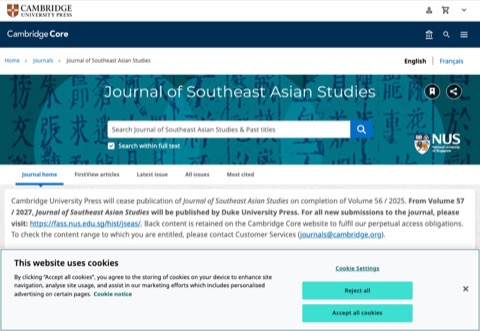
- Malay Concordance Project (MCP) (马来文献索引计划)The Malay Concordance Project is a search tool for classical Malay literary texts hosted by the Australian National University (ANU). It was created by the late scholar Ian Proudfoot, and the website states that it has been used by scholars in more than thirty countries. It presents classical Malay texts in romanised transcription and provides concordance-style word searching, allowing researchers to see how a word, personal name or place name is used in context and to observe the distribution of word formation and syntax. For Chinese-in-Southeast-Asia and area studies, early Malay texts (including traditional narratives, chronicles and verse) are primary materials for understanding the political and cultural context of the Malay world and a basis for tracing the historical vocabulary of Malay; they can be read alongside research on the social history of the Chinese, the Straits Settlements and the history of the Malay Peninsula.
Coverage, how to use, and notes
Coverage According to the website, the corpus contains 165 texts of about 5.8 million words, including 140,000 lines of verse. The texts are based on romanised transcriptions of manuscript materials and cover classical and pre-modern Malay works, extending to some Malay newspaper texts. The list of texts is on the site's 'texts' page; the date range is not stated on the home page, so follow the official website.
How to use From the home page, use the 'searching' page to learn how to formulate the different search types, the 'texts' page to see the list of searchable texts, and then 'direct search' to search. Words and phrases can be searched in a single text, a category of texts or the whole corpus, with results shown in context. The home page does not mention a registration requirement.
Notes According to the website information found, full texts are not available for download for copyright reasons and can only be searched online. The corpus consists of transcribed texts, so citations should still be checked against the original manuscripts or authoritative critical editions.
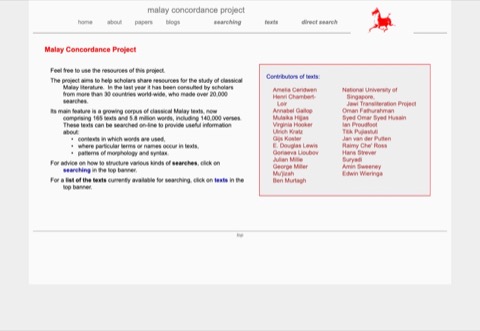
- Open Development Mekong – Laws Record (Laos) (开放湄公河发展平台·老挝法律库)Open Development Mekong (ODM) is an open data and knowledge platform covering Cambodia, Laos, Myanmar, Thailand and Vietnam. Its Laws record collection, built on the CKAN data platform, gathers original documents of national laws, decrees, announcements and decisions, and the Laos site (Open Development Laos) is one of its sub-sites. The official disclaimer states that ODM is a private, non-profit open data and open knowledge media group, not a government or intergovernmental body, so the texts here are secondary compilations that need to be checked against official gazettes. For researchers, its value lies in filtering by country, language, topic, document type and license, and many documents come with English versions, which is useful for regional researchers who do not read Lao when looking for entry points to regulations on land, forestry, hydropower, mining, investment and other aspects of Mekong regional development. It can supplement official gazettes and is also suitable for cross-national comparison.
Coverage, how to use, and notes
Coverage The Laws record page shows 4,319 records on the whole platform, of which 119 are marked as Lao People's Democratic Republic; most of the rest are Cambodia (3,657), Myanmar (313), Vietnam (175) and Thailand (144). Record languages are mainly Khmer and English, with 67 in Lao. Document types include laws, decrees, sub-decrees, announcements and decisions; the format is mainly PDF (4,218). These figures are as shown on the page at the time of search and will change with updates; please check the website.
How to use Open the laws record page of the Laos site and use the filter bar to select country, language, format, agency, topic, license and document type, and sort by relevance, name or last modified time. Most records can be downloaded directly as PDF, and the platform also provides a CKAN-based API for bulk retrieval. Browsing requires no registration. When citing, record the record page URL and the original source of the document, and check provisions against the official gazette wherever possible.
Notes This is an unofficial source; the texts are for reference only, and legal effect and the latest versions must be checked against the official Lao gazette. The number of Laos-related records is limited (119 shown on the page) and incomplete. Licenses differ by record, the most common label being License not specified, so check each one before republishing or reuse. The platform's own original content uses CC BY-SA 4.0, and copyright of news summaries belongs to the original media.
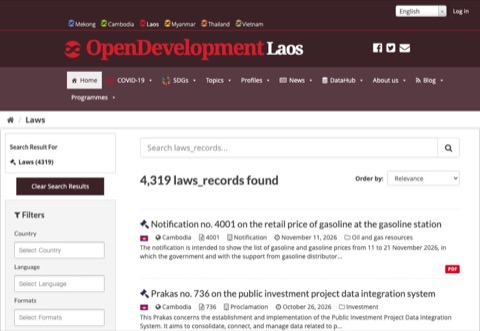
- ProQuest Dissertations & Theses Global (PQDT Global) (ProQuest 全球博硕士论文数据库)PQDT Global is provided by ProQuest and is one of the largest databases of doctoral and master's theses in the world. The website states that it includes graduate theses from North America, Europe, Asia, Africa and elsewhere, with unified search and rich metadata. For research on Southeast Asian Chinese and the region, many anthropology, history and political science doctoral theses from European and American universities on Southeast Asian topics are first-hand fieldwork and archival studies that often precede monograph publication, and they can be searched systematically here. The website also states that, via Web of Science, citations for more than 6 million theses from over 3,600 institutions in more than 70 countries can be consulted. Some records come with full text. The database is a commercial subscription product; individuals can buy single theses in the ways the page provides, or order bound copies printed on demand.
Coverage, how to use, and notes
Coverage The website states there are more than 6 million metadata records, of which about 4 million include full text; records come from North America, Europe, Asia, Africa and other regions. The page does not state the period covered; please refer to the website.
How to use Access is usually through an institutional library subscription. You can search by subject term, keyword, author, advisor or institution, for example Chinese in Malaysia, Peranakan, Singapore Chinese. Check whether full text is available; where it is not, follow the Buy a Dissertation or Thesis on Demand routes provided on the website. You can also cross-check with WorldCat, NDLTD and similar.
Notes Institutional subscription or per-item payment is required. Not every record has full text, and some theses may be under embargo or have usage restrictions; please refer to the website.
- Southeast Asian Studies (Kyoto University) (《东南亚研究》(京都大学东南亚地域研究研究所英文期刊))Southeast Asian Studies (SEAS) is published by the Center for Southeast Asian Studies, Kyoto University. It is an open access interdisciplinary journal focusing on Southeast Asia and related regions. The website states that it publishes research based on fieldwork and empirical evidence and connected to broader concepts, methods and comparative discussion, covering the humanities, social sciences and natural sciences, and also welcomes interdisciplinary collaborative research. Its sections include articles, book reviews, Early View manuscripts published online ahead of issue, and special issues or special focuses. For regional studies researchers, it offers the perspective of Japanese scholarship, known for fieldwork, and articles can be downloaded as PDFs for free; humanities and social science articles can be read alongside topics such as Southeast Asian Chinese, migration and local society. The journal is also listed on J-STAGE. Note that this site's scope is mainly humanities and social sciences, so natural science articles are not included.
Coverage, how to use, and notes
Coverage The website states that it appears three times a year, and the latest issue shown on the current page is Volume 15, Issue 2 (August 2026). The print ISSN is 2186-7275 and the electronic ISSN is 2423-8686. The homepage does not state the retrospective period; please refer to the All Issues page.
How to use On the website, browse by issue through All Issues, find articles by author through Index by Author, or see Special Issues and Special Focuses for thematic collections. Whole issues and individual articles can be downloaded as PDFs with no registration. The Early View section provides manuscripts not yet assigned to a regular issue. Submissions are made through the ScholarOne Manuscripts system. For specific copyright and license terms, see the website's Copyright and Licensing Statement.
Notes The journal includes natural science content, so please select humanities and social science articles when using it. The homepage does not list a specific license agreement; please check the licensing statement before citing or reusing.
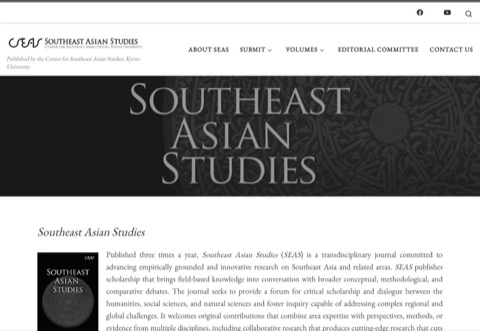
- Southeast Asian Studies (SEAS), Center for Southeast Asian Studies, Kyoto University (《东南亚研究》英文刊(京都大学东南亚研究中心))Southeast Asian Studies (SEAS) is an English-language peer-reviewed journal published by the Center for Southeast Asian Studies (CSEAS), Kyoto University, and is freely readable on the J-STAGE platform. The J-STAGE page describes it as an interdisciplinary journal committed to advancing empirically grounded and innovative Southeast Asian studies, with articles spanning the humanities, social sciences and natural sciences, and welcomes interdisciplinary comparative and collaborative research. The journal was relaunched in 2012 entirely in English, aimed at regional and global readers, and is published in parallel with its Japanese-language sister journal Tonan Ajia Kenkyu. For those doing area studies, its advantages are free full text, HTML full text and Advance Publication, and it is indexed by Scopus, so it can be used directly for literature reviews and for following developments in Southeast Asian studies in the Japanese academic community. Relevant articles on topics such as Chinese society, migration, religion, political economy and the environment may be found in it; specifics depend on search results.
Coverage, how to use, and notes
Coverage Three issues per year. The J-STAGE page shows 719 registered articles as of 18 November 2026. Online ISSN 2423-8686, print ISSN 2186-7275. The disciplinary scope covers Southeast Asia-related research in the humanities, social sciences and natural sciences.
How to use Open the journal's page on J-STAGE, where you can browse by volume and issue or use the platform's search box to search by keyword or author; HTML full text can be read without registration. The page marks Advance Publication. Submissions go through the ScholarOne Manuscripts system. For citation, use the DOI and citation information on each article's page; for specific export functions, please refer to the platform page.
Notes The J-STAGE page does not explicitly state the language of articles, but the titles listed are all in English. For the access status of individual articles, please refer to the article page.
- Southeast Asian Studies Guide (Northwestern University Libraries) (东南亚研究指南(西北大学图书馆))This is the Southeast Asian studies guide of Northwestern University Libraries, maintained by subject librarian Li (Qunying) Li; the Articles page shows it was last updated in June 2026. The guide is divided by resource type into seven sections: articles, books, news resources, digital collections, visual resources, government resources, and NGO and think tank resources. Key resources listed on the Articles page include the Bibliography of Asian Studies, the FBIS Daily Reports (1941–1996) and the Reformasi Weekly Review, along with general databases such as JSTOR, Project MUSE, Historical Abstracts, IBSS and ProQuest Dissertations & Theses Global, and three Southeast Asian journal indexes: Excerpta Indonesica, the Malaysiana Journal Index and the Thammasat University Thai Journal Index. For readers working on Malaysia, Indonesia and Thailand, these regional journal indexes are entry points worth noting separately from the usual English-language databases. The guide is suitable as a list of search tools, helping researchers decide which database to consult for a given type of literature.
Coverage, how to use, and notes
Coverage Covers articles, books, news, digital collections, visual materials, and government and NGO materials for Southeast Asian regional studies. Key indexes include the FBIS Daily Reports (1941–1996) and three country-focused journal indexes. The specific scale of the other sections is not listed uniformly on the official site; please refer to the official site.
How to use After opening the guide homepage, choose sections such as Articles, Books and News Resources from the tabs at the top. When looking for journal articles, first see Key Resources and Southeast Asia Journal Indexes, then supplement with general databases. The guide pages can be browsed directly; whether the linked databases are accessible depends on their own licensing, which the page does not describe one by one.
Notes Most of the databases listed are Northwestern University subscription resources, which off-campus readers usually cannot access directly, and the page does not indicate the access requirements item by item. The link path for the Reformasi Weekly Review contains the word restricted; please refer to the official site for its access status. The guide can be used as a source of search leads, after which similar databases or open alternatives can be sought at a local library.
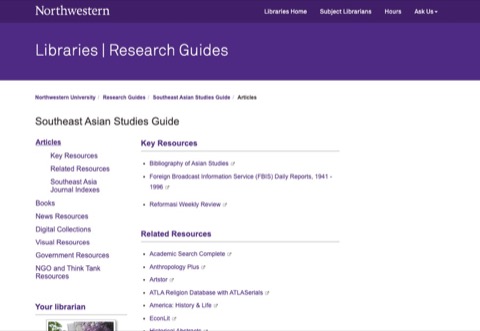
- Thai Journal Index (University of Washington Libraries) (泰文期刊索引(华盛顿大学图书馆))The Thai Journal Index is the Thai Journal Indexing Project of the University of Washington Libraries, a cooperative program of the Committee on Research Materials on Southeast Asia (CORMOSEA) of the Association for Asian Studies (AAS), funded for two years by the AAU/ARL Global Resources Program, with partners including the Technical Information Access Center in Bangkok, the University of Wisconsin-Madison, and the Center for Research Libraries (Chicago). The project scans the abstracts or introductions of articles, retains the original Thai, and transliterates authors and titles into Roman letters according to ALA/LC rules, so that researchers who cannot read Thai fluently can use Roman-letter searching to judge whether an article is worth requesting. For Southeast Asia researchers who need to track Thai-language scholarly literature from Thailand but lack Thai input capability, it is a practical introductory tool.
Coverage, how to use, and notes
Coverage The website lists six indexed journals, such as Chiwit mai, Sinlapawatthanatham (Art and Culture), Thammasat Law Journal, Warasan phasa lae phasasat (Journal of Language and Linguistics), Warasan setthakit lae sangkhom, and Warasan thammasat (Thammasat Journal). The years covered and the total number of records are not stated on the website pages; please refer to the official website.
How to use On the website, click "Browse Collection" to browse, or use the advanced search page of the collection, which also has a "How to Search" guide. Searching is mainly by subject analysis and Roman-letter transliteration, and author names or title words can be searched in Roman letters. After getting hits, judge relevance from the Thai abstracts, then request the full text through interlibrary loan or similar means; the index itself does not provide full text.
Notes The index covers only a small number of journals, and the project pages show no update date, so it should not be treated as a complete index of Thai journals; full texts must be obtained separately. It can be used together with domestic platforms such as ThaiJO.
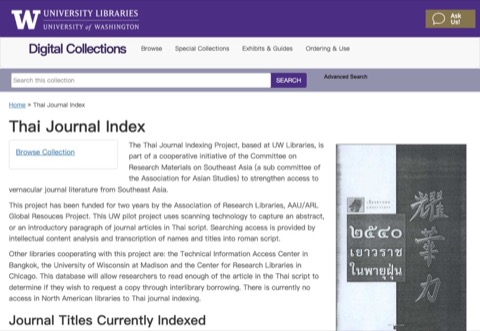
- UN Population Division Data Portal (联合国人口司数据门户)The United Nations Population Division Data Portal, built by the United Nations Population Division, provides interactive queries of global demographic indicators and is one of the main online entry points to UN population estimates and projections such as the World Population Prospects. The portal organizes indicators by theme, including child mortality, family planning, fertility, marital status, population, maternal mortality, mortality, urbanization and international migration. Users can query by indicator and region, or quickly get an overview of the population profile of a country or area through country profile pages. For readers of Southeast Asian and Chinese studies, it offers cross-nationally comparable data on population size, age structure, fertility and mortality levels, urbanization and international migrant stock for Southeast Asian countries, providing macro-level background for national demographic history, migration studies and regional comparison. The portal also offers a selection wizard and a comparison function between different revisions, and opens an API so that data can be connected to one's own analysis tools.
Coverage, how to use, and notes
Coverage Demographic indicators for countries and areas worldwide, with themes including population, fertility, mortality, marriage, family planning, urbanization and international migration. According to examples on the official site, estimates begin in 1950, the medium-variant projection runs to 2050, and some series extend to 2100; for the exact years of each indicator and the revision on which it is based, please refer to the portal pages.
How to use On the portal homepage, select an indicator by theme, then choose the country or area and the time range. You can also use the selection wizard to set parameters step by step, or go to Country Profiles to view a single country. Results can be viewed online as tables or charts, and data can be obtained through the API; the revision comparison function allows checking differences between versions. No registration is needed for browsing. Please record the revision number of the data when using it.
Notes Population projections are based on assumed scenarios and are not actual statistics; data are adjusted between revisions, so the version must be stated when citing. The portal focuses on globally common indicators and does not contain data classified by Chinese or ethnic group.
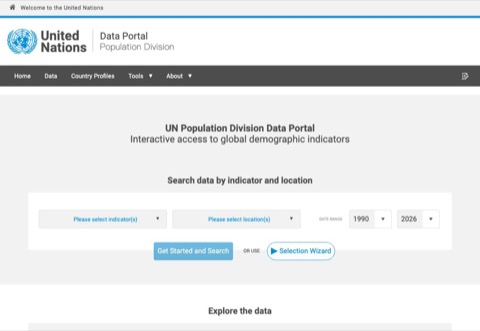
- Wordnet Bahasa (马来语—印尼语词网(Wordnet Bahasa))Wordnet Bahasa is a free semantic lexicon of the Malay language family covering Malaysian Malay and Indonesian, modelled on Princeton WordNet and the Global WordNet Grid. It is led by Francis Bond of Nanyang Technological University, with Hammam Riza, Ruli Manurung, Lian Tze Lim, David Moeljadi and others taking part. The wordnet organises word meanings into synsets; semantic relations such as hypernymy and part-whole are taken from Princeton WordNet 3.0, with Indonesian and Malay entries added on top, and the results of earlier Malaysian and Indonesian wordnet projects are also integrated. For readers studying Indonesian lexical semantics, doing text analysis or comparing word usage between Malaysia and Indonesia, it can be searched online or downloaded for natural language processing and lexical research. The project page states that the data may be used freely, that academic use should cite the project's paper, and that the licence text is in its SourceForge repository.
Coverage, how to use, and notes
Coverage The website lists 49,668 synsets, 145,696 senses and 64,431 unique words; the languages are Malaysian and Indonesian, and the sense structure comes from the English Princeton WordNet 3.0.
How to use Open the website homepage and, following the page instructions, search online through the web interface provided by NTU, or go to the SourceForge download page for the data and source code. No registration is required. For questions or to take part in development, contact the wn-msa-devel mailing list. When used in research, cite the papers listed on the project website.
Notes The project states that this version may contain errors in as many as 5–10% of entries, so samples should be checked before quantitative use; the sense framework derives from the English wordnet, so coverage of concepts specific to Indonesia is limited.
- World Bank Microdata Library (世界银行微观数据库)The World Bank Microdata Library collects microdata from the World Bank and other international, regional, and national agencies; the website homepage shows 7,154 datasets in the catalogue. Featured collections include the Living Standards Measurement Study (LSMS), the Global Financial Inclusion Database (Global Findex), high-frequency phone surveys, and the IPUMS collection. The website also provides materials on metadata standards, disclosure risk, and anonymization, and an API for searching, browsing, and exporting metadata. Most of its holdings are household surveys, and those relevant to this topic are mainly the census microdata and the IPUMS collection, which suit finding available survey and census samples and their respective terms of use when the country and year are known. Note that household health surveys are not a focus of this section; when using it, please select only datasets related to population and ethnic groups.
Coverage, how to use, and notes
Coverage The homepage shows a total of 7,154 datasets, from the World Bank and other international, regional, and national agencies. The content is mainly national survey and census microdata; the country, year, and variables of each dataset can be seen on its dataset page. Whether census microdata for a given country are included must be confirmed by searching one by one.
How to use Enter a country, topic, or survey name in the homepage search box, or browse the full catalogue through Browse Catalog. Each dataset page lists the metadata and terms of use. The homepage has a login entry; the page does not explain the access tiers of the datasets, and a common situation is that downloading requires prior registration and application, so please see the Terms of use on each dataset page. The API can be used to search and export metadata in bulk.
Notes Access conditions vary by dataset, and the page does not state access levels; please refer to the terms of each dataset. The homepage does not state whether census microdata are included, so you need to search the catalogue to find out.
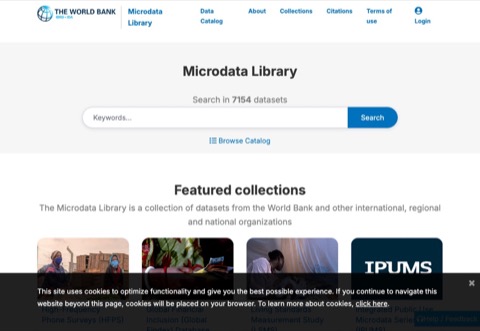
- WorldCat (WorldCat 世界联合图书馆目录)WorldCat is operated by OCLC, a nonprofit library cooperative, and is one of the largest union library catalogues in the world, allowing one-stop searching of library holdings worldwide. The material types listed on the homepage include books, articles, audio recordings, scores, maps and theses. For research on Southeast Asian Chinese and the region, its main uses are bibliographic scoping and locating holdings: confirming whether a monograph, conference proceedings or thesis in Malay, Indonesian, Chinese or a Western language exists, what its edition details are, and which libraries hold it, so as to decide between interlibrary loan, a scan request or a visit in person. Search results can generate citations, and personal lists can be created. For grey literature held at only a few institutions and older local publications, it often provides leads. Used together with the institutional catalogues already included, one can first locate an item in WorldCat and then check call numbers and borrowing conditions in the specific institution's official catalogue.
Coverage, how to use, and notes
Coverage The approximate figures given on the homepage are: about 405 million books, 440 million articles, 25 million audio recordings, 10 million scores, 6 million maps and 30 million theses. The homepage does not state the period covered or the language distribution; please refer to the website.
How to use Open search.worldcat.org directly and enter a title, author, subject or keyword in the search box; results can be filtered by material type (such as theses) and language. Result pages usually show edition details and holding libraries, and can generate citations. Creating an account lets you save lists; whether any fee applies is not stated on the homepage, so please refer to the website. When searching, try the original Chinese title, pinyin, and Malay or Indonesian titles to avoid omissions. Once an entry is found, check the holding library's official catalogue for actual loan availability and interlibrary loan.
Notes WorldCat provides bibliographic and holdings leads, not full text; whether a library allows borrowing or scanning varies by library. Different writing systems and romanization methods affect search hits, so try several forms.
Research methods & tools
- 11.384 Malaysia Sustainable Cities Practicum (MIT OpenCourseWare) (马来西亚可持续城市实习课程(麻省理工学院开放课程))An open graduate course from the Department of Urban Studies and Planning at MIT, available on MIT OpenCourseWare. It was offered in Spring 2018, taught by Lawrence Susskind, with teaching assistants Jessica Gordon and Yasmin Zaerpoor. According to the course page, it is an intensive, field-based course in which 15 graduate students travel to Malaysia to analyze sustainable development practices in five cities, assess their effectiveness, and identify projects or policies that the next year's international visiting scholars could study. Materials posted on the course page include the syllabus, Instructor Insights (four subpages covering project history and implementation, working with international visiting scholars, reflective practice, and online technology), a pre-trip tutorial, research agenda, related resources, written assignments with examples, and additional videos. The course is licensed under CC BY-NC-SA 4.0 and offers a full-course download option. For readers interested in urban governance and regional development in Malaysia, or in how area-studies fieldwork teaching is designed, it is one of the few openly available Malaysia-focused course materials.
Coverage, how to use, and notes
Coverage A single graduate course from Spring 2018 on sustainable development in five Malaysian cities. Published content includes the syllabus, instructor insights, a pre-trip tutorial, research agenda, assignment examples and videos. The page does not separately list readings; please refer to the official site.
How to use Open the course page and use the left-hand menu to view the syllabus, Instructor Insights, pre-trip tutorial, research agenda and assignment examples in turn. The page offers a Download Course option for the full course without registration; please check the official site for the exact contents of the download package. When citing or reusing the materials, follow the terms of CC BY-NC-SA 4.0.
Notes This is the open material of a single course, not a comprehensive resource on Malaysian studies, and it focuses on urban planning and sustainable development, with limited relevance to Chinese studies. Readers can search ocw.mit.edu separately for other courses under Southeast Asia or country names.
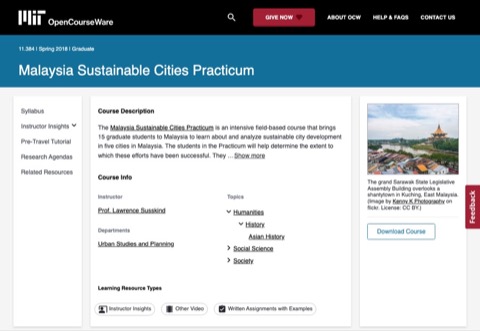
- China Historical Geographic Information System (CHGIS) (中国历史地理信息系统)CHGIS is a historical geography database jointly built by the Center for Historical Geography Studies at Fudan University and Harvard University. It was launched in January 2001 and is provided free of charge to the academic community. The project was led by the Institute of Historical Geography at Fudan University, with Zou Yilin as editorial adviser and Ge Jianxiong and Man Zhimin among the participants; on the Harvard side, Lex Berman was responsible and designed the website. The database covers settlements and historical administrative units in China from 221 BCE to 1911 CE, presented in GIS form, and can be used for spatial analysis, visualization of historical administrative divisions, and teaching, research and publishing. For research on Southeast Asian Chinese, the county and prefecture histories and place-name locations of emigrant home areas such as Fujian and Guangdong can be linked to place-of-origin information in remittance letters (qiaopi), genealogies and migration records. The website also provides TGAZ place-name search and an open API, and includes other historical GIS datasets such as Hartwell's, which help with place-name disambiguation and mapping.
Coverage, how to use, and notes
Coverage The website states that it covers settlements and administrative units in Chinese history from 221 BCE to 1911, and that six data versions were released between 2002 and 2016. The time series covers 22 'core provinces'; Inner Mongolia, Qinghai, Xinjiang and Tibet are not within the time series but appear in the time-slice data (especially the 1911 layer). It also includes base-map layers such as historical coastlines, major rivers and generalized elevation.
How to use Visit chgis.fas.harvard.edu and use 'Search Placenames' (TGAZ) to search place names or call the API. Data can be downloaded from the Fudan University project website (yugong.fudan.edu.cn) or the Harvard Dataverse (dataverse.harvard.edu/dataverse/chgis). The data are GIS layers and need software such as QGIS or ArcGIS to open. Each temporal record has a unique ID, which can be used as a geocoding field in a relational database.
Notes The website states that the project was built for free distribution to scholars, but the pages do not state specific licence terms; for citation and redistribution, please follow the licence on the download page and the website. The data consist mainly of administrative divisions before 1911 and are not original maps or imagery, so they should be checked against the literature when used.
- Hong Kong Studies Research Guide (York University Libraries) (香港研究研究指南(约克大学图书馆))This is a Hong Kong studies guide built on the LibGuides platform by York University Libraries in Canada. It belongs to the Regional and Ethnic Studies subject group and is also tagged China Studies and East Asian Studies. The guide is organized into Home, Getting Started, Bibliographic Databases, Print Media, Audiovisual Materials, Hong Kong Research Topics, Hong Kong Research Centres and Projects, and Other Hong Kong Research Guides. The Getting Started page gathers Hong Kong yearbooks, language tools and dictionaries (including a character database and Cantonese resources), an overview of the Hong Kong government, statistics and data (including census data), and archival and heritage resources, such as government archives, a historical geographic information system, and national archives and digital repositories in the UK and Japan. The Other Hong Kong Research Guides section also lists similar guides from various universities, for comparison and further searching. For researchers interested in Chinese migration and diaspora communities, such a navigation page helps link Hong Kong materials with overseas Chinese studies and offers one-stop access to freely available external websites.
Coverage, how to use, and notes
Coverage The guide is Hong Kong-themed and includes reference tools, statistical data, archival and heritage resources, and lists of research topics and research institutions. The period and scale are not stated on the website; some resources are in Chinese and require Chinese reading ability.
How to use Open the page to browse directly, with no registration required. The left-hand menu is ordered as Getting Started, Bibliographic Databases, Print Media, Audiovisual Materials, Research Topics, Research Centres. Most entries are external websites and open in a new window. Use of subscription databases requires York University affiliation; other open websites are freely accessible. The Other Hong Kong Research Guides section lets you compare resource recommendations from several universities.
Notes The page does not name a specific maintainer. Subscription resources are limited to York University users. Links point to external sites, so availability is subject to each site's own website.
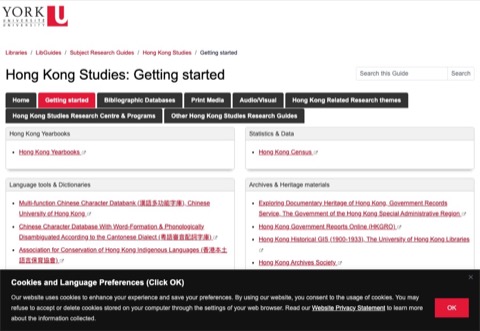
- International Corpus of English – Hong Kong (ICE-HK) (国际英语语料库·香港子库)ICE-HK is the Hong Kong component of the International Corpus of English (ICE) project and is used to study the vocabulary, grammar and stylistic features of Hong Kong English. The ICE research group at the University of Zurich distributes the corpus. According to the official access page, ICE-HK is a one-million-word corpus restricted to non-commercial academic research, and authorization must be obtained first. Applicants apply with an academic email address and fill in and submit a licence form; once approved, they receive a download account, usually within about 10 working days. A licence granted to an instructor also covers classroom teaching. For scholars studying language contact, Chinese–English code-mixing and varieties of English in Hong Kong, it is a standard comparative resource, since it follows the same design as the other regional ICE components and so permits cross-regional comparison.
Coverage, how to use, and notes
Coverage About 1 million words, with word-level annotation, covering spoken and written English in Hong Kong. For text categories, collection years and annotation details, please consult the ICE website and the documentation for each component.
How to use Visit the access page on the ICE website, apply with an academic email address as instructed, fill in the licence form and submit it as directed. After approval, log in to the download page with the credentials provided and download the corpus. The licence covers academic, non-commercial use. The page does not state any fee; please confirm with the ICE research group.
Notes Approval is required, so the corpus cannot be downloaded immediately; academic use only. The website does not state any fee.
- MARKUS: Text Analysis and Reading Platform (MARKUS 古典汉语文本标注与分析平台)MARKUS is an online platform for reading, tagging and analysing classical Chinese texts. The website states that it was developed in the Communication and Empire project, funded by the European Research Council, with further development funded by DID, JISC and the AHRC; the Harvard Library guide also lists it as an openly available tool. After a user uploads a text, the system can automatically tag personal names, place names, dates, official titles and Buddhist terms, and also supports keyword tagging, regular expressions, and batch and manual tagging. Results can be exported as HTML or TEI, or sent to tools such as VISUS, Docusky and Geoport for network, timeline, map and GIS analysis. For research on the Chinese in Southeast Asia, it is suitable for processing Chinese-language sources such as gazetteers, travel accounts, inscriptions, collected writings and Chinese-language newspapers, turning the people and places in the text into analysable data.
Coverage, how to use, and notes
Coverage A tool rather than a repository: it mainly targets Chinese texts, and automatic tagging is mainly for classical Chinese; the website states that keyword tagging can be used for all languages. The website does not state how well the preset lexicons cover modern Nanyang Chinese sources (such as clan association inscriptions and newspapers); test it in practice.
How to use On the website, upload a text file, choose automatic, keyword or manual tagging mode, then view the tags in reading mode and, as needed, export to HTML or TEI or send to visualisation and GIS tools. The website mentions that personal accounts can store files free of charge, but the home page does not make clear whether login is required; the website provides help documentation, videos and an FAQ.
Notes The pricing section of the website contains placeholder text and should not be used to judge fee plans. Automatic tagging relies on existing lexicons, so modern materials and dialect characters need manual proofreading. The code is licensed under AGPL v3, and the documentation and videos under CC BY SA 4.0.
- Malaysia: IALS Library Guides (马来西亚法律研究指南(伦敦大学高等法律研究所图书馆))This is a guide to Malaysian legal research compiled by the library of the Institute of Advanced Legal Studies (IALS), University of London, explaining how to find Malaysian constitutions, legislation, case law and legal literature. The guide first describes Malaysia's federal and state structure and its legal system based on English common law, then covers in turn the constitution, the court system (including the parallel Islamic law courts), federal legislation, state legislation, case law, encyclopaedias, books, journals and web resources. The guide was created by Helen Gaterell and updated by Katie Radford. For humanities and social science readers studying Malaysian politics, religion, land and ethnic institutions, it explains where legal materials come from and what various databases cover, making it easier to trace primary legal texts.
Coverage, how to use, and notes
Coverage Covers the federal and state constitutions, federal and state legislation, law reports and web resources. The page notes that the Attorney General's Chambers federal legislation portal includes Acts from March 2011 and subsidiary legislation from 26 April 2011; CommonLII holds some legislation from 1914 to 2006; Sabah LawNet and Sarawak LawNet provide state law; case law resources include the Malayan Law Journal, SCC Online, Lexis+ and CommonLII. It also lists the IALS library classification mark (GM4, subdivided by state). Mainly in English.
How to use Open the guide and read through the sections in the left-hand menu (constitution, judiciary, federal legislation, state legislation, case law, etc.). Free resources (such as the federal legislation portal, CommonLII and the state LawNet sites) can be used online; subscription databases such as Lexis+ International, SCC Online and HeinOnline have access restrictions. The page states that the enquiry desk is open Monday to Friday, 9:30–17:00.
Notes The guide notes that the texts on the federal legislation portal are not the official versions of the Government Printer; IALS does not subscribe to the CLJ Law database; on-site and remote access conditions for subscription databases vary by user status, so please check the IALS website. The page states it was updated in March 2025.
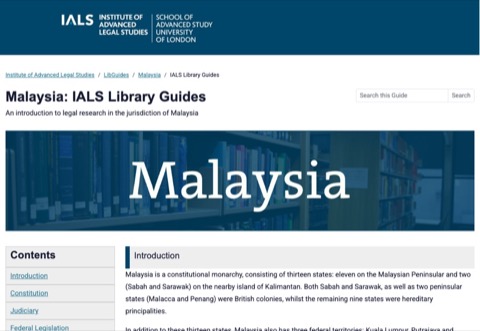
- Malaysian studies (ANU Library) (马来西亚研究指南(澳大利亚国立大学图书馆))This is the Malaysian Studies LibGuide of the Australian National University (ANU) Library, describing the Malaysia research resources and collections available through the Menzies Library (Asia-Pacific services centre). The guide is organised by stages of the research process: reference tools (atlases and language resources), books and e-books, databases, journals and e-journals, audiovisual materials, news and newspapers (including historical newspapers), theses, websites, open access, archives, citation styles, and resource requests and training. For readers who want to learn systematically how to search for Malaysian materials in a university library, it offers a clear search roadmap and is also useful as a model for building one's own research guides.
Coverage, how to use, and notes
Coverage The home page lists only section names and does not give the names or size of specific databases, newspapers or thesis collections; please open each tab to confirm the contents. The sections cover reference tools, books, databases, journals, audiovisual materials, newspapers, theses, websites, open access and archives.
How to use After opening the home page, enter each section via the left-hand tabs. Off-campus access to some resources requires an ANU account, and the page has an Off-campus access section explaining this; contact details are those of the Menzies Library (see the website's contact page), and the page also provides a way to book an appointment with an information adviser. Resources in the open access and websites sections can be used without logging in.
Notes The home page has limited information; you need to click into each section to see specific resources. Collections and subscribed resources are available only to ANU users; please check the website.
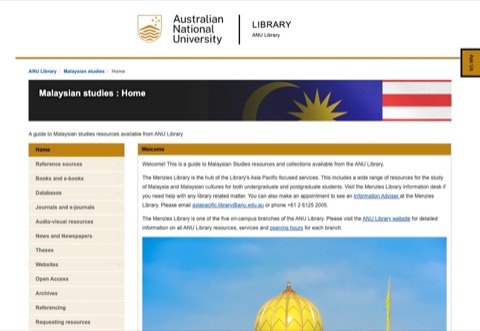
- NusaCrowd: A Collaborative Project to Collect Indonesian-Language Datasets (NusaCrowd 印度尼西亚语言数据集汇集计划)NusaCrowd is an open collaborative project that brings together datasets in Indonesian and regional languages; its official GitHub repository describes itself as 'A collaborative project to collect datasets in Indonesian languages'. The project registers Indonesian text, speech and other datasets scattered in various places in one location and provides unified data-loading scripts for them, so researchers need not find, download and parse them one by one. For readers studying Indonesian languages, dialects and regional languages, it works as a dataset catalogue plus loading tool: one can first list the registered datasets and then load one by name. The related paper NusaCrowd: Open Source Initiative for Indonesian NLP Resources was published in ACL 2023 Findings and describes its resource consolidation and benchmark construction. The project was later expanded into SEACrowd, covering Southeast Asia; the current repository sits under SEACrowd as a fork of IndoNLP/nusa-crowd. Humanities and social science researchers can use its sentiment analysis, translation, speech and other datasets for Indonesian text analysis and language comparison. Copyright in each dataset remains with its original authors.
Coverage, how to use, and notes
Coverage The repository page shows 143 registered datasets; according to the ACL 2023 Findings paper, it then covered 137 datasets, of which 118 had standardised loading scripts, covering Indonesian and 18 regional languages and 3 data modalities. Please rely on the repository for the specific dataset list and languages.
How to use Read the README and dataset list in the GitHub repository; after installing with pip install nusacrowd as instructed, use list_datasets() to list datasets and load_dataset() to load one by name, for example smsa. Datasets not yet registered can also be submitted via the repository page. Browsing the repository requires no registration; contributing requires a GitHub account. A Python environment is needed.
Notes The licence of each dataset is set separately in its loading script, and individual entries may be marked Unknown, so check the original source and licence before research and publication; some datasets must be downloaded separately from their original sources. The repository page is a snapshot, so whether it is still being updated should be checked on the official site.
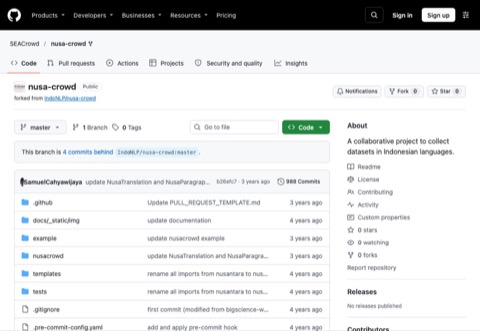
- Philippines (Harvard Library guide for HIST 1037: Modern Southeast Asia) (哈佛图书馆东南亚近代史课程指南·菲律宾页)This is the Philippines page of a research guide made by the Harvard Library for the Faculty of Arts and Sciences course HIST 1037 (Modern Southeast Asia), listing print and digital materials for studying Philippine history and culture. The page is divided into Background and Context, Archives and Manuscripts, Bibliographies, Biographies, Document Collections, Government Publications, Images, Statistics, Travel Accounts and the 1904 St. Louis World's Fair, so readers can start by resource type. The materials it recommends include the Historical Dictionary of the Philippines (Artemio R. Guillermo, 3rd ed., 2012), the Dictionary of Philippine Biography (E. Arsenio Manuel, 4 vols., 1955–95), Who's Who in Philippine History, the Official Gazette of the Republic of the Philippines (from 1946), and the digital resources Philippine eLib and the Philippine Diary Project, as well as archival leads on Forbes's photographs of the Philippines (1907–1946). For readers working on the American colonial period, colonial imagery and the search for Philippine historical sources, it is a selective introductory reading list and map of sources.
Coverage, how to use, and notes
Coverage The page lists reference works, bibliographies, biographical dictionaries, document collections, official gazettes, statistics, images and travel accounts by theme, and includes entries such as the official catalogue and handbooks of the 1904 St. Louis World's Fair. The resources listed are mainly in English, and their scale is as actually listed on the page; the page shows its latest update as October 2026.
How to use After opening the URL, switch between the sections at the top of the page (such as Archives and Manuscripts, Bibliographies, Document Collections, Images and Statistics). Open digital resources on the page can be clicked directly; print materials and subscription resources must be obtained through the Harvard Library catalogue and accounts. Reading the guide requires no login.
Notes This is a selective guide for a single course, not a complete bibliography of Philippine studies; some resources are limited to Harvard users. The content of externally linked resources such as Philippine eLib is as stated on their own websites.
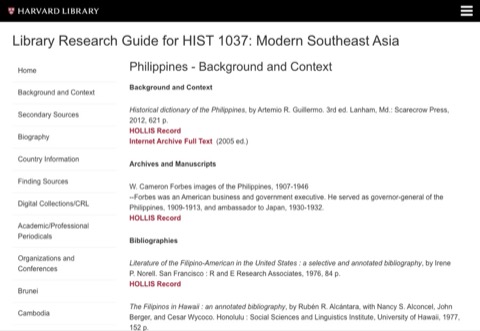
- Philippines Research Guide (University of Hawaiʻi at Mānoa Library) (夏威夷大学马诺阿分校图书馆菲律宾研究指南)This is a research guide on the Philippines from the University of Hawaiʻi at Mānoa Library (Hamilton Library), maintained by the university's Philippine Studies librarian. The guide is organized around Philippine identity, history and culture, Filipino communities in Hawaiʻi and the United States, and the Philippines in global context. It brings scattered resources together: about 30 subpages by common research topic cover Philippine history, literature, architecture, folklore, indigenous peoples of Luzon and Mindanao, Islam in the Philippines, human trafficking and more; resources are also listed by type, including reference works, newspapers, archives, journals, theses and dissertations, digital archives, US government documents on the Philippines, and related events. The guide also has a separate section on the Ramon Sison collection, explains the difference between primary and secondary sources, and lists Philippines-related departments and programs on campus. For readers of Southeast Asian Chinese and regional history, it is a one-stop navigation page to the landscape of Philippine studies collections in North America, to the Computer Index to Philippine Periodical Articles (CIPPA), and to electronic editions of Philippine revolutionary documents, and it also serves as a template for designing search paths.
Coverage, how to use, and notes
Coverage The databases listed on the page include ABI/Inform Global, Academic Search Complete, JSTOR, MLA International Bibliography, Project MUSE, the ProQuest dissertations database, Alt-PressWatch, and CIPPA, the Computer Index to Philippine Periodical Articles (the page says it covers over a hundred publications, 1988 to the present). Digital resources include the Philippine Revolutionary Papers (documents from the Philippine revolution 1896–1898 and the Philippine–American War 1899–1902) and UH digital images. There are also leads to holdings such as Hawaiʻi congressional papers, manuscripts and university archives. The page says general Philippine materials at Hamilton Library are on floors 3 and 4.
How to use Open the guide's URL directly and go from the tabs at the top to Common Research Topics or browse by resource type (newspapers, archives, journals, theses and dissertations, digital archives, etc.). The guide itself can be read without registration, and the open resources in it can be used directly by clicking. The subscription databases listed require access through a University of Hawaiʻi account. The page states that the Asia reference desk is open Monday to Friday, 10:00–14:00 (excluding holidays); details are as on the website. You can contact the Philippine Studies librarian from the guide page for consultation.
Notes Most commercial databases in the guide require institutional subscription; the database size figures on the page come from vendor descriptions and may change over time. The resources are framed by the holdings and readers of US universities, and physical holdings must be consulted at the University of Hawaiʻi.
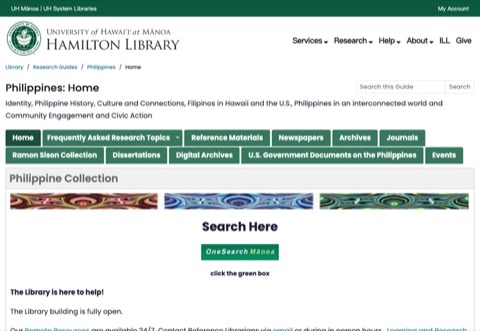
- Resources Guide to Hong Kong Studies (University of Toronto Libraries) (香港研究资源指南(多伦多大学图书馆))This is a Hong Kong studies resource guide compiled by the University of Toronto Libraries. It accompanies the special collections of the library's Richard Charles Lee Canada-Hong Kong Library, whose holdings focus on Hong Kong studies, Chinese Canadian studies and Canada-Hong Kong studies. The guide lists a public services librarian as contact, and its sections include reference tools, finding books, articles and theses, finding Hong Kong newspapers, primary and visual materials, finding statistics, and resources organized by themes such as history, film and politics. The collections highlighted on the page are the art collection, the Carl T. Smith collection (56 reels of microfilm covering Hong Kong, Macao and Chinese coastal cities), the Hong Kong Basic Law portal, the Hong Kong handover collection, the Hong Kong newspaper clippings (microfilm, 1850s to 1999) and the Senator Vivienne Poy fonds (1998-2012). For readers studying Chinese migration, trans-Pacific Chinese communities, and the history of Hong Kong and Macao, the guide leads both to openly accessible online resources and to important overseas Hong Kong collections.
Coverage, how to use, and notes
Coverage Mainly Hong Kong, with some attention to Chinese in Canada and Canada-Hong Kong relations. It includes print and electronic reference resources, newspapers, primary materials, statistics and thematic resources. The time span of the special collections varies by collection (for example, clippings microfilm 1850s to 1999; Poy fonds 1998-2012).
How to use Open the guide page and browse by section; the page itself requires no registration. Physical collections (such as microfilm) must be consulted at the University of Toronto Libraries, so please consult a librarian to arrange before visiting; subscription databases require campus affiliation. The guide page provides an email link to report problems and the librarian's contact details.
Notes The page does not state access restrictions, but the conditions of use for subscription databases and physical collections are subject to the website. The guide is aimed at University of Toronto faculty and students; external readers can browse the open links.
- South East Asian Studies: Philippines (SOAS Library LibGuide) (伦敦大学亚非学院图书馆东南亚研究指南·菲律宾页)This is the Philippines page of the Southeast Asian studies guide of the SOAS Library (SOAS, University of London), published by the SOAS Library. The guide as a whole has sections on e-books and e-journals, databases, print and special collections, resources by country and web resources; the Philippines page offers recommendations of newly added e-books on Philippine topics and a list of useful websites. The new books recommended on the page include Norman Owen's Prosperity Without Progress, Stephen Acabado and Marlon Martin's Indigenous Archaeology in the Philippines, Philip Bowring's The Making of the Modern Philippines and Paula C. Park's Intercolonial Intimacies. The website list includes Jose Rizal, Philippine government websites, the Chan Robles Virtual Law Library, Spanish–American War film materials, and Philippine population and housing censuses. It is helpful for readers who want to understand how Southeast Asian studies resources are laid out in British academia and to find entry points to Philippine law, demographic statistics and early film sources.
Coverage, how to use, and notes
Coverage The page lists 4 newly added e-books and 9 useful websites; the guide as a whole contains 12 country entries. The content covers history, archaeology, politics, law, journalism, population censuses and early film material. More databases and information on print and special collections are in other sections of the guide; please check the website. The page shows its latest update as November 2026.
How to use After opening the URL, use the tabs at the top to reach sections such as Ebooks & Ejournals, Databases, Print and Special Collections, Resource by country and Web resources; external website links on the Philippines page can be visited directly. The page gives the SOAS Library's email and telephone for enquiries; details are as on the website. Reading the guide requires no login.
Notes E-books and databases mostly require a SOAS account, so readers outside SOAS may not be able to open them; the new books recommended on the page are not a complete bibliography.
- Southeast Asia Collection: Hán Nôm Studies (Yale University Library Research Guide) (东南亚馆藏:汉喃研究(耶鲁大学图书馆研究指南))This is the Hán Nôm research section of the Yale University Library's Southeast Asia collection guide, giving beginning researchers routes to finding Hán Nôm materials at Yale. The guide describes Hán Nôm as an ideographic writing system used from about the 15th to the early 20th century, and focuses on the Maurice Durand Hán Nôm Collection held in the Manuscripts and Archives department of Sterling Memorial Library, Yale. It has four subpages: the Maurice Durand Collection (digital and archival materials), Hán Nôm institutes and collections around the world, Chữ Nôm editors (websites that convert modern Vietnamese into Nôm), and print reference tools for Hán Nôm research in Yale libraries. The same guide also includes sections on the Southeast Asia reading room, periodicals and newspapers, electronic archives and databases, and primary sources. For researchers of premodern Vietnamese documents, inscriptions, and Chinese- and Nôm-language literary and religious texts, such a guide helps locate Hán Nôm holdings worldwide and the tools needed for reading and transcription. For research on Southeast Asian Chinese, the extension of the Chinese-character writing tradition in Vietnam is also an important thread for regional comparison.
Coverage, how to use, and notes
Coverage Mainly Hán Nôm studies, centered on Yale's Maurice Durand Hán Nôm Collection, with leads to Hán Nôm institutions and collections worldwide, Nôm input tools and print reference tools. The guide page does not give specific volume counts; please refer to the official subpages.
How to use Open the guide URL, go to the Hán Nôm section, and view the four subpages in turn: Maurice Durand Collection, Institutes, Research Centers and Collections of Han Nom, Chu Nom Editors, and Print Reference Tools. Some digitized items can be searched in Yale's digital collections; physical archives must be consulted by appointment through Manuscripts and Archives. For appointment and usage rules, please refer to the Yale Library website.
Notes The guide page itself gives only brief introductions to the subpages; the specific content requires opening the subpages. The page does not list an individual maintainer. Subscription-based electronic journals require a Yale account.
- Southeast Asian Collection: Asian Collections at the Library of Congress (东南亚馆藏指南(美国国会图书馆))A research guide to the Library of Congress's non-rare Southeast Asian collections, published by the library's Asian Division on guides.loc.gov. According to the guide, the collections hold more than 370,000 titles in over 100 languages, 86 of them indigenous to the region, covering eleven countries: Brunei, Myanmar, Cambodia, Indonesia, Laos, Malaysia, the Philippines, Singapore, Thailand, Vietnam and Timor-Leste. Indonesian materials form the largest share; Indonesia, the Philippines, Thailand and Vietnam are the strongest areas, and history, economics and government are especially well represented. The guide has sections on books, newspapers and periodicals, rare books and manuscripts, digital collections, electronic resources, web archives, related materials in other reading rooms, event videos, romanization and search strategies, and how to use the Library of Congress. For readers studying the Chinese in Southeast Asia and regional history, the guide shows how to locate Southeast Asian-language and Western-language materials in the Library's very large catalog, and offers romanization search tips to reduce missed results caused by transliteration differences.
Coverage, how to use, and notes
Coverage Books, serials, digital collections, electronic resources and web archives from eleven Southeast Asian countries. The guide states that the holdings exceed 370,000 titles in more than 100 languages; acquisition of Southeast Asian materials began in 1866, and a regional office was established in Jakarta in 1963. The Asian reading rooms as a whole hold more than 4 million items in about 200 Asian languages.
How to use After opening the guide, first read Romanization & Search Strategies for transliteration and search methods for each language, then go to sections such as Books, Newspapers & Periodicals and Digital Collections. The collection catalog can be searched online, and questions can be sent to the Asian Division through Ask a Librarian (ask.loc.gov/asia). Non-rare materials can be used without an appointment, though prior consultation is possible; the guide also provides event videos and webinars.
Notes The guide mainly introduces the collections and search methods; consulting physical items requires visiting the library, and only part of the content is digitized. Rare books and manuscripts are covered by a separate guide and an appointment system. Holdings are strongest for Indonesia, the Philippines, Thailand and Vietnam; materials on the Chinese must be found by searching the catalog.
- Southeast Asian Studies (University of Michigan Library Research Guide) (东南亚研究指南(密歇根大学图书馆,含泰国专藏))This is the Southeast Asian studies guide of the University of Michigan Library, maintained by the library's Southeast Asia librarian, covering the ten Southeast Asian countries and Timor-Leste, and including an introduction to the collections, directions of collection development, regional resources, and selected indexes. The guide notes that, within the library's Southeast Asian collections, Indonesia, the Philippines, and Thailand have received the most attention, and introduces Thailand-related special collections: the William J. Gedney collection, with more than 6,000 monographs, manuscripts, and periodicals on Thai history and culture, focusing on Thai Buddhism and the Chakri dynasty and including microfilms of Khmer and Pali Thai manuscripts; 18th–19th-century bamboo-strip and palm-leaf manuscripts; the Heimenway family collection at the Clements Library; and the Breezewood collection of more than 3,500 photographs of Thai art and architecture among the art history visual resources. The guide also lists journal indexes from Chulalongkorn University and Thammasat University in Thailand (searchable in Thai and English), and points to regional digital archives such as DREAMSEA, CORMOSEA, and the British Library Endangered Archives Programme.
Coverage, how to use, and notes
Coverage The page sections are: Introduction, Philippine historical collections (special collections), Southeast Asian projects and collections, Information by Country, and Web Resources. The Thailand part includes the Gedney collection (more than 6,000 items), palm-leaf and bamboo-strip manuscripts, the Heimenway family collection, the Breezewood photographs (more than 3,500), and links to Thai journal indexes. For figures on scale for other countries, please refer to the official website.
How to use After entering the guide, view the collections and regional resources from the "Introduction" page, then go to "Information by Country" and "Web Resources". To use physical special collections (such as the Gedney collection and manuscripts), consult and make an appointment with the Southeast Asia librarian through the University of Michigan Library's contact page (the official website lists an email address); online indexes and archive projects can be accessed directly.
Notes Physical materials in the collections require an on-site visit or interlibrary loan; some databases require institutional subscription; contact information on the page may change with staff changes, so please refer to the official website; the guide focuses on collection descriptions and has limited content on ethnic Chinese topics.
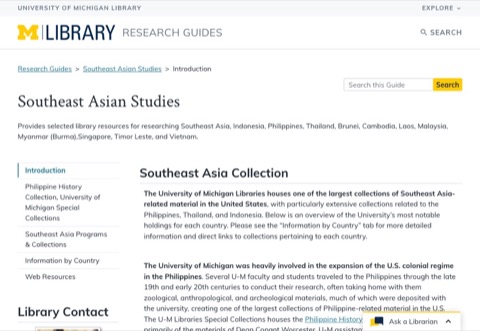
- Southeast Asian Studies Research Guide (University of Washington Libraries) (东南亚研究研究指南(华盛顿大学图书馆))This is a comprehensive guide to Southeast Asian studies built by the Southeast Asia Section of the University of Washington Libraries and maintained by its head, Judith Henchy; the page shows it was last updated in October 2026. The Starting Points section recommends databases such as the Bibliography of Asian Studies, JSTOR and Academic Search Complete; the remaining sections are organized by type of material, including encyclopedias, handbooks and dictionaries; articles, books and e-journals (with country pages for Cambodia, Indonesia, Malaysia, the Philippines, Thailand and Vietnam); digital resources (including Timor-Leste); news resources; dissertations; government and NGO resources; audiovisual materials and maps; think tanks; and evaluating sources of information. The guide also has an Archival Collections section covering Southeast Asia Section archives, special collections archives, digitized archives and ethnomusicology archives, and links to related guides such as Modern Classics of Southeast Asia and Indochina Studies. For researchers who want a systematic understanding of how to search the Southeast Asian literature of English-language scholarship, it is a clearly structured, continuously updated introductory guide. The page text is licensed under CC BY-NC 4.0.
Coverage, how to use, and notes
Coverage Covers all Southeast Asian countries; country pages include Cambodia, Indonesia, Malaysia, the Philippines, Thailand, Vietnam and Timor-Leste. Resource types include databases, books, journals, news, dissertations, government and NGO materials, maps, audiovisual materials and archival collections. Specific numbers are not listed on the official site; please refer to the official site.
How to use After opening the guide homepage, first read Starting Points, then use the left-hand sections to reach each type of resource; for country-specific searches, go to the corresponding country page. To find primary sources, use the Archival Collections sections. The guide pages can be read without login; some of the databases are only open on the campus network, and off campus a UW account is required. For inquiries, contact the Southeast Asia subject librarian listed on the page.
Notes Subscription databases listed require login from off campus; some digitized archival materials may require UW login or special permission, so please refer to the official site. The guide's focus countries lean toward Indonesia, Thailand, Vietnam and the Philippines, so content on Malaysia and Singapore needs to be supplemented with other resources.
- Thailand (Columbia University Libraries Southeast Asia Research Guide) (泰国研究指南(哥伦比亚大学图书馆东南亚研究指南))This is the Thailand page of the Southeast Asia research guide of Columbia University Libraries, maintained by Columbia University Libraries, with the page noting its most recent update as September 2026. The guide organizes introductory links for Thai studies by topic, including economics and finance (country pages on Thailand from the Asian Development Bank and the World Bank), politics and public policy (resources from human rights, policy, and aid institutions), history, and media. Distinctive items include the Thailand election web archive (covering the 2011, 2014, and 2019 general elections), the web archive of the post-2016 cremation ceremony of King Rama IX, and an entry point to the Chiang Mai University digital collections (including open access resources). For readers who only want a quick overview of publicly available resources for Thai studies, it is a concise navigation page.
Coverage, how to use, and notes
Coverage The page is divided into sections on economics and finance, politics and public policy, Thai history, Thai media, and religion. The history section contains three collections: U.S. Relations and Policy toward Southeast Asia (1944–1958), the web archive of the cremation ceremony of King Rama IX, and U.S. Declassified Asian Intelligence (1945–1991, including Thailand). The media section includes a small number of Thai films in the Alexander Street video collections and the Chiang Mai University digital collections. Figures on scale are not stated on the official website.
How to use After entering, browse through the page sections and click the external links to reach each resource; the top navigation can be used to switch to the library's other Southeast Asian country guides and its "Reference" and "Data" sections. Open resources such as the Chiang Mai University digital collections can be used directly; restricted collections require Columbia University authentication.
Notes The U.S. Relations and Policy toward Southeast Asia (1944–1958) collection is limited to Columbia University members; the Alexander Street video collections usually require an institutional subscription; this page is a navigation list with a limited number of entries and has no section on ethnic Chinese topics, so it should not be regarded as a complete bibliography.
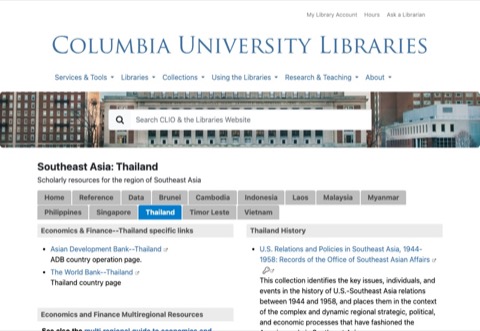
- Thailand: Print Resources (UW-Madison Libraries) (泰国纸本资源指南(威斯康星大学麦迪逊分校图书馆))A guide to print resources on Thailand under the 'Find Resources by Region' section of the University of Wisconsin–Madison Libraries. It lists Thai- and English-language reference tools held by the libraries, with call numbers and locations for each entry. Categories include general reference (handbooks, directories, country studies, historical dictionaries), abstracts and indexes, atlases, bibliographies, biographical sources, dictionaries and statistics. The bibliographies include topical lists on women's studies, the Chinese in Thailand and Thai culture; the dictionaries include Thai–English, Pali–Thai–English and Khmer–Thai–English. For readers studying the Chinese in Thailand and Thai social history, it serves as a list of early reference works and bibliographic leads for tracing older literature and statistics.
Coverage, how to use, and notes
Coverage The listed materials date mainly from the 1940s to the 1990s, and some are serials. Categories: general reference, indexes, atlases, bibliographies, biography, dictionaries and statistics. The number of entries is not stated on the site; please consult the official site.
How to use Browse by category on the page, note the call numbers and locations, then check current holdings in the library catalogue. Readers off campus can use the titles and bibliographic leads to request items through interlibrary loan at a local library or to search other databases. The page also provides inquiry and contact links; see the contact page on the official site.
Notes All listed resources are in print, and many were published before the 1990s. Full texts are not provided; holdings must be located separately.
- Universal Dependencies: UD Indonesian-GSD (通用依存印尼语树库(UD Indonesian-GSD))UD Indonesian-GSD is the Indonesian dependency treebank in the Universal Dependencies project, usable for research on part-of-speech, morphological and syntactic analysis of Indonesian corpora. The website page credits Ryan McDonald, Joakim Nivre, Daniel Zeman, Septina Dian Larasati and Ika Alfina, among others. The treebank text is from the news and blog genres and is licensed under CC BY-SA 4.0. Its lemmas, XPOS and morphological features were assigned by program with some manual correction, while UPOS and dependency relations were first annotated manually in a non-UD style, then automatically converted to UD with partial manual revision; the page states that these annotations have not been fully manually verified. For humanities and social science researchers working on Indonesian linguistics, corpus linguistics or text analysis, this is an open resource that can be downloaded directly and compared cross-linguistically with other UD treebanks, and it is also often used as training and evaluation data for Indonesian natural language processing. The page also notes that the treebank can be searched online via PML-TQ, and that the source data are hosted in the UD_Indonesian-GSD repository on GitHub.
Coverage, how to use, and notes
Coverage The page lists 5,598 sentences and about 122K syntactic words (119,830 tokens), of which the training set is about 97K words, the development set about 12K and the test set about 11K; the genres are news and blog text; the language is Indonesian. The page shows it was included in UD release 2.19.
How to use On the treebank page of the UD website, one can view statistics, annotation guidelines and examples of each part of speech and dependency relation; for the raw data, download CoNLL-U files from the GitHub repository UD_Indonesian-GSD, or search the treebank online using the PML-TQ provided on the page. No registration is required. Users should comply with the attribution and share-alike requirements of CC BY-SA 4.0 and cite the treebank and the UD project.
Notes The text genres are mainly news and blogs and do not represent spoken language, dialects or classical texts; the annotations include automatically converted and program-assigned parts, so samples should be checked when used for fine-grained grammatical research.
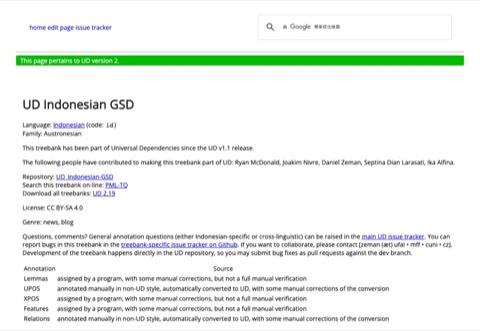
Libraries & archives
- Archives nationales d'outre-mer (ANOM) (法国海外国家档案馆(艾克斯-普罗旺斯))The Archives nationales d'outre-mer (ANOM) belongs to the national archives system under the French Ministry of Culture and is located in Aix-en-Provence. The official page states that it holds archives from the colonial period, including archives transferred back to France from former colonies and Algeria between 1954 and 1962. For Vietnam studies it is one of the core archives for the administration, justice, economy, and society of French Indochina (Tonkin, Annam, Cochinchina). Scholars studying the Chinese in Vietnam (Hoa), Chinese merchants of Cholon, bang organizations, immigration control, and colonial policy toward the Chinese often need to start from this kind of colonial administrative archive. The official page links to 'Instruments de recherche en ligne' (online finding aids) and 'État général des fonds' (general overview of holdings), which can be used to learn the structure of the holdings before a visit.
Address 29 chemin du Moulin de Testas, 13090 Aix-en-Provence, France View on map ↗
Coverage, how to use, and notes
Coverage The holdings are archives from the French colonial period and those transferred around the independence of the colonies, covering former colonies and Algeria. This page of the official website does not list the quantity or fonds names of the Indochina holdings; please use its online finding aids and the general overview of holdings to find Vietnam (Indochina)-related fonds. Documents are mainly in French.
How to use Consultation on site: the official page states that the archives are open to anyone of any nationality aged 15 or over with valid photo ID. For opening hours, booking procedures, and use of the online search system, please check the official website. It is advisable to first identify fonds and reference numbers through the online finding aids and the general overview of holdings, then arrange a visit.
Notes The official page does not list opening hours; the URL and services of the search system may change, so please check the official page. Many originals must be consulted on site, and not all archives have been digitized.
- Asian & African Studies Reading Room, British Library (大英图书馆亚非研究阅览室)The Asian & African Studies Reading Room of the British Library is on the third floor of the St Pancras site. It is used to consult publications, manuscripts and visual materials from Asia and Africa, including manuscripts written in Asian and African languages or concerning Asian and African subjects. The official collection guide states that the collection includes published, manuscript and visual materials relating to Asia and Africa. Drawings, photographs and paintings are consulted in the Print Room within the reading room and must be booked in advance with the Visual Arts team. The official reading room page does not give details of Southeast Asian materials (such as Malay and Indonesian manuscripts), so please refer to the British Library catalogue and website. The library is an important gateway for research on Southeast Asia in the British colonial period, and readers can search the catalogue for relevant manuscripts, East India Company and India Office records, and printed materials. A free Reader Pass is required to use the reading room.
Address The British Library, 96 Euston Road, London NW1 2DB, United Kingdom(Asian & African Studies Reading Room, Floor 3) View on map ↗
Coverage, how to use, and notes
Coverage The official guide gives only a general summary of publications, manuscripts and visual materials on Asia and Africa, and India Office records and the like. The scale, languages and dates of the Southeast Asian part are not listed on the website pages; please verify through the collection catalogue.
How to use Persons aged 18 or over can apply for a free Reader Pass at Reader Registration at the St Pancras site. To book items online in advance, the Reader Pass must have been issued or renewed after 21 March 2024. Reading room opening hours: Monday 10:00–17:00, Tuesday to Saturday 09:30–17:00, closed on Sunday (subject to the website). Before use, please read the guide on how to search the catalogue and request items, and note the information on restricted items. Some materials can be consulted only in particular reading rooms, so please confirm with the library before visiting.
Notes The website notes that the site is closed in its entirety on certain dates for maintenance, so check the latest notices before travelling. Materials on Southeast Asian topics must be identified by searching the catalogue; the reading room page does not list Southeast Asian collections separately.
- CSEAS Library, Center for Southeast Asian Studies, Kyoto University (京都大学东南亚地域研究所图书室)The Library of the Center for Southeast Asian Studies (CSEAS), Kyoto University, is one of the most important specialized libraries on Southeast Asian studies in Japan and is run by the center. According to the website, its holdings number about 270,000 items, consisting mainly of Southeast Asian scholarly publications, with special collections of Southeast Asian languages organized by country. The library houses several personal collections, such as the Charas Collection on Thailand (about 9,000 volumes), the Ishii Yoneo Collection on Southeast Asia (about 10,000 volumes), the Foronda and Ocampo Collections on the Philippines, and the Islamic Collection for Indonesian studies. The Map and Document Room holds about 48,000 maps and 10,000 aerial photographs, centered on Southeast Asia, many of which are open to the public. The center has also built databases of maps, statistics and visual materials, as well as a Southeast Asian periodicals database. The library follows an open access policy and provides reference services to readers in Japan and abroad. For those doing Southeast Asian regional studies who also wish to use materials from the Japanese academic community and Japanese-language research, this is an important place for on-site consultation.
Address 〒606-8501 46 Yoshida Shimoadachi-cho, Sakyo-ku, Kyoto, Japan View on map ↗
Coverage, how to use, and notes
Coverage About 270,000 items of Southeast Asia-related scholarly publications; includes special collections of Southeast Asian languages and the personal collections mentioned above; the Map and Document Room holds about 48,000 maps and 10,000 aerial photographs. The languages and chronological span are not stated on the website; please refer to the website.
How to use Search the holdings through the catalog on the library's website, or inquire by email (see the website's contact page) or by telephone at 075-753-7306. According to the website's directions, take City Bus No. 4, 7 or 205 from JR Kyoto Station to Kōjinguchi and walk east for about 5 minutes; or walk about 5 minutes from Jingu-Marutamachi Station on the Keihan Line. Visitors must first enter the Inamori Center building and then follow the signs to the library entrance.
Notes Visitor eligibility, opening hours and borrowing rules are not stated on the address page; please first check the library guide on the website or write to ask.
- Center for Burma Studies, Northern Illinois University (北伊利诺伊大学缅甸研究中心)The Center for Burma Studies is located at Northern Illinois University in the United States. According to its website, it was designated in 1986 as the national center for Burma studies by the Burma Studies Group of the Association for Asian Studies. The center's Burma collections include art, music, books and maps, and have continued to grow in recent years through the bequest of the private collection of Jerry Paul Bennett. Books and old manuscripts are kept in the Southeast Asia and special collections departments of the Founders Memorial Library; art collections (including the Konrad and Sarah Bekker collection) are held at the Northern Illinois University Art Museum; music collections are at the center and in the university's music library; maps can be viewed at the Davis Hall Map Library and the Founders Memorial Library. The website also provides an online collections database, and images of some artworks are posted on the center's Flickr page. For scholars abroad studying Burmese history, religion, art and material culture, it is one of the few physical institutions with a concentrated collection of Burma materials, and it complements Burma-related digital resources.
Address Center for Burma Studies, Pottenger House, Northern Illinois University, 1425 W. Lincoln Hwy., DeKalb, IL 60115 View on map ↗
Coverage, how to use, and notes
Coverage The website states that the collections contain more than 10,000 items related to Burma, covering art, music, books and maps; it does not give separate figures for art, music or maps. For books, the library catalogue is available free of charge through interlibrary loan.
How to use First read the 'About Our Collections' page on the website to learn where each type of collection is held, then search the online collections database. Books can be requested through interlibrary loan; artworks can be seen in the art museum's displays; maps can be consulted at the Davis Hall Map Library or the Founders Memorial Library. The pages read do not state visiting, appointment or opening-hour arrangements; please first confirm by calling 815-753-0512 or through the website's contact page.
Notes The collections are spread across several locations on campus; confirm the opening arrangements of each before visiting. For opening hours and whether an appointment is required, rely on the website and email replies.
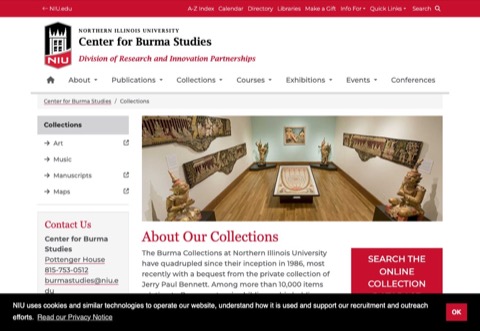
- EFEO Vientiane Centre (École française d'Extrême-Orient) (法国远东学院万象中心)The Vientiane Centre of the École française d'Extrême-Orient (EFEO) is the school's permanent research base in Laos. EFEO first had a resident presence in Laos from 1950 to 1966, and a new centre was reopened in 1993 by Buddhist text specialist François Bizot. Research areas listed on the website include inscriptions of the middle Mekong, Lan Xang historiographical traditions, a compilation of royal decrees from northern Laos, and Khmer and Mon archaeology in Laos; there is also a research project on the Buddhist art collection of the Vat Ho Phra Kaeo museum. The centre has a library (Bibliothèque du Centre) and has published works including Nouvelles recherches sur le Laos (2008), Vat Phou: from exploration to research (1866–1957) (2012) and Tamnan Muang Khamthong Luang (2012). For scholars of Lao history, inscriptions, archaeology and Buddhist texts, it is an important node for on-site access to French-language scholarly resources on Laos.
Address Rue Sisangvone, ruelle 3, unité 6, n°113, Bane Naxay, Muang Saysettha, Vientiane, Laos View on map ↗
Coverage, how to use, and notes
Coverage The website page lists research directions and publications: inscriptions of the middle Mekong, Lan Xang historiographical traditions, royal decree documents of northern Laos, Khmer and Mon archaeology, and Buddhist art of Vat Ho Phra Kaeo. The size, languages and opening hours of the library are not stated on this page of the website; please check the website.
How to use First check the contact details on the Vientiane Centre page of the EFEO website (telephone +856 21 41 46 20); before visiting, contact the centre to confirm library opening and consultation conditions. Publications can be found through the EFEO publishing platform (publications.efeo.fr). The website also has a digital resources section of the main institution, which can serve as a supplement.
Notes This page of the website does not state library opening hours, whether an appointment is needed, or the size of the holdings. The postal address in Laos is given as a post office box (P.O. Box 3248), and the website lists no postal code.
- East Timor Collection and Subject Guide (Charles Darwin University Library) (查尔斯·达尔文大学图书馆东帝汶馆藏与主题指南)The Charles Darwin University (CDU) Library in Australia's Northern Territory holds a collection of Timor-Leste materials, mainly from the Portuguese Timor period, donated by the late Kevin Sherlock. The website states that the collection comprises 1,640 titles, including materials published in Portuguese during the Salazar dictatorship era (1926–1974); some have been digitised and can be viewed online. CDU has also produced a Timor-Leste subject guide (libguides) gathering external web resources, such as legal sources (AsianLII), government and aid agencies, statistics sites, CHART, the CIDAC digital library, La'o Hamutuk and the Arquivo & Museu da Resistência Timorense (AMRT), and lists books and audiovisual materials. For those researching Timor-Leste's colonial-era history, early publications and the distribution of resources, the guide is a useful gateway list, while the collection itself provides rarely seen printed matter from the Portuguese period.
Coverage, how to use, and notes
Coverage The Timor-Leste collection has 1,640 titles, relating to Portuguese Timor and mainly in Portuguese; the digitised part dates from 1885 to 1985. The number digitised is given as 36 on the CDU collection page and 88 in the subject guide; the two are inconsistent, so please check the site. There is also a digitised copy of a Portuguese-language newspaper published by Fretilin in Dili from September to December 1975.
How to use In the subject guide, view web resources and digital collections by tab; digitised items can be viewed directly on the CDU digital collections site. All 1,640 titles can be searched through CDU's Library Search; for items not digitised, you can make a request to the library, and staff will retrieve them. For remote enquiries, use the library's online chat, booking or email channels (see the guide page).
Notes The number of digitised items is stated differently on different pages of the site, so please rely on the latest page; the subject guide was last updated in February 2022, and some external links may have changed.
- Institut de recherche France-Asie (IRFA) – Archives of the Paris Foreign Missions Society (法国—亚洲研究所(巴黎外方传教会档案馆))The Institut de recherche France-Asie (IRFA) holds the archives produced by missionaries of the Missions Étrangères de Paris (MEP) in the course of their missionary work in Asia. The official site states that the holdings total about 800 linear meters, date back to the mid-17th century, and for some Asian countries are the earliest surviving French sources. The site provides several online inventories, including Series A (old archives), Series B (governance), thematic inventories for Cambodia, Korea, Japan and Vietnam, the personal archives of Joseph Guesdon and Jacques Dournes, and Series H (Asian manuscripts); it also offers a catalogue of the Asian library, photographs and audiovisual materials, maps and plans, a database of missionaries, and a digital library of MEP publications that can be searched and downloaded. For scholars studying the Catholic Church in Southeast Asia, missionaries and local society, the religious life of Chinese and regional communities, and 19th- to 20th-century missionary reports and letters, this is an important primary source.
Address 28 rue de Babylone, 75007 Paris, France View on map ↗
Coverage, how to use, and notes
Coverage The archives date back to the mid-17th century and total about 800 linear meters. The online inventories listed on the official site cover Series A (old archives), Series B (governance), Cambodia (03C), Korea (05C), Japan (09C), Vietnam (17C), two personal archives and Series H (Asian manuscripts). The digital library includes MEP publications from 1840 to 1962: Compte rendu des Missions Étrangères (1898–1940), Les Missions Étrangères de Paris bulletin (1922–1941 and 1948–1962), Circular letters (1852–1962) and Annual reports (1840–1962).
How to use The Archives section of the English pages of the official site lists the online inventories of each series, which can be browsed one by one; the digital library page supports search by keyword or criteria, with online reading and download. For on-site consultation, reading-room seats can be reserved online; the official site states that copies can be requested, and documents that are temporarily unavailable can be requested for consultation. Telephone +33 1 44 39 91 40.
Notes The archives page of the official site does not mention dedicated inventories for Malaysia or Singapore; the Southeast Asian part focuses mainly on Cambodia and Vietnam, and relevant materials for other countries may be scattered across inventories such as Series A and need to be checked by the researcher. The documents are mainly in French. The date range of the digital library records is given as 1840–1964 or 1840–1962 on different pages; please refer to the search page of the official site.
- John M. Echols Collection on Southeast Asia (Cornell University Library) (康奈尔大学图书馆埃科尔斯东南亚特藏)The John M. Echols Collection on Southeast Asia is the Southeast Asia collection of Cornell University Library, built jointly by the library and the university's Southeast Asia Program (SEAP). According to the website, it is regarded as the largest collection of its kind in the United States and in the world, covering 11 countries: Brunei, Cambodia, Indonesia, Laos, Malaysia, Myanmar, the Philippines, Singapore, Thailand, Timor-Leste and Vietnam. It emphasizes the humanities and social sciences and collects Southeast Asia-related materials published in national languages and other languages. Its earliest materials date back to the seventeenth century, and most were published in the latter half of the twentieth century; the formats are mainly monographs, periodicals and microforms, with newspapers, audiovisual materials, maps, photographs and archives in addition. The Rare and Manuscript Collections holds photograph albums, professors' research collections and travelers' publications. For readers working on Southeast Asian Chinese and regional studies, it is a good place to find publications, periodicals and colonial-era documents from Malaysia and Singapore, Indonesia and Thailand; Cornell also offers digital resources such as Southeast Asia Visions (early travel accounts) and SEAPapers.
Address 180 Kroch Library, Ithaca, NY 14853, USA View on map ↗
Coverage, how to use, and notes
Coverage According to the website: covers 11 Southeast Asian countries in all languages, including Burmese, Indonesian, Khmer, Lao, Malay, Tagalog, Thai and Vietnamese; dates from the seventeenth century, with most published in the latter half of the twentieth century; formats include monographs, serials, microforms, newspapers, audiovisual materials, maps and photographs. The website says more than 9,000 volumes are added each year. Different pages give differing figures for total holdings, and the website gives no single number; please refer to the website.
How to use The collection is mainly in Kroch Library, with some in library branches and Olin Library (maps and visual materials are on the lower level of Olin Library). The Asia collections stacks are open to members of the Cornell community and to visitors; rare and manuscript materials must be used in the lower-level reading room. Before visiting, please contact Asia Collections Reference (telephone 607-255-8199; email on the website's contact page) to confirm opening hours and appointment requirements for rare materials. The Southeast Asia page of the Asia Collections website also links to online resources such as Southeast Asia Visions, SEAPapers and SEAiT.
Notes Consultation is mainly on site, and the materials are mainly in print and microform. For total holdings, please refer to the website. Please confirm with the library in advance the rules for using rare and manuscript materials.
- Lao collection (National Library of Australia) (澳大利亚国家图书馆老挝馆藏)The Laos collection of the National Library of Australia mainly gathers publications from Laos, and also includes publications of the Lao-Australian community and Laos-related works published overseas. The website states that the collection is growing fastest in the social sciences, development studies, statistics and law, and also includes popular magazines, children's books and award-winning literature, along with some rare pre-1975 Lao-language publications. English- and French-language Laos-related publications are placed in the main collection and can be found through the online catalogue. The library has also worked with the Internet Archive to select and archive some websites of Lao non-governmental organizations and government agencies. For researchers who need to consult Lao domestic publications, government and development documents from outside Laos, or trace pre-1975 Lao-language publications, it is a useful point of access.
Address Parkes Place, Canberra ACT 2600, Australia View on map ↗
Coverage, how to use, and notes
Coverage The scope described on the website page is: mainly Lao publications, together with publications of the Lao-Australian community and overseas publications; the main growth areas are the social sciences, development studies, statistics and law; and some rare pre-1975 Lao-language publications are included. The page gives no total number of items and does not mention digitized content; please check the website.
How to use First search the library's online catalogue for Laos-related titles; English and French publications are in the main collection. For questions, submit an enquiry through Ask a Librarian on the website. The page does not state how to visit, borrow or book items in the Laos collection; please check the website. Archived Lao websites can be found through the library's web archiving service.
Notes This page does not explain on-site access to the Laos collection or the extent of digitization; the availability of older publications should be confirmed with the library. The collection consists of contemporary public publications and some older periodicals; it is not an institutional archive.
- Leiden University Libraries – Asian Library and Southeast Asian Special Collections (莱顿大学图书馆亚洲图书馆与东南亚特藏)Leiden University Libraries (including the KITLV collections of the Royal Netherlands Institute of Southeast Asian and Caribbean Studies) is one of the most important repositories of Southeast Asian studies in Europe. Official information states that the Asian Library holds the world's largest collection on Indonesia, along with important collections on South and Southeast Asia, China, Japan and Korea. The Southeast Asia special collections focus on the Malay world, especially the Dutch East Indies/Indonesia; besides printed matter before 1950, they include more than 18,000 manuscripts, rubbings of inscriptions, archives, letters, drawings, posters, thousands of regional maps and about 220,000 photographs. Collecting began in 1587. Since 2014 the KITLV has been entrusted to Leiden University Libraries for management, including Chinese-Malay novels and periodicals from 1870 to 1950 and materials of the Cultural Heritage Center of Indonesian Chinese (CIHC), which are especially important for readers studying Indonesian Chinese and Peranakan Chinese. Some maps and Chinese-Malay texts are already part of the digital collections.
Address University Library, Witte Singel 27, 2311 BG Leiden, the Netherlands View on map ↗
Coverage, how to use, and notes
Coverage Collecting since 1587; printed matter before 1950; more than 18,000 manuscripts, including about 340 Batak manuscripts; about 220,000 photographs; archives (including KIT, KITLV and the former Ministry of Overseas Territories); Chinese-Malay novels and periodicals (1870–1950).
How to use First search through the Leiden University Libraries catalog or the collection guides, then request special collections items. Visitors must bring a valid, activated LU-Card; the library has no separate help desk, so please go to the main service desk on the ground floor. For special collections reading room reservation rules and opening hours, see the Using Special Collections and Opening hours pages on the website. Some maps and Chinese-Malay texts in the digital collections can be consulted directly online.
Notes Some materials are kept in closed stacks and must be requested in advance. Seating and other facilities are limited during exam periods. The KITLV office address has been Witte Singel 27A since May 2024, which differs from the reading room entrance; please do not confuse them.
- Nationaal Archief (National Archives of the Netherlands) (荷兰国家档案馆)The National Archives of the Netherlands (Nationaal Archief) is located in The Hague and is the custodian of the Dutch central government's archives. For Indonesian studies, it is one of the most important physical entry points to the archives of the Dutch East Indies and colonial administration. The finding aid Overview of Archives on the Dutch East Indies divides the relevant fonds into five categories: archives of the Ministry of Colonies and its successors; archives of other ministries; archives of the governments of the Dutch East Indies, Indonesia and New Guinea; archives of private organisations in the Netherlands and the East Indies (such as the trading company Nederlandsche Handel-Maatschappij); and family and personal archives (such as H.J. van Mook). Among them, the Ministry of Colonies archives (the 2.10 series) cover policy, administrative and military correspondence of Dutch colonial rule, and the Indisch Archief 1945–1953 (2.10.36.15) concerns political and military archives around the Indonesian War of Independence. The VOC archives (1.04.02) can be used for research on the earlier East India Company period. For readers interested in the Chinese in Indonesia (Tionghoa), archives on colonial administration, migration, commerce and policing are basic materials for examining Chinese society from the colonial government's perspective. All fonds have online archival description (inventaris) pages, where finding aids can be searched online and downloaded in PDF or XML format, so you can find out what materials exist without visiting.
Address Prins Willem-Alexanderhof 20, 2595 BE Den Haag, Nederland View on map ↗
Coverage, how to use, and notes
Coverage The relevant archives listed on the overview page range in date from 1584 (a family archive) to 1996 (archives related to an Indonesian pension fund), with most entries concentrated between the 1900s and the 1950s. They mainly include Ministry of Colonies archives (e.g. 2.10.01 for 1814–1849, 2.10.02 for 1850–1900, and 2.10.03, a supplementary volume, for 1826–1952), archives of the government of the Dutch East Indies, private company and personal archives, and the VOC archives (1602–1795). Finding aids are mainly in Dutch. The website does not give an overall holdings total; please consult the website.
How to use First open the Research section of the website and use the archive search, or browse the overview page Overzicht van archieven over Nederlands-Indië directly and enter each archival description page by fonds number (e.g. 2.10.36.15), where PDF/XML finding aids can be downloaded. Some items have digitised scans, but not all, and many are marked as physical copies only. To consult originals in person, you must first book online and hold a valid passport to receive a visitor pass; the reading room is free. Opening hours listed on the website: Tuesday 10:00–21:00, Wednesday to Friday 10:00–17:00, closed Saturday, Sunday and Monday; for closure dates and archives temporarily unavailable, check the website.
Notes Many finding aids and notes are in Dutch, and some pages carry machine translation notices, so translations may be inaccurate. Most archival description pages show no scans or transcriptions, so a visit or a request is still needed. Some older finding aids are early scans and may not reflect the current arrangement. The website has planned maintenance downtime; please check opening hours and booking status before visiting.
- SOAS Library and Special Collections, SOAS University of London (伦敦大学亚非学院图书馆与特藏)The SOAS Library belongs to SOAS University of London. Its official page describes the Special Collections as the leading holdings in Britain of archives, manuscripts and rare books on Africa, Asia and the Middle East. The School has a Centre of South East Asian Studies and the SOAS China Institute, and the collections are useful to readers working on Southeast Asian history, missionary and colonial-era documents, and Chinese and regional studies. The library is open seven days a week throughout the year, offers membership applications to the public, and its website has pages on visit planning, opening hours and accessibility support. The homepage does not list specific Southeast Asian or Chinese holdings, so readers should search the library catalogue and Special Collections pages for particular materials.
Address SOAS University of London, 10 Thornhaugh Street, Russell Square, London WC1H 0XG View on map ↗
Coverage, how to use, and notes
Coverage The homepage gives only a general description of archives, manuscripts and rare books on Africa, Asia and the Middle East. For specific holdings, dates and scale relating to Southeast Asia or the Chinese, please consult the Special Collections pages and catalogue on the official website.
How to use First check opening hours and visit planning on the official website, then apply for membership (the page says it is open to everyone and can be applied for online). Search the library catalogue for specific special collections, and book in advance for consultation as directed on the website. Telephone number on the website: 020 7898 4163.
Notes The homepage does not list Southeast Asian special collections. Before use, confirm in the catalogue and collection guides where the required materials are held and what the conditions of access are.
- Southeast Asia Collection, University of Michigan Library (密歇根大学图书馆东南亚馆藏)The University of Michigan Library's Southeast Asia collection was established in the early 1960s to support the university's area studies programs and is concentrated mainly in the Hatcher Graduate Library. The official collection page states that the holdings include publications in Western languages and Southeast Asian vernacular languages, with emphasis on the humanities and social sciences. Its core strengths are the Philippines, Thailand, Indonesia and Vietnam, and it also covers Myanmar, Singapore, Malaysia, Timor-Leste, Laos, Cambodia and Brunei. Holdings in Spanish, Dutch, French, English, Japanese, Portuguese and German reflect the region's colonial history. Related specialized collections elsewhere on campus include Indonesian music recordings in the Music Library, the Askwith Media Library, maps and documents in the Clark Library, and the Bentley Historical Library and the Clements Library. Readers studying Southeast Asian regional politics, colonial history, and Philippine and Indonesian topics can find relatively comprehensive literature here.
Address Hatcher Graduate Library, University of Michigan Library, 913 S. University Avenue, Ann Arbor, MI 48109-1190, USA View on map ↗
Coverage, how to use, and notes
Coverage Mainly a multilingual Southeast Asia collection built since the 1960s, covering 11 Southeast Asian countries. The website does not give total volumes; please refer to the website. There are also related collections scattered across other units on campus.
How to use Search through the University of Michigan Library catalog and consult the Southeast Asia, Australia, New Zealand and Pacific librarian (Fe Susan T Go; the page lists telephone and email). For Hatcher Library opening hours and visitor rules, see the Locations and Hours page on the website. Materials in other campus units (such as the Bentley and the Clements) are subject to their own appointment rules.
Notes The collection is spread across several locations, so be sure to confirm the location of each item in the catalog first. East Asian (including Chinese) materials are managed separately by the Asia Library and are not part of the Southeast Asia collection.
- Southeast Asia Collection (Yale University Library) (耶鲁大学图书馆东南亚特藏)Yale University Library's Southeast Asia collection is housed mainly in Sterling Memorial Library. The official collection policy states that the collection began in 1899 and covers history, linguistics, anthropology, political science and other fields of Southeast Asia, with particular depth in Indonesia and the Philippines, and also includes Cambodia, Vietnam and Laos; it supports the teaching and research of the Council on Southeast Asia Studies. Languages include Thai, Vietnamese, Burmese, Malay, Indonesian, Tagalog and Javanese, Chinese published in Southeast Asia, and Western-language materials in the humanities. The South and Southeast Asia Reading Room on the second floor (Rooms 214 and 214A) is equipped with reference works such as atlases, bibliographies and dictionaries. For readers studying Southeast Asian Chinese, the collection's value is that Chinese-language materials published in Southeast Asia can be found here, complementing collections such as Cornell's. Seventeenth-century rare books are held in the Beinecke Rare Book and Manuscript Library.
Address Sterling Memorial Library, 120 High Street, New Haven, CT 06511, USA View on map ↗
Coverage, how to use, and notes
Coverage The collection began in 1899 and covers Myanmar, Thailand, Laos, Cambodia, Vietnam, Malaysia, Singapore, Brunei, Indonesia, Timor-Leste and the Philippines. The collection policy page does not list the number of volumes; please refer to the website. Subjects include art, religion, music, literature and geography; engineering, mathematics, medicine and law are not collected.
How to use First search through the Yale Library catalog, then contact the Southeast Asia librarian as needed. The public areas on the first floor (lobby and exhibition spaces) are open to visitors; after 6 p.m., entry requires swiping a valid Yale ID. Reading Room 214 is used mainly for classes and events and can be used for individual study when free. Rare books and manuscripts must be requested by appointment at the Beinecke Library; visitor hours are as stated on the website.
Notes Visitor access and opening hours at Sterling Library are subject to change, so please check the website for current-day information before traveling. Information about the Southeast Asia librarian is inconsistent across pages; please refer to the staff directory on the website.
- Timor-Leste collection (Victoria University Library Special Collections) (维多利亚大学图书馆东帝汶特藏)The Special Collections of Victoria University (VU) Library in Australia include a Timor-Leste collection, established in 2012 to support the university's Timor-Leste strategy and to document Timor-Leste's post-independence development. The collection originated in a donation from the Oxfam Australia Library, later supplemented by rare and research-level materials transferred from the main Footscray Park collection, and includes Dr Helen Hill's Timor-Leste research collection. Other content listed on the website includes the journals Tapol and Timor Link, digitised in cooperation with CHART (the Clearinghouse for East Timor Archive Resources and Timor-Leste Documentation), proceedings of the biennial Timor-Leste conference co-hosted by VU and the National University of Timor-Leste, and the archive of the Australia East Timor Association (AETA), donated in 2022. The AETA archive comprises 77 archive boxes plus a set of posters. For those studying the Timor-Leste solidarity movement, international advocacy and post-independence development, this is a rare combination of physical archives and thematic literature.
Coverage, how to use, and notes
Coverage Timor-Leste research materials, two digitised journals, conference proceedings and the AETA archive (77 boxes and posters). The AETA archive covers the association's activities, correspondence, and related solidarity and action groups. The total size of the whole special collection is not stated on the site.
How to use The website says the AETA archive must be consulted by appointment; how the other parts are accessed is not stated on the page, and you can check its Searching the Collections page or contact the library's enquiry email. Catalogue records carry the prefix FTS TIMOR-LESTE COLL (according to search results; please rely on the website catalogue).
Notes The page on the website gives no physical address, so the entry is filed as a website-type resource; before visiting, contact the library to confirm opening and appointment arrangements.
Museums & memorials
- ASEMUS Virtual Collection – National Museum (Yangon) and Bagan Archaeological Museum (亚欧博物馆网络虚拟馆藏:仰光国家博物馆与蒲甘考古博物馆)ASEMUS (Asia-Europe Museum Network) is a cross-cultural museum network centered on Asian collections; its website provides museum profiles and virtual collection pages for member museums. Two members are from Myanmar: the National Museum, Yangon, and the Bagan Archaeological Museum. The page for the National Museum in Yangon describes its history: it opened in June 1952 at Jubilee Hall on Shwedagon Pagoda Road in Yangon, moved to Pansodan Road in 1970, and moved to its current site on Pyay Road in 1996; its permanent collection of nearly 5,000 items includes stone inscriptions, fossils, bronzes, paintings, gold and gemstone jewelry, Buddha images, textiles, palm-leaf manuscripts, musical instruments, puppets, and royal regalia, displayed in 14 galleries over five floors. The page for the Bagan Archaeological Museum states that its collection numbers 850 items, that its history goes back to the first museum founded by Taw Sein Kho in 1902, and that the current museum opened in 1998 with 10 galleries. For researchers, these two pages are a convenient entry point to the collection categories, histories, and display structures of Myanmar's national museum and the Bagan site museum.
Coverage, how to use, and notes
Coverage Covers two member museums: the National Museum, Yangon, and the Bagan Archaeological Museum. According to the site pages, the former has a permanent collection of nearly 5,000 items and 14 galleries; the latter has 850 items and 10 galleries, with themes including the royal city of Bagan, literature, social life, architecture, crafts, Buddha images, Buddhist art, and murals. The number of images viewable online is as stated on the site.
How to use Open the ASEMUS pages for the two museums and read the museum history, collection overview, and gallery information; the sections marked Virtual Collection allow browsing of collection items. The site also has a member directory and news and event archives. No registration is needed. To study originals or apply to photograph them, contact the museums directly; the site pages do not list opening hours, admission, or contact details.
Notes These are introductions and virtual collections on a network platform, not a complete database built by the museums themselves; the page content is general and gives no detailed description of search fields. The page for the National Museum in Yangon gives only a street address (66/74 Pyay Road) and no postal code, so it is not included as an on-site venue entry.
- Chinese Canadian Museum (加拿大华人博物馆)The Chinese Canadian Museum is located in the historic Wing Sang Building in Vancouver's Chinatown. Its official website describes it as the only museum in Canada dedicated to the history and culture of Chinese Canadians, telling their stories, influence and living heritage through exhibitions, events and community engagement. It has no direct connection to Southeast Asia, but is useful to readers undertaking comparative research on overseas Chinese societies (migration history, community organizations, identity and heritage-making), and can be used alongside Nanyang Chinese museums and archives. Permanent exhibitions listed on the website include A Soldier For All Seasons on the third floor and period rooms such as a history classroom and a living room, and the site links to genealogy research resources.
Address 51 E Pender St, Vancouver, BC V6A 1S9 View on map ↗
Coverage, how to use, and notes
Coverage The homepage does not describe the collection as a whole. It shows current and permanent exhibitions and a link to genealogy research resources. For the scope and dates of the holdings, please consult the official website.
How to use The website shows opening hours of Wednesday to Sunday, 10:00–17:00, closed on Mondays and Tuesdays. Tickets can be bought online; annual passes and public or private guided tours are also offered. Telephone number on the website: 604.262.0990.
Notes The museum focuses on the history of Chinese Canadians and has limited direct material on Southeast Asian Chinese; it is best used as a point of reference for cross-regional comparison.
- Hellfire Pass Interpretive Centre (地狱火山口解说中心)The Hellfire Pass Interpretive Centre is located in Kanchanaburi Province, Thailand, and is presented on the website of the Australian Department of Veterans' Affairs (DVA). It commemorates the prisoners of war and Asian labourers involved in building the Thailand-Burma Railway. The website states that the centre has a gallery displaying exhibits and photographs, a walking trail, and an audio guide, and also accepts bookings for school and group visits. The Thailand-Burma Railway was a major event of the Second World War occupation of Southeast Asia and involved Allied POWs and large numbers of Asian labourers, so it is a useful reference for studying labour, migration, and the politics of memory in wartime Southeast Asia. The website page does not give a full list of holdings and does not state whether archival access is offered.
Address 207 Moo 11, Tha Sao, Sai Yok District, Kanchanaburi 71150, Thailand View on map ↗
Coverage, how to use, and notes
Coverage The theme is the construction of the Thailand-Burma Railway and the Hellfire Pass section. The website page mentions a gallery (exhibits and photographs), a walking trail, and an audio guide; the size, date range, and languages of the holdings are not stated.
How to use On-site visit. The website states that it is open daily 9:00-16:00, with the audio guide available until 15:00, and that the centre and trail cannot be entered before 9:00. The centre closes for three weeks each May for maintenance (the website lists 3-23 May for 2027) and is closed on several holidays (1 January, 13-15 April, 5 December, 24-27 December, and 31 December). Groups and schools can use the website's online booking; tel. +66 (0)34-919605. The page does not state admission fees.
Notes The website page does not state whether a fee is charged or whether research access services are available; please check the official website.
Institutions & societies
- Hong Kong History Centre, University of Bristol (香港历史中心(布里斯托大学))The Hong Kong History Centre is based in the Department of History at the University of Bristol, UK. Founded in 2022, it is described as the world's first academic centre dedicated to the study of Hong Kong history. It grew out of the Hong Kong History Project, launched in 2015, which was funded by the Hatton Trust and led by Robert Bickers. The centre's aims include supporting rigorous scholarship, exploring new dimensions of Hong Kong history, and building archival collections to serve future research. Its website and YouTube channel publish many interviews, lectures and event announcements, including the 2024 interview series Hong Kong Documented (香港史·記), and the online classroom series Hong Kong Academy (香港歷史學堂) developed from it, in which several historians each discuss an important topic in Hong Kong history; there are also Cantonese events such as History Salon and the Speaker's Series. The centre also builds the Hong Kong collections in University of Bristol Library Special Collections and runs the open-access platform Historical Photographs of Hong Kong. For readers studying Hong Kong history and Hong Kong's links with South China and Southeast Asia, it is a window onto new developments in the field.
Coverage, how to use, and notes
Coverage Themed on Hong Kong history research; the website is mainly in English, with some content in Chinese and some events in Cantonese. Content types include interviews, lecture videos, online course series, event information, news and an open-access historical photographs platform; exact quantities are not stated on the site.
How to use Visit the website for events, news, videos and research projects; videos such as Hong Kong Academy can also be watched by searching YouTube for the channel Hong Kong History Centre (@HKhistorycentre). The website offers a mailing list for news and events, and contact details are on the Contact us page. The historical photographs platform can be reached through a link on the site. Watching videos requires no registration; whether in-person or online events charge fees or require sign-up should be checked on each event page.
Notes The website does not give unified terms of use for each type of resource and states clearly only that the historical photographs platform is open access; for event fees, please refer to the specific announcements. Video content is continually being updated.
- ANU Indonesia Project Online Archive (ANU 印度尼西亚项目在线档案)The ANU Indonesia Project is a research project based at the Australian National University. Its online archive page states that it includes recordings and slides of past events and a repository of past publications. The items listed on the page include the Bulletin of Indonesian Economic Studies (BIES Journal), Forum Kajian Pembangunan, the Indonesia Update and its book series, the Hadi Soesastro Policy Forum, the Mubyarto Public Policy Forum and the Sadli Lecture; research areas include trade and development, agricultural resources and environment, political media and governance, social policy, gender and human capital, and doctoral theses; there are also podcasts, events, a library, a photo archive and newsletters. The Library section is a catalogue with subject tags and filters for call number and holding status, with topics covering agriculture, decentralization, economic history, forestry, palm oil, poverty and politics. For readers studying contemporary Indonesian economic and social policy, it is an institutional entry point for following academic forums, publications and research topics.
Coverage, how to use, and notes
Coverage The content types listed on the page include an academic journal (BIES), annual conferences and forums, lecture series, a publications repository, podcasts, event records, a photo archive and a library catalogue. The library catalogue can be filtered by format (physical, digital or both) and status (available, on loan, reference only), and sorted by title, year and author. The page does not state the number of holdings; please consult the official website.
How to use From the homepage, use the navigation to reach Library, Photo Archive, Podcasts, Events and the pages for each research area. The library catalogue can be filtered by subject tag and format. The page states that the physical library is located in Room 1.262 of the HC Coombs Building and is open to visitors Monday to Friday, 9:00–17:00, but it does not give a full street address or postcode; please contact the Project before visiting (the page lists an email address, see the website's contact page, and telephone +61 2 6125 2380). Project news is sent through a mailing list.
Notes The page does not state whether the items in the online archive are free or require login; please check each item on the official website. The page also does not mention datasets. The full address of the physical library was not verified on this page; this entry is included as a website resource.
- Chinese Indonesian Heritage Center (CIHC) (印尼华人遗产中心(CIHC))The Chinese Indonesian Heritage Center (CIHC) is a Dutch foundation dedicated to preserving and sharing the heritage and history of Chinese Indonesian migrants in the Netherlands. According to its website, its work includes encouraging research, publications and public event days, cooperating with universities and museums, and recording the stories of Chinese Indonesian migrants. The site has sections on oral history, Foto met Verhaal (photographs with stories), traditions and culture, entries on people and institutions, and articles and lectures, and it posts events, news and publications. For readers studying Chinese Indonesian migration, family memory and religious practices, it is an entry point to related oral and family-image materials; the CIHC can also be contacted about heritage donations and research cooperation.
Coverage, how to use, and notes
Coverage The site's content centers on oral histories of Chinese Indonesians in the Netherlands, personal photographs and the stories behind them, traditions and culture, entries on people and institutions, and events, news and publications. The official pages do not state the size or date range of the holdings; please consult the official website.
How to use From the homepage, browse by section: oral history, photographs with stories, traditions and culture, entries on people and institutions, articles and lectures, as well as archives of events, news and publications. Individuals can contact the CIHC through the website to offer their own stories or donate heritage materials. No registration is needed to browse the site.
Notes The website is in Dutch. The official pages do not explain how to search or borrow the collection. According to public information from Leiden University Libraries, the CIHC oral history archive has been donated to Leiden University Libraries; access requires an appointment and is subject to privacy rules. Please consult the official website and the Leiden University Libraries page for specific conditions.
- Timor-Leste Studies Association (TLSA): Conference Proceedings (东帝汶研究协会(TLSA)会议论文集)The Timor-Leste Studies Association (TLSA) is an international scholarly community in the field of Timor-Leste studies. Its website has sections for events, conference proceedings, researchers and archives. The proceedings section lists conferences by edition from 2009 to 2023, and also includes the 2020 TLSA-Portugal conference, the 2018 TLSA-Brazil conference and the 2021 international symposium. One item the site clearly describes is the proceedings of the 2021 international symposium, The 1991 Santa Cruz Massacre: Thirty Years On (the symposium was held on 9–10 November 2021, and the book was launched in Dili on 15 July 2023); print copies can be ordered and a link to a PDF e-version is provided. For Timor-Leste studies, these proceedings gather recent research in history, politics, language, education, development and other fields, and also show the researcher networks and changing topics in the field. The site also publishes calls for papers for conferences, in English, Tetum and Portuguese.
Coverage, how to use, and notes
Coverage Entry points to the proceedings of each TLSA conference from 2009 to 2023, plus TLSA-Portugal (2020), TLSA-Brazil (2018) and the 2021 symposium. The number of papers, languages and download availability of each proceedings are not uniformly stated on the site's pages, so please check page by page.
How to use On the website, open the Conference Proceedings section and choose by year; the 2021 proceedings page provides a PDF download link (external cloud drive). Calls for papers and registration information are in the Events section. Before use, confirm on each year's page whether the full text is open and what licence terms apply.
Notes The website does not state the licence for the 2021 proceedings, and access arrangements for other years need to be checked page by page; the site shows no journal or bibliography section.
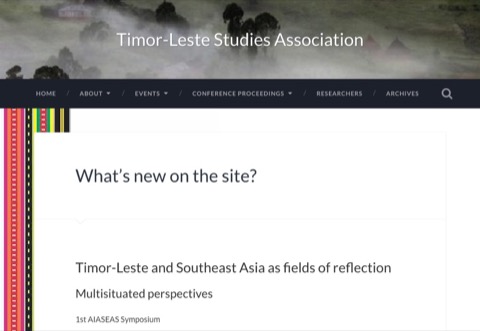
- UW Center for Southeast Asia & Its Diasporas: Lectures and Presentations (past talks)Archive page of past lectures and presentations from the University of Washington's Center for Southeast Asia and Its Diasporas, where past lecture topics and speakers can be consulted.
Other
- Singapore Film Locations Archive (新加坡电影拍摄地点资料库)The Singapore Film Locations Archive (新加坡电影拍摄地点资料库) is a blog-style website with the subtitle Places in Singapore, as films remember them. The site's author is credited as Hun Ping (Toh Hun Ping according to an interview report); the project is planned to receive support from the irememberSG fund of the Singapore Memory Project and is one of the activities for the 50th anniversary of Singapore's independence (SG50). It records films shot on location in Singapore in the twentieth century, listing for each film the title, director, screenwriter, cast, production company, release date and filming locations, with short commentary on how far the story and images reflect real places. According to its introduction, the site lets readers learn about the filming locations of films shot in Singapore between 1900 and 1999, and is of some help to scholars of Singapore film history and to those approaching Singapore history from a visual studies perspective. The distinctive feature of the archive is that it treats films as visual evidence of changing urban and rural landscapes: readers can compare streets, stations and wharves in old films with their present locations to study urban space and historical memory. Most of the films are Malay-language, with others in English, Mandarin, German, Japanese and other languages.
Coverage, how to use, and notes
Coverage Pages are divided by decade, from 1900–1919 to 1990–1999. The site sidebar shows about a hundred entries, most of them Singapore productions, with Malay-language films and narrative features in the majority, and also films from the United States, the United Kingdom, France, Hong Kong, Japan, Germany and elsewhere. The site archive shows articles concentrated between August 2014 and February 2022.
How to use Use the top menu to enter Map (map of filming locations) and Filmography (film list), or browse by decade page, or filter using the country, genre and language categories in the sidebar. Each article usually has the film title, director, cast, filming locations and location tags, and clicking a tag shows other films shot at the same place. No registration is needed; just read directly. It is advisable to find locations on the map first, then return to each film's article for details.
Notes The domain sgfilmlocations.com currently redirects to an unrelated website, so please use sgfilmlocations.wordpress.com; the site is a personal blog that is no longer updated frequently, and the last visible post was published in February 2022; the About page does not state the sources of each item of information and the stills, so they should be checked against the films themselves or other archives before academic citation.
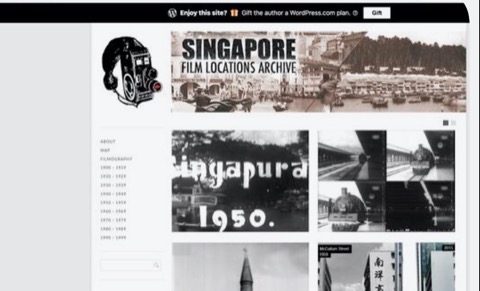
- Cambodia Tribunal Monitor (柬埔寨法庭观察网)The Cambodia Tribunal Monitor (CTM) is a joint project of academic, philanthropic and non-profit organisations, aimed at opening the proceedings of the Extraordinary Chambers in the Courts of Cambodia (ECCC) to the public. The organisations credited in the site footer include the Northwestern University School of Law's Center for International Human Rights and the Documentation Center of Cambodia. The site is divided into sections on trial monitoring, multimedia, commentary, news, court filings and history: court filings are organised by case, covering Case 001, Case 002 (with a page for each defendant), Case 003, Case 004 and Case 004/01; the multimedia section has trial videos, interviews and press conferences for Cases 001 and 002, as well as the 'Memory of Atrocities' project; the history section contains Cambodian history, background on the tribunal and a chronology, and preserves CTM content from before 2013. For those studying the Khmer Rouge trials and transitional justice, it is a supplementary route beyond the official archive, especially suitable for finding commentary, background materials and early trial footage.
Coverage, how to use, and notes
Coverage Court filings are classified by case, with a section for miscellaneous rulings; multimedia includes trial videos, interviews and the 'Memory of Atrocities' project for Cases 001 and 002; there are also expert commentary, news and reports, and historical background. The latest content on the website dates to 2020; for whether it has been updated since, please consult the website. The homepage does not mention transcripts, so it cannot be confirmed whether they are provided.
How to use Go to cambodiatribunal.org and use the top navigation to enter sections such as 'Court Filings' (by case), 'Multimedia', 'Commentary' and 'History'. The homepage does not describe an on-site search function; you can use the browser's in-site search. No registration is needed.
Notes The site stopped being updated some time ago; for authoritative official case files, rely on the ECCC archive. CTM is suitable as supplementary and background material.
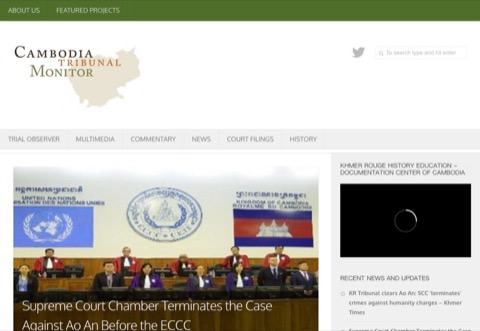
- Georeferenced and cropped '63k Maps of Burma' (Zenodo) (缅甸 1 英寸 1 英里地形图(地理配准版,Zenodo))This is a dataset of historical topographic maps of Burma on the open platform Zenodo, compiled by Horst Held and published in May 2024, with the DOI 10.5281/zenodo.11367062, within the Old Survey of India Maps community. The dataset consists of about 820 topographic maps of Burma at a scale of 1 inch to 1 mile (1:63,360), covering about 75% of the country. The original maps come from the Survey of India system and date from 1899 to 1946; most are reprints of prewar maps, mostly first or second editions. The compiler georeferenced each scanned sheet using the latitude and longitude of its corner points and trimmed off the map borders so that sheets can be mosaicked seamlessly, and converted all to WGS 1984 (EPSG:4326). Researchers can load the maps directly into QGIS, ArcGIS, or Google Earth to check colonial-period place names, villages and towns, roads, railways, rivers, and settlement patterns; they suit regional history, migration and trade networks, urban history, and GIS-based historical geography. The dataset is licensed under CC BY 4.0 and can be freely downloaded and reused with attribution.
Coverage, how to use, and notes
Coverage About 820 topographic maps at 1 inch to 1 mile, covering about 75% of Burma, with the original maps produced in 1899–1946 and published under the Survey of India system. The total file size is about 8.7 GB, including cropped and georeferenced JPGs (with KML for Google Earth and an ArcGIS mosaic dataset), uncropped original scans, a master list of sheets (xlsx), and a small-scale index map. Sheet names are coded by 4°×4° block number, letters A–P, and sheet numbers 1–16.
How to use Open the Zenodo record page; files can be downloaded without registration. First download the index maps (indexMaps.zip) and the master list (masterlist.xlsx), find the target sheet through the lettered grid, then download mm_OI_JBv2024.zip (georeferenced and cropped, ready to mosaic); to see the full map border and marginal notes, download scanMaps.zip (original scans). Load the sheets or the mosaic dataset in QGIS or ArcGIS; Google Earth users can load the KML directly. The archives are large (4.7 GB and 4.0 GB), so please reserve space before downloading. For citation, use the DOI given on the Zenodo page and credit the compiler.
Notes The compiler is an individual, and the sheets come from scans shared by others on Zenodo rather than from an official institutional publication. Coverage is about 75%, not the whole country. The publication years of many sheets are unknown, and file names use X or 0000 as placeholders; check the master list before use. When citing, please give both the original publishing body and the compiler.
- Kayan Baram Living Dictionary (卡扬语(巴南)活词典)The Kayan Baram Living Dictionary is an online dictionary documenting the Baram variety of the Kayan language used in the Baram area of Sarawak and along its tributaries. The dictionary is hosted on the Living Dictionaries platform, credited as compiled by Roselind Wan, and states that it belongs to the Living Tongues Institute for Endangered Languages and Curtin University Malaysia; the page is marked as a 2026 resource. The dictionary is part of a Kayan language and culture documentation project; the page has sections for entries, example sentences, grammar, contributors, a map and About, supports searching in English and Malay, and includes photographs. Materials on Borneo indigenous languages are often scattered and hard to obtain, and this dictionary provides a public vocabulary record with map locations, which is useful for readers studying Sarawak's linguistic diversity, the documentation of indigenous languages and endangered language preservation. It can also serve as introductory vocabulary material for linguistics, anthropology and the study of East Malaysian ethnic groups, showing how words are connected with places and cultural contexts.
Coverage, how to use, and notes
Coverage It covers the Baram variety of Kayan, in the Baram area of Sarawak and its tributaries. Content includes entries, example sentences, grammar notes, a list of contributors and a map. The page does not state the total number of entries and does not mention audio recordings, showing only photographs; for the specific scale and updates, please refer to the official site.
How to use On the dictionary page, use the search box to look up words in English or Malay, or browse sections such as entries, example sentences, grammar and the map. The page also provides links for contributors, donations, tutorials and FAQs; first-time users may start with the tutorial and the About page. The page does not mention that registration is needed to view it. The page states that to use the content in applications, courses or publications, prior consent from the dictionary team is required even with attribution; please contact the team before use.
Notes The dictionary page states that it belongs to the Living Tongues Institute and Curtin University Malaysia; a news report also mentions that Curtin University separately launched a project called the Kayan Ethnographic Online Dictionary with an accompanying website, but the report does not give the address of that website, and this entry does not cover it. The total number of entries and whether there are audio recordings are not stated on the site; please refer to the official site. Reuse of content requires prior consent from the team.
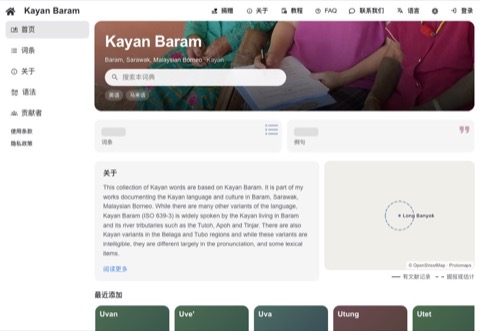
- Legacies Library (Legacies of War) (遗产图书馆(Legacies of War))The Legacies Library was built by the U.S. non-profit organization Legacies of War and is a curated resource library on events related to the U.S. bombing of Laos, Vietnam and Cambodia in 1964-1973. The website states that it includes books, films, articles, lectures and oral histories reviewed by the organization and selected by staff and board members, whose members include Southeast Asian diaspora members, American veterans, diplomats and war survivors; the project is supported by the Henry Luce Foundation. The pages have categories such as articles and reports, books, children's books, films, lectures and maps, and an interactive timeline of the U.S. Secret War in Laos (from 84,000 BCE to 1974). The Library of Congress page further lists that library's Laos-related materials: databases (such as FBIS daily reports), the Souvanna Phouma Papers (apart from Souphanouvong), Joel Martin Halpern's photographs and recordings of Laos at the American Folklife Center, Lao narratives in the Veterans History Project, and about 300 maps of Laos. It is useful for researchers who want to quickly map out leads on war records, oral histories and maps.
Coverage, how to use, and notes
Coverage The subject is limited to the U.S. bombing of Laos in 1964-1973 and its background, and also touches on Vietnam and Cambodia. Formats include books, films, articles and reports, lectures, maps and oral histories. The Library of Congress page lists that library's databases, manuscripts, Folklife Center materials, Lao-language newspapers and maps; the total number of entries is not stated on the website.
How to use Go to the Legacies Library page and browse by category; the Library of Congress page gives the location, catalogue links and access methods for each kind of material (some databases can be used only on site at the Library of Congress, and the manuscript reading room requires an appointment). That page also lists contact details for the Southeast Asia reference librarians, who can be consulted. The pages can be browsed without registration.
Notes This is a curated resource guide, not an archive of original documents, and most entries require going to external websites or consulting on site. The website does not state the terms of use of each resource. The scope leans toward the U.S. bombing and war legacy issues, with little content on the period after 1975 or from Laos's own perspective, and the organization itself acknowledges insufficient resources on the Hmong.
- UNMIT Office of Legal Affairs – Timor-Leste Legal Reference Material (联合国东帝汶综合特派团法律事务办公室:东帝汶法律参考资料库)This site is a legal reference library compiled by the Office of Legal Affairs (OLA) of the United Nations Integrated Mission in Timor-Leste (UNMIT) for legal and government staff; the page is marked as the seventh edition, September 2008. The contents fall into five categories: Indonesian legislation, legislation of the United Nations Transitional Administration in East Timor (UNTAET), a selection of legislation of the Democratic Republic of Timor-Leste (RDTL), selected important court decisions, and other documents such as agreements and administrative documents. Indonesian legislation is in Indonesian; UNTAET regulations are mainly in English and Portuguese, most with Indonesian versions and a few in Tetum, with the English text prevailing where versions differ; RDTL laws are English translations provided by OLA and have no official status. For studying the changes in Timor-Leste's legal system from Indonesian occupation through UN transition to independence, this is a convenient entry point to primary legal texts for comparison.
Coverage, how to use, and notes
Coverage Indonesian legislation: 1959 to 25 October 1999; UNTAET legislation: October 1999 to May 2002; RDTL legislation: selected laws promulgated after May 2002; also important court decisions (the page mentions a July 2003 Court of Appeal decision). The material is current to the 2008 edition; later laws are not included.
How to use Open the homepage and browse each category through the five-part directory; the legal texts are mostly downloadable files. No registration is required. When a legally authoritative text is needed for citation, consult the official gazette of Timor-Leste; the RDTL English translations on this site are for reference only.
Notes This is the 2008 edition and has not been updated; the page states that UNMIT accepts no responsibility for documents that have been modified after being copied from this site; the English translations have no official status. For how to obtain the official gazette (Jornal da República), please check the Ministry of Justice website.