Book of the Day · 2026-11-19
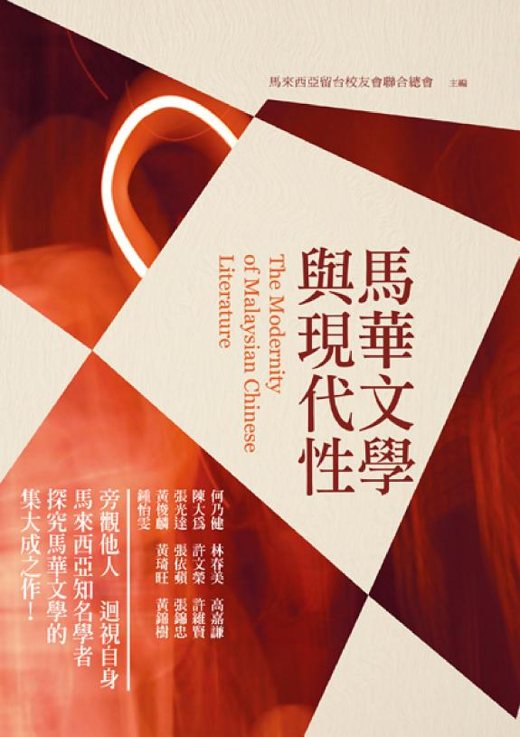
The Modernity of Malaysian Chinese Literature
馬華文學與現代性
馬來西亞留台校友會聯合總會 主編 · 2012 · 新鋭文創(秀威資訊科技股份有限公司) · Chinese · 314 pp.
Summary
This volume collects papers from the 2005 international conference on Malaysian Chinese literature and modernity held in Kuala Lumpur, edited by the Federation of Alumni Associations of Taiwan Universities Malaysia (馬來西亞留台校友會聯合總會) and published in Taipei in 2012. It contains He Naijian's keynote, twelve papers and Wen Renping's closing remarks, covering Chineseness and localism, traumatic modernity, poetry and prose, diaspora and translingualism, Chinese scholarship on the field, and the films of Tsai Ming-liang.
Reading guide
This book gathers papers from the international conference on Malaysian Chinese literature and modernity held in Kuala Lumpur on 9-10 July 2005. It was organised by the Federation of Alumni Associations of Taiwan Universities Malaysia (馬來西亞留台校友會聯合總會) and Sin Chew Daily (星洲日報), with the Department of Chinese Literature at National Chi Nan University (臺灣暨南國際大學中文系) as co-organiser, and more than ten scholars from Malaysia and Taiwan took part. The guiding question is how the modernity of Malaysian Chinese literature has developed, and whether this angle can help frame a periodised literary history. The preface notes that this was the federation's second large conference, after the first international symposium on Malaysian Chinese literature in 1997, and that its scope was deliberately narrowed to modernity, with local and Taiwan-based scholars presenting together. A forum on the Taiwan experience and Malaysian Chinese literature was also held. Because of funding and other problems, the volume appeared only in March 2012.
The papers argue from different positions, and the chapter titles show several threads. Xu Wenrong describes a 'trinity' in which Chineseness, localism and modernity are structurally intertwined. Huang Jinshu discusses the 'traumatic modernity' of Malaysian Chinese literature in relation to (national) nationalism, while Gao Jiaqian reads Huang's fiction as allegorical writing about history. Zhang Jinzhong asks whether transnational and translingual Malaysian Chinese writing should be seen as continued diaspora or as mobility. Zhang Guangda examines the postmodern and consumer aesthetics of the 'seventh-generation' poets, touching on the city, commodities, identity and subjectivity.
The book opens with a preface by Yao Digang, followed by He Naijian's keynote, twelve papers, Wen Renping's closing remarks titled on the complex and plural nature of modernity, and notes on contributors. The papers fall roughly into conceptual studies (Xu Wenrong, Huang Jinshu, Zhang Jinzhong); writers and texts (Gao Jiaqian, Lin Chunmei on Jiaying prose, Zhong Yiwen on the 'romantic' tradition of Malaysian Chinese prose, Zhang Yiping on one pattern in the course of modernity); poetry (Zhang Guangda; Huang Qiwang on the language of Singaporean and Malaysian modern poetry of the 1960s-70s); periodicals and scholarship (Huang Junlin on a literary magazine from 1996 to 2004, Chen Dawei on Chinese academic discourse on the field from 1987 to 2005); and film (Xu Weixian on Tsai Ming-liang).
Sources and methods differ from chapter to chapter. He Naijian's keynote is autobiographical: born in Bangkok, taken to Penang in 1953, schooled in Chinese after being refused entry to an English school, publishing early poems in Hong Kong and Penang periodicals, issuing the collection Sui ye, and later studying agriculture at the University of Malaya. He says a childhood experience of a Bangkok coup left him opposed to violence, and his early writing keeps returning to nature. Xu Weixian frames Tsai Ming-liang through auteur theory from the French New Wave, drawing on Bazin and Truffaut, interviews, the director's recurring cast, and early writings published in Kuching under the pen name Momo. Xu argues that the cast forms a 'family without a roof' whose members are linked by non-blood, quasi-paternal ties, and that Tsai's oeuvre should be read together with television drama, theatre and early literary work, where observation of lower-class men already points to the bodily narrative of the films.
The preface presents the volume as a reference for scholars tracing modernity in Malaysian Chinese literature and as a modest contribution to periodised literary history. As conference proceedings, the papers range widely and were written in 2005, six years before publication.
It will interest readers of Malaysian Chinese literary history, Sinophone Southeast Asian writing, diaspora and translingual literature, and Chinese-language cinema.
This guide is based on the contents, preface, introduction and conclusion, not a chapter-by-chapter reading. This site does not offer an e-copy of the book.